Board of Peace Has Met with UNRWA Despite Saying it Has No Gaza Role, Agency's Ex-chief Says

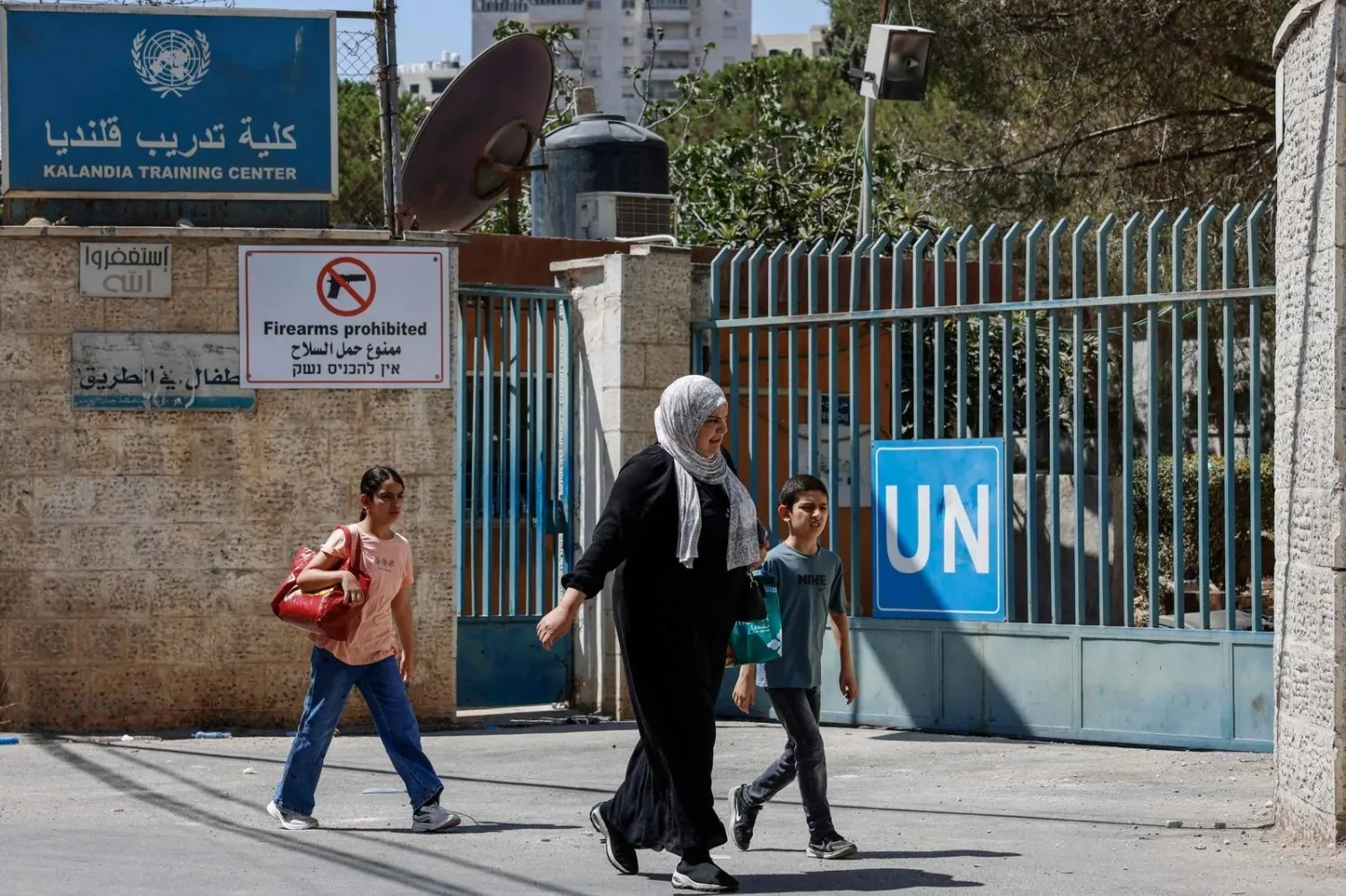
People walk past the UNRWA Vocational Training Center, where Israeli security forces have remained since raiding the facility on August 25, at the Qalandia refugee camp, south of the Israeli-occupied West Bank city of Ramallah, on August 27, 2026. (Photo by Zain JAAFAR / AFP) (AFP)
TT

Board of Peace Has Met with UNRWA Despite Saying it Has No Gaza Role, Agency's Ex-chief Says

People walk past the UNRWA Vocational Training Center, where Israeli security forces have remained since raiding the facility on August 25, at the Qalandia refugee camp, south of the Israeli-occupied West Bank city of Ramallah, on August 27, 2026. (Photo by Zain JAAFAR / AFP) (AFP)

As the US-created Board of Peace pushes ahead with plans to rebuild Gaza, it has said there’s no place for the UN body that for decades has provided support to displaced Palestinians. But the agency’s last chief says that behind the scenes, board members and others have been more open to working with the UN agency for Palestinians than it seems.

Israel wants the agency known as UNRWA out of Gaza and has repeatedly accused it of being infiltrated by Hamas militants, allegations the International Court of Justice says have not been substantiated. And yet UNRWA remains the territory’s largest aid provider, playing a key role in health and education.

Philippe Lazzarini, who led UNRWA until earlier this year, told The Associated Press in an exclusive interview — his first since stepping down — that members of the Palestinian technocratic committee want to work with the agency. Another UN official shared with AP minutes from meetings where UNRWA and the committee discussed collaborating on plans for Gaza.

A Board of Peace official confirmed that board members had met multiple times with UNRWA officials.

And while the agency’s days are over, its programs “may persist if they are serving Gazans well,” the official added, speaking on condition of anonymity because they were not authorized to talk to the media.

Israel's Foreign Ministry did not respond when asked about these remarks.

UNRWA has more workers in Gaza than anyone else

There’s been no reconstruction in Gaza, almost a year since the ceasefire. Israel still prevents the entry of the Palestinian committee chosen by the Board of Peace to eventually govern the strip, saying Hamas must first disarm. The committee says it needs to be inside the strip to activate Gaza plans.

That's left UNRWA on the ground in Gaza, with far more workers than any other UN agency or nongovernmental organization. It props up about half of Gaza’s public health system, said Lazzarini, whose last working day was March 31. He plans to publish a book this year about his tenure.

“They want to get rid of the agency, but on the other hand they know that if you get completely rid of the agency today, it might have a further additional devastating impact on the population,” Lazzarini said.

During the war, sparked by the Hamas-led attack on southern Israel on Oct. 7, 2023, UNRWA temporarily took on a larger role, coordinating the entry and distribution of aid into the besieged Palestinian territory. Israel's attacks on the agency neutered that role, banning UNRWA international staff and humanitarian aid from entering Gaza.

But UNRWA's core programs remained, Lazzarini said.

It still has around 11,000 Palestinian employees in Gaza. They conduct about 14,000 medical appointments daily, maintain water and waste management systems for over a million Palestinians, run digital literacy and math programs for over 280,000 children and staff temporary learning spaces for 60,000 more, UNRWA says.

UNRWA makes sure aid reaches people, Lazzarini said. “If you want the vaccine to end up in the mouths of the children, you still need the workforce, the presence of an agency like ours.”

UNRWA was told it's vital in planning Gaza's future Publicly, the agency has not been included in the Board of Peace’s planning for Gaza. At Wednesday's board briefing, members named various UN agencies as partners in the territory's reconstruction, but not UNRWA.

However, behind the scenes, the Palestinian committee that will eventually govern Gaza acknowledged that UNRWA is necessary for planning, Lazzarini said.

Two senior UN officials and the board official told the AP the board had met multiple times with UNRWA since the ceasefire was signed.

The officials, who spoke on condition of anonymity because they were not authorized to brief the media, confirmed at least three meetings between UNRWA officials and the Palestinian committee this year, most recently this month. Two took place during Lazzarini’s tenure.

Shortly before the end of his tenure, Lazzarini said, he spoke to Ali Shaath, a former Palestinian Authority deputy minister who leads the Palestinian committee.

“Basically, he said, ‘I don’t know how I can succeed without you’,” Lazzarini said. Shaath and a spokesperson did not respond to requests for comment.

An internal UN description of a Jan. 26 meeting in Cairo, held without UNRWA, said Shaath praised the agency, showed a clear intention to see it back on track and said the Palestinian committee's system would largely build on its work.

The Tony Blair Institute, a Board of Peace partner, also asked for UNRWA’s help and spoke to UNRWA personnel, one senior UN official said. The institute did not respond to a request for comment.

At a pledging conference for UNRWA on June 30, the agency's current acting chief, Christian Saunders, called it “vital” to efforts by the board and the Palestinian committee to move forward with the ceasefire.

But the Board of Peace official painted a different picture, saying the meetings focused on determining how UNRWA’s operations work in order to develop programs that are “far more efficient and accountable.”

“UNRWA’s days are over,” the official said. Still, its employees ”will remain if they pass vetting and are delivering on their mandate and not advancing ideology or Hamas interests.”

Lazzarini said it's an “absurd contradiction" — the Board of Peace says UNRWA is not wanted while UN member countries “expect it to deliver.”

“We continue to emphasize that UNRWA is indispensable,” Jordan’s foreign minister, Ayman Safadi, told journalists Thursday after over 50 countries attended a ministerial meeting on the agency at UN headquarters.

Lazzarini says he has faced personal attacks UNRWA was established to help Palestinians who fled or were driven out of what is now Israel during the 1948 war surrounding its creation.

In January 2024, Israel claimed, in many cases without providing evidence, that hundreds of Palestinians worked for the agency and that over a dozen of its employees took part in the Oct. 7 attack.

Lazzarini said that he was never given written evidence to back up the allegations despite asking Israel and UN member states, but that he doesn't regret his decision to fire the employees accused of taking part in the attack.

“I did because it was in the best interest of the agency and the population we were helping," Lazzarini said, adding that he has faced “extraordinary vicious, heinous attacks on social media” as well as being accosted in the streets, "in Geneva and in New York” and shouted at by "pro-Israeli groups.”

His book, “A Witness to Gaza: What Cannot Be Erased," will be published in French in October, with an English version to follow.

From Gaza to Ramallah, Palestinians See Little Hope in Israeli Vote

Palestinians walk past buildings destroyed during the Israel-Hamas war in Gaza City Wednesday, Oct. 28, 2026. (AP)
TT

From Gaza to Ramallah, Palestinians See Little Hope in Israeli Vote

Palestinians walk past buildings destroyed during the Israel-Hamas war in Gaza City Wednesday, Oct. 28, 2026. (AP)

In war-ravaged Gaza and the occupied West Bank, many Palestinians were less focused on who would win Israel's election than on whether anything would really change.

Whether Benjamin Netanyahu clings to power with his far-right allies or centrist rival Gadi Eisenkot comes out on top, few see much reason for hope in the Tuesday vote.

"We fear these elections could bring an even worse leader," said Huda al-Houli, a displaced resident of Khan Younis in southern Gaza.

Such an outcome, she said, would only bring "more destruction and devastation" to the Palestinian territory.

Still, Houli said she hoped a more "human voice" would emerge in Israeli society and demand an end to the conflict, regardless of who forms the next government.

In Ramallah, in the West Bank, Ahmed Awad, 67, was equally skeptical.

"Whatever the result, and even if the politicians change, I don't think there will be any radical or dramatic shift in policies towards the Palestinian-Israeli conflict," he told AFP.

With 85 percent of ballots counted from Tuesday's vote, Netanyahu's camp remained ahead but without a clear majority, leaving uncertainty over Israel's next government.

The first election since Hamas's October 7, 2023 attack comes after years of right-wing and far-right rule marked by the war in Gaza and rising settler violence in the West Bank.

For Netanyahu, fighting for his political survival, several paths remain open: renewing his alliance with the far right, building a broader coalition or facing yet another political deadlock.

Far-right minister Itamar Ben-Gvir has already signaled that, if the current coalition survives, he would seek the defense portfolio and push for the expulsion of Gaza's population.

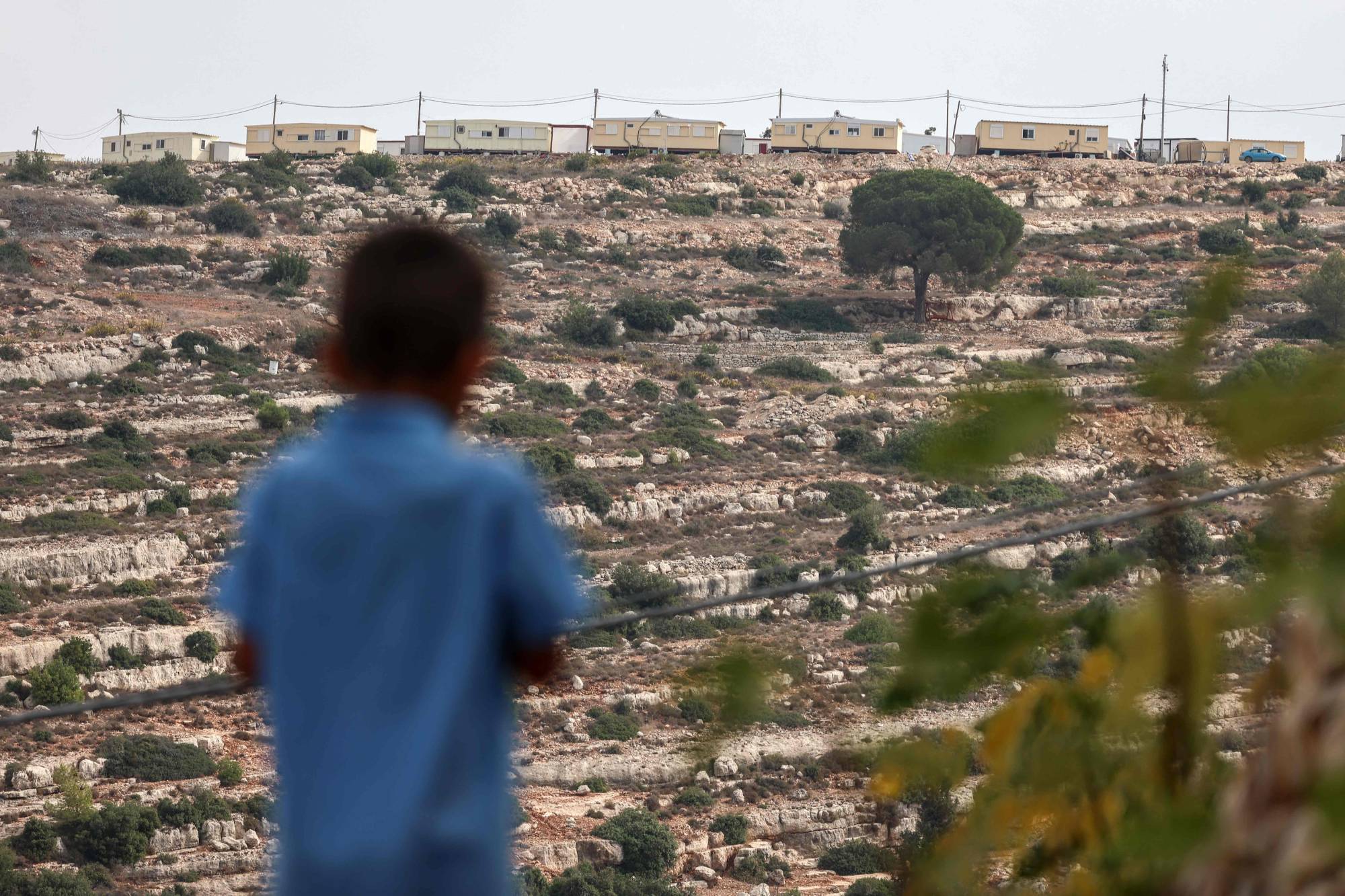
A Palestinian boy looks at an Israeli outpost on a hill overlooking the village of Umm Safa, northwest of Ramallah in the Israeli-occupied West Bank, on October 27, 2026, following a reported attack by Israeli settlers. (AFP)

- More of the same -

Not everyone has given up hope.

"Whatever happens, it will surely be better than what we've lived through in recent years," said Abdallah Abu Rahma, 54, from Ramallah.

But if Netanyahu remains in office, he added, "any coalition he forms, he will continue down the same path".

A government led by Eisenkot, a former army chief, could rein in the influence of the pro-settlement far right, said researcher Beth Oppenheim of the European Council on Foreign Relations.

It could also ease pressure on the Palestinian Authority and take a more flexible approach on aid and a ceasefire in Gaza.

But she warned against expecting too much.

There would be "nothing transformative", she said, and certainly no major shift on Palestinian statehood or the peace process, issues that have largely disappeared from Israeli political debate since October 7.

A renewed Netanyahu coalition with far-right partners would likely mean more of the same, including settlement expansion and impunity for settler violence, Oppenheim added.

"I think we need to have quite low expectations when it comes to seeing any major changes in policy from a different government," she said.

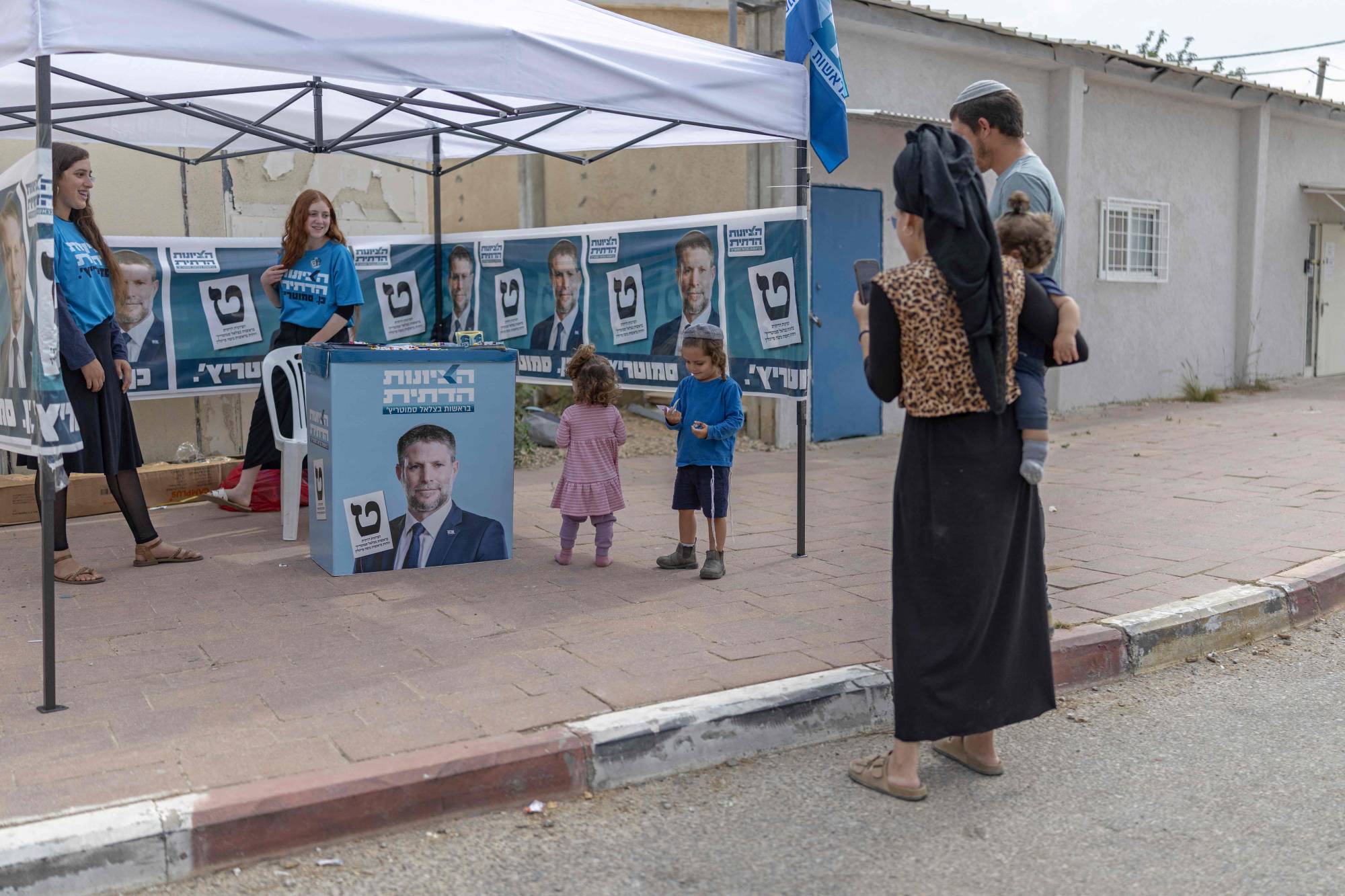
Israeli right-wing settlers stand at a polling station in the settlement of Adora in the occupied West Bank on October 27, 2026, amid Israel's legislative election. (AFP)

- Fears of escalation -

Even a Netanyahu defeat could leave Palestinians worse off in the short term, argued Yousef Munayyer, head of the Palestine-Israel program at the Arab Center Washington.

"There is every reason for Palestinians to be concerned," he said.

Eisenkot himself served in Israel's wartime cabinet during the Gaza offensive, Munayyer noted.

A fragile alternative coalition under constant attack from Netanyahu and the right could try to prove it was tough enough by taking a harder line on Palestinian issues.

In the West Bank, violence could rise if the far right loses power, with settlers potentially acting out against a new government, he explained.

"It's important to understand that most settler violence in the West Bank is structural. It's not about the government in charge," Munayyer said.

"Settlers live in places that surround the Palestinian population. The Palestinian population is vulnerable to the settlers, who are armed, whereas the Palestinians overwhelmingly are not."

In Gaza, Adnan Al-Assar said he harbored few illusions.

"Netanyahu may win," he said. "But whatever happens, they all follow the same overarching policy, directed against the Palestinian people."


What Has Lebanon So Far Implemented in its Ban on Hezbollah’s Military Activities?

A supporter of Hezbollah holds a placard reading in Arabic "We will not leave the weapon" during a gathering held to mark the 2nd anniversary of Hezbollah leader Hassan Nasrallah's death at the site where he died in Beirut, Lebanon, 26 September 2026. (EPA)
TT

What Has Lebanon So Far Implemented in its Ban on Hezbollah’s Military Activities?

A supporter of Hezbollah holds a placard reading in Arabic "We will not leave the weapon" during a gathering held to mark the 2nd anniversary of Hezbollah leader Hassan Nasrallah's death at the site where he died in Beirut, Lebanon, 26 September 2026. (EPA)

The seizure of a Hezbollah explosives shipment in eastern Lebanon has reignited questions over the government's enforcement of a ban on the group's military and security activities, imposed after its rocket attacks on Israel triggered a new war on March 2.

The explosives were intercepted in Dahr al-Baidar, and Hezbollah acknowledged they belonged to the Iran-backed party and were intended for use against Israel.

The March 2 ban orders Hezbollah to surrender its weapons to the state and to confine its activities to politics within constitutional and legal frameworks. It also instructs military and security agencies to act immediately to enforce the ban, prevent rocket and drone launches from Lebanese territory and arrest violators.

The most significant enforcement measures came in mid-to-late March, as Hezbollah fought Israel. Several armed members were arrested while heading to the battlefronts in southern Lebanon. A handful faced trial, but most were released on bail.

'Ink on paper'

Hezbollah rejects the ban outright, arguing that it serves Israel's interests while it continues to occupy Lebanese territory. The group maintains that liberating the occupied land remains part of its duty.

Its opponents say the government has not gone nearly far enough. They want tougher enforcement of the ban to ensure that decisions of war and peace rest exclusively with the Lebanese state.

Ghada Ayoub, a lawmaker from the Lebanese Forces' Strong Republic parliamentary bloc, said the ban "remains ink on paper, with none of it implemented."

That failure does not diminish the decision's political and legal weight, she told Asharq Al-Awsat.

"It marked a fundamental shift in the Lebanese state's position, clearly declaring Hezbollah's military and security activities illegitimate and stripping them of any official cover," she explained.

"It is no coincidence that Hezbollah keeps demanding its reversal. The group fully understands the decision's significance and its implications for its military and security project."

Waiting on developments abroad

Ayoub said that the Dahr al-Baidar explosives case underscored the importance of the ban, providing grounds to demand its referral to the Judicial Council because it involved prohibited military and security activities and posed a threat to the state and its citizens.

But she blamed the lack of enforcement on a failure of political will.

"The political leadership is still betting on regional and international developments, waiting to see how the confrontation between Israel and Hezbollah unfolds instead of assuming its responsibilities," she remarked.

"It is as though the authorities have chosen to let Hezbollah bear the consequences of refusing to surrender its weapons and abandon its military project, without confronting the group itself."

The result is a state that makes sovereign decisions but leaves their enforcement hostage to developments abroad, she went on to say.

She pointed to a cabinet decision on August 5, 2025, to impose state monopoly over weapons, saying its implementation remained incomplete. The government then banned Hezbollah's military and security activities on March 2 but failed to follow through with concrete action.

"Now, with the Dahr al-Baidar case, this approach is no longer acceptable," Ayoub stressed.

"Failing to refer the case to the Judicial Council raises serious questions about the government's commitment to its own decision."

Ayoub urged the state to demonstrate that it was serious about enforcing its decisions rather than waiting for Israel or the United States to carry out responsibilities that belonged to Lebanon itself.

"We cannot keep moving from one regional development to another while sovereign decisions remain on hold, using the need to preserve civil peace as a pretext for allowing violations of the law to continue," she demanded.

"Fear of confrontation cannot become a permanent surrender of state sovereignty."

'Arrest every armed Hezbollah member'

Retired Brigadier General George Nader echoed Ayoub's criticism, saying the government's decisions to establish state control over weapons and curb Hezbollah's military activities had yielded nothing.

"The slogans have proved hollow and the decisions remain on paper. It is a major blow to a state that issues decisions it cannot enforce," Nader told Asharq Al-Awsat.

"After the decision to bring weapons under state control, we went into Palestinian refugee camps and came back with truckloads of scrap metal," he said.

"Even after identifying those responsible for the Dahr al-Baidar explosives, we arrested only the people transporting them, not those behind them."

Nader said enforcing the cabinet's decisions would require arresting every armed Hezbollah member, not just those stopped at checkpoints.

"If we genuinely want to implement the cabinet's decisions, every armed Hezbollah member is breaking the law and must be arrested," he added.

"Arrests should not be limited to checkpoints. The authorities should go to where these members are and arrest them."

Nader placed responsibility squarely on the government, saying the army operates under the political leadership's instructions.

"What is needed today is a clear, explicit order to the Defense Ministry, directing it to instruct the army to arrest every armed Hezbollah member, wherever they may be," he urged.


Lebanese Judiciary Identifies Seven Suspects in Hezbollah Explosives Case

Lebanese President Joseph Aoun receives Justice Minister Adel Nassar at the Presidential Palace on Wednesday. (Lebanese Presidency)
TT

Lebanese Judiciary Identifies Seven Suspects in Hezbollah Explosives Case

Lebanese President Joseph Aoun receives Justice Minister Adel Nassar at the Presidential Palace on Wednesday. (Lebanese Presidency)

Lebanon's judiciary is nearing the end of its preliminary investigation into Hezbollah explosives seized in Dahr al-Baidar, setting the stage for charges against suspects as Justice Minister Adel Nassar pushes to refer the case to the Judicial Council.

Nassar said the case went far beyond the transportation and storage of explosives, warning that it posed a threat to national security and civil peace.

Judge Claude Ghanem, the government commissioner to the Military Court, is expected to receive the findings of investigations conducted by Lebanese Army Intelligence and the Internal Security Forces' Information Branch within hours.

He will review the evidence before deciding on charges against those implicated.

Seven suspects

Despite reports of a third arrest, a judicial source told Asharq Al-Awsat that only two suspects remained in custody: A.K. and H.A., who were aboard the truck carrying the explosives.

Investigators have identified five other suspects linked to the case, the source said.

Among them is a man known as "Sajed," a Hezbollah security operative suspected of handing over the explosives in Baalbek, and another known as "Zulfiqar," who also holds a security role and was allegedly designated to receive the shipment in Beirut's southern suburbs.

The suspects also include H.A.'s wife and the truck's owner.

While the government weighs whether to refer the case to the Judicial Council, proceedings are expected to continue before the Military Court.

Ghanem will examine investigation records, confessions and evidence to determine which criminal offenses apply to each suspect before filing charges against those detained and those still at large, the judicial source said.

Charges are expected on Thursday against suspects whose roles have been established.

The investigation has also uncovered the suspects' real identities, the source said, adding that warrants to bring in suspects and search notices had been issued against some of them and were being executed.

‘National security threat’

Even as the case moves toward the military judiciary, which has jurisdiction over such crimes, Minister Nassar remained adamant that it should go before the Judicial Council.

He stressed that his demand did not cast doubt on the investigators, particularly Ghanem.

"This is not simply a case of transporting explosives. It has broader implications that threaten national security and civil peace," Nassar told Asharq Al-Awsat.

Nassar said he had submitted a legal memorandum to the president and prime minister during the latest cabinet meeting, arguing that receiving explosives of such a dangerous nature was a breach of national security.

Their storage and transportation, he said, also endangered Lebanese lives.

He argued that Hezbollah's acknowledgment that it possessed the explosives and intended to use them in a "new support front" amounted to an admission that it was contributing to threats against Lebanon's internal security.

The case has intensified a dispute involving Lebanese officials who accuse Hezbollah of endangering the country's security, both through its activities at home and its repeated threats to open a new front against Israel.

Nassar said the acknowledgment by an armed security and military organization that it imports explosives for use in warfare outside state control is a major threat to Lebanon's internal national security.

For Nassar, pursuing the case through state institutions and upholding their authority would mark "a victory for legitimate authority over illegal weapons."