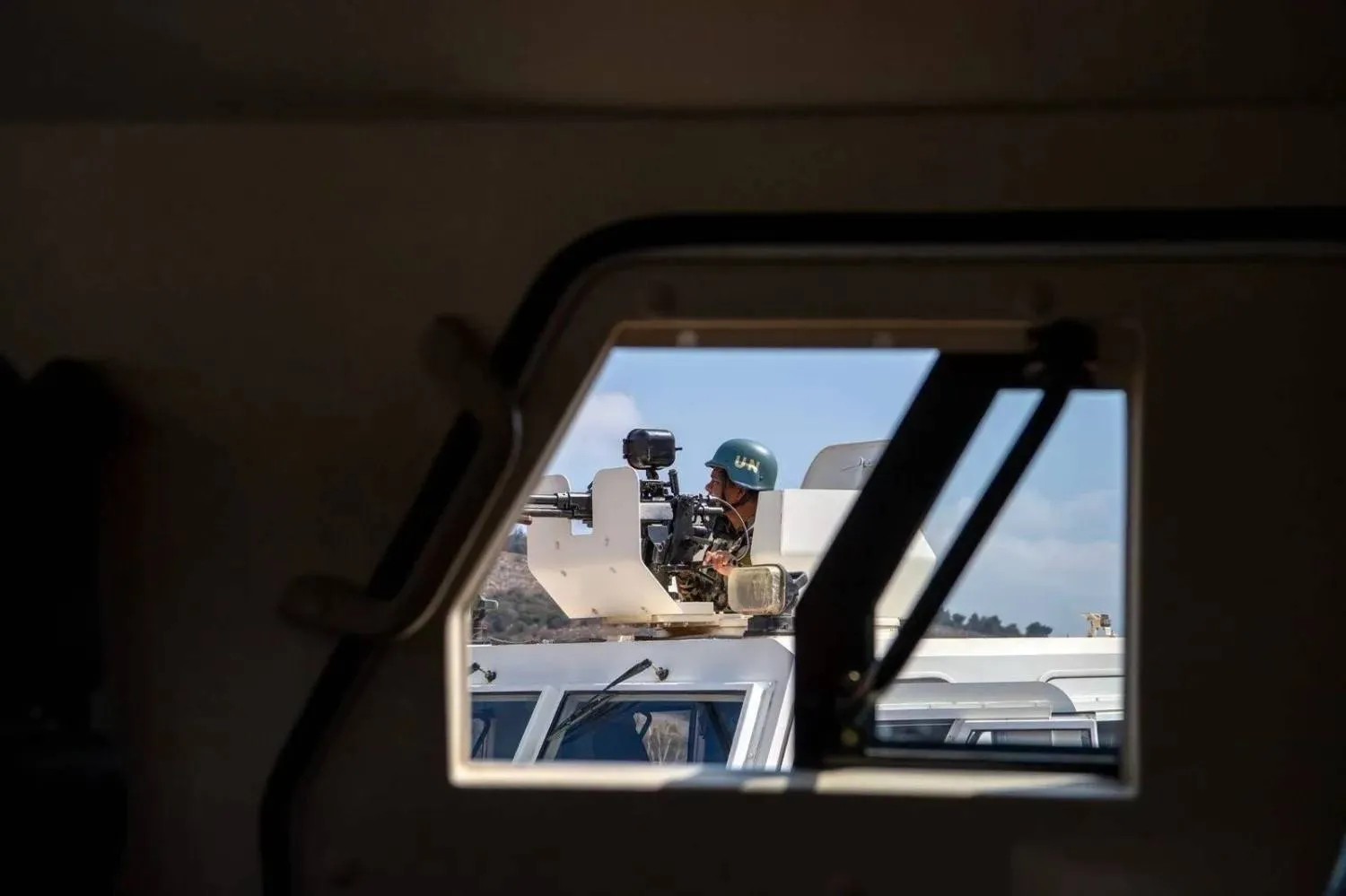
Washington Pushes for Lebanese Army to Secure Southern Border Alone

A UNIFIL soldier aboard a military vehicle during a patrol in southern Lebanon (UNIFIL)
TT

Washington Pushes for Lebanese Army to Secure Southern Border Alone

A UNIFIL soldier aboard a military vehicle during a patrol in southern Lebanon (UNIFIL)

Lebanon fears a vacuum in its south when the mandate of the UN peacekeeping force expires late this year. The United States and Europe agree that the Lebanese army should ultimately secure the border, but differ over whether it can do so alone now.

Washington last week blocked a Lebanese proposal to extend the mandate of the United Nations Interim Force in Lebanon (UNIFIL) by six months.

UN Under-Secretary-General for Peace Operations Jean-Pierre Lacroix is due in Beirut next week to discuss ways to avoid a vacuum with President Joseph Aoun and other Lebanese officials.

Lebanese ministerial sources told Asharq Al-Awsat that Beirut was waiting to hear Lacroix’s proposals. Options raised so far include a European force to replace UNIFIL and more personnel for the United Nations Truce Supervision Organization (UNTSO).

The sources also cited a French-Italian initiative to form a replacement force after European and Asian countries contributing to UNIFIL said they were willing to stay in Lebanon to continue the mission.

Most UN Security Council members support extending UNIFIL’s mandate or forming a replacement force, but Washington opposes both options. Western diplomatic sources told Asharq Al-Awsat that the US position is that the Lebanese army alone should secure the border. On that basis, they said, “there should be no need for any other force in the area.”

Europe agrees that the army should eventually protect the border and maintain security on its own. It says the army cannot yet do the job without international support.

“The Lebanese army should ultimately take on the mission by itself, but at present it cannot do so alone and needs international support during this transitional phase,” the diplomatic sources said.

The European position rests on two factors. The first is Israel’s occupation of Lebanese territory and the failure of security talks to reach understandings that would allow direct coordination between the Lebanese and Israeli armies.

The second is the Lebanese army’s need for more personnel and weapons. That issue was not settled at meetings in Paris last week, despite international willingness to support the army and official security forces.

Lebanon backs the European approach. Its army “needs weapons, ammunition and vehicles,” Lebanese sources said. “Without the support it needs, the army cannot carry out the mission alone.”

“Washington must begin equipping and strengthening the army before talking about leaving it solely responsible for border security,” the sources told Asharq Al-Awsat.

Beirut’s insistence on an international force also reflects a concern about direct coordination with Israel. Lebanese officials believe Washington’s opposition to a force in the south is meant to push the Lebanese army toward such coordination. Beirut, meanwhile, wants an international witness to Israeli violations.

“Beirut wants a witness to any violations Israel commits in the south, because Tel Aviv will dispute the Lebanese army’s reports and campaign against it,” Lebanese sources following the issue said.

“What is needed is an international force that can testify to Israeli violations before the world and help the Lebanese army deploy.”

Lebanon also wants the force to help clear mines and remnants of war, reopen roads, and provide electricity, ambulance services and health care at clinics, the sources said. The army’s duties in the south include securing the return of residents under current conditions.

Several countries, particularly in Europe, have expressed interest in a replacement force if efforts to extend UNIFIL’s mandate fail.

Representatives of European countries discussed an alternative mission at meetings early this month, Western diplomatic sources told Asharq Al-Awsat. They focused on bringing together countries that could work well together and securing the approval of Lebanon and Israel. Funding was also discussed.

France, Italy, Spain and Britain are among the countries willing to join any replacement force, Lebanese sources following the issue said.

UNIFIL currently has 8,100 personnel in the south. Its French contingent continues to patrol the border area occupied by Israel and escort convoys of Lebanese residents from three predominantly Christian border villages on journeys to and from other parts of Lebanon.

Lebanon has raised the need for an international presence in the south with visiting officials.

Aoun most recently discussed it in Beirut with Vice Admiral Edward Ahlgren, Britain’s senior defense adviser for the Middle East.

Aoun said that allowing UNIFIL’s mandate to lapse without forming a replacement international force would create a vacuum that would not serve security or stability, particularly while Israel continues to occupy a number of southern villages and towns.

Lebanon’s efforts have met US opposition. Prime Minister Nawaf Salam plans to seek a way through the impasse with US Secretary of State Marco Rubio when they meet in Washington next Monday.

Salam also raised the issue with several officials he met in New York on the sidelines of the 81st session of the UN General Assembly.

They included UN Under-Secretary-General for Humanitarian Affairs and Emergency Relief Coordinator Tom Fletcher, whom he met on Thursday.

“We discussed the importance of maintaining an international presence under the UN umbrella in the south after UNIFIL’s mission ends, to prevent any vacuum and support stability and the process of extending state authority,” Salam said.


Yemeni Government Rallies European Support to Confront Houthis, Protect Shipping

Yemen's foreign minister meets with Arab ambassadors in Berlin (SABA)
TT

Yemeni Government Rallies European Support to Confront Houthis, Protect Shipping

Yemen's foreign minister meets with Arab ambassadors in Berlin (SABA)

The Yemeni government has intensified its diplomatic efforts in Berlin to mobilize European political and economic support for confronting Houthi escalation and restoring state institutions.

The diplomatic push comes amid warnings that the threat posed by the Iran-backed group could extend to international maritime security and global trade interests, alongside calls to correct what the government describes as misleading narratives about the Yemeni crisis.

During a series of meetings with German officials and lawmakers, Arab diplomats, experts and representatives of research centers, Foreign Minister and Minister of Expatriates Dr. Afrah Al-Zouba said continued international tolerance of Houthi violations had emboldened the group to expand its destabilizing activities and extend its threats beyond Yemen to vital regional shipping routes.

At a roundtable organized by Germany's Körber Foundation as part of the Berlin Political Breakfast, Al-Zouba outlined the roots of Yemen's crisis, beginning with the Houthi coup against the national consensus and internationally recognized government in September 2014.

She recalled the group's armed takeover of the capital, Sanaa, and its undermining of the outcomes of the National Dialogue Conference, leading to the latest military escalation and attempts to target international shipping in the Bab Al-Mandab Strait.

Al-Zouba said the group's escalating actions posed a direct threat to regional and international peace and security, warning that international silence and tolerance of its violations gave the Houthis greater room to continue threatening global trade.

Expanding Houthi Threat

As part of the same diplomatic efforts, Al-Zouba warned during another roundtable organized by Germany's Konrad Adenauer Foundation that the Houthi threat was expanding to regional security and international shipping.

She pointed to attacks on shipping routes and coordination with terrorist groups in the Horn of Africa, including Somalia's Al-Shabaab.

Al-Zouba linked the Houthis' rejection of peace efforts and attempts to establish control over the Bab Al-Mandab Strait to the launch of Operation Fajr Yemen.

She said the operation aimed to restore state institutions and protect maritime routes against threats to international shipping and trade.

The minister urged participating officials, experts and members of Germany's governing party to convey an accurate picture of developments in Yemen to their institutions and policymakers and to correct misleading narratives about the crisis.

She stressed the need to ensure that Yemenis' voices were heard and that the military escalation's humanitarian consequences received appropriate attention.

Al-Zouba emphasized that political, economic and humanitarian support for the Yemeni government was essential to strengthening its ability to fulfill its responsibilities, consolidate stability and restore state institutions.

Siege of Taiz and Collective Punishment

The humanitarian situation in the city of Taiz featured prominently in the minister's discussions.

She highlighted the continuing Houthi siege and its consequences, including restrictions on the entry of food, medicine and essential supplies, the closure of healthcare facilities and obstruction of efforts to evacuate patients and wounded civilians through safe corridors.

Al-Zouba described these practices as collective punishment against civilians, saying they had intensified the suffering of the most vulnerable groups, particularly women and children.

She added that the siege had caused civilian deaths because people were unable to obtain necessary medical care and supplies.

During a meeting with Armin Laschet, chairman of the German Bundestag's Foreign Affairs Committee, Al-Zouba discussed developments in Yemen and their regional repercussions.

She stressed that threats to freedom of navigation and global trade represented an extension of the Houthis' destabilizing activities since the group seized control of state institutions.

Al-Zouba also outlined the internationally recognized government's efforts, operating from the temporary capital Aden, to fulfill its public service and development responsibilities.

She emphasized that stabilizing state institutions and securing their own revenue sources were essential to addressing the humanitarian crisis sustainably.

The foreign minister called on Germany and European partners to provide urgent political and economic support to the government, with particular emphasis on strengthening national capabilities.

These include the coast guard and maritime border surveillance, which would improve Yemen's ability to combat the smuggling of Iranian weapons and military technology to the Houthis.

According to Yemen's official media, Laschet expressed concern over Houthi human rights violations, particularly the recruitment of children and deteriorating living conditions among civilians.

He stressed that attacks on shipping in the Red Sea threatened the economic security of European Union countries and the wider world.

The German official also emphasized the need for Germany's parliament and government, in coordination with the European Union, to develop a new strategy for addressing the Yemeni crisis, one that keeps pace with rapidly evolving developments and protects regional and international security.


Hamas Awaits Positive Response from Board of Peace to Salvage Gaza Agreement

Egyptian President Abdel Fattah el-Sisi and US President Donald Trump sign the Gaza ceasefire agreement in Sharm El-Sheikh in October 2025 (Egyptian Presidency)
TT

Hamas Awaits Positive Response from Board of Peace to Salvage Gaza Agreement

Egyptian President Abdel Fattah el-Sisi and US President Donald Trump sign the Gaza ceasefire agreement in Sharm El-Sheikh in October 2025 (Egyptian Presidency)

Tony Blair, a prominent member of the Board of Peace, is seeking to salvage the Gaza ceasefire agreement by pressing Israel to begin implementing some of its provisions in stages, pending full implementation, following the conclusion of Israel's Knesset elections in recent days.

Meanwhile, Hamas is awaiting a positive response concerning the fate and future of the agreement, as security and humanitarian conditions in the Gaza Strip continue to deteriorate.

Blair met Israeli President Isaac Herzog on Thursday morning, followed by a meeting that afternoon with Prime Minister Benjamin Netanyahu, who will lead a caretaker government until a new administration is formed.

On Friday afternoon, Blair also met Gadi Eisenkot, a potential candidate for prime minister, to discuss the situation in Gaza.

According to the Israeli Public Broadcasting Corporation, Blair held meetings with senior Israeli officials over the past three days to discuss advancing US President Donald Trump's 20-point plan, which was agreed upon in late September 2025 before taking effect with the ceasefire announced on October 10 of that year.

The broadcaster and Israel's Channel 13 reported that Blair emphasized the need to allow the National Committee for the Administration of Gaza (NCAG) to enter the territory and assume its responsibilities.

He also called for allowing the International Stabilization Force (ISF), which is still being assembled, to begin deploying soon to designated locations.

These would constitute initial steps toward bringing the weapons of Hamas and other Palestinian factions under control.

Blair's visit coincided with a trip by the Board of Peace's High Representative for Gaza, Nickolay Mladenov. It was not immediately clear whether Mladenov participated in Blair's meetings or held separate discussions.

Both Blair and Mladenov visited the US-led Civil-Military Coordination Center in Kiryat Gat, southern Israel, where senior military officers from dozens of countries are monitoring implementation of the ceasefire agreement.

According to Israel's Yedioth Ahronoth newspaper, US pressure to advance Trump's plan to end the war has continued even after the Israeli elections, despite stalled talks with Hamas and ongoing Israeli military operations in Gaza.

The newspaper noted that developments on the ground showed no indication of meaningful progress toward the next phase.

Citing sources familiar with the details, the newspaper reported that negotiations remain frozen, with no substantial progress in implementing the US plan.

This comes as Hamas remains armed and continues rebuilding its ranks, while the Israeli military continues operations aimed at thwarting its plans, with those operations intensifying recently.

The newspaper argued that the security and political situation would become more complicated because of the political turmoil following the Knesset election results.

Israel's political system is facing uncertainty amid the absence of a clear majority and questions over whether a stable government can be formed.

The newspaper said this directly affects Israel's ability to formulate a long-term policy toward Gaza, particularly regarding how to proceed with the American plan.

While Washington is seeking progress on Trump's initiative, Israel remains uncertain about its political future in the coming months.

Israel is skeptical about the prospects of successfully implementing or advancing any new measures, partly because Hamas refuses to disarm or surrender control of its weapons.

Citing Israeli officials, the Hebrew-language Walla news website reported several days ago that the political situation following the Knesset elections has further complicated efforts to advance the agreement.

It added that the Israeli military is also making preparations for a possible operation to occupy Gaza City in an effort to force Hamas to disarm.

Hamas Awaits a Response

Hamas, which appears to have few options remaining, is growing increasingly impatient over the failure to implement previously reached agreements, particularly as daily killings and bombardment continue and humanitarian conditions deteriorate.

In a statement documenting daily Israeli violations, Hamas said: "Peace is not measured by the signing of agreements alone, but by an end to the killing and the return of life to our people in Gaza."

In a video message published on its website, the movement added: "Gaza has never been a marginal consideration in political calculations, and the lives of its people must not be treated as something that can be postponed."

A Hamas official in the Gaza Strip told Asharq Al-Awsat that the movement is awaiting a response from mediators who are in direct contact with Board of Peace officials, following Blair's diplomatic efforts and meetings with Israeli leaders.

The official explained that the mediators had informed Hamas that the Board of Peace intended to undertake new efforts to move the Gaza agreement forward, and that the movement would await the outcome of those efforts.

Asked whether Hamas was counting on stronger US pressure, particularly following calls for a change in Washington's policy toward Israel after the Republican Party's defeat in the midterm elections, the official said such a possibility existed.

However, he added that past experience did not suggest the United States had any genuine intention of pressuring Israel, which was why progress remained extremely slow.


Lebanese Foreign Ministry Sources to Asharq Al-Awsat: US Declares Consul Charara Persona Non Grata

People enter the US State Department building in Washington (File/Reuters)
TT

Lebanese Foreign Ministry Sources to Asharq Al-Awsat: US Declares Consul Charara Persona Non Grata

People enter the US State Department building in Washington (File/Reuters)

Sources at Lebanon's Foreign Ministry confirmed to Asharq Al-Awsat that the Lebanese Embassy in Washington had been officially notified by the US State Department of its decision to declare Ibrahim Charara, Lebanon's consul in Detroit, persona non grata and order him to leave the United States within 48 hours.

Reports had indicated that the decision followed controversy sparked by American media coverage of old social media posts attributed to Charara, in which he described the 1983 bombing of the US Marine barracks in Beirut as an act of "heroic resistance."

His participation in political events in Michigan, including an event supporting Democratic candidate Abdul El-Sayed, also attracted media attention in the United States.