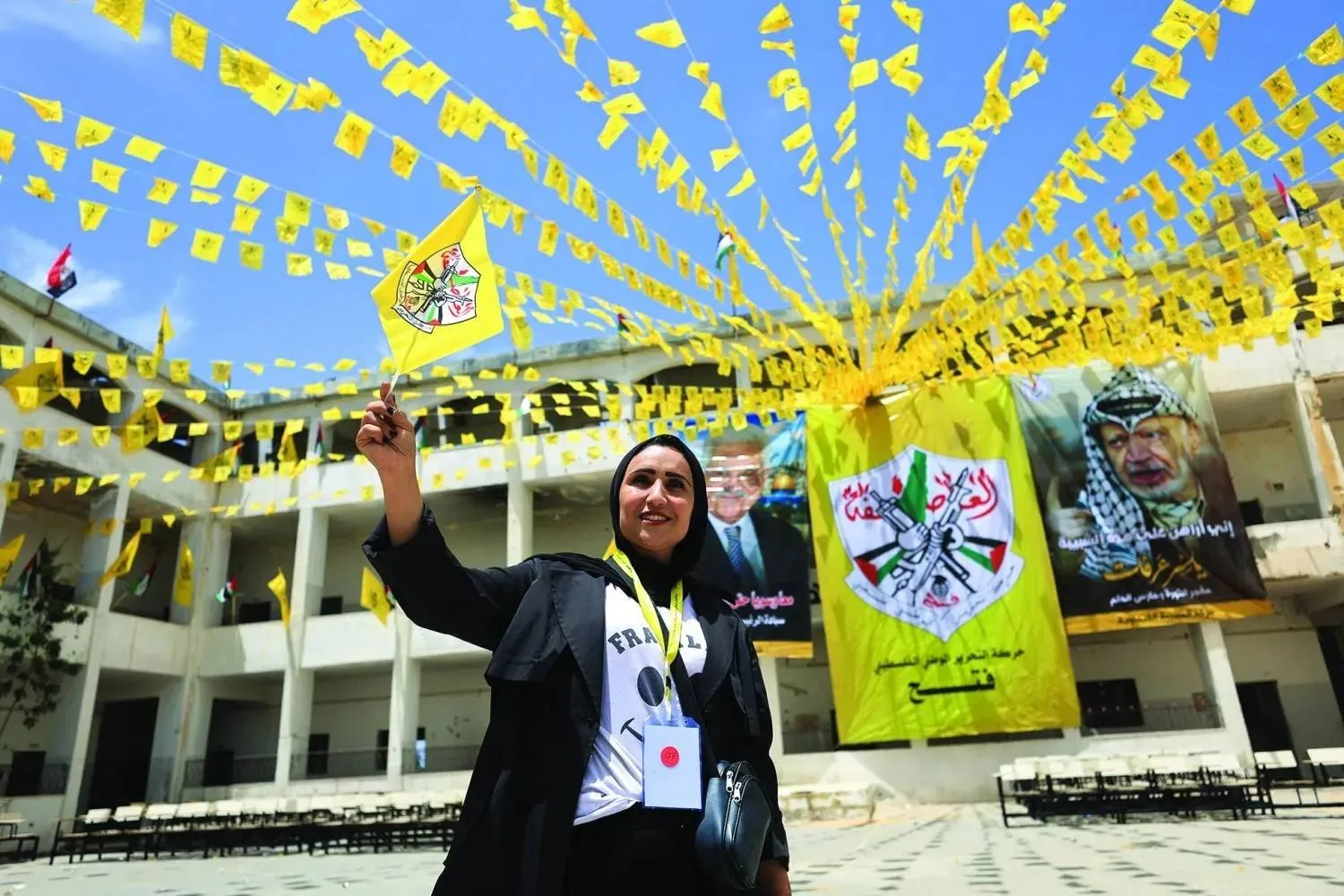

Palestinian factions face difficult choices over how to take part in legislative elections set for November 28, the first in 20 years.
A Hamas delegation has held a series of meetings in recent days with leaders of other factions in Cairo.
The group said the talks were part of continuing political consultations on developments affecting the Palestinian cause, including the elections, efforts to end the political split and plans to rebuild and reactivate the Palestine Liberation Organization on democratic, inclusive and national foundations.
A Hamas source and a source from another faction involved in the meetings told Asharq Al-Awsat that they had again discussed the possibility of running on a single national list led by technocrats and academics acceptable internationally, with the aim of representing the broadest possible coalition.
Another factional source said the Hamas delegation had offered nothing new on which to build.
Sources said the Fatah Democratic Reform Current, led by Mohammed Dahlan, had put a proposal concerning the national list to Hamas at a bilateral meeting and was awaiting a response. None disclosed its details, citing the sensitivity surrounding the elections.
Hamas also hopes the elections will be postponed, despite publicly insisting they should take place on schedule. At the same time, it continues to seek the broadest possible national list to compete with Fatah.
The uncertainty is adding to confusion among the factions, which will have 12 days from Saturday to settle their plans.
Islamic Jihad has decided to support such a list without fielding candidates of its own. But the Palestinian left, particularly the Popular Front and the Democratic Front, remains undecided about joining Hamas and other factions on a common list.
Both fronts have called for the elections to be postponed while the factions seek common ground to end the split and rebuild the PLO, a position supported by some other factions.
The Democratic Front has sought to form a list of leftist parties that would include the Popular Front, keeping a broad national list with Hamas as its last option. A Democratic Front source told Asharq Al-Awsat that, as the opening of nominations approaches, it may ultimately decide to join the wider national list.
Fatah insists the elections should go ahead. Palestinian President Mahmoud Abbas reaffirmed that position in his address to the United Nations General Assembly, saying the vote was part of a process to renew the institutions of the Palestinian National Council before holding a presidential election.
He said it formed part of a comprehensive national reform program for the Palestinian Authority that would strengthen governance, transparency and accountability.
The stance has left several factions still weighing how to participate. The Popular Front had been awaiting a positive response from Fatah to its call to postpone the elections and begin national steps, including a broad meeting to discuss the Palestinian situation.
Fatah has given neither a positive nor a negative response, leaving the Popular Front undecided. The front considers the timing unsuitable for any election.
Fatah appears to see an opportunity to win as many votes as possible while Hamas’s popularity has declined following the war in Gaza and the destruction it has caused there. But internal disagreements also pose challenges for Fatah, amid calls within the movement to hold all elections, including the presidential vote, at once.
The Palestinian Central Elections Commission said it would begin accepting candidate-list applications for the 2026 legislative elections at 8 a.m. on Saturday at its headquarters in Al-Bireh and its regional office in Deir al-Balah in the Gaza Strip.
Nominations will remain open for 12 days, including public holidays, and close at 4 p.m. on Wednesday, October 7. Applications submitted outside that period will not be accepted.
Candidates for the Palestinian Legislative Council must run on lists under a full proportional representation system; individual candidacies are not permitted. A list’s coordinator and authorized representative must submit its application.
The commission urged prospective lists to complete their applications and supporting documents and check that they meet the legal requirements before filing.
Each list must have between 16 and 132 candidates. At least one woman must appear among its first three names, with at least one woman in every subsequent group of three. A list must also submit signatures from 3,000 eligible voters supporting its candidacy, its electoral program and its symbol or logo.
Other requirements include proof of a $20,000 bank payment, a sealed list of candidates in order, and an application and supporting documents for each candidate.
Candidates must be Palestinian, at least 23 years old on election day, permanent residents of the Palestinian territories and listed on the final voter register. They must also meet the remaining legal requirements.
The nomination period is the third stage of the electoral process, following voter registration and the publication and objections stage.
The commission said 2.97 million Palestinians were eligible to vote: 1.24 million in Gaza, 1.59 million in the West Bank and 140,000 Jerusalem ID holders in the city.
Its data showed that people who have not voted in a general election before make up a majority of eligible voters. It said 1.50 million voters are under 38, representing 53% of those eligible.
That age group is especially significant after nearly two decades without a legislative election.
Women account for 49.9% of eligible voters and men for 50.1%, the data showed.