Lebanon Urges US Pressure on Israel, Seeks Army Support and Commits to Reforms

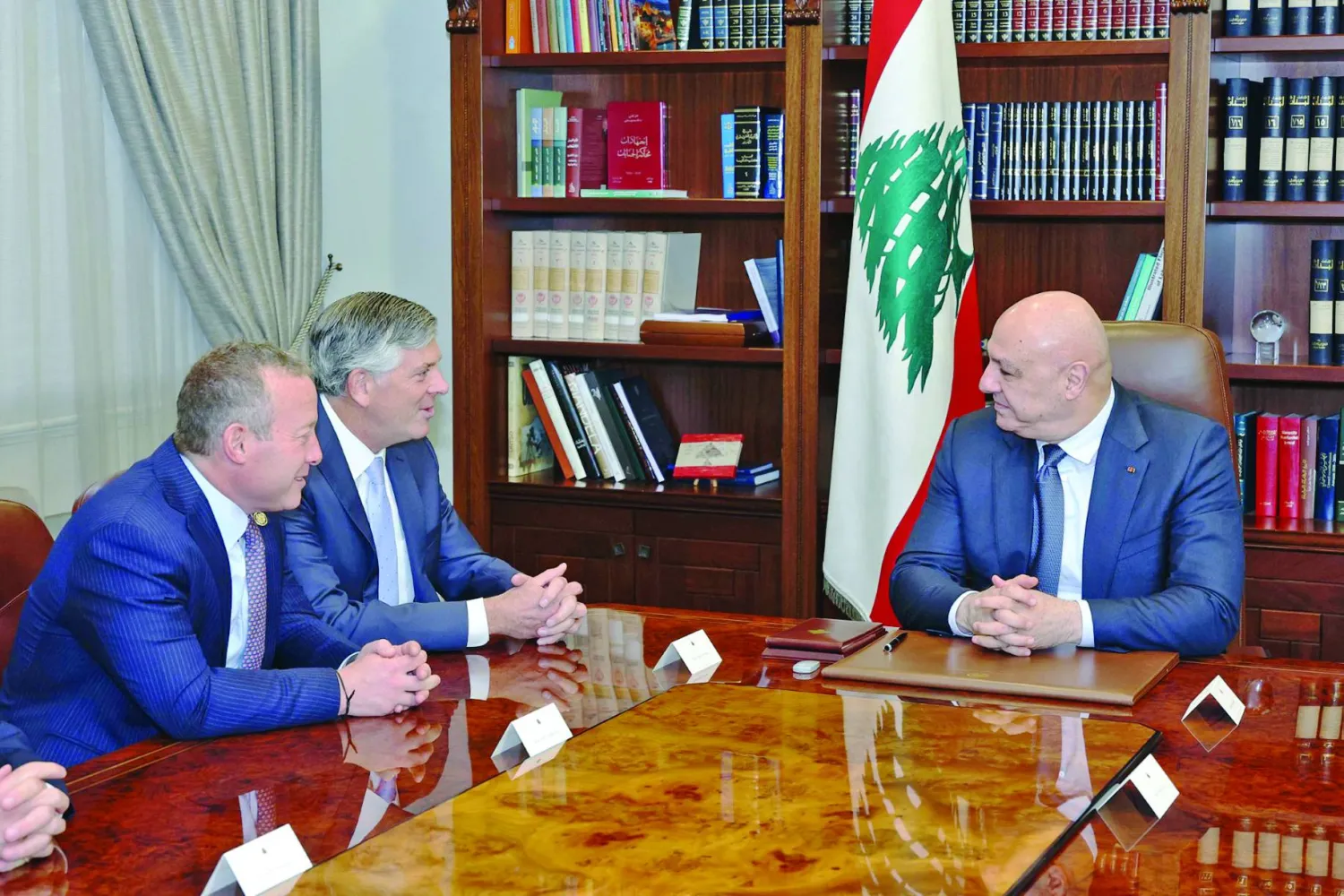
President Joseph Aoun welcoming US Congress members Darin LaHood and Josh Gottheimer (Lebanese Presidency)
TT

Lebanon Urges US Pressure on Israel, Seeks Army Support and Commits to Reforms

President Joseph Aoun welcoming US Congress members Darin LaHood and Josh Gottheimer (Lebanese Presidency)

Lebanon’s top leaders urged Washington to pressure Israel to implement agreements and halt its operations in South Lebanon, while stressing the need for continued support for the Lebanese Army and pledging to press ahead with economic, financial and political reforms.

The messages emerged from President Joseph Aoun’s and Parliament Speaker Nabih Berri’s meetings with US Reps. Darin LaHood and Josh Gottheimer, as well as Prime Minister Nawaf Salam’s talks in Washington.

Aoun told the US lawmakers that Lebanon was placing considerable importance on Washington pressuring Israel to implement the “framework agreement” reached through Lebanese-US-Israeli negotiations in Washington.

Lebanon remains fully committed to the agreement, while Israel continues to disregard its provisions, Aoun stressed, according to a Lebanese presidency statement.

He stressed the need to halt demolition, bulldozing and destruction activities in the southern villages occupied by Israel, arguing that implementing the agreement required accelerating the return of Lebanese prisoners, resolving disputed points along the Blue Line and a gradual Israeli withdrawal from Lebanese territory alongside Lebanese Army deployment up to the internationally recognized southern border.

Aoun warned that continued delays would prolong tensions in the south and hinder the state’s ability to extend its authority throughout its southern territory, remove armed manifestations and return displaced residents to their villages and towns.

He also underscored the need to provide the Lebanese Army with the resources required to carry out its wide-ranging duties, from combating terrorism and smuggling and securing borders to protecting institutions and maintaining civil peace.

On domestic affairs, Aoun reaffirmed the government’s commitment to financial, economic and judicial reforms, pointing to legislation including amendments to the banking secrecy law, bank restructuring and the media law.

LaHood described the current situation as an opportunity to restore stability to Lebanon and the wider region and affirmed continued US assistance to Lebanon and its army through military aid provided by the administration with congressional approval.

Berri, meanwhile, focused on the continuing Israeli operations in Lebanon, arguing that Israel’s failure to fulfill its obligations under agreements reached to end the war was the main obstacle to their implementation.

He reiterated that the US administration and President Donald Trump had the ability to pressure Israel to halt its war on Lebanon, warning that its continuation would undermine efforts by the state and its institutions to carry out their roles, according to a statement from the parliament speaker’s office.

Berri welcomed assistance to the Lebanese Army but stressed the need to avert a failure to renew the mandate of the UN Interim Force in Lebanon, or UNIFIL, noting that there was still time to prevent such a step.

During a separate meeting with a British military delegation, he emphasized the importance of maintaining a UN umbrella and flag for any force assisting the Lebanese Army after Israel withdraws from occupied Lebanese territory.

Deputy Prime Minister Tarek Mitri also presented Berri with a documented report on crimes committed by Israeli forces in South Lebanon. Berri maintained that Lebanon’s right to pursue Israel over those acts was a “sovereign right” that could not be relinquished.

In Washington, Salam discussed economic and financial relations with US Treasury Secretary Scott Bessent, along with financial and banking reforms, negotiations with the International Monetary Fund and cooperation with the World Bank.

Salam outlined government measures to address the repercussions of Lebanon’s financial crisis and rebuild the banking sector, while seeking US support for reforms and economic recovery. Discussions also covered efforts to curb the cash economy and strengthen transparency, compliance and measures against money laundering and terrorism financing.

Meeting young Lebanese in Washington, Salam linked domestic reform with full state sovereignty, stressing that state-building rested on two inseparable tracks.

“There can be no state with two armies, and no state with two decision-making authorities,” he declared, reaffirming the government’s determination to pursue reforms and extend state authority across all Lebanese territory.

Salam stressed that government success should be measured not only by laws and projects but by its ability to build a country where young people see a future, making the return of Lebanese from abroad “a choice, not a sacrifice.”

He called for a state that respects its citizens and provides a trustworthy judiciary, a productive economy and an effective administration, urging Lebanese abroad to remain engaged through their expertise, investments and connections.

“Judge us by our work; judge us by the results,” Salam concluded.


Palestinian Teen Reunites with Family After Month in Israeli Jail

The mother of Ezzedine al-Lahalia, a 15-year-old Palestinian teenager, kisses him as they reunite in the village of Al-Jib in the Israeli-occupied West Bank, late on November 12, 2026, after his release from an Israeli prison where he had spent a month in detention. (AFP)
TT

Palestinian Teen Reunites with Family After Month in Israeli Jail

The mother of Ezzedine al-Lahalia, a 15-year-old Palestinian teenager, kisses him as they reunite in the village of Al-Jib in the Israeli-occupied West Bank, late on November 12, 2026, after his release from an Israeli prison where he had spent a month in detention. (AFP)

Looking tiny in his adult-size grey prison jumpsuit, 15-year-old Palestinian Ezzedine al-Lahalia appeared stunned as his mother embraced him after a month in an Israeli jail.

His first request was a child's wish for his favorite food: stuffed cabbage and shawarma.

The teenager, who had been charged with throwing stones, was reunited with his family Thursday night in an emotional scene witnessed by an AFP photographer.

Ezzedine's mother held back tears as she kissed his cheeks, while the older men released alongside him greeted their wives and children.

Then Israeli troops fired tear gas, interrupting the families' reunions.

Lahalia, from the West Bank city of Sair, reunited with his family in the village of Al-Jib near Jerusalem, where Israeli authorities typically release Palestinian prisoners on Thursdays.

"After the Israelis brought the prisoners out, after we had received them, they fired tear gas," Ezzedine's mother, Rania Jaradat told AFP, adding that the scene was reminiscent of when soldiers took the boy from the family home on October 14, 2026.

"They were afraid that the families would assemble near the gate and celebrate," she said.

After Lahalia's release, she said, "the first thing he asked for was stuffed cabbage and shawarma". She happily complied.

He was released after the family paid 5,000-shekels (around $1,500) in bail.

As the eldest of five, his absence was particularly felt by his younger siblings.

"They're happy that I've returned, but they were very distressed while I wasn't with them," Ezzedine told AFP.

According to the Addameer Prisoner Support and Human Rights Association, 9,300 Palestinians are currently held in Israeli jails, including 350 minors.

Earlier this week, the military said it had shot a 14-year-old in a group of boys it suspected of throwing stones at a passing car in the north of the West Bank.

The Israeli human rights group B'Tselem noted an increase in deaths of Palestinians after the easing of open-fire rules in 2022 for stone throwers.


Lebanon Hands Over Al-Alwani’s Body to Iraq without Autopsy

The building where former Iraqi MP Ahmed al-Alwani was found strangled to death in Beirut, Lebanon, November 11, 2026. (Reuters)
TT

Lebanon Hands Over Al-Alwani’s Body to Iraq without Autopsy

The building where former Iraqi MP Ahmed al-Alwani was found strangled to death in Beirut, Lebanon, November 11, 2026. (Reuters)

Lebanon's Public Prosecutor at the Court of Cassation Judge Ahmad Rami al-Hajj ordered the handover of the body of former Iraqi MP Ahmed al-Alwani to the Iraqi Embassy in Beirut for transfer to Baghdad, at the request of his family.

A judicial source explained that X-rays conducted Thursday on al-Alwani’s body revealed a quantity of fluid in the victim's lower abdomen and pelvis.

It said the judiciary had ordered an autopsy to determine the nature of the fluid and whether it was blood, which could indicate that he had been beaten and suffered internal bleeding.

However, the Iraqi Embassy asked the judiciary to forego the autopsy and transfer the body to Baghdad so that those procedures could be carried out there. The request was granted.

The judicial source said that determining the causes of death can be accomplished once the suspects or those accused in the crime are arrested and through their confessions.

The source also revealed that two individuals who sold phone lines to the perpetrators in the Tariq al-Jdideh area in Beirut have been placed under investigation, with no decision made yet on whether to detain or release them.

The judicial source further noted that Lebanon has so far received no response from Damascus about the arrest and extradition of the two Syrian suspects who fled into Syrian territory.


An Israeli Strike on a Hospital Highlights the Devastation to Gaza’s Healthcare System

 A medical staff member salvages medical equipment at Nasser Hospital after it was hit by an Israeli airstrike overnight in Khan Younis, Gaza Strip, Thursday, Nov. 12, 2026. (AP)
A medical staff member salvages medical equipment at Nasser Hospital after it was hit by an Israeli airstrike overnight in Khan Younis, Gaza Strip, Thursday, Nov. 12, 2026. (AP)
TT

An Israeli Strike on a Hospital Highlights the Devastation to Gaza’s Healthcare System

 A medical staff member salvages medical equipment at Nasser Hospital after it was hit by an Israeli airstrike overnight in Khan Younis, Gaza Strip, Thursday, Nov. 12, 2026. (AP)
A medical staff member salvages medical equipment at Nasser Hospital after it was hit by an Israeli airstrike overnight in Khan Younis, Gaza Strip, Thursday, Nov. 12, 2026. (AP)

A deadly airstrike on the biggest hospital in the southern Gaza Strip highlighted the devastation that Israel's campaign has wreaked on the Palestinian territory's healthcare system over the past three years.

The strike that hit Nasser Hospital's surgical wing killed six people, including a surgeon and a 13-year-old boy, and heavily damaged operating rooms and patient wards. The Israeli military said it targeted a Hamas commander using the hospital as a base, though it did not provide evidence for the claim.

Israel has carried out near daily strikes in Gaza despite a ceasefire agreement with Hamas that took effect in October 2025. Israel says it is targeting fighters. Israel launched its campaign in Gaza in retaliation for Hamas' deadly October 2023 attack on southern Israel.

Direct attacks on hospitals have become rarer during the truce. But Thursday's strike underscored how Gaza's health system is still struggling to recover.

Here is a look at Israel's attacks on hospitals, its accusations against Hamas and the impact on Gaza's healthcare system.

Israel has attacked Gaza hospitals frequently in the war

The Israeli military besieged multiple hospitals around Gaza throughout the war, often surrounding them for weeks and battering them with strikes and gunfire while patients and staff were trapped inside and supplies ran out. Some sieges ended with troops storming hospitals, often leaving medical equipment destroyed, or with staff and patients forced to evacuate. Troops detained hundreds of healthcare workers.

Two major raids left Gaza City’s Shifa Hospital, the territory’s largest, in ruins.

Aside from the sieges, hospitals and other medical facilities have frequently come under Israeli fire or been hit by airstrikes that the military says target Hamas fighters. During some of the worst months, as few as 14 of Gaza's 36 prewar hospitals were functioning, and shortages of medicine meant patients writhed in pain without painkillers and deadly infections ran rampant.

The World Health Organization says it has documented more than 1,050 attacks on health facilities in Gaza, causing more than 1,000 deaths. The UN says more than 1,700 medical personnel were killed in the war, including in strikes away from medical facilities. At least six medical staffers from Gaza, including three prominent doctors, have died in Israeli prisons, according to rights groups that have documented abuses in custody.

Israeli forces have struck Nasser Hospital repeatedly. In 2025, the military killed 22 people when it shelled a vantage point used by reporters on the hospital roof, then hit rescue workers and journalists rushing to help the wounded. Among those killed were five journalists, including Mariam Dagga, who was working with The Associated Press.

While attacks during the ceasefire have waned, some strikes in recent months have damaged medical facilities, according to the UN.

Israel accuses Hamas of using the facilities for military purposes

Israel has sought to justify the assaults by accusing Hamas of using the hospitals as command-and-control centers, though it has provided limited evidence. Palestinian and hospital officials have denied these claims.

Hamas security men have sometimes been seen in hospitals, controlling access to certain areas.

The international medical aid group Doctors Without Borders suspended most operations at Nasser Hospital in January because of the presence of masked armed men and situations in which patients were arrested or intimidated. It resumed operations a few months later, citing “concrete improvements” after talks with Gaza authorities, including restrictions on entry of armed individuals.

In the case of Nasser Hospital, the Israeli military said Thursday that it was targeting Muhammad Abu Ismail, who it said headed Hamas’ Khan Younis Brigade and had been using the facility as a headquarters for planning attacks.

It did not explain why the hospital’s surgical unit was targeted. The strike smashed through a patient recovery area and wrecked operating rooms and a rest area for doctors.

The military did not say whether it had killed Abu Ismail. He was not on the hospital’s list of people killed.

International law gives protections to hospitals Hospitals are protected under international humanitarian law and attacking them is a war crime.

Medical facilities can lose that protected status if they are used for military purposes “to commit acts harmful to the enemy.” But the Geneva Conventions, passed in 1949, say there must be a warning with a reasonable period of time before any attack, and that the attack must be proportional to the military threat and take care to avoid civilian casualties.

The Israeli military said it had held “warning conversations” with Gaza health officials before Thursday's strike regarding militant use of hospitals. It said it made clear that “if the activity was not halted, it would act to remove the threats posed by it.”

Medical organizations and rights groups also have criticized Israel’s restrictions on medical aid and equipment entering Gaza as a violation of international law. The Israeli military says it allows aid to enter Gaza but bars some “dual use” items it asserts could be used for military purposes.

Gaza's healthcare system is struggling to recover

Israel’s attacks, along with restrictions on aid, have left Gaza’s healthcare system in ruins. Twenty of Gaza’s 36 pre-war hospitals are functioning, though none is fully operational.

During much of the war, some of those hospitals offered little beyond first aid even as they dealt with scores of wounded people. They struggled to keep lights and equipment functioning because of fuel shortages.

The ceasefire deal has given aid groups and the Health Ministry breathing room to get some services functioning again. But the sector continues to suffer from Israel’s restrictions on entry or slow approvals for medicines, supplies and equipment. The World Health Organization said in a Sept. 30 report that 47% of essential medicines were out of stock and that shortages in lab supplies, medical equipment, spare parts and fuel hampered health work.

At the same time, hospitals and clinics struggle to treat a population where almost everyone has lost their homes and more than 1.6 million live in tents or other ramshackle shelters. Communicable diseases and infections are widespread, and thousands have life-changing wounds from the war.