West Bank's Violent Settlers Part of a New Generation Fueled by Ideology

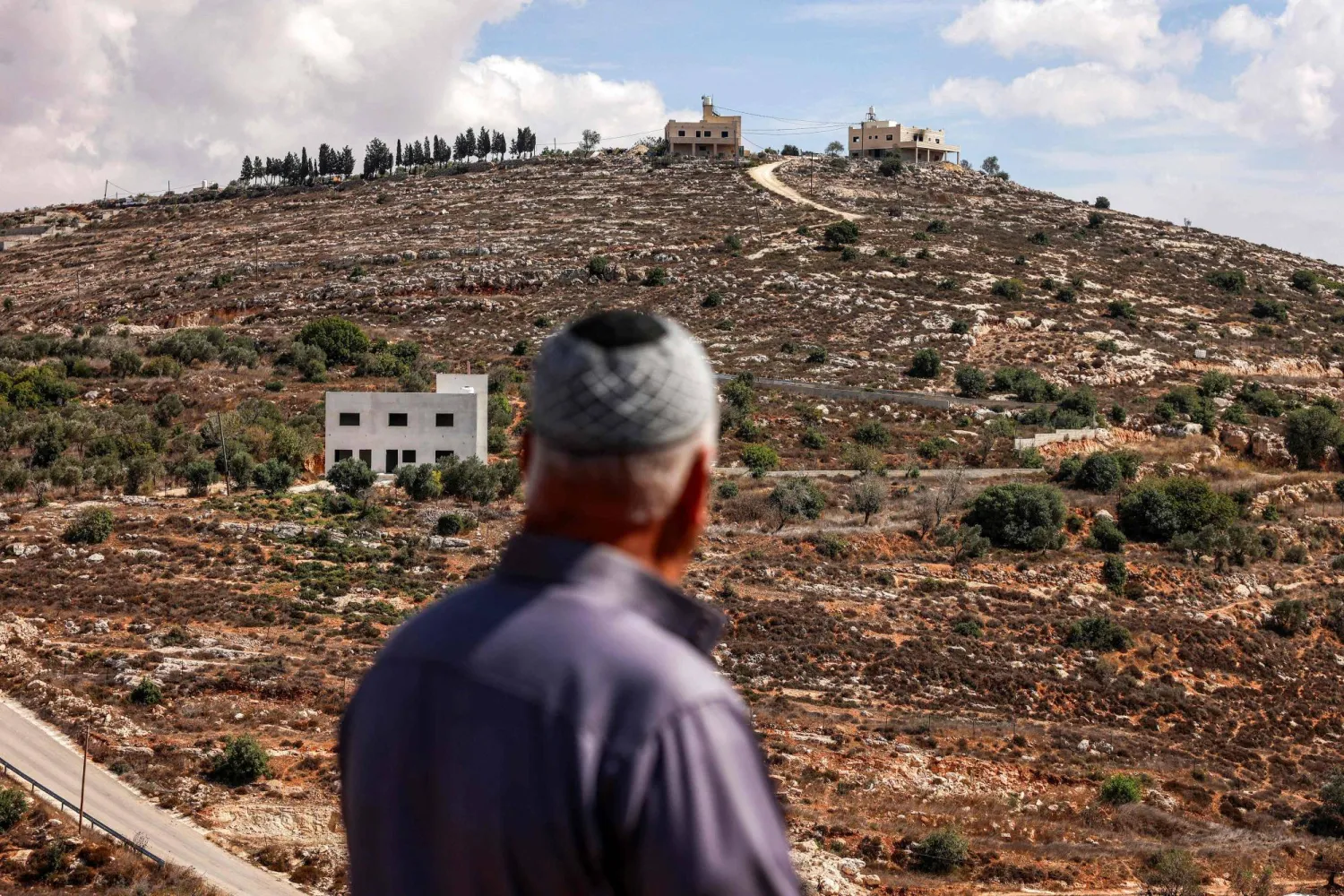
TOPSHOT - Mahmoud al-Toubasi, a 60-year-old Palestinian who was displaced from his home months earlier following an attack by Israeli settlers, stands from a distance looking at his house in the Palestinian village of Jalud, south of Nablus in the Israeli-occupied West Bank, on September 29, 2026. (Photo by Zain JAAFAR / AFP)
TT

West Bank's Violent Settlers Part of a New Generation Fueled by Ideology

TOPSHOT - Mahmoud al-Toubasi, a 60-year-old Palestinian who was displaced from his home months earlier following an attack by Israeli settlers, stands from a distance looking at his house in the Palestinian village of Jalud, south of Nablus in the Israeli-occupied West Bank, on September 29, 2026. (Photo by Zain JAAFAR / AFP)

A mass attack by Israeli settlers on a Palestinian village in the occupied West Bank has placed new focus on the emergence of a generation of radicals in the territory.

A loosely connected movement of hardline Israeli settlers, most of them young and including school dropouts from outside the West Bank, known as the "Hilltop Youth", is behind the surging violence against Palestinians.

Inspired by religious-nationalist ideology, the movement seeks to expand the Jewish presence in the Palestinian territory by setting up unauthorized outposts -- usually makeshift tents or mobile homes -- on hilltops outside established Israeli settlements.

While groups of Israelis living off-grid in the West Bank have existed since the 1990s, the new generation has a clear agenda to take over Palestinian lands through violent means, said Dvir Warshavsky of Children of Abraham, a group of observant Jewish activists supporting Palestinian rights.

Early on Tuesday, more than 100 Israeli settlers attacked the village of Jalud, wounding three members of Israeli security forces, as the army accompanied a Palestinian family seeking to return to their home after being displaced by settler attacks.

The ramp-up in violence, including attacks on mosques and churches, had already prompted countries including Britain and the Netherlands to impose sanctions on settlement products, infuriating Israel.

A post published in a WhatsApp channel affiliated with the movement and seen by AFP recently claimed that over the past 12 months, the Hilltop Youth had carried out 635 attacks in 158 different Palestinian villages, and that 409 Palestinians were wounded and 436 cars were burned during the attacks. The figures could not be independently verified.

The perpetrators of such violence are rarely prosecuted by Israeli authorities.

Israeli Prime Minister Benjamin Netanyahu, addressing the UN General Assembly last week, dismissed settler attacks as the work of a "handful of juvenile delinquents, about 150 in number" and accused the rest of the world of ignoring violence by Palestinians.

Israel has occupied the West Bank since 1967. More than 500,000 settlers live in the territory which is home to some three million Palestinians.

About 140 settlements are recognized by the Israeli government while being illegal under international law, but farms and outposts that are also illegal under Israeli law now number around 400, according to the Peace Now watchdog.

- 'Minimum people on maximum land' -

Israeli rights experts who have tracked the Hilltop Youth for years said the movement gathered pace after Israel dismantled 21 settlements in the Gaza Strip and four in the West Bank as part of its unilateral "disengagement" in 2005.

The failure of the settler movement's old guard to prevent thousands of Israelis from losing their homes in the forced evacuations, combined with resentment toward the central government, ushered in a new phase.

More ideological settlers emerged, challenging "the traditional strategy of the settler movement, whose logic was to build more and more settlements with more and more people," Warshavsky said.

The "new generation" focused on building small illegal outposts and agricultural projects without permits from Israeli authorities -- a strategy known as "minimum people on maximum land".

Grazing flocks of sheep and goats has allowed the hilltop youth to significantly expand control over rural areas which are under Israeli military authority.

With the rise of politicians representing the ideological settlers, such as Finance Minister Bezalel Smotrich, the communities have received growing legitimization and financial support -- some of it channeled toward illegal farms and outposts, according to experts.

While the government cannot make direct transfers because of their illegal status, "they fund all the rest", said Hagit Ofran of the Peace Now watchdog, meaning roads, ranger cars, security cameras, solar panels and drones -- along with protection from the Israeli army.

Some funding also comes from private donations and crowdfunding, she added.

- Protected by the army -

Some settler leaders have sought to distance themselves from the movement. At the end of last year, the leaders of three Israeli local councils in the West Bank issued a joint statement urging law enforcement to adopt a "zero tolerance" policy towards the Hilltop Youth, saying they "do not represent" the broader settler movement.

Since Hamas's October 7, 2023 attack on Israel and the outbreak of war in Gaza and on other fronts, regular soldiers have been diverted away from the West Bank, with troops patrolling around the settlements now often reservists who are themselves settlers.

Such troops are much less likely than regular soldiers to dismantle illegal outposts, experts say.

"The army is not really fighting against them. They don't want to deal with them," Ofran said.


EU Urges ‘Immediate, Unimpeded’ Flood Aid to Gaza

 Displaced Palestinians walk through a rain-soaked tent camp following heavy rainfall in Deir al-Balah, central Gaza Strip, Saturday, Nov. 7, 2026. (AP)
Displaced Palestinians walk through a rain-soaked tent camp following heavy rainfall in Deir al-Balah, central Gaza Strip, Saturday, Nov. 7, 2026. (AP)
TT

EU Urges ‘Immediate, Unimpeded’ Flood Aid to Gaza

 Displaced Palestinians walk through a rain-soaked tent camp following heavy rainfall in Deir al-Balah, central Gaza Strip, Saturday, Nov. 7, 2026. (AP)
Displaced Palestinians walk through a rain-soaked tent camp following heavy rainfall in Deir al-Balah, central Gaza Strip, Saturday, Nov. 7, 2026. (AP)

The European Union on Saturday demanded Israel grant urgent access for aid groups to Gaza to help the victims of devastating floods there.

"We urge Israel to allow immediate, unimpeded access and sustained distribution of humanitarian assistance and early recovery support at scale, and to reopen all Gaza border crossings," it said in a statement.


Israeli Drone Strike Kills 2 Palestinians in Gaza

 Palestinians walk through a tent camp housing displaced people amid buildings destroyed by Israeli strikes during the Israel-Hamas war in Gaza City, Sunday, Nov. 8, 2026. (AP)
Palestinians walk through a tent camp housing displaced people amid buildings destroyed by Israeli strikes during the Israel-Hamas war in Gaza City, Sunday, Nov. 8, 2026. (AP)
TT

Israeli Drone Strike Kills 2 Palestinians in Gaza

 Palestinians walk through a tent camp housing displaced people amid buildings destroyed by Israeli strikes during the Israel-Hamas war in Gaza City, Sunday, Nov. 8, 2026. (AP)
Palestinians walk through a tent camp housing displaced people amid buildings destroyed by Israeli strikes during the Israel-Hamas war in Gaza City, Sunday, Nov. 8, 2026. (AP)

An Israeli drone strike killed two Palestinians in the Gaza Strip on Saturday, hospital officials said.

The drone struck two Palestinians walking down a street in Jabaliya, on the northern edge of Gaza City, said Mohamed Abu Selmiya, director of Shifa Hospital in Gaza City, where the casualties were taken.

The American field hospital said several other people were wounded but did not provide a number.

Asked about the attack, the Israeli military said it had struck two Hamas fighters in the area.

Near-daily Israeli fire and airstrikes have continued in Gaza more than a year after Israel and Hamas reached a ceasefire deal.

At least 1,600 Palestinians have been killed since the ceasefire, according to Gaza’s Health Ministry. The ministry, part of the Hamas-run government, maintains detailed records and is seen as generally reliable by UN agencies and independent experts. It does not distinguish between civilians and combatants in its toll but says women and children make up around half the dead.


Thousands Mourn al-Alwani as Lebanese Probe Awaited

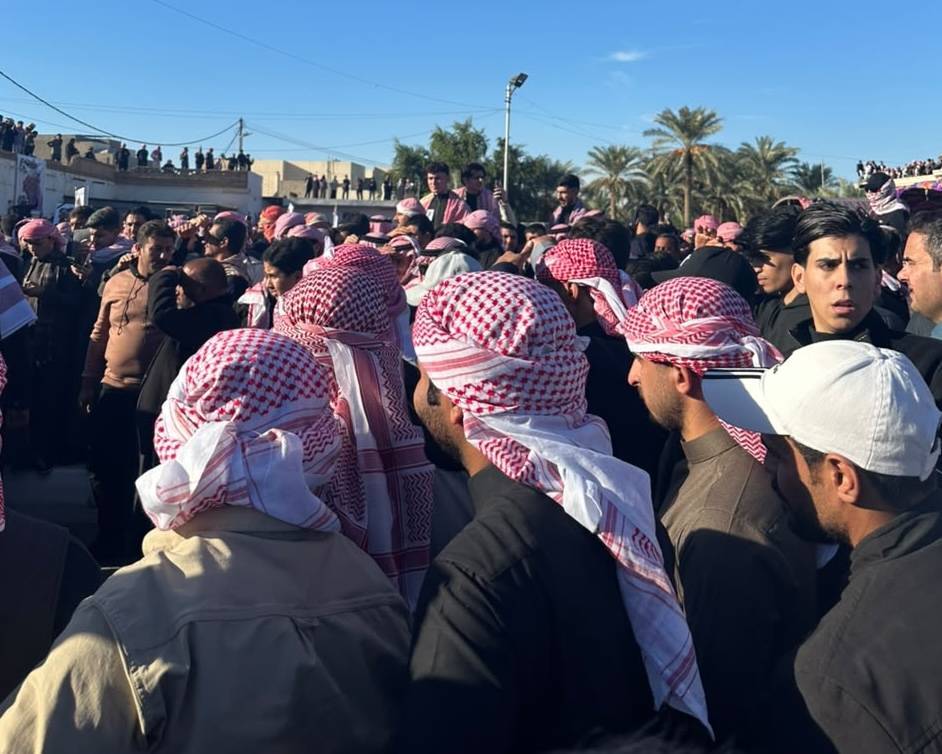
Relatives receive former MP Ahmed al-Alwani's coffin upon its arrival at Baghdad airport on Saturday. (X)
TT

Thousands Mourn al-Alwani as Lebanese Probe Awaited

Relatives receive former MP Ahmed al-Alwani's coffin upon its arrival at Baghdad airport on Saturday. (X)

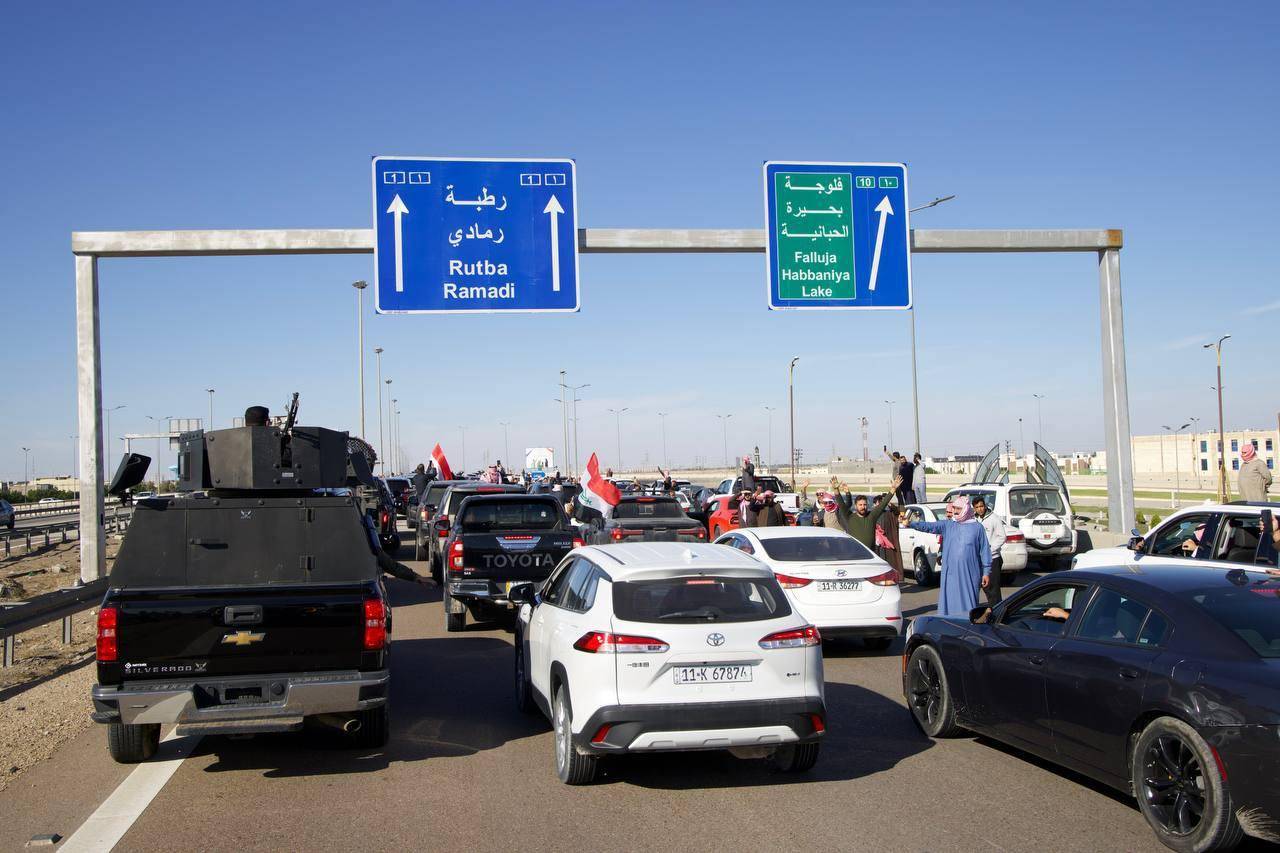
Thousands of Iraqis on Saturday escorted the body of former MP Ahmed al-Alwani from Baghdad Airport to Ramadi in Anbar Governorate, where tribespeople and residents from across the province awaited his arrival amid scenes of grief and anger.

Meanwhile, the circumstances surrounding his killing in Beirut remain under investigation, even as Lebanese authorities have made progress in identifying two suspects.

A private jet carrying al-Alwani's body from the Lebanese capital landed at Baghdad Airport in the morning, with large crowds of mourners gathering at the airport.

Local media reported that Iraqi politician Khamis al-Khanjar, head of the Sovereignty Alliance, covered the cost of transporting the body aboard the private aircraft.

The funeral procession traveled toward Ramadi, located 110 kilometers from Baghdad, under heavy security and accompanied by military vehicles.

Mourners are seen at al-Alwani's funeral on Saturday. (Asharq Al-Awsat)

The Security Media Cell had urged the public to await the investigation's findings and refrain from reading broader motives into the case before it concludes, noting the ongoing coordination between the Iraqi Embassy in Beirut, Lebanese judicial and security authorities, and the Iraqi National Intelligence Service.

Al-Alwani's killing has sparked uproar across Iraq, particularly in his home province of Anbar. Discussion of the case has been accompanied by political debates and sectarian commentary on social media, amid demands to identify those responsible for his death.

Kamel al-Dulaimi, former head of the Iraqi Presidential Diwan, told Asharq Al-Awsat that the circumstances and motives behind the crime still require clear and transparent disclosure to the public, underscoring the Iraqi state's responsibility to uncover the truth.

The funeral procession traveled toward Ramadi, located 110 kilometers from Baghdad, under heavy security and accompanied by military vehicles. (Asharq Al-Awsat)

He added that the case requires security and judicial cooperation among Iraq, Lebanon, and Syria to track down the perpetrators and those behind them, particularly if the investigation calls for cross-border coordination.

He warned that the sectarian rhetoric surrounding the incident reflects a persistent tendency to view national issues through a narrow lens, emphasizing that the matter concerns the sanctity of Iraqi blood and must not be reduced to the affiliation of an individual or a governorate.

Legal researcher Saif al-Saadi, who hails from Anbar, said al-Alwani was not merely a former lawmaker, but a prominent tribal, social, and political figure in the province, adding that the funeral reflects the depth of grief and anger across Anbar's cities.

Al-Alwani, who rose to prominence during the late 2013 Anbar protests, was arrested in December of that year and sentenced to death in 2014 after being convicted of killing two soldiers during clashes accompanying his arrest.

He was released in April 2025 after spending more than 11 years in prison, following the withdrawal of a complaint by one of the victims' families and his inclusion under the General Amnesty Law.