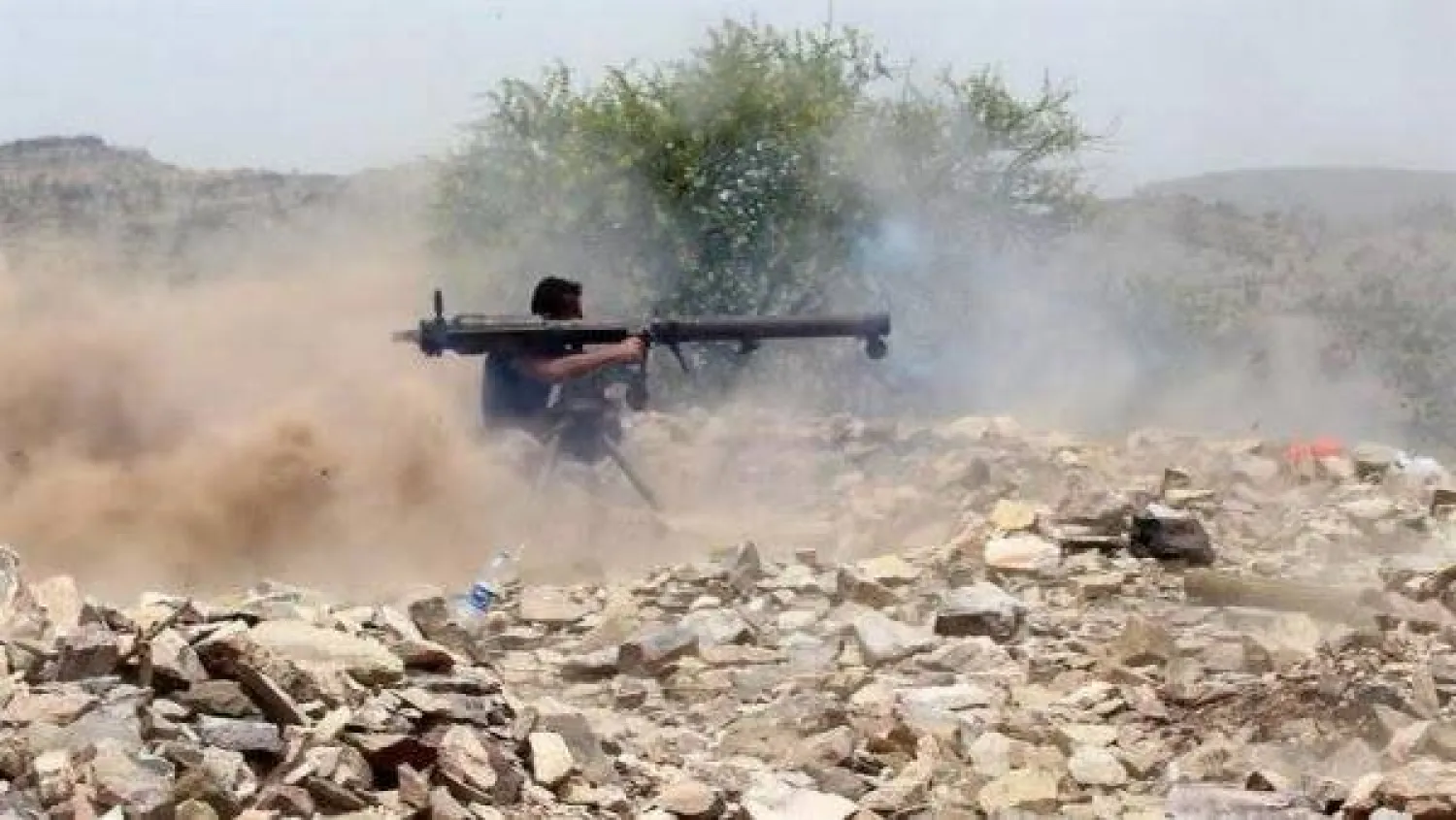
Signs of a Full-Scale Yemeni Offensive Against the Houthis

Yemeni leadership's move toward general mobilization signals a decisive battle against the Houthis (Military Media)
TT

Signs of a Full-Scale Yemeni Offensive Against the Houthis

Yemeni leadership's move toward general mobilization signals a decisive battle against the Houthis (Military Media)

Clashes between Yemen's government forces and the Iran-backed Houthi group have intensified on the fronts in Taiz and Lahj, alongside an increase in airstrikes, ground operations, and missile attacks. Meanwhile, the general mobilization measures and military readiness announced by Yemen's leadership are pointing toward a new phase that could signal the launch of a full-scale confrontation with the group.

The fronts west of Taiz and in areas bordering Lahj are witnessing ongoing battles, amid Houthi attacks, infiltration attempts, and flanking maneuvers, met by intensive Yemeni military operations involving formations from the Giants Brigades and Nation's Shield Forces, as well as tribal fighters.

The confrontation has also moved to a broader government level following the adoption of executive measures related to general mobilization and a discussion by Yemen's National Defense Council of the readiness of the armed forces, security forces, and military formations across the various fronts. The Yemeni leadership has reiterated that the objective is to restore state institutions and extend their sovereignty over the country's entire territory.

The al-Aghbari front, on the outskirts of al-Mudharaba District and Ras al-Ara in Lahj Governorate, witnessed fierce nighttime battles in the areas of Dhi Ahdah, al-Khazm, and al-Mansoura following a Houthi attack on positions held by government forces and backed by tribal fighters.

Yemeni military sources said government forces and tribal fighters repelled the attack, with clashes continuing through Wednesday and leaving casualties on both sides.

The fighting coincided with airstrikes targeting Houthi positions in the areas of al-Bazalah and al-Dhuhourah, located between al-Wazi'iyah and al-Mudharaba. The Taiz Military Axis Media Center also reported airstrikes on Houthi positions in al-Wazi'iyah District, west of the governorate.

Taiz Under Fire

In Taiz, the Houthi group has stepped up its missile and artillery attacks on residential areas and villages in the south and west of the governorate.

Local sources said the group targeted areas in al-Shamayatayn District with four ballistic missiles, while villages in Jurdad Bani Omar were also shelled with rockets and artillery, injuring two civilians and causing fear among residents.

In al-Turbah, south of the governorate, local sources said the group shelled residential neighborhoods with four ballistic missiles, causing material damage to a number of homes and properties.

Other field reports said three ballistic missiles were fired, one of which struck the building of the Mother and Child Hospital, which is still under construction in the city, causing material damage.

The Houthi shelling also reached the villages of Bani Bakari in Jabal Habashi District, while government forces continued their operations along several axes of the governorate.

At the military level, Yemeni Armed Forces spokesman Colonel Staff Officer Majed Abdullah al-Nazili said the forces had carried out 414 precise targeting operations over a 24-hour period against Houthi reinforcements and military capabilities on various fronts.

Al-Nazili said the operations employed a range of modern capabilities and resulted in the neutralization of Houthi militants and military equipment.

This came a day after government forces announced that they had carried out 356 targeting operations over a 24-hour period, saying that, according to their field estimates, the operations had killed or wounded 476 Houthi militants. This brought the total casualties announced by the government forces over four days to nearly 3,000 dead and wounded.

According to the government forces, the targets included command-and-control centers, weapons and artillery depots, and dozens of military vehicles, as the group continued sending reinforcements to the front lines.

General Mobilization Takes Effect

Alongside the developments on the battlefield, the most significant political and military development has been the move by Yemen's state institutions toward organizing a general mobilization.

The National Defense Council held a meeting chaired by Rashad al-Alimi, Chairman of the Presidential Leadership Council, and attended by political, military, and government leaders. The meeting discussed the latest national developments and the readiness of the armed forces, security forces, and military formations on the various fronts, as well as executive measures related to general mobilization.

The council affirmed that the armed forces would continue carrying out their responsibilities to protect civilians and deter sources of threat, with the ultimate goal of restoring state institutions and extending state sovereignty over the entire national territory.

It also stressed the importance of integrating military, security, economic, humanitarian, media, and diplomatic efforts under state leadership, and mobilizing the country's capabilities, resources, and potential in support of this objective.

This follows the Yemeni House of Representatives' approval of a request by the Chairman of the Presidential Leadership Council to declare a general mobilization, a step encompassing human and material resources as well as the capabilities of state institutions.

The National Defense Council approved directives and executive measures related to the general mobilization, stressing the need to move it from a broad framework to a disciplined institutional mechanism in accordance with the constitution and applicable laws.

At the same meeting, the council praised what it described as the cohesion of the armed forces, military formations, and popular resistance, as well as what it said was their ability to regain the initiative on various fronts. It also praised popular and tribal support for the forces and displaced people.

This course of action takes on particular significance as fighting continues in Taiz and Lahj. The institutional measures are coinciding with an increase in the intensity of military operations on the ground, reflecting the state's readiness to deploy its resources and capabilities more broadly in the confrontation.

The National Defense Council has not announced the start of a full-scale offensive. However, its combination of military readiness, general mobilization measures, calls for the integration of national resources, and continued operations on several fronts points to preparations for a broader confrontation.

A Threat Beyond the Front Lines

The National Defense Council linked the military developments to threats it said the Houthi group poses beyond the battlefronts. It warned of the use of mobile Iranian air-defense systems, cruise missiles, and advanced military technologies.

It said these capabilities were expanding the scope of the threat to air-navigation routes in Yemen and the region, putting civilian aircraft and humanitarian and relief flights at risk. The council called for international action to prevent the flow of weapons, technology, and military expertise to the group.

The council also welcomed regional and international positions supporting the government and state institutions, and referred to UN Security Council resolutions concerning Yemen, foremost among them Resolution 2216.

On the humanitarian front, the council affirmed the state's commitment to protecting civilians and civilian facilities and responding to the needs of displaced people and families forced from their homes by the group. It called on international organizations and donors to support the growing humanitarian response.

Alongside the military effort, Yemen's leadership has maintained a parallel political track targeting members of the group. The National Defense Council renewed its assurance that the door to "safe return" remains open to those who abandon the Houthis and stop fighting or working on their behalf.


Israeli Military Says Killed Two After West Bank Shooting

 Israeli soldiers and emergency personnel gather near ambulances following a shooting attack near Yehuda Junction, near Hebron, in the occupied West Bank, Friday, Oct. 23, 2026. (AP)
Israeli soldiers and emergency personnel gather near ambulances following a shooting attack near Yehuda Junction, near Hebron, in the occupied West Bank, Friday, Oct. 23, 2026. (AP)
TT

Israeli Military Says Killed Two After West Bank Shooting

 Israeli soldiers and emergency personnel gather near ambulances following a shooting attack near Yehuda Junction, near Hebron, in the occupied West Bank, Friday, Oct. 23, 2026. (AP)
Israeli soldiers and emergency personnel gather near ambulances following a shooting attack near Yehuda Junction, near Hebron, in the occupied West Bank, Friday, Oct. 23, 2026. (AP)

Israeli troops on Friday shot dead two suspected Palestinian assailants in the West Bank after a shooting that left at least five people wounded, officials said.

Footage shared by rescuers showed a lifeless body in casual attire on the ground next to a petrol station as Israeli troops patrolled in all directions.

The Israeli military said soldiers had rushed to the Judea Junction area near the flashpoint city of Hebron after the early-morning shooting attack.

"Israeli soldiers eliminated two terrorists and continue searches in the area," it said in a statement.

The initial shooting wounded five people, two of whom were in critical condition, said Magen David Adom, Israel's emergency medical rescue service.

The incident comes as tensions soar in the West Bank, including over attacks by extremist Israeli settlers against Palestinian olive harvesters, and days ahead of Israeli elections.


Istanbul Hosts Middle East, European FMs to Discuss Regional Crises

The foreign ministers of Saudi Arabia, Egypt, Türkiye and Pakistan meet in Amman on August 5. (Turkish Foreign Ministry)
TT

Istanbul Hosts Middle East, European FMs to Discuss Regional Crises

The foreign ministers of Saudi Arabia, Egypt, Türkiye and Pakistan meet in Amman on August 5. (Turkish Foreign Ministry)

Foreign ministers from seven European and Middle Eastern countries will hold talks in Istanbul Friday focusing on the Strait of Hormuz and the crises in the Middle East.

Ministers from the so-called E3 group -- Britain, France and Germany -- will meet counterparts from the newly created R4 group comprising Saudi Arabia, Egypt, Türkiye and Pakistan to discuss the Palestinians, developments in Yemen and the Strait of Hormuz, and ways to end the Russia-Ukraine war, a Turkish foreign ministry source said.

Turkish Foreign Minister Hakan Fidan is hosting the meeting, the first to bring together the two groups.

In chairing the talks, Fidan was to stress that "regional security first and foremost requires countries of the region to assume responsibility" and within that context, Türkiye "prioritizes strengthening cooperation mechanisms based on regional ownership".

He would also say "existing disputes should not be allowed to feed one another, conflicts should not be allowed to spread to new areas, and regional tensions should not be allowed to turn into broader instability".

Fidan will focus on the international community "increasing pressure on Israel" in response to its settlement expansion and its "encouragement of settler terrorism".

He will also underline Türkiye's support for Saudi Arabia's security in the face of Houthi attacks and the need for permanent freedom of navigation in the Hormuz and Bab el-Mandeb Straits.

British foreign minister Ed Miliband's office said the talks would essentially revolve around "the Strait of Hormuz and the situation in Saudi Arabia".

"Despite positive progress from the US and regional partners, passage through the Strait remains under threat, with traffic through the waterway sharply down on pre-war levels," a foreign ministry statement said.

It said Miliband "will advocate for a diplomatic solution to the crisis that restores full navigational rights and freedoms" and stress "how Iranian tactics are being replicated across the region, with attacks on Saudi Arabia further destabilizing the region and increasing pressure on vital waterways and global chokepoints, such as Bab El-Mandeb and the Suez Canal."

"The UK is stepping up to help stabilize the region, having this week committed RAF Typhoons to defend Saudi Arabia from Houthi attacks in their airspace," it added.

- Black Sea security -

Unrest in the Black Sea would also be a key focus, with the minister pointing to Türkiye's ongoing "warnings and proposals" to prevent the Russia-Ukraine war from spreading to the Black Sea and to draw a line under the civilian deaths there.

Armed attacks on commercial ships, often with drones, have multiplied in recent months as the war has spilled into the Black Sea, with Turkish ships increasingly in the firing line.

Last month, Türkiye sent a proposal to Russia and Ukraine to end the strikes, but it appears to have fallen on deaf ears with the attacks increasing in recent weeks, notably near Romania and Bulgaria.

NATO said Tuesday it was deploying additional planes, drones and radar systems to the Black Sea, calling for more "situational awareness" in the region through increased sensors and more data-sharing.

The E3 was set up more than 20 years ago to advance diplomatic coordination over Iran's nuclear program.

The R4 was formed this year and brings together Egypt with the signatories to the Makkah Defense Agreement -- a mutual defense pact set up by Saudi Arabia, Türkiye and Pakistan in August.


Iraq Fears Return of ‘Shadow Factions’ to Regional ‘Unity of Fronts’ Campaign

Members of Harakat al-Nujaba movement attend a gathering in Baghdad on Oct. 8, 2023 (AFP)
TT

Iraq Fears Return of ‘Shadow Factions’ to Regional ‘Unity of Fronts’ Campaign

Members of Harakat al-Nujaba movement attend a gathering in Baghdad on Oct. 8, 2023 (AFP)

Fears are mounting in Iraq that armed factions’ refusal to surrender their weapons may be an attempt to buy time ahead of a possible resumption of the war with Iran and the revival of the so-called “Axis of Resistance,” as Baghdad faces growing security and political pressure to prevent attacks on regional targets from Iraqi soil.

Political sources close to the Coordination Framework, an alliance of Iraq’s main Shiite political forces, said negotiations to bring all weapons under state control had made no tangible progress, with several factions yet to hand over the rockets and drones in their possession.

However, the sources told Asharq Al-Awsat that some alliance leaders considered it unlikely that the factions would attack countries in the region in support of Iran if the war resumed, given the potential repercussions for Prime Minister Ali al-Zaidi’s government, which could face mounting regional and international pressure.

Nujaba Reaffirms Refusal to Surrender Weapons

Those assessments have failed to ease fears that smaller armed groups could resume attacks that would be difficult to attribute directly to major factions, amid rising regional tensions and continuing divisions in Iraq over weapons outside state control.

Underscoring resistance to any change in the factions’ military status, Abdul Qadir al-Karbalai, military deputy of the Harakat al-Nujaba movement, said Wednesday that the group would not participate in the political process and that its position remained unchanged.

In a statement, al-Karbalai rejected the terms “placing weapons under state control,” “handing over weapons” and “disarmament” in reference to what the group calls resistance weapons.

His remarks pose an additional challenge to the government’s efforts to bring weapons under state control, with concerns extending beyond the political standoff between Baghdad and the factions to the possibility of renewed attacks on regional targets from Iraqi territory.

‘Shadow Factions’

Iraqi newspaper Al-Mada, citing informed sources, reported that the closure of the al-Sheeb border crossing with Iran in Maysan province was not solely related to the technical reasons cited by the government.

The move also came amid security fears of a return by so-called “shadow factions,” small groups of five to 10 members suspected of being used to carry out attacks that would be difficult to trace to those responsible.

Security agencies have stepped up surveillance of suspected attack sites over the past two weeks, the newspaper’s sources said, after attacks targeting Saudi Arabia reportedly shifted from areas in the Najaf desert in July to locations near the al-Sheeb crossing in September.

The developments suggest that armed groups may be changing tactics, avoiding heavily monitored sites and seeking new areas from which to operate.

The assessments and the identities of those behind the reported attacks could not be independently verified.

The Iraqi government has maintained that the crossing’s closure is temporary and intended to improve operational efficiency.

Government spokesman Haider al-Aboudi denied any political motive, describing the closure as “a purely administrative measure that requires no political interpretation.”

Meanwhile, Prime Ministerial adviser Abdul Amir Taiban accused the Iranian side of “serious violations” of Iraqi sovereignty, creating chaos along the shared border and deliberately undermining Iraq’s economy through the smuggling of counterfeit currency and drugs.

Mounting US Pressure

The closure comes as Washington steps up pressure on Baghdad over cross-border trade with Iran.

AFP quoted an Iraqi source Wednesday confirming the closure, while an Iranian official said border crossings with Iraq remained open to travelers, although truck traffic was experiencing delays.

Two political sources said Washington was pressing Baghdad to close additional crossings with Iran. One said the US Treasury Department had raised the issue with al-Zaidi during his visit to New York last month.

Security concerns also extend beyond Iraq’s land borders.

A security source in Basra province said Wednesday that a drone fell into the sea about 200 meters from an oil tanker identified as the Corden Eikel, after its crew alerted Iraqi naval forces to the presence of two drones.

One crashed into the water, while the other disappeared from sight, the source said.

Meanwhile, Baghdad is pursuing diplomatic contacts with regional countries in an effort to contain the escalation.

Iraq’s Foreign Ministry said Foreign Minister Fuad Hussein and his Emirati counterpart, Sheikh Abdullah bin Zayed Al Nahyan, discussed by phone ways to create conditions conducive to peaceful understandings that could ease regional tensions and strengthen security and stability.