

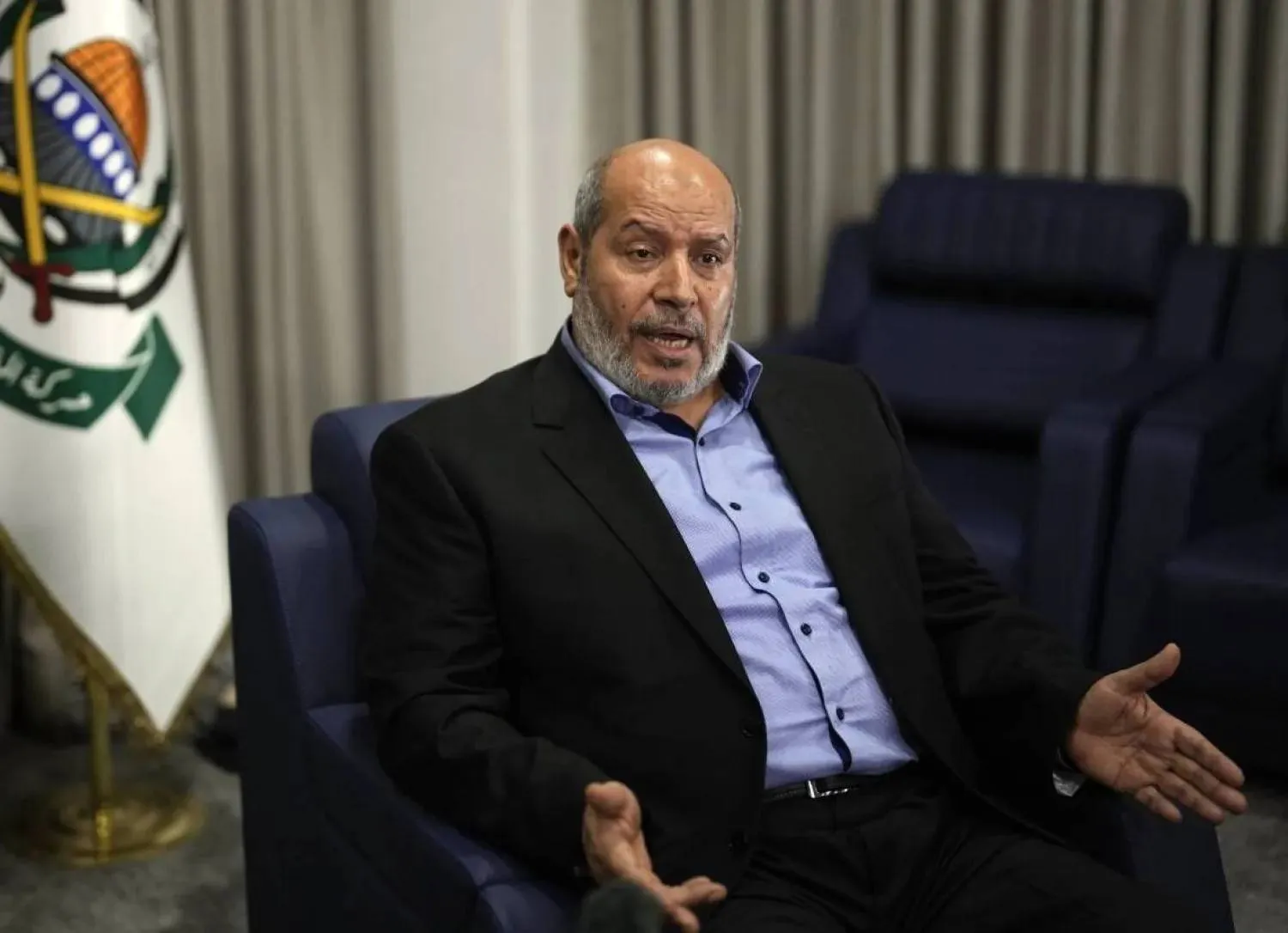

Khalil al-Hayya: Hamas’ Unexpected Leader at a Turning Point

Hamas political bureau chief Khalil al-Hayya (File photo/AP)
TT

Khalil al-Hayya: Hamas’ Unexpected Leader at a Turning Point

Hamas political bureau chief Khalil al-Hayya (File photo/AP)

Before Oct. 7, 2023, Khalil al-Hayya, now about 65, was a prominent figure in Hamas. But few inside or outside the movement saw him as a leading contender for its top job.

“Al-Aqsa Flood” changed that.

The attack reshaped the roles and fortunes of Hamas leaders, along with Gaza and the landscape beyond it. Hayya now heads the movement’s political bureau, steering it through one of the most sensitive turning points in its history.

His victory over Khaled Meshaal, a former Hamas leader and one of its best-known figures, was announced in July. It surprised some outside the movement. Others inside had seen it coming, as leaders from Gaza tightened their hold on key portfolios and senior posts.

When “Al-Aqsa Flood” began, Hayya was deputy to Hamas’ Gaza leader, Yahya Sinwar. He handled contacts with Palestinian factions, UN bodies and mediators over conditions in Gaza and its recurring rounds of escalation with Israel.

Hayya first rose to prominence when Hamas contested the 2006 parliamentary election, before seizing military control of Gaza in 2007.

He moved through leadership posts in Gaza City, then across the territory, before joining the movement’s wider leadership. Along the way, he drew sustained support from commanders of Hamas’ military wing in Gaza, including Ahmed al-Jaabari and Izz al-Din al-Haddad.

Where was he — and what did he know?

Before the Oct. 7 attack, Sinwar asked Hayya and other members of Hamas’ Gaza political bureau to leave the territory to handle specific matters abroad. None knew the full extent of his plans.

Hamas sources told Asharq Al-Awsat that Hayya knew more about some aspects of the attack than other political bureau members.

“But his information was neither complete nor precise. Only Sinwar knew the full details, while commanders in the military wing knew specific elements of the attack,” one source said.

In an interview published in April 2024 by the Hamas-affiliated Palestinian Information Center, Hayya said “the Oct. 7 attacks that ignited the Gaza war were intended to be a limited operation by Hamas to capture a number of soldiers and exchange them for Palestinian prisoners.”

“The Gaza Division of the Zionist army collapsed completely,” he added, referring to the Israeli military.

A senior Hamas source abroad told Asharq Al-Awsat that Hayya knew a relatively large-scale attack was being prepared, but did not know its timing or all its details.

“He was among the leaders who voted in favor of the attack. But everyone who voted believed it would be a limited operation, including Ismail Haniyeh, who was then head of the political bureau,” the source said.

Haniyeh was preparing to travel from Türkiye to Iraq with Hayya, Meshaal and other leaders on their first visit to the country.

Personal losses, a depleted leadership

The bloodshed since Oct. 7 has reached deep into Hayya’s family. Three years of fierce Israeli war have inflicted devastating losses on Gaza — and on Hayya, even while he was abroad.

In May, he mourned his son Azzam, following the death of another son, Hammam, in September. Israel killed them in separate attacks. Two other sons, Hamza and Osama, were killed by Israel in 2008 and 2014, respectively.

A Hamas source inside Gaza said repeated Israeli attacks on Hayya’s home, and the killing of several of his sons, particularly during the latest war, had strengthened his standing and positioned him to lead the movement ahead of other longstanding figures.

Another Hamas source pointed to the gaps left by the killing or absence of senior leaders.

“The assassination of Ismail Haniyeh and Saleh al-Arouri, then Yahya Sinwar’s unexpected death in fighting inside Gaza, the assassination of figures such as Rawhi Mushtaha and Osama al-Mazini, and the absence of others for health reasons, including Mahmoud al-Zahar — all of this made Hayya the most prominent figure available to take on responsibility,” the source said.

Leaders from Gaza also held key posts in the political bureau and Shura Council, the source added.

“This does not diminish Hayya’s own standing. He proved his ability to lead and shoulder responsibility in the many portfolios and posts he held,” the source said.

“He became very close to Ismail Haniyeh in Gaza, and later when he joined him abroad. He also faced previous assassination attempts, most notably in Doha in September 2025, while reviewing a US ceasefire proposal with other leaders.”

Hayya’s consistent backing for Sinwar’s plans, inside and outside the movement, also broadened his support, the source said — particularly among Sinwar’s close associates and supporters, and the leadership of the Qassam Brigades.

The Qassam leadership in Gaza backed Hayya for the top job and pushed for his election.

“They saw him as an important choice representing Gaza’s leadership, which they believed should be honored and continue to lead the movement after leading the ‘Al-Aqsa Flood’ battle and sacrificing its senior leaders,” the source said.

Ties with Iran

Within Hamas and among Palestinian factions, Hayya is known for backing Sinwar’s drive, supported by the Qassam leadership, to rebuild ties with the so-called “axis of resistance,” particularly Iran.

That appears to have been a key factor in his growing influence. He handled contacts with Syria’s former government and visited Damascus to meet Bashar al-Assad in October 2022 — the first visit by a Hamas official since the movement left in 2012 amid mounting popular protests against Assad’s rule.

A senior source from Gaza said the territory’s political and military leaders agreed on the need to restore relations with Iran.

Hayya and Sinwar threw their weight behind renewed ties with Tehran, backed overwhelmingly by the Qassam Brigades’ longstanding leadership, from Mohammed Deif and Mohammed Sinwar to all members of its military council.

Some within Hamas supported the move with reservations, a source abroad said.

“There were voices that backed this step cautiously, given the difficulties the movement had faced in its relationship with Iran at certain times, and demands that it support Iran-aligned parties in other arenas,” the source said.

“The movement rejected this and insisted on the independence of its positions.”

Hayya’s path as Hamas leader is strewn with thorns.

In Gaza, he must work to end the war and confront immense humanitarian pressures after the killing of more than 70,000 people and the occupation of more than 60% of the territory.

That task carries a price. He is negotiating through mediators with Israel, which says it will not compromise on disarming Gaza — a demand that would mark one of the most consequential shifts in Hamas’ history.

Hayya and Hamas face a difficult equation: preserving the movement’s existence and cohesion while confronting the possible loss of its weapons, one of its strongest sources of leverage.

The path to political participation is also obstructed. Hamas would need to abide by the Palestinian Authority’s agreements with Israel, a red line for the movement.

Hayya’s rise was a striking and unexpected shift. His tenure now brings a further test, one likely to determine his own fate and the course of the movement he leads.



Netanyahu Dismisses Claims That Israel Is Blocking Supplies to Gaza

A Palestinian child sits beside a pool of rainwater at a camp for displaced people in Deir al-Balah in the central Gaza Strip, Saturday, Nov. 7, 2026. (AP)
TT

Netanyahu Dismisses Claims That Israel Is Blocking Supplies to Gaza

A Palestinian child sits beside a pool of rainwater at a camp for displaced people in Deir al-Balah in the central Gaza Strip, Saturday, Nov. 7, 2026. (AP)

Netanyahu said Israel was not to blame for the worsening conditions for Palestinians in Gaza’s tent camps that have been hit with severe winter floods.

His remarks came after the US-created Board of Peace — established under US President Donald Trump's plan to end the Israel-Hamas war and oversee Gaza’s recovery — said Monday that Israel's delaying of the entry of winter supplies into Gaza had “exacerbated the consequences of a foreseeable humanitarian challenge.”

Torrential rain has battered the war-torn enclave in recent days, damaging tens of thousands of makeshift tents. Four people, including three children, were killed on Sunday when a large sandstone slab collapsed onto tents during the rains.

Netanyahu said the Palestinian group Hamas is to blame because it continues to refuse to disarm, a condition of the deal announced by Trump, and seizes humanitarian aid in order to use it for military purposes.

“Hamas alone is responsible for the suffering of the people of Gaza, and it is now cynically exploiting that suffering to shift blame onto Israel once again,” he said Tuesday.

British Foreign Secretary Ed Miliband said the situation in Gaza was “intolerable” and demanded Israel end “arbitrary restrictions” on aid.

In Washington, Sen. Brian Schatz of Hawaii, the top Democrat on the Senate's foreign spending subcommittee, called for Israel to immediately allow winter gear into Gaza.

“There are a lot of challenges when it comes to Israel and Palestine that are complicated, and fraught, and contentious,” Schatz said on the Senate floor on Tuesday. “But we should all be able to agree that repairing torn tents and helping people to dry out, and providing warmth to freezing children is a basic human obligation.”


Representatives of 3 Countries Receive Families of ISIS Fighters from Syria’s Roj Camp

Women and their children at the Roj camp in Syria. (AFP file)
TT

Representatives of 3 Countries Receive Families of ISIS Fighters from Syria’s Roj Camp

Women and their children at the Roj camp in Syria. (AFP file)

Representatives of Sudan, Somalia and Indonesia have received another group of their nationals from the Roj camp in Syria’s northeastern Hasakah province, the country’s last remaining camp housing families of ISIS fighters.

The handover took place three days ago during a visit by the foreign representatives, accompanied by Syrian government officials and members of the Internal Security Forces, according to a local activist.

The repeated visits by government security delegations suggest that Damascus is preparing to take over administration of the facility from the dissolved Kurdish Syrian Democratic Forces (SDF), the activist said.

Ibrahim al-Halabi, a resident of Hasakah, told Asharq Al-Awsat that the delegation met women living at the site who described their circumstances.

Located in the far northeast of Hasakah province, Roj houses around 2,200 women and children in 750 tents. Its residents hold various foreign and Arab nationalities, including Turkish, Russian, British, French, German, Australian, Indonesian, Sudanese, Somali and Tunisian citizenship. It became Syria’s last remaining camp for families of ISIS fighters following the closure of al-Hol, also in the Hasakah countryside.

Several groups of Sudanese, Somali and Indonesian nationals have already been repatriated since 2022.

According to Halabi, the latest handover included 12 Indonesian women and their children, 30 Somali women and between three and nine Sudanese women.

Dual citizenship complicates repatriation

Halabi explained that Sudanese and Somali nationals repatriated in previous operations held only one nationality. Others, however, have dual citizenship, including Sudanese-British and Somali-British nationals, complicating efforts to arrange their return.

Some women have refused to be handed over to Sudanese authorities, demanding instead that they be transferred to the British government. As a result, Sudanese and Somali women holding dual nationality have yet to be repatriated, Halabi noted.

He added that Syrian government Internal Security Forces had entered Roj several times recently, during which residents from Australia, Sudan, Somalia, Indonesia and Trinidad and Tobago were transferred out.

The latest visit brought considerable relief to residents.

Halabi also viewed the visits as a sign that Damascus would assume responsibility for managing the facility. However, he expected security arrangements to remain under the supervision of former SDF personnel integrated into the government’s Internal Security Forces under the January 2026 agreement between Damascus and the Kurdish-led force.

Roj's future

In February, the Syrian government took control of al-Hol, previously the country’s largest detention camp for families of ISIS fighters, after wresting it from the SDF, which had administered both facilities.

Al-Hol, described as the world’s most dangerous camp, had housed tens of thousands of families of various nationalities.

Following its takeover, Damascus began evacuating foreign residents and transferring them to another camp in the northern Aleppo province.

With al-Hol closed, Roj emerged as the most prominent remaining facility housing women and widows of ISIS members from different countries.

However, activists in northern Syria say it remains unclear when the camp will close or where its residents will be transferred afterward.


Iraq Reopens One Border Crossing with Iran, Closes Another as It Pursues Mediation

Iraqi Prime Minister Ali al-Zaidi. (INA)
TT

Iraq Reopens One Border Crossing with Iran, Closes Another as It Pursues Mediation

Iraqi Prime Minister Ali al-Zaidi. (INA)

Iraqi Foreign Minister Fuad Hussein confirmed Tuesday that Prime Minister Ali al-Zaidi’s secret visit to Iran was aimed at bringing Tehran and Washington closer together, as Baghdad reopened one border crossing with Iran and announced the temporary closure of another.

Speaking to the Iraqi News Agency (INA) on the sidelines of the Paris Peace Forum, Hussein described the visit as “an attempt to bring the Iranian and American positions closer together, alongside other efforts.”

He stressed Iraq’s interest in easing tensions, citing the economic impact of the closure of the Strait of Hormuz and casualties from the US war on Iran.

“We have strong relations with our neighbor Iran, as well as excellent relations with the United States,” Hussein said. “That is why Iraq can play this role, although other countries are also doing so.”

Request for time

A senior Iraqi government official told Asharq Al-Awsat that al-Zaidi had conveyed an American message to Tehran outlining a possible formula for resolving the conflict between the two countries.

The Iranian side, however, requested more time to respond, according to the official.

A source familiar with the visit confirmed to Iran’s Fars News Agency that al-Zaidi had traveled to Tehran last Friday for several hours and met Mohammad Bagher Ghalibaf, Iran’s parliament speaker and head of its negotiating delegation.

The agency reported that talks focused exclusively on Baghdad’s efforts to end the war.

Despite repeated official statements presenting the visit as a mediation effort, a source close to Iraq’s Coordination Framework suggested it might instead have been motivated by domestic concerns.

“Al-Zaidi’s recent policies, particularly the ban on Iranian flights and the closure of some border crossings, have caused considerable harm to Iran,” the source told Asharq Al-Awsat.

The visit may therefore have been intended to explain Baghdad’s position on those measures and avoid angering Tehran, it added.

It pointed to the recent public confrontation between al-Zaidi and Kataib Hezbollah, warning that tensions could lead to a direct clash. Given its influence and close ties with some armed factions, Tehran could help ease the dispute.

Regional role

Ihssan Shmary, an academic and head of the Political Thinking Center, believes al-Zaidi’s visit was primarily part of his efforts to establish a regional diplomatic role through an initiative he had previously presented to US President Donald Trump.

Speaking to Asharq Al-Awsat, Shmary said that the trip coincided with extensive Arab and regional efforts to reduce tensions and prevent renewed fighting between Washington and Tehran.

He described the trip as an attempt to break the deadlock between the two countries and secure a foreign policy achievement for Iraq.

Nevertheless, he questioned Baghdad’s ability to bring Washington and Tehran to the negotiating table.

“Iraq may be very far from being able to play the role of a country that brings the US and Iran together at a table of understanding,” he cautioned.

Al-Sheeb reopens, Mandali closes

In a separate development, Omar al-Waeli, head of Iraq’s Border Ports Authority, announced Tuesday the reopening of the al-Sheeb crossing with Iran, which had been closed since October 21.

Authorities also decided to temporarily close the Mandali crossing in the Diyala province beginning Friday.

Al-Waeli explained that al-Sheeb would resume operations following completion of the required technical procedures, while Mandali’s closure would allow similar technical requirements to be addressed.

The decisions followed earlier remarks by Foreign Minister Hussein revealing that the US Treasury Department had formally requested Baghdad to close all its border crossings with Iran except two.

Ban on Iranian flights remains in place

Meanwhile, Iran’s Football Federation announced Tuesday that Iraq had refused permission for a direct flight carrying the Iranian national team to land at Basra airport.

The team was scheduled to participate in a friendly tournament alongside Iraq, Lebanon and Palestine.

Iran’s Mehr News Agency quoted the federation as blaming obstacles imposed by the Iraqi government, particularly its refusal to authorize a direct flight to Basra.

As a result, the players traveled to the Iranian city of Abadan, from where they would continue to Basra by road.

An Iraqi Transport Ministry official told Asharq Al-Awsat that Iranian aircraft were permitted to land only at Najaf airport.

The Iranian side had chosen to fly the team to Abadan because it was closer to the stadium in Basra, the official explained.

He confirmed that Iraq remained committed to its ban on Iranian flights landing at Iraqi airports, with Najaf as the sole exception, to avoid US Treasury sanctions.