


Condemnation in Sweida as Hijri Followers Rally for Israel on Oct. 7 Anniversary

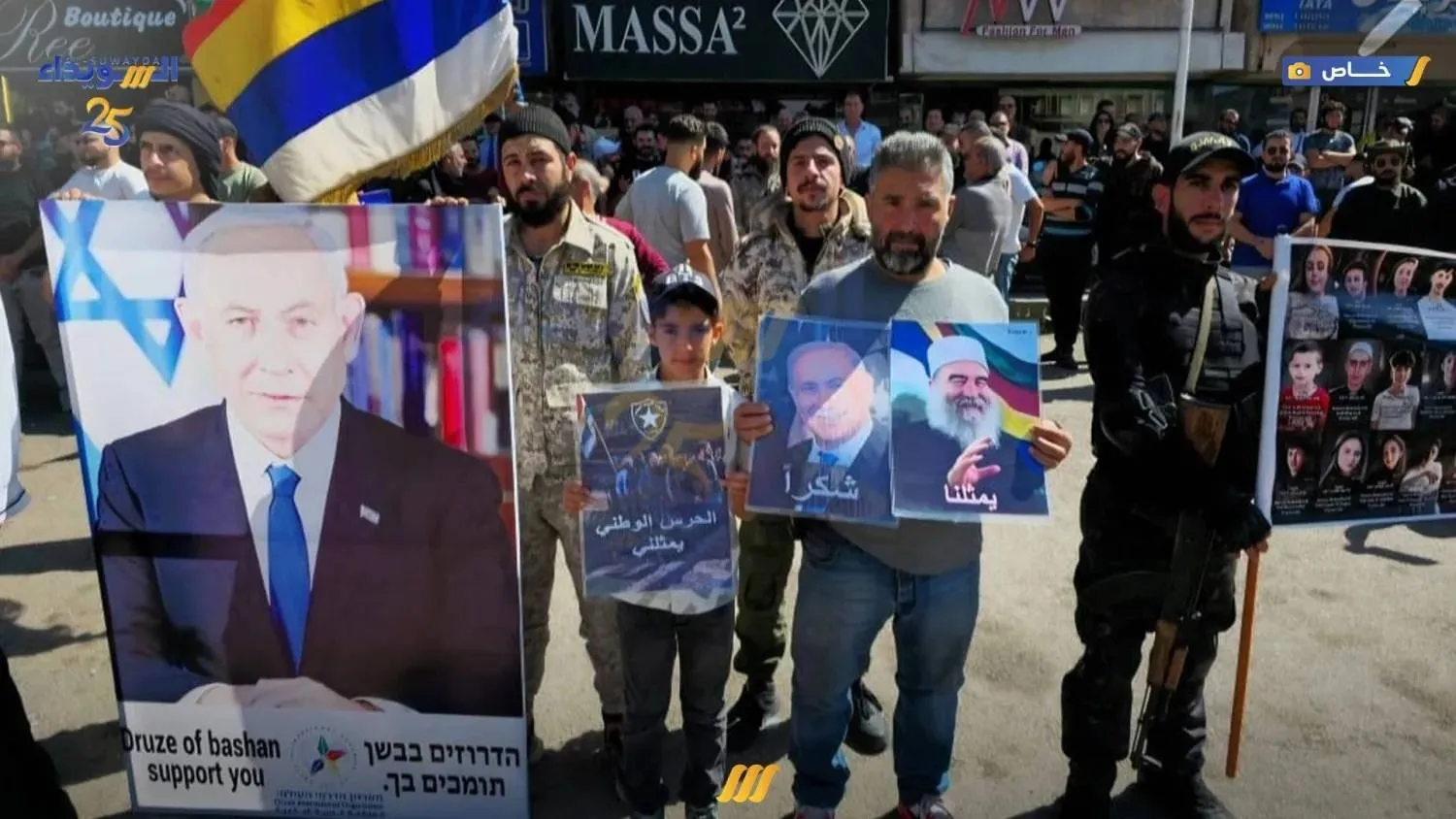
A rally in Sweida’s al-Sayr Square, formerly al-Karama Square, in solidarity with Israel and Netanyahu on the anniversary of the Oct. 7 attacks. (Pro-Hijri websites)
TT

Condemnation in Sweida as Hijri Followers Rally for Israel on Oct. 7 Anniversary

A rally in Sweida’s al-Sayr Square, formerly al-Karama Square, in solidarity with Israel and Netanyahu on the anniversary of the Oct. 7 attacks. (Pro-Hijri websites)

Sources in Syria’s predominantly Druze province of Sweida condemned rallies held by followers of Druze spiritual leader Sheikh Hikmat al-Hijri on Wednesday in solidarity with Israel on the anniversary of the Oct. 7 attacks.

A Druze figure mediating between the Syrian government and the Druze told Asharq Al-Awsat that an alternative to Hijri’s movement had been formed.

Demonstrators and a car procession in Sweida city displayed Israeli flags and portraits of Israeli Prime Minister Benjamin Netanyahu and Hijri, whose affiliated “National Guard” controls much of the province, including the city. Hijri previously announced what he called the “State of Bashan.”

The rallies marked the anniversary of the Oct. 7, 2023, attacks that triggered the Gaza war.

Sources in Sweida city described participants as “Hijri’s thugs,” telling Asharq Al-Awsat the events were another way of throwing themselves into Israel’s arms. Solidarity, they said, would have been better directed toward the thousands of children Israel has killed in Gaza.

Separately, a Druze source mediating an end to Sweida’s crisis, which has persisted since the bloody events of July 2025, said an “Emergency Committee” had 15 members and a broad advisory body representing families, sheikhs, academics and cultural figures in the province.

The source requested anonymity to protect the mediation’s confidentiality at this stage and the safety of those involved.

The committee brings together Druze figures living in Sweida, elsewhere in Syria and abroad, the source said.

A Syrian-led solution

The government and Sweida residents share a tacit understanding that Hijri has become part of the problem and is no longer part of the solution, the source said.

Both sides agree in principle that “any solution must be Syrian-led. There will be no compromise on that.”

The source said Sweida residents knew the government had accepted almost all their demands before the July 2025 events and remained ready to offer more to safeguard their security and dignity.

Both sides share the same interests, the source said: preserving Syrian sovereignty over all its territory and ensuring the Druze have a voice in national decisions, particularly those affecting their areas.

But the source faulted the government for sidelining strong, patriotic Druze figures who disagreed with it on some aspects of how to resolve Sweida’s crisis.

“The Syrian government backed figures from the province whom the Druze see as unable to truly represent them and firmly demand their rights from Damascus,” the source said. “It therefore failed to engage with leaders who represent the community’s concerns, interests and fears.”

The government must correct that, the source said, and work with Druze figures who are “neither agents of foreign powers nor subservient to the government, and who firmly defend the interests of both the country and the community.”

“There is considerable hope of resolving Sweida’s crisis, but the problem lies with Israel,” the source said. “The two issues are closely linked. They must be separated, and Sweida’s crisis resolved through a Syrian-led solution.”

Mediation now centers on what the government will offer and what Sweida residents will accept. The government has responded positively to the demands, the source said.

The two sides broadly agree that their interests as Syrians are inseparable: what harms the Druze harms Syria, and what harms Syria harms the Druze.

But progress hinges on how to deal with those blocking any solution in the province — the leaders of the “Security Office,” run by Hijri’s son Salman, the source said.

The security obstacle

Many solutions are on the table, the source said. Agreement will come when mediation gives way to direct negotiations at the same table.

“The talks have shown that the political and social issues have been resolved, with understandings reached on many matters,” the source said. “The only remaining obstacle is purely a security one: who will deal with the ‘thugs,’ and how to support and strengthen that patriotic group with funding, equipment and media backing.”

For the committee to go public, the source said, the influence of those “the U.S. envoy and the international community have described as gangs” must end.

“That is the problem now being examined, and this is where the Israeli factor comes in.”

The source added, however, that “Israel has sent no financial support to Hijri since the beginning of 2026.”

The United States is putting enormous pressure on Israel over Syria as a whole, the source said, with Sweida only a small part of Syrian-US-Israeli relations.

The source repeatedly distinguished between those described as “gangs and thugs” and those whose hands were not stained by treason, direct collaboration with foreign powers or collusion against the country. The latter would have a place in Sweida and, in the future, in state institutions.

Rifts within the “National Guard”

Signs of growing divisions among “National Guard” factions emerged when Bassem Abu Fakhr, a leader of the Men of Dignity Movement, accused Hijri and his supporters of dragging Sweida’s residents into a “project of bloodshed,” without naming them.

The movement is one of Sweida’s largest local armed factions, with an estimated 8,000 fighters.

“They dragged people into a project of bloodshed and mobilized hundreds of accounts to provoke others, promote the vilest people and smear honorable ones, until they turned truth into falsehood and falsehood into truth in the minds of those they had misled,” Abu Fakhr wrote on Facebook.

Asharq Al-Awsat learned that families belonging to the Abu Fakhr clan were asked to disavow the statements made in their name in the post. Most refused.



Lebanon's Hezbollah Gets $200 million from Iran to Help Displaced

Supporters of Hezbollah wave flags of the group during a ceremony held to mark the second anniversary of the killing of leader Hassan Nasrallah in a strike by Israel, in Beirut's southern suburbs on September 27, 2026.  (Photo by Anwar AMRO / AFP) /
Supporters of Hezbollah wave flags of the group during a ceremony held to mark the second anniversary of the killing of leader Hassan Nasrallah in a strike by Israel, in Beirut's southern suburbs on September 27, 2026. (Photo by Anwar AMRO / AFP) /
TT

Lebanon's Hezbollah Gets $200 million from Iran to Help Displaced

Supporters of Hezbollah wave flags of the group during a ceremony held to mark the second anniversary of the killing of leader Hassan Nasrallah in a strike by Israel, in Beirut's southern suburbs on September 27, 2026.  (Photo by Anwar AMRO / AFP) /
Supporters of Hezbollah wave flags of the group during a ceremony held to mark the second anniversary of the killing of leader Hassan Nasrallah in a strike by Israel, in Beirut's southern suburbs on September 27, 2026. (Photo by Anwar AMRO / AFP) /

Hezbollah has received $200 million from Iran to help Lebanese displaced by this year’s war with Israel, two people with direct knowledge of the transfer said, the first significant aid from the group to supporters who bore the brunt of the conflict.

Hezbollah received the cash last month despite a tightening US economic chokehold on Iran and increasing difficulties in getting funds to Tehran's Lebanese ally, said the people.

Intermediaries who moved the money charged a 20% fee, reflecting the risks of dealing with the group, they said. One said this was four times the normal fee.

Asked for comment, a Hezbollah official said an amount had been secured and a plan for distributing it would be announced in the coming days, without elaborating on the source of the funds.


Sisi Seeks to Boost Strategic Cooperation During Asia Tour

Egyptian President Abdel Fattah al-Sisi received his South Korean counterpart in Cairo last November. (Egyptian Presidency)
TT

Sisi Seeks to Boost Strategic Cooperation During Asia Tour

Egyptian President Abdel Fattah al-Sisi received his South Korean counterpart in Cairo last November. (Egyptian Presidency)

Egyptian President Abdel Fattah al-Sisi has begun an Asian tour taking him to South Korea, Malaysia and Indonesia as Cairo seeks to deepen strategic cooperation with Asian countries amid turmoil in the Middle East.

The trip will focus heavily on strengthening economic partnerships, according to experts, who point to presidential diplomacy as an important tool in attracting major foreign investment to Egypt in recent years. Cairo is also seeking to draw high-tech industries from the three countries.

Sisi headed to South Korea on Tuesday on the first leg of his tour, which will also take him to Malaysia and Indonesia.

The Egyptian presidency said Sisi would hold talks with his South Korean counterpart, Lee Jae Myung, and take part in a roundtable with executives and representatives of major Korean companies.

Lee visited Cairo last November, his first trip to Egypt since taking office in June of that year.

Egypt has sought to strengthen ties with East Asian countries through bilateral visits and participation in multilateral forums. Among those efforts was Foreign Minister Badr Abdelatty’s participation in meetings of the Association of Southeast Asian Nations (ASEAN) in Manila in late July.

At the time, Egypt’s Foreign Ministry described the participation as part of a diplomatic drive to develop relations with ASEAN members and broaden political, economic and development cooperation.

Former Egyptian Assistant Foreign Minister Gamal Bayoumi views Sisi’s visit to Asia as an extension of Egypt’s foreign policy approach of diversifying relations with international partners.

“The visit has political and economic objectives, particularly in light of regional developments and their repercussions for the economies of countries in the region,” Bayoumi told Asharq Al-Awsat.

He expects the trip to bolster economic partnerships with East Asian countries, whose large markets offer significant trade opportunities. Their advanced manufacturing technologies also create scope for investment partnerships with Egypt, he added.

Bayoumi pointed to Al-Azhar as another asset in Cairo’s relations with the region, given the ties many citizens of these countries have with education at the Egyptian institution.

Official figures show trade between Egypt and South Korea reached $995.3 million from January through September 2025, down from $1.2 billion during the same period in 2024.

South Korean investment in Egypt totaled $413.8 million in the 2024/2025 fiscal year, compared with $288.3 million the previous year.

The Egyptian government is seeking to attract more industrial investment from Asian countries, including South Korea, according to Walid Gaballah, a member of the Egyptian Society for Political Economy, Statistics and Legislation.

While Cairo enjoys political coordination with these countries, Gaballah argued that economic cooperation has yet to match the level of political ties.

He stressed that a country such as South Korea possesses advanced manufacturing technology that could be localized in Egyptian industrial zones, including the Suez Canal Economic Zone.

Gaballah told Asharq Al-Awsat that Egypt’s presidential diplomacy had played a significant role in attracting major investments in recent years.

He added that economic issues are therefore expected to take priority during Sisi’s visits to the three Asian countries, particularly given the potential of their economies as Cairo looks to diversify its partnerships.


Khalil al-Hayya: Hamas’ Unexpected Leader at a Turning Point

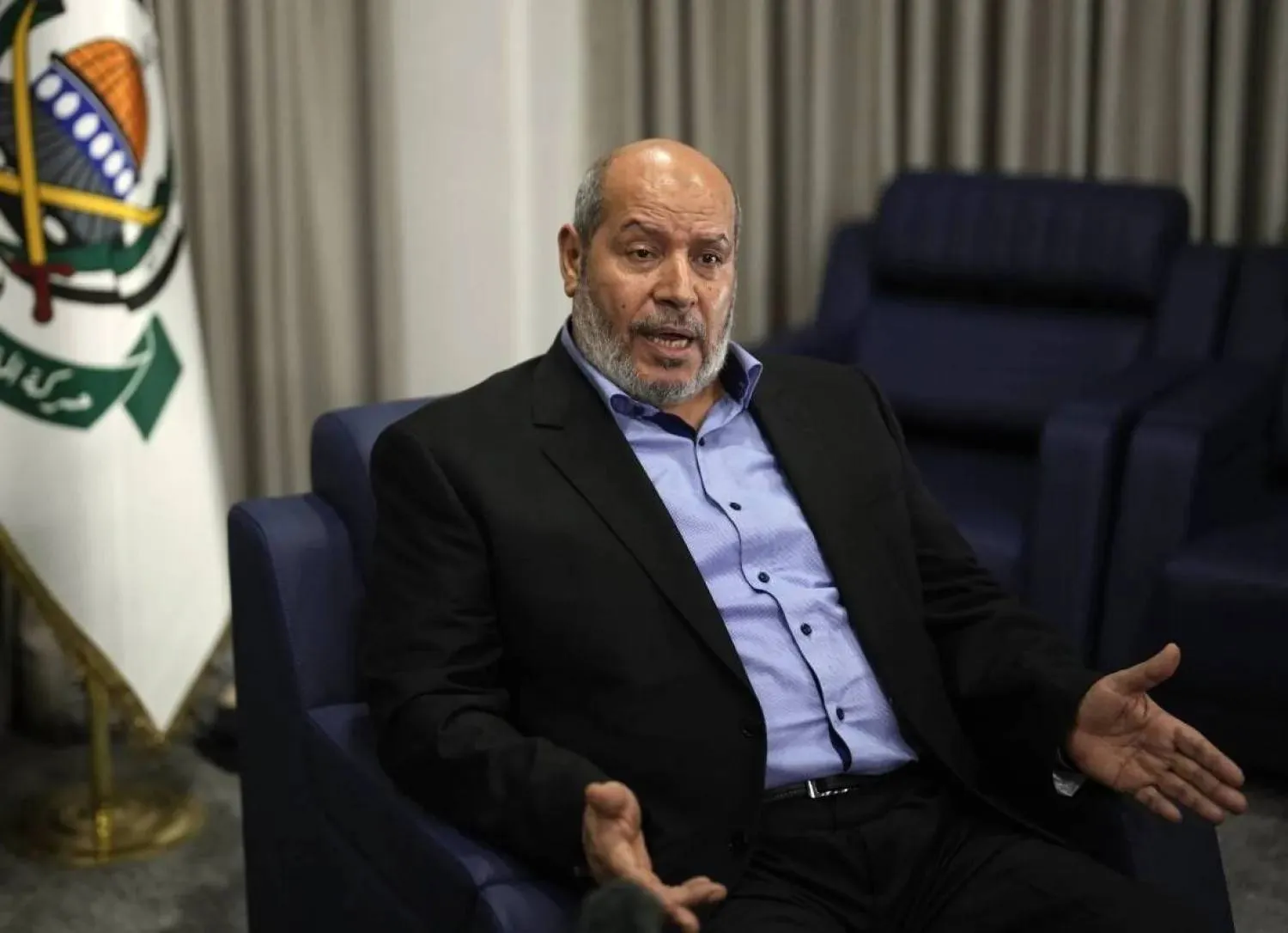
Hamas political bureau chief Khalil al-Hayya (File photo/AP)
TT

Khalil al-Hayya: Hamas’ Unexpected Leader at a Turning Point

Hamas political bureau chief Khalil al-Hayya (File photo/AP)

Before Oct. 7, 2023, Khalil al-Hayya, now about 65, was a prominent figure in Hamas. But few inside or outside the movement saw him as a leading contender for its top job.

“Al-Aqsa Flood” changed that.

The attack reshaped the roles and fortunes of Hamas leaders, along with Gaza and the landscape beyond it. Hayya now heads the movement’s political bureau, steering it through one of the most sensitive turning points in its history.

His victory over Khaled Meshaal, a former Hamas leader and one of its best-known figures, was announced in July. It surprised some outside the movement. Others inside had seen it coming, as leaders from Gaza tightened their hold on key portfolios and senior posts.

When “Al-Aqsa Flood” began, Hayya was deputy to Hamas’ Gaza leader, Yahya Sinwar. He handled contacts with Palestinian factions, UN bodies and mediators over conditions in Gaza and its recurring rounds of escalation with Israel.

Hayya first rose to prominence when Hamas contested the 2006 parliamentary election, before seizing military control of Gaza in 2007.

He moved through leadership posts in Gaza City, then across the territory, before joining the movement’s wider leadership. Along the way, he drew sustained support from commanders of Hamas’ military wing in Gaza, including Ahmed al-Jaabari and Izz al-Din al-Haddad.

Where was he — and what did he know?

Before the Oct. 7 attack, Sinwar asked Hayya and other members of Hamas’ Gaza political bureau to leave the territory to handle specific matters abroad. None knew the full extent of his plans.

Hamas sources told Asharq Al-Awsat that Hayya knew more about some aspects of the attack than other political bureau members.

“But his information was neither complete nor precise. Only Sinwar knew the full details, while commanders in the military wing knew specific elements of the attack,” one source said.

In an interview published in April 2024 by the Hamas-affiliated Palestinian Information Center, Hayya said “the Oct. 7 attacks that ignited the Gaza war were intended to be a limited operation by Hamas to capture a number of soldiers and exchange them for Palestinian prisoners.”

“The Gaza Division of the Zionist army collapsed completely,” he added, referring to the Israeli military.

A senior Hamas source abroad told Asharq Al-Awsat that Hayya knew a relatively large-scale attack was being prepared, but did not know its timing or all its details.

“He was among the leaders who voted in favor of the attack. But everyone who voted believed it would be a limited operation, including Ismail Haniyeh, who was then head of the political bureau,” the source said.

Haniyeh was preparing to travel from Türkiye to Iraq with Hayya, Meshaal and other leaders on their first visit to the country.

Personal losses, a depleted leadership

The bloodshed since Oct. 7 has reached deep into Hayya’s family. Three years of fierce Israeli war have inflicted devastating losses on Gaza — and on Hayya, even while he was abroad.

In May, he mourned his son Azzam, following the death of another son, Hammam, in September. Israel killed them in separate attacks. Two other sons, Hamza and Osama, were killed by Israel in 2008 and 2014, respectively.

A Hamas source inside Gaza said repeated Israeli attacks on Hayya’s home, and the killing of several of his sons, particularly during the latest war, had strengthened his standing and positioned him to lead the movement ahead of other longstanding figures.

Another Hamas source pointed to the gaps left by the killing or absence of senior leaders.

“The assassination of Ismail Haniyeh and Saleh al-Arouri, then Yahya Sinwar’s unexpected death in fighting inside Gaza, the assassination of figures such as Rawhi Mushtaha and Osama al-Mazini, and the absence of others for health reasons, including Mahmoud al-Zahar — all of this made Hayya the most prominent figure available to take on responsibility,” the source said.

Leaders from Gaza also held key posts in the political bureau and Shura Council, the source added.

“This does not diminish Hayya’s own standing. He proved his ability to lead and shoulder responsibility in the many portfolios and posts he held,” the source said.

“He became very close to Ismail Haniyeh in Gaza, and later when he joined him abroad. He also faced previous assassination attempts, most notably in Doha in September 2025, while reviewing a US ceasefire proposal with other leaders.”

Hayya’s consistent backing for Sinwar’s plans, inside and outside the movement, also broadened his support, the source said — particularly among Sinwar’s close associates and supporters, and the leadership of the Qassam Brigades.

The Qassam leadership in Gaza backed Hayya for the top job and pushed for his election.

“They saw him as an important choice representing Gaza’s leadership, which they believed should be honored and continue to lead the movement after leading the ‘Al-Aqsa Flood’ battle and sacrificing its senior leaders,” the source said.

Ties with Iran

Within Hamas and among Palestinian factions, Hayya is known for backing Sinwar’s drive, supported by the Qassam leadership, to rebuild ties with the so-called “axis of resistance,” particularly Iran.

That appears to have been a key factor in his growing influence. He handled contacts with Syria’s former government and visited Damascus to meet Bashar al-Assad in October 2022 — the first visit by a Hamas official since the movement left in 2012 amid mounting popular protests against Assad’s rule.

A senior source from Gaza said the territory’s political and military leaders agreed on the need to restore relations with Iran.

Hayya and Sinwar threw their weight behind renewed ties with Tehran, backed overwhelmingly by the Qassam Brigades’ longstanding leadership, from Mohammed Deif and Mohammed Sinwar to all members of its military council.

Some within Hamas supported the move with reservations, a source abroad said.

“There were voices that backed this step cautiously, given the difficulties the movement had faced in its relationship with Iran at certain times, and demands that it support Iran-aligned parties in other arenas,” the source said.

“The movement rejected this and insisted on the independence of its positions.”

Hayya’s path as Hamas leader is strewn with thorns.

In Gaza, he must work to end the war and confront immense humanitarian pressures after the killing of more than 70,000 people and the occupation of more than 60% of the territory.

That task carries a price. He is negotiating through mediators with Israel, which says it will not compromise on disarming Gaza — a demand that would mark one of the most consequential shifts in Hamas’ history.

Hayya and Hamas face a difficult equation: preserving the movement’s existence and cohesion while confronting the possible loss of its weapons, one of its strongest sources of leverage.

The path to political participation is also obstructed. Hamas would need to abide by the Palestinian Authority’s agreements with Israel, a red line for the movement.

Hayya’s rise was a striking and unexpected shift. His tenure now brings a further test, one likely to determine his own fate and the course of the movement he leads.