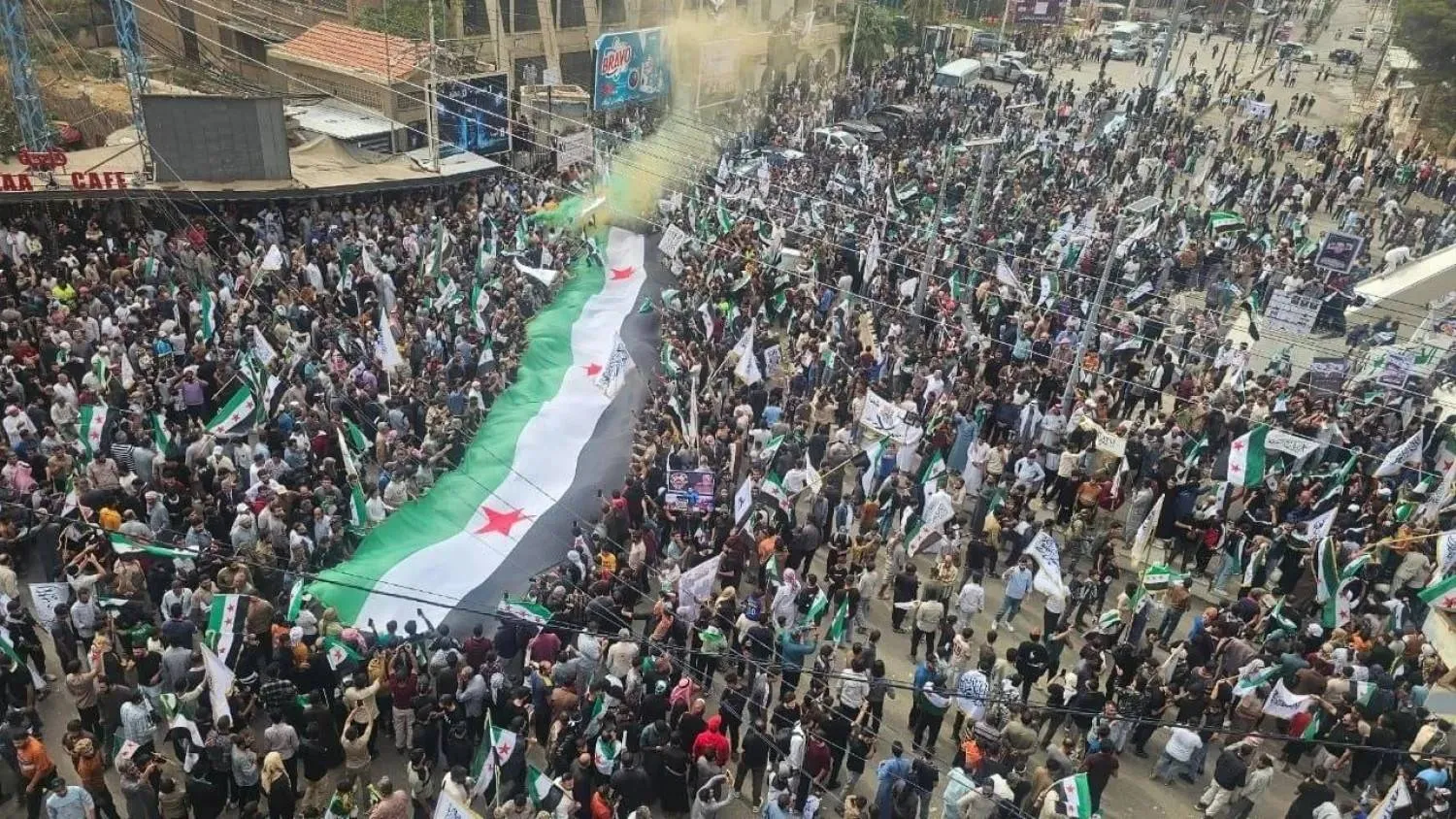
Mass Protests in Hasakah Under ‘Friday of the Syrian Flag’ Banner

The Syrian flag at a protest in Hasakah (Social media)
TT

Mass Protests in Hasakah Under ‘Friday of the Syrian Flag’ Banner

The Syrian flag at a protest in Hasakah (Social media)

Thousands of residents of Syria’s Hasakah province rallied after Friday prayers to demand state authority across the province and the release of detainees and people forcibly disappeared in prisons run by the dissolved Syrian Democratic Forces (SDF).

In scenes described as the “greatest celebration” and the “Hasakah flood,” protesters gathered in Freedom Square in the city center under the slogan “Friday of the Syrian Flag.”

They called for state sovereignty and a stronger presence for its institutions, a day after the national flag was raised on the square’s tallest flagpole before a large gathering of residents and officials.

The protests capped a week of rapid developments in Hasakah over the implementation of a Jan. 29, 2026, agreement between the Syrian government and the SDF.

The deal called for the former Kurdish Autonomous Administration’s civilian, security and military institutions to be integrated into state structures.

Arabs, who make up the province’s population majority, have complained that the SDF remains dominant despite its announced dissolution in late August.

Residents began arriving early in the morning from Hasakah’s al-Aziziya, al-Kallasa and al-Nashwa neighborhoods and from other towns, including al-Shaddadi, Markada, al-Hol and al-Arisha.

They gathered outside Abu Bakr al-Siddiq Mosque in Ghweiran before marching after Friday prayers to the city’s main square, known as Liberation Square, carrying Syrian national flags.

Government internal security forces reinforced their presence across the city from midnight Thursday to protect protesters, residents and public and private property. The deployment followed indiscriminate gunfire by “outlaw” gunmen in several neighborhoods.

Activists accused a Kurdish group referred to as “Revolutionary Popular” of stirring tensions to impose a curfew and block the demonstrations. Internal security forces restored calm that night, Syria’s Al-Ikhbariya television channel reported.

Protesters carried national flags, photographs of SDF detainees and pictures of “martyrs of the Syrian revolution.”

They chanted, “One, one ... the Syrian people are one,” seeking to reassure the province’s Arab, Kurdish and Christian communities that all were subject to the law and equal in rights and duties.

Their demands included extending state sovereignty and authority across Hasakah, restoring state institutions and making them operational, releasing detainees forcibly disappeared in SDF prisons, and allowing their sons to join the internal security forces. They also called for an end to the province’s dual authorities and the presence of Revolutionary Youth.

Videos posted on social media showed protesters removing Kurdistan Workers’ Party (PKK) and SDF flags and banners from streets and buildings.

Sohaib al-Yaarubi, an activist from the province’s Arab tribes and one of those who called for the protests, said the message was clear: the overwhelming majority in Hasakah supported the Syrian state, wanted its sovereignty extended across the province and wanted only the flag of the Syrian Arab Republic flown there.

Yaarubi told Asharq Al-Awsat the demonstrations were “successful” and the demands “patriotic and legitimate.” He said there were no tensions or provocations apart from one incident involving Revolutionary Youth members, which protesters defused.

Ibrahim al-Halabi, another activist from the province’s Arab tribes, described the crowds in Liberation Square as “awe-inspiring, beautiful and truly wonderful.” The peaceful demonstrations lasted about two hours.

He said the raising of the national flag brought overwhelming joy, stirring emotions that recalled the early days of the Syrian revolution against the former government in 2011.

“Some described the demonstrations and the crowds in Liberation Square as the greatest celebration in Hasakah, a city denied the chance to celebrate the victory achieved when the ousted government fell nearly two years ago,” Halabi said.

Delegations from other provinces, including Deir Ezzor, joined the Hasakah protests.

Similar demonstrations took place in several provinces in support of its residents’ demands.

The Friday rallies followed Thursday’s raising of the national flag on the tallest flagpole in central Hasakah before a large gathering of residents and officials. Government officials also inspected the courthouse to “create suitable conditions for making the judicial system operational.”

Internal security forces had deployed around the courthouse after members of the dissolved SDF vacated their positions there, while the government strengthened its security presence across the city.

On Tuesday, the SDF’s counterterrorism forces had handed over their positions to internal security forces.

Maj. Gen. Abdul Qader Tahhan, head of Syria’s General Intelligence Service, and Brig. Gen. Abdul Rahman al-Dabbagh, head of foreign intelligence, subsequently arrived in Hasakah with a large security delegation.

The developments followed mass peaceful protests after prayers the previous Friday in several towns and cities across Hasakah province, demanding state authority and a stronger presence for its institutions throughout the province.


UN Demands Probe into Death of Its Employee in Houthi Custody

Armed Yemeni supporters of the Iran-backed Houthis brandish their weapons during a protest against US strikes on Iran in Sanaa on July 10, 2026. (AFP via Getty Images)
TT

UN Demands Probe into Death of Its Employee in Houthi Custody

Armed Yemeni supporters of the Iran-backed Houthis brandish their weapons during a protest against US strikes on Iran in Sanaa on July 10, 2026. (AFP via Getty Images)

The United Nations on Saturday condemned the "heartbreaking" death of one of its employees in Yemen under custody of the Houthis and demanded an inquiry.

Mohammad al-Shami, a staff member of the UN Human Rights Office in Yemen, had been "arbitrarily held" by the Houthis since June 2024, the organization said in a statement.

It cited his family as saying he had died more than a month ago but that his relatives had only been recently informed.

The UN High Commissioner for Human Rights, Volker Turk, said in the statement that no explanation had been given for the "heartbreaking loss".

The statement said Turk "demanded full transparency from the Houthis and an urgent, independent and thorough investigation into his death".

It quoted Turk as saying he was also "gravely concerned for the safety and well-being of the other UN personnel who remain detained", demanding their release.

The Houthis "are gravely undermining our ability to support the people of Yemen during a most serious humanitarian and human rights crisis," he said.

"I urge them to change course."

On October 14, UN spokesman Farhan Haq told reporters in New York that 71 UN personnel were being held by the Houthis.


Yemen Mobilizes International Support to Confront the Houthi Aggression

Minister of Foreign Affairs and Expatriates Afrah Al-Zouba meets with US Assistant Secretary of State for Near Eastern Affairs Donald Blome. (SABA)
TT

Yemen Mobilizes International Support to Confront the Houthi Aggression

Minister of Foreign Affairs and Expatriates Afrah Al-Zouba meets with US Assistant Secretary of State for Near Eastern Affairs Donald Blome. (SABA)

The Yemeni government has intensified its diplomatic efforts to mobilize a firmer international stance against Houthi military aggression, as well as the security and humanitarian threats posed by the group.

It called on the United Nations and the international community to shift from political support to practical measures that enable the government to reclaim state institutions, end the coup, and protect civilians and international shipping lanes.

The government presented US and UN officials with a portfolio of priority issues. Chief among these are the repeated attacks on Aden International Airport, the ongoing blockade of the city of Taiz, the planting of anti-personnel landmines in residential areas and rural roads, and threats facing the security of the Red Sea and the Bab al-Mandeb Strait.

On the sidelines of her participation in the Manama Dialogue 2026 conference in Bahrain, Minister of Foreign Affairs and Expatriates Afrah Al-Zouba discussed developments in Yemen and the wider region with US Assistant Secretary of State for Near Eastern Affairs Donald Blome, focusing on ways to support the government and bolster the capabilities of state institutions.

Al-Zouba reviewed the repercussions of the Houthi military escalation and its ongoing blockade of Taiz, which is obstructing the delivery of food, medicine, and fuel to the people.

She highlighted the repeated attacks on Aden International Airport, which she said threaten civilian safety and civil aviation, while hindering the movement of patients and the arrival of humanitarian aid.

The minister stressed the importance of translating international positions supporting the Yemeni government into practical steps that assist it in ending the coup, restoring state institutions, and extending its authority over the entire territory of the country.

This represents the foundation for achieving security and stability in Yemen and the region, Al-Zouba said.

The meeting also addressed international efforts aimed at halting arms smuggling to the Houthis and countering their threats to navigation in the Red Sea and Bab al-Mandeb.

For his part, the US official affirmed the continuation of coordination with the Yemeni government and regional and international partners regarding the developments of the crisis, renewing Washington's support for the government and its institutions to boost the security and stability of Yemen and the region.

In the same context, the Yemeni government renewed its demand before the UN General Assembly for support to state institutions, enabling them to exercise their authority across the entire national territory, protect citizens, and achieve a comprehensive and sustainable peace based on agreed-upon references, foremost of which is Security Council Resolution 2216.

Yemen's Permanent Representative to the UN Abdullah Al-Saadi said the government is committed to cooperating with the UN and its relevant human rights mechanisms, as well as implementing the international agreements and covenants to which it has acceded.

The government warned of an unprecedented humanitarian catastrophe in the city of Taiz, home to approximately 4 million residents, due to the compounding Houthi blockade. The ongoing road closures, shelling of residential areas, and denial of food, water, medicine, fuel, and healthcare have created a critical emergency.

Pregnant women, children, and vulnerable groups bear the brunt of the blockade. The government said that these actions represent flagrant violations of international humanitarian law that may amount to war crimes requiring immediate legal accountability.

The government demanded urgent international intervention from the UN and the global community to lift the blockade and reopen roads. It called for the immediate securing of safe, sustainable corridors to transport the sick and wounded and deliver unhindered humanitarian aid.

It also accused the Houthis of expanding attacks using artillery, missiles, and drones against residential areas, displacement camps, and schools. This escalation includes recent ballistic missile and drone strikes targeting the presidential palace in the interim capital of Aden, which resulted in fatalities and injuries.


Intense Strikes Thwart Houthi Advance on Al-Maqatirah

An armored vehicle operated by fighters loyal to Yemen's legitimate government is positioned along the frontlines against the Houthis around Mount al-Midan in Yemen's western Taiz province on October 26, 2026. (AFP)
TT

Intense Strikes Thwart Houthi Advance on Al-Maqatirah

An armored vehicle operated by fighters loyal to Yemen's legitimate government is positioned along the frontlines against the Houthis around Mount al-Midan in Yemen's western Taiz province on October 26, 2026. (AFP)

The Al-Maqatirah front, located on the border between the Lahij and Taiz governorates in southwestern Yemen, turned into a theater of violent clashes over the past 24 hours. Field and military sources reported that the terrorist Houthi group deployed significant human and military reinforcements in an attempt to advance toward strategic areas overlooking the Haijat al-Abed road, before facing government and local resistance and intensive air support.

Field sources said that the Houthis pushed columns of fighters, armored vehicles, and military trucks toward the Sailat Souq Al-Rubu and areas below the Haijat al-Abed pass.

The offensive began at midnight on Friday and continued until the early hours of Saturday, coinciding with heavy artillery shelling and attempts to advance across the ridges overlooking the area.

The sources added that the airstrikes targeted Houthi reinforcements and blocked their movement, disrupting supply lines and reinforcements from Taiz.

Fighters from Al-Maqatirah and other areas launched a counteroffensive against the Houthis with government artillery support to prevent them from consolidating new positions and advancing toward the high ground.

Furthermore, field sources said that several Houthis were trapped in a difficult tactical position at the foot of the Haijat al-Abed pass after the road was targeted. Groups of fighters scattered into the surrounding heights, while military trucks and armored vehicles came under fire during their withdrawal.

The sources added that additional Houthi reinforcements arriving from the direction of Al-Turbah to a halt before the blocked road - obstructed by airstrikes and rockslides - before they were also targeted. Meanwhile, dead and wounded personnel were transferred to local health facilities.

Local sources said some 60 bodies of Houthi fighters, including commanders, arrived in the city of Al-Turbah, the administrative center of Al-Shamayatayn District. They also noted that other dead and wounded personnel were transported to the areas of Al-Nashmah and Al-Bayrin.

The Maqatirah battles coincided with the continuation of clashes across other fronts in Taiz, particularly on the southern and western axes, where government forces announced on Friday that they had carried out attacks and artillery and drone strikes against Houthi positions and vehicles.