Yemen’s Houthis Blow Up Roads, Loot Homes in Rural Taiz

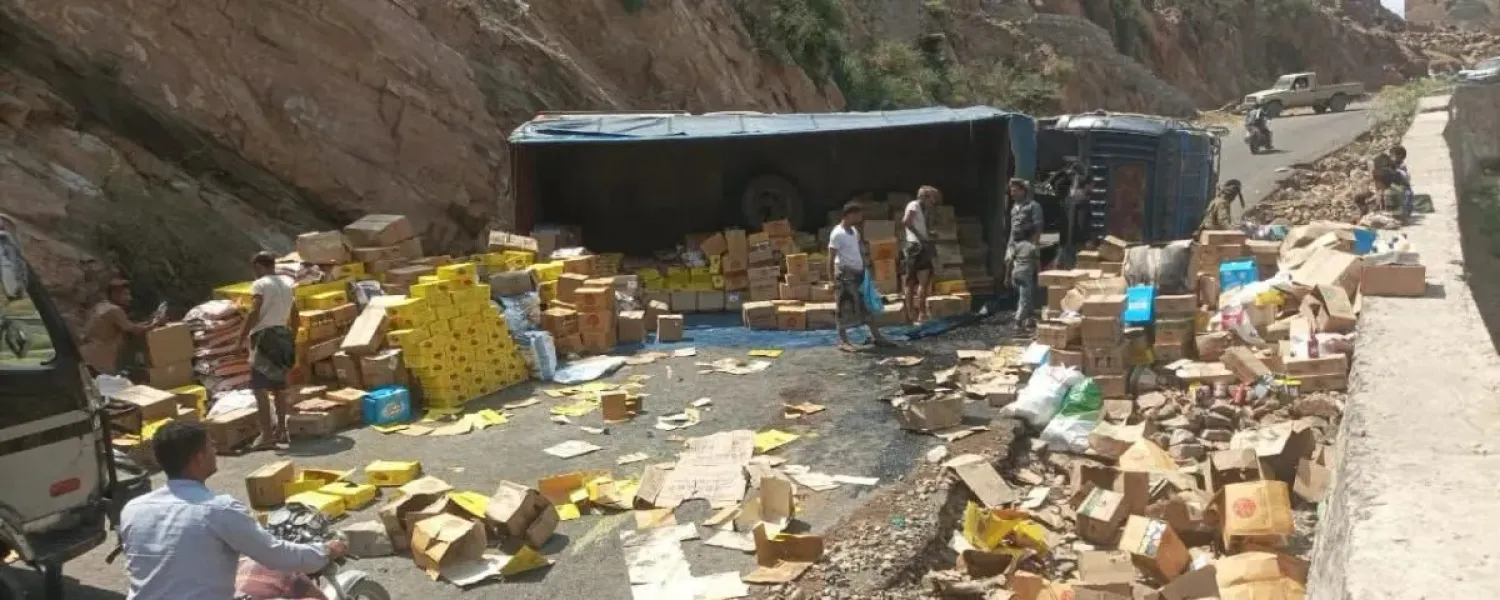
A cargo truck overturns on a road between Lahj and Taiz after the Houthis blocked the main route (X)
TT

Yemen’s Houthis Blow Up Roads, Loot Homes in Rural Taiz

A cargo truck overturns on a road between Lahj and Taiz after the Houthis blocked the main route (X)

Houthi militias are tightening their grip on rural communities in southwestern Yemen, blowing up roads, erecting military barricades and digging trenches as abductions, home raids and attacks on drinking water sources disrupt daily life and raise fears of fresh displacement.

The crackdown is concentrated in the districts of Al-Shamayatayn and Al-Mawasit in Taiz province and neighboring Al-Maqatirah in Lahj, a vast, densely populated area of strategic importance.

The measures contrast sharply with the Houthis' efforts to restore normal life, win public acceptance of their rule and recruit supporters and fighters through various incentives.

The Yemeni army's Tur al-Baha military command said last Saturday that eight of its soldiers had been killed in Houthi shelling in Al-Maqatirah, without providing further details.

Local sources said Houthi fighters in Al-Shamayatayn had fired an artillery shell at soldiers gathered at a military facility.

Residents of Al-Maqatirah told Asharq Al-Awsat that Houthi gunmen had destroyed sections of roads connecting their villages to Al-Shamayatayn and the city of Al-Turbah.

Last Sunday, the Houthis blew up several culverts along the Hayjat al-Abd road, cutting off the main route linking Taiz to Lahj and Aden and forcing travelers and truck drivers onto the Al-Suha-Karbah road.

Five trucks carrying goods and essential supplies overturned on the alternative route on Tuesday, blocking traffic for hours and damaging large quantities of merchandise. The disruption came as areas under Houthi control faced severe food shortages.

The Yemeni government had improved the Al-Suha-Karbah road as an alternative to Hayjat al-Abd, which has repeatedly closed because of Houthi attacks and flooding. But its rugged terrain and narrow stretches make it unsuitable as a permanent replacement.
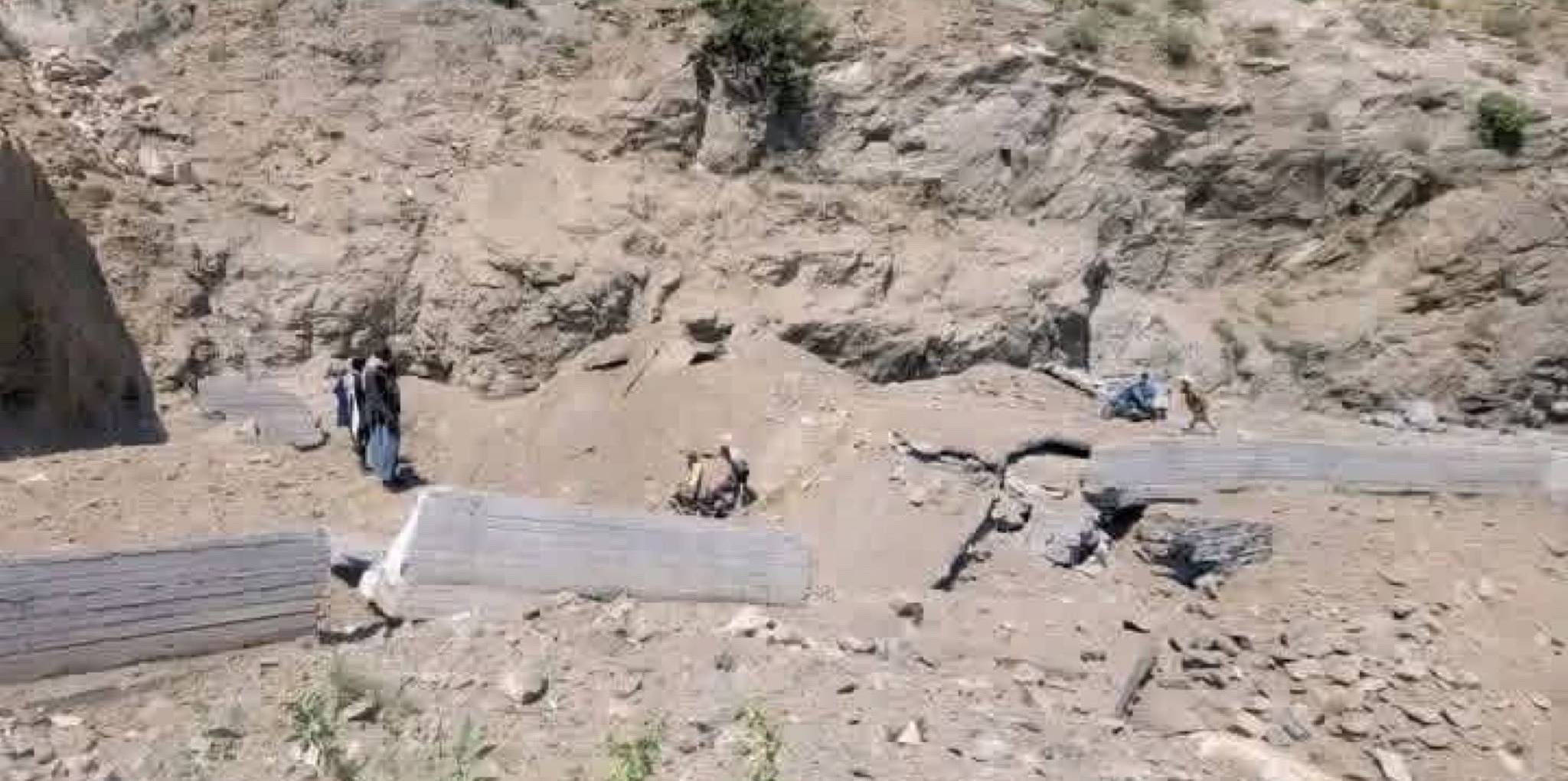
The Houthis resort to blowing up roads to impose collective punishment on the residents of Taiz and Lahj (X)

Villages cut off

The Houthis also blew up culverts along Naqil Musayr, a road connecting villages in western Al-Maqatirah to Al-Turbah, the administrative center of Al-Shamayatayn.

Residents must now walk to the city to shop and run errands. Vehicles can reach it only via the rugged Karbah road, a journey of at least three hours.

The group also blew up part of Naqil al-Khazrah, a stone stairway linking Al-Sharaf village and the Al-Jahili area in Al-Shamayatayn to villages in eastern Al-Maqatirah, forcing residents to take lengthy detours.

In Yemen, a naqil is a winding mountain route connecting higher elevations to foothills and valleys. Residents often build long stone stairways along these routes to make travel easier.

The blasts sent huge boulders crashing onto agricultural terraces, damaging farmland and nearby homes.

Residents of both districts told Asharq Al-Awsat that Houthi fighters had erected barricades and military outposts, dug trenches along roads connecting the districts and positioned weapons toward Al-Maqatirah.

The military buildup has left residents fearing they could be targeted on any pretext.

The Houthis have advanced only a few kilometers into Al-Maqatirah along the Hayjat al-Abd road, securing control of the route and blowing up its culverts. They also control the district's eastern areas.

Observers say the group appears satisfied, for now, with its hold over the high ground in Al-Shamayatayn overlooking Al-Maqatirah. Those positions put the district within range of Houthi fire and allow the group to monitor nearby military movements.
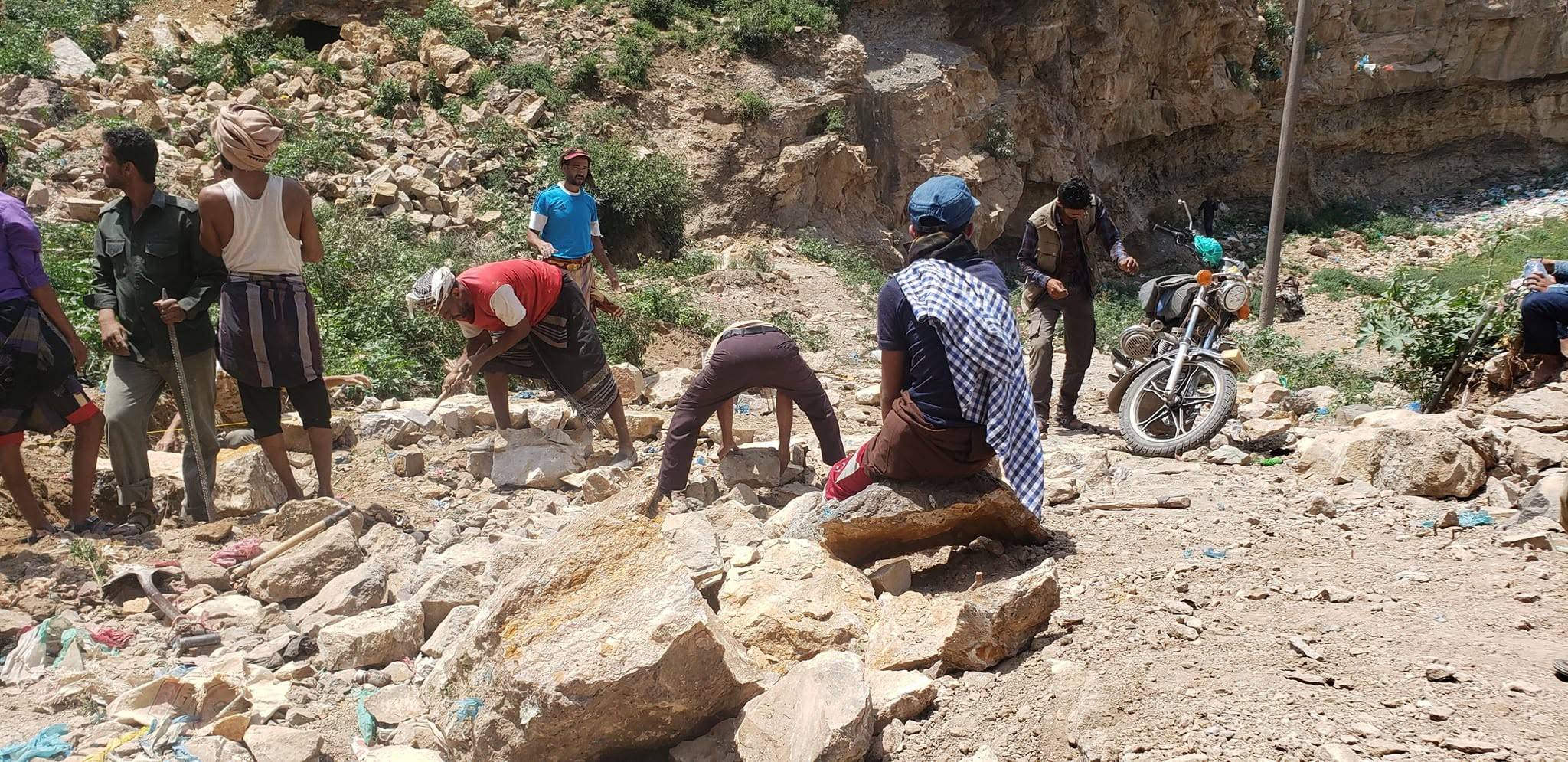
The Houthis blew up several rural roads after residents spent many years building them (Facebook)

Abductions and home raids

The Houthis abducted about 20 people in Qadas, in Al-Mawasit district, after a vehicle belonging to the group's so-called "Preaching Committee" caught fire.

The committee works to persuade residents to embrace the Houthis' ideology and sectarian views.

The group accused residents of Al-Mukayshah village of setting the vehicle ablaze and launched a manhunt, tightening security across the area.

Dozens of gunmen were deployed and new checkpoints set up, where passersby were forced to open their phones for inspection and explain why they were traveling.

In Al-Alqamah, west of Al-Shamayatayn, Houthi fighters also looted homes abandoned by residents who had fled fighting following the group's advance from Al-Wazi'iyah district.

Residents said the fighters broke down doors and entered the homes, claiming to be searching for weapons and accusing their owners of collaborating with the Yemeni army and the Saudi-led coalition supporting Yemen's internationally recognized government.

But the raids went beyond searches. Fighters seized household belongings and loaded them onto vehicles before taking them out of the area.

The escalating restrictions, raids and abductions have heightened fears across rural Taiz that hundreds more residents could be forced to flee their homes for Lahj and Aden.


How Will the Showdown Between al-Zaidi and Kataib Hezbollah End?

Members of Iraq's Kataib Hezbollah carry the group's flag in central Baghdad (AFP)
TT

How Will the Showdown Between al-Zaidi and Kataib Hezbollah End?

Members of Iraq's Kataib Hezbollah carry the group's flag in central Baghdad (AFP)

A two-week standoff between Iraqi Prime Minister Ali al-Zaidi and Kataib Hezbollah has erupted into a public war of accusations, complicating government efforts to bring the weapons of Iran-backed armed groups under state control.

Tensions flared after leaked intelligence reports accused Kataib Hezbollah of smuggling thousands of barrels of oil extracted from Jurf al-Sakhar, south of Baghdad. The group has controlled the area for nearly a decade, barring successive governments from entering.

On Friday, the government sent a committee headed by the Popular Mobilization Forces (PMF) to investigate the smuggling allegations.

Lieutenant General Saad Maan, head of Iraq's Security Media Cell, said neither political parties nor armed factions were represented on the committee investigating the smuggling of petroleum products in Jurf al-Sakhar.

A senior official in the ruling Shiite Coordination Framework told Asharq Al-Awsat that the investigation into Kataib Hezbollah's alleged oil sales marked the first government move on the ground inside the restricted area controlled by the group.

Iran's patronage

Kataib Hezbollah was founded after the 2003 US invasion of Iraq by Abu Mahdi al-Muhandis, who was killed in a US strike near Baghdad International Airport in early 2020 alongside Qassem Soleimani, commander of the Quds Force of Iran's Revolutionary Guard Corps.

The Coordination Framework official said the group's strength and influence could not be understood without examining its ties to its Iranian patron.

Successive governments had largely failed to confront Kataib Hezbollah or enter Jurf al-Sakhar because of the power it drew from its close ties with Tehran, the official said, describing it as the spearhead of factions loyal to Iran's doctrine of guardianship of the Islamic jurist.

Despite a lack of reliable figures on its fighters and weapons, the official warned against underestimating the group's military strength.

Kataib Hezbollah has a sizable arsenal of rockets and drones, the official said, without specifying their types or numbers.

But Iran's financial backing was largely limited to the group's early years, the source said. Over the past few years, Kataib Hezbollah has developed a network of financial interests of its own, potentially including oil investment or theft.

The group also receives substantial funding from the PMF through three brigades under its command.

The official warned that the standoff with al-Zaidi's government had reached a dangerous point, raising serious alarm within the Coordination Framework.

Senior Shiite leaders were working intensively to avert a possible confrontation between the government and Kataib Hezbollah, the official said.

Taking on armed factions

Will al-Zaidi see the confrontation through?

Political analyst Akeel Abbas believes the prime minister has already gone further than any of his predecessors in confronting armed factions over their weapons.

Al-Zaidi has not only openly challenged one of Iraq's most powerful armed groups but also exposed corruption cases in Jurf al-Sakhar, an area of exceptional geographical and political sensitivity, Abbas told Asharq Al-Awsat.

"The decision to confront the group has already been made," Abbas said, although the nature of that confrontation could change as events unfold.

The Coordination Framework's influence over the dispute appears to be waning, he said, with its traditional role as mediator between the prime minister and armed factions no longer as effective as before.

Abbas called the latest standoff a significant development that challenged a long-standing assumption in Iraqi politics: any prime minister who confronted armed factions would be ousted.

US backing and the judiciary

Two factors have strengthened al-Zaidi's hand, according to Abbas: US backing at a time when Iran is grappling with acute weakness and turmoil, and support from Iraq's judiciary.

Together, he said, they have made the difference in the confrontation.

Still, Abbas did not rule out a retreat by the prime minister.

Under current circumstances, al-Zaidi appears to hold the stronger position against Kataib Hezbollah, a striking reversal in Iraqi politics, he said.

But backing down would be difficult for the prime minister, making a political deal between the two sides the more likely outcome as both seek to avoid defeat.

No clear strategy

Ayad al-Anbar, a political science professor at the University of Baghdad, is less convinced by the government's campaign to bring armed groups' weapons under state control.

He questioned whether the government has a coherent strategy for disarming the factions or confronting Kataib Hezbollah.

"The government's strategy for bringing weapons under state control remains unclear," Anbar told Asharq Al-Awsat.

Instead, he said, authorities rely on short-term tactics that shift with events and the reactions they provoke.

There is little sign of a clearly defined plan, with successive steps or contingency options, he said. Government measures trigger responses from armed factions, only for tensions to ease and the escalation to be contained.

Anbar said the same pattern applied to the government's latest pressure tactic: economic pressure.

The confrontation with Kataib Hezbollah and the wider disarmament issue have become exercises in political sparring and shows of force rather than a serious debate over a fundamental problem, he said.

The Iraqi state's fragility inevitably weakens its security system and allows competing centers of power and control to emerge, Anbar argued.

"In a country of political fiefdoms, why wouldn't those with weapons seek to become security fiefdoms themselves?" he asked.

That, he said, explains a fundamental part of the problem.


Senior Hamas Commander Killed in Israeli Strike

File photo of Samir Abu Younis
TT

Senior Hamas Commander Killed in Israeli Strike

File photo of Samir Abu Younis

Hamas' armed wing said on Sunday that a senior commander who helped plan and oversee the October 7, 2023, attack on Israel had been killed in an Israeli airstrike.

The Al-Qassam Brigades identified the commander as Samir Abu Younis, 53, the commander of its Rafah brigade, and said he was killed on Saturday.

The Israeli military said ⁠on Sunday it ⁠had struck a senior commander in Hamas' armed wing but did not identify him.

Medics said Abu Younis was killed and others were wounded in an airstrike that targeted him in a street in ⁠the Mawasi area of Khan Younis in the southern Gaza Strip.

Hamas said Abu Younis joined Hamas' armed wing in 1991 and had held several senior operational roles in Rafah before becoming commander of the brigade.

Hamas said his funeral would be held on Sunday afternoon in Khan Younis.

An October 2025 ceasefire halted major fighting but has not stopped Israeli attacks ⁠or ⁠secured Hamas' disarmament.

Gaza health authorities say at least 1,600 Palestinians have been killed since the ceasefire went into effect. Five Israeli soldiers have been killed during the same period.

Palestinian authorities say more than 74,000 people have been killed in Israel's military campaign against Gaza, launched after Hamas-led fighters killed about 1,200 people in southern Israel in October 2023.


EU Urges ‘Immediate, Unimpeded’ Flood Aid to Gaza

 Displaced Palestinians walk through a rain-soaked tent camp following heavy rainfall in Deir al-Balah, central Gaza Strip, Saturday, Nov. 7, 2026. (AP)
Displaced Palestinians walk through a rain-soaked tent camp following heavy rainfall in Deir al-Balah, central Gaza Strip, Saturday, Nov. 7, 2026. (AP)
TT

EU Urges ‘Immediate, Unimpeded’ Flood Aid to Gaza

 Displaced Palestinians walk through a rain-soaked tent camp following heavy rainfall in Deir al-Balah, central Gaza Strip, Saturday, Nov. 7, 2026. (AP)
Displaced Palestinians walk through a rain-soaked tent camp following heavy rainfall in Deir al-Balah, central Gaza Strip, Saturday, Nov. 7, 2026. (AP)

The European Union on Saturday demanded Israel grant urgent access for aid groups to Gaza to help the victims of devastating floods there.

"We urge Israel to allow immediate, unimpeded access and sustained distribution of humanitarian assistance and early recovery support at scale, and to reopen all Gaza border crossings," it said in a statement.