Karak Attack: Jordan's King Vows Justice Will Reach Every Terrorist

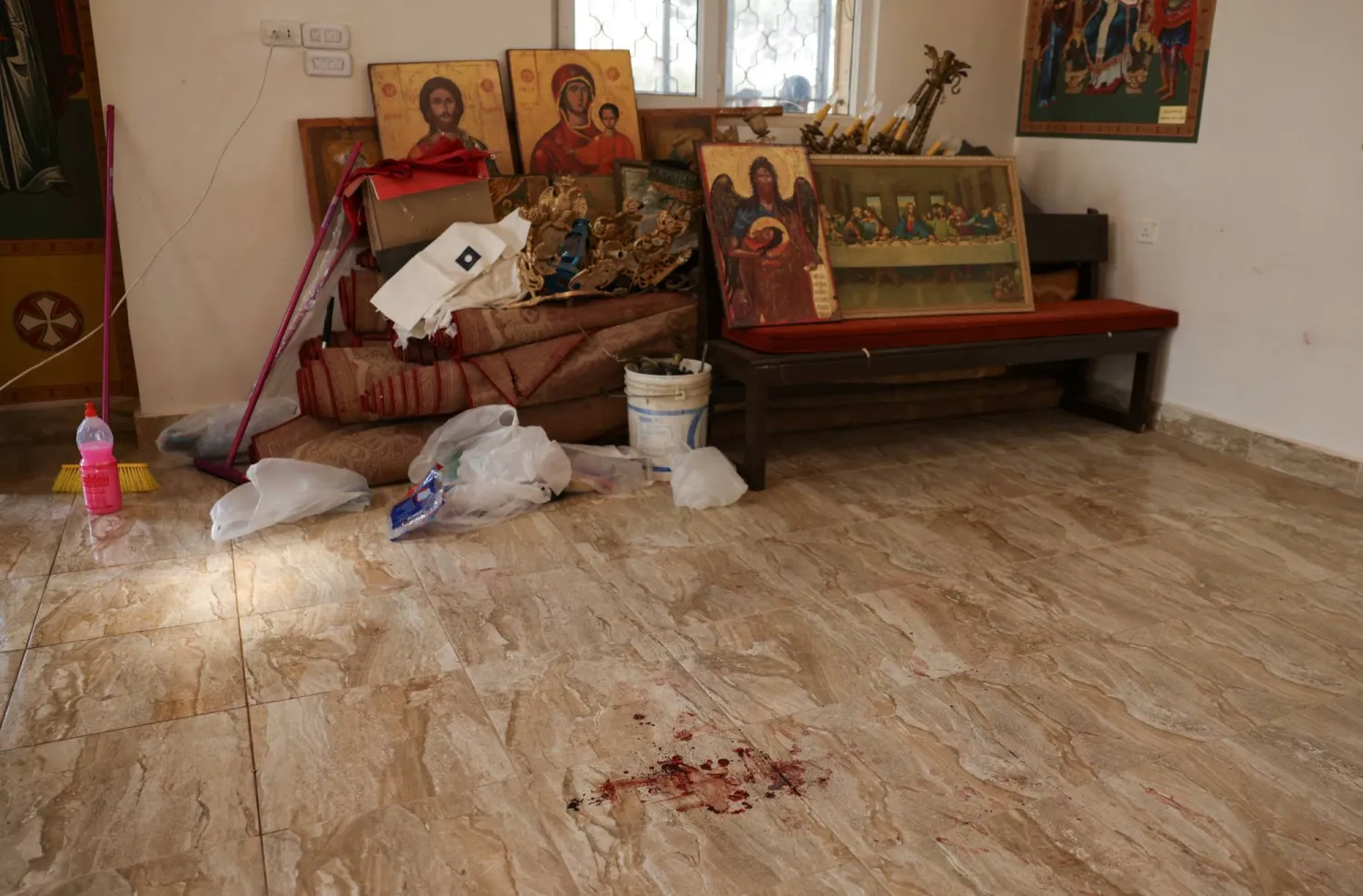
A bloodstain at Saint George’s Greek Orthodox Church, where gunmen opened fire during a funeral the previous day, in the village of Hamoud, Karak, Jordan, October 24, 2026. REUTERS/Alaa Al Sukhni
TT

Karak Attack: Jordan's King Vows Justice Will Reach Every Terrorist

A bloodstain at Saint George’s Greek Orthodox Church, where gunmen opened fire during a funeral the previous day, in the village of Hamoud, Karak, Jordan, October 24, 2026. REUTERS/Alaa Al Sukhni

Jordanians rallied around the families of the victims of the Hamoud Church attack in Karak, southern Jordan, as they received condolences following Friday's terrorist assault, which left eight people dead and dozens wounded, according to the latest toll announced Saturday afternoon.

In recent hours, Hamoud village has become a gathering place for mourners arriving to show solidarity with the families of those killed and injured.

King Abdullah II stressed Saturday the need to "keep citizens informed of developments in the investigation as they emerge and firmly confront rumors and misinformation that could exploit this crime to spread fear and discord."

The king also emphasized the importance of "conducting a comprehensive security assessment of the response to the terrorist attack and developing practical measures to strengthen security preparedness and prevent similar attempts."

He underscored the need to uphold the rule of law and the authority of the state.

King Abdullah chaired a meeting of the National Security Council on Saturday, during which he received a security briefing on the terrorist attack targeting the church in Hamoud village in Karak Governorate.

He instructed the government and relevant institutions to review policies aimed at combating extremist ideology and intensify efforts to eliminate its sources through a systematic plan coordinated with religious authorities.

During the meeting, attended by Crown Prince Al Hussein bin Abdullah II, the king stressed that there could be no complacency when Jordanian lives were at stake, reiterating his condemnation of the heinous terrorist attack.

He emphasized that the security and safety of Jordanians were a red line, affirming that the hand of justice would reach every terrorist and that such cowardly acts had never intimidated Jordan and its people, nor would they undermine national unity.

The king instructed the relevant security agencies to respond decisively and deal with an iron fist with the "Kharijites" and anyone seeking to undermine Jordanian unity.

He also stressed the need to pursue and hold accountable, to the fullest extent of the law, anyone who supported or justified the attack.

Karak and Attempts to Sow Discord

For decades, the southern governorate of Karak has served as a model of coexistence between Christian and Muslim clans.

Jordanians recount numerous stories of longstanding social ties between neighbors and the shared customs and traditions of the governorate's residents.

Notably, Jordan has sought to respond carefully to a social media campaign aimed at sowing discord in the country.

Organizations monitoring online comments and their sources told Asharq Al-Awsat that social media users generally appeared more inclined to accept the official account, despite the limited information available because of the ongoing investigation into the church attack.

Prioritizing Security Over Politics

Immediately after the attack, a government delegation traveled to Karak Governorate, held a series of meetings and delivered several press briefings.

However, the response was not limited to government officials. King Abdullah II personally traveled to Karak wearing military fatigues and the uniform of the Special Operations Forces.

In 1998, Abdullah, then a prince and a brigadier general in the Jordanian army, personally led a military operation with a Special Operations battalion to arrest a terrorist cell in the Sahab area east of Amman.

Analysts say the king's appearance in military uniform carries significant messages and implications, particularly under the current security circumstances, and offers an indication of the country's approach in the coming period.

Officials who have attended meetings with King Abdullah say he personally develops plans for military operations and frequently supervises them directly, not merely in his capacity as supreme commander of the armed forces, but also as a seasoned military officer with extensive experience in training and operational environments.

The Videos Told the Story

Videos documenting the details of the terrorist attack spread rapidly after the assault on the church, leaving little need for further explanation of what had happened.

Footage showed three terrorists getting out of a vehicle carrying automatic weapons and opening fire on civilians in cold blood. Some of their faces were clearly visible on camera.

Upon arriving at a gathering point for the families of those killed and wounded, accompanied by Prime Minister Jafar Hassan, Interior Minister Mazin Al Farrayeh was questioned about why one of the three terrorists had allegedly been released on bail just days before the attack.

The minister denied the allegation after leaving the condolence gathering, stating in a press release that "the perpetrator had not been released on bail."

Informed sources confirmed that the investigation into the Hamoud Church attack was progressing and that the perpetrators had been identified.

They said the findings would be announced once the investigation was complete and all aspects of the terrorist operation, considered a dangerous precedent in the country, had been thoroughly examined.

Jordan's security is, in fact, being targeted by several parties.

Analysts in Amman say hostility toward takfiri groups makes their members susceptible to being used as instruments to strike at the country's security and unity through attacks such as the assault on mourners at Hamoud Church in Karak.

According to these analysts, the Karak attack was intended to provoke sectarian discord in the country.

Father Nabil Haddad, one of Jordan's most prominent Christian religious figures, described the intended targets of such discord in press statements as "two closely united communities that cannot be separated."

Jordanians are now awaiting answers about the affiliations of the terrorist group responsible for the Hamoud Church attack and whether its members maintained contacts with organizations abroad or were motivated by extremist beliefs they had adopted.

Pending an official announcement identifying the group's affiliations, questions are also being raised about whether it has links to other groups in different parts of the country, amid fears of similar attacks, including those carried out by so-called lone wolves.

Terrorism and the Targeting of Karak

Karak Governorate experienced painful events in both 2015 and 2016.

After the aircraft flown by Jordanian pilot Muath al-Kasasbeh, who came from a village in the southern part of the governorate, went down and he was captured by ISIS in Syria, the terrorist organization burned him to death in January 2015.

The killing reflected the ideology of "management of savagery" embraced by takfiri organizations and provoked widespread outrage in Jordan.

In December 2016, Karak Governorate experienced another terrorist attack centered on its historic castle, where ISIS militants barricaded themselves after concealing weapons inside the fortress.

During that incident, hostages were held inside the castle, and the operation lasted more than 15 hours.

The attack left 14 people, including security personnel, civilians and a foreign tourist, dead, while many others in the vicinity of the castle were wounded.

All four members of the ISIS cell were also killed.


Israel Fortifies Defenses Against ‘Swarms of Hezbollah Drones’

An Israeli soldier gestures as a tank moves onto a truck to depart from the site, on the Israeli side of the border with Lebanon. (Reuters file)
TT

Israel Fortifies Defenses Against ‘Swarms of Hezbollah Drones’

An Israeli soldier gestures as a tank moves onto a truck to depart from the site, on the Israeli side of the border with Lebanon. (Reuters file)

Israel is reinforcing military positions against potential Hezbollah attacks involving dozens or even hundreds of drones, fueling debate over whether the preparations reflect genuine alarm over a cheap, hard-to-counter weapon or are laying the groundwork for a major offensive against Lebanon.

The competing assessments come amid diplomatic efforts to determine the future of security arrangements in southern Lebanon as the mandate of the UN Interim Force in Lebanon (UNIFIL) comes to an end.

Radars, protective nets and a costly threat

Israel's Maariv reported Tuesday that the military was preparing for simultaneous drone attacks by deploying early-warning radars developed by Israel Aerospace Industries, installing thousands of square meters of protective netting over military positions, fortifications and vehicles, and bolstering sniper and air defense capabilities.

The measures are not entirely new. Israeli media reported in May that the military had received about 158,000 square meters of protective netting.

Israeli media, citing military assessments, said Hezbollah still possessed thousands of explosive drones and about 10,000 rockets and projectiles, while training drone operators and extending their operational range.

But the estimates remain independently unverified and do not establish whether Hezbollah can launch hundreds of drones simultaneously.

A report on Monday by the Institute for the Study of War and the Critical Threats Project said the Israeli estimates could not be verified and found no clear signs of an imminent attack on Israel.

Small drones pose a particular challenge because they can strike troops and vehicles at a fraction of the cost of the systems deployed to intercept them.

Reuters documented Hezbollah's use of fiber-optic-guided drones in May. Unlike conventional drones, their communications are difficult to disrupt through radio jamming, though they remain vulnerable to detection and physical interception.

A study by the Armed Conflict Location & Event Data Project (ACLED) found that first-person-view (FPV) drones accounted for about 21% of Hezbollah's attacks inside Lebanon between March and July 2026, compared with 24% involving one-way attack drones. The categories may overlap.

The figures shed light on Hezbollah's battlefield tactics, but offer little indication of how much of its arsenal remains intact.

Genuine concern

Retired Brigadier General Dr. Khalil al-Gemayel, a former commander of the southern military region, said Israel's reinforced defenses reflected mounting concern over Hezbollah's drones, but were no proof of an imminent attack.

"Militarily, these preparations reflect growing Israeli concern about the drone threat, particularly one-way attack drones and fiber-optic-guided drones," he told Asharq Al-Awsat.

Israel has yet to develop a system capable of providing complete protection, he noted.

"Drones allow Hezbollah to challenge Israel's air and technological superiority in a relatively low-cost war of attrition, potentially threatening troops, equipment and even northern Israeli settlements, and possibly areas farther away, despite the security buffer zone," he said, but that "does not necessarily mean Israel has confirmed intelligence about an imminent attack."

Gemayel said Israel was drawing lessons from previous confrontations that exposed the limits of technological superiority in protecting ground forces. It was also preparing for possible regional escalation, particularly if fighting between Iran and the United States resumed and Israel became involved.

On Hezbollah's military strength, Gemayel said the party has been rebuilding some of its capabilities, particularly its drone arsenal, while reorganizing command-and-control units to operate more independently under electronic jamming.

Seizures of rockets and explosives being smuggled across borders or moved inside Lebanon suggested attempts to rearm, he said, but were "not sufficient on their own to conclude that Hezbollah has fully restored its former capabilities."

Hezbollah had probably recovered some of its military strength, he added, though the size of its arsenal, its readiness and its ability to mount large-scale coordinated operations remained unclear.

Gemayel identified three potential triggers for renewed fighting: another Israel-Iran confrontation drawing in Hezbollah; a major battlefield incident or miscalculation; or an expansion of Israeli operations deeper into Lebanon, including strikes on Hezbollah leaders.

Both sides were preparing for war without making it inevitable, as a clear political and security settlement remained elusive.

Preparing the public for war

Retired Brigadier General Khaled Hamadeh offered a sharply different assessment, arguing that Israel was deliberately inflating the drone threat to prepare its public for another war.

Israel's warnings amounted to "deliberate exaggeration aimed at preparing Israeli public opinion for the possibility of another confrontation, rather than necessarily reflecting a military assessment of an imminent threat," he told Asharq Al-Awsat.

"Everything Israel puts out is intended to promote the next war," he said. "In my opinion, the Israelis will carry out a major military operation after their government is formed."

Hamadeh dismissed Hezbollah's remaining drone capabilities as insufficient to change the balance of power or deter a large-scale Israeli offensive.

"What does it mean if Hezbollah launches 100 drones? And if Israel carries out three days of airstrikes on Beirut's southern suburbs, what can Hezbollah do?" he asked.

He also does not expect a government led by Gadi Eisenkot to alter Israel's military approach. "Eisenkot would be no different from Benjamin Netanyahu when it comes to military dealings with Lebanon," he said.

Hamadeh linked his assessment to a visit by US Ambassador to the United Nations Mike Waltz and diplomatic activity in Beirut, describing them as "something resembling a final warning to the Lebanese authorities."

"Israel is not waiting for Hezbollah to carry out an operation," he said, adding that Hezbollah itself was unlikely to act while awaiting developments involving Iran and the wider region.


Washington Hardens Stance on Hezbollah’s Arms: ‘The Cancer It Represents Must Not Continue’

Lebanese Parliament Speaker Nabih Berri (R) meets with US Ambassador to the UN Mike Waltz (L), in Beirut, Lebanon, 16 November 2026. (EPA)
TT

Washington Hardens Stance on Hezbollah’s Arms: ‘The Cancer It Represents Must Not Continue’

Lebanese Parliament Speaker Nabih Berri (R) meets with US Ambassador to the UN Mike Waltz (L), in Beirut, Lebanon, 16 November 2026. (EPA)

Washington has stepped up pressure to disarm Hezbollah, with US Ambassador to the United Nations Mike Waltz likening the group to a cancer that must not be allowed to persist.

His remarks come as Lebanon debates future security arrangements in the south ahead of the expiration of the United Nations Interim Force in Lebanon (UNIFIL) mandate.

Parliament Speaker Nabih Berri has insisted that any future international force must operate under a UN mandate, Waltz called for changes to the UN’s role and UNIFIL’s mission, reiterating Washington’s support for a single army under state authority.

Lebanese political parties, meanwhile, called on the government to implement its decisions placing all weapons under state control.

Berri insists on Resolution 1701

During a meeting with French Ambassador Patrick Durel, Berri reaffirmed Lebanon’s unified official position on implementing UN Security Council Resolution 1701.

He stressed that any force tasked with implementing the resolution must operate under UN authority.

He also called for an end to Israel’s occupation of Lebanese territory and the return of displaced residents to their homes.

The meeting addressed political and security developments and efforts to determine future security arrangements in South Lebanon.

Waltz: One state, one army

Waltz, who met President Joseph Aoun and other Lebanese officials Monday, reiterated Washington’s message of “one state, one army,” stressing that a sovereign Lebanon would be stronger.

Describing his talks with Aoun as productive, Waltz welcomed the Lebanese president’s decision to participate in trilateral dialogue with the US and Israel aimed at achieving peace.

He called for changes to the role of the UN and UNIFIL’s peacekeeping mission after two decades, while reaffirming US support for Lebanon’s freedom and independence.

In posts following his meetings in Beirut, Waltz said he had held a candid discussion with Berri about bringing all weapons under state control. He stressed that the move was not optional but the only way forward.

Waltz also likened Hezbollah to a “cancer” afflicting Lebanon, saying the group’s continued presence in its current form could not be allowed to persist.

He described his meeting with Prime Minister Nawaf Salam as productive, saying their discussions focused on economic reform and security.

Waltz stressed that meaningful economic reforms and the restoration of full state authority were essential to attracting investment and ending Lebanon’s recurring crises.

They also discussed a coordinated government approach to providing services to communities devastated by the war in South Lebanon, as well as improving cooperation among the dozens of UN agencies operating on the ground to assist the Lebanese people.

Kataeb: Hezbollah’s arms undermine stability

The Kataeb Party urged the government to accelerate the implementation of its decisions to place all weapons under state control and ban Hezbollah’s military and security activities.

Following its regular meeting chaired by MP Sami Gemayel, the party’s political bureau described Hezbollah’s arsenal as the main obstacle to safeguarding Lebanon’s independence, territorial integrity and unity.

It said the group’s continued possession of weapons undermined the foundations and stability of the state and had brought occupation to Lebanon.

Lebanese Forces MP Ghassan Hasbani said Lebanon had entered a new phase extending beyond the ceasefire agreement and Resolution 1701, requiring more detailed arrangements for Hezbollah’s disarmament and the dismantling of its military infrastructure.

He blamed Hezbollah for bringing the country to this point by involving Lebanon in wars unrelated to its interests.

Hasbani said an international presence could oversee the process even without a UN force.

He warned that the longer the issue remained unresolved, the more difficult conditions would become.


Yemen’s Interior Ministry Tightens Crackdown on Arms Smuggling to Houthis

Yemeni army fighters on the Jabal Han front near the city of Taiz. (AFP)
TT

Yemen’s Interior Ministry Tightens Crackdown on Arms Smuggling to Houthis

Yemeni army fighters on the Jabal Han front near the city of Taiz. (AFP)

Yemen’s Interior Ministry has intensified efforts to combat arms smuggling to the Houthis, tightening control over land, sea and air routes to prevent weapons and equipment from reaching the group, a senior security official said.

Maj. Gen. Mohammed Salem al-Sharif, first undersecretary of the ministry, told Asharq Al-Awsat that security operations target not only illicit shipments but also the routes used by smuggling networks, particularly coastal roads and desert crossings.

He estimated the ministry’s success in curbing smuggling operations at around 70 percent, saying tighter controls had restricted the networks’ movements along traditional routes and made smuggling through desert crossings possible only in rare cases.

Al-Sharif said efforts were continuing to strengthen surveillance and prevent weapons from reaching the Houthis.

He added that the ministry also plays a frontline role through police units operating in areas outside government control, fighting alongside military and resistance forces in what he described as “fields of honor and duty.”

Meanwhile, a high-level security meeting in Marib reviewed recent developments and discussed strengthening coordination among security agencies from several governorates.

Participants examined security issues, information-sharing mechanisms and ways to improve cooperation between security commanders and agencies to boost operational efficiency and respond to emerging challenges.

Addressing military developments in Marib, where the ministry’s forward office is based, al-Sharif said government forces were making advances while the Houthis’ ability to achieve military breakthroughs was declining.

He maintained that the group was no longer capable of advancing toward the governorate, citing the readiness of government forces and support from Saudi Arabia.

Despite Houthi attempts to advance toward Marib, Yemeni forces had secured gains on the ground, he stressed.

Al-Sharif credited strong Saudi support with bolstering the forces’ capabilities, resilience and battlefield advances, as well as coordinated efforts by military commanders and fighters across several fronts.