
Palestinian Authority Arrests Brokers Over Alleged Sale of Jericho Homes to Settlers

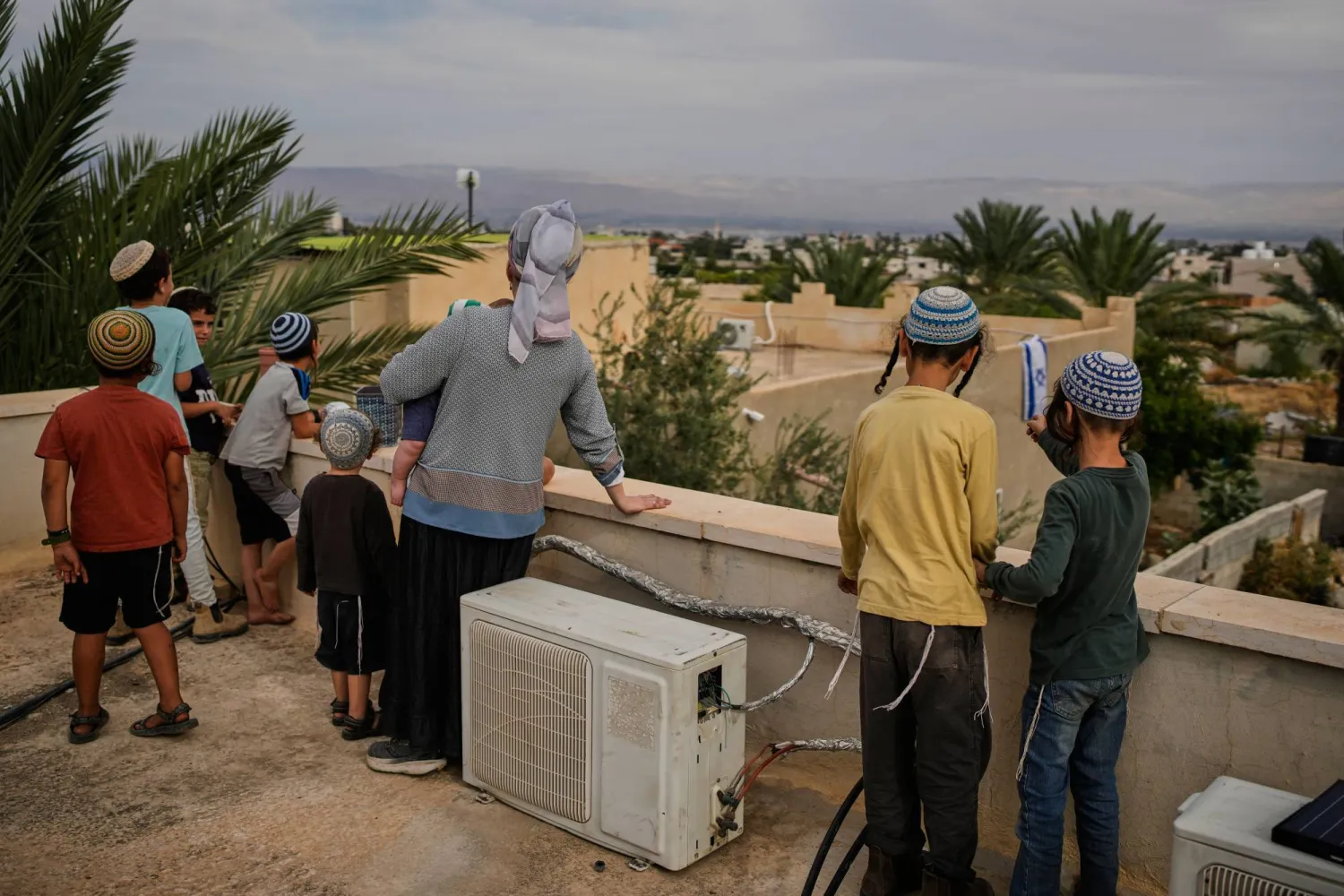
Settlers stand on the roof of one of eight homes they said they purchased in Jericho last Thursday (AP). 
TT

Palestinian Authority Arrests Brokers Over Alleged Sale of Jericho Homes to Settlers

Settlers stand on the roof of one of eight homes they said they purchased in Jericho last Thursday (AP). 

The Palestinian Authority has arrested several property and land brokers suspected of facilitating the transfer of homes in Jericho to Israeli settlers, amid fears the move could mark the beginning of what has been described as a “Jewish invasion” of one of the world’s oldest continuously inhabited cities.

Palestinian security forces spokesman Maj. Gen. Anwar Rajab said several suspects had been detained in connection with homes seized by settlers in Al-Duyuk al-Tahta, west of Jericho.

Security sources told Asharq Al-Awsat that the brokers were suspected of facilitating the transfer of the properties as part of a plan to enable settlers to take control of an entire neighborhood. The suspects were remanded in custody for 15 days pending investigation.

The case emerged Wednesday when 20 Jewish families entered eight homes they claimed to have legally purchased through the Nachala settlement movement, with the involvement of the Binyamin Regional Council, in an operation described as secret.

The houses are located in Area C of the occupied West Bank, near the archaeological site known as the Hasmonean Palaces.

Israel’s Yedioth Ahronoth newspaper reported that the purchases had been arranged in secrecy, with only a small number of people involved. Even some participants’ wives were reportedly surprised by the move.

Settlers who arrived at the site said they were reestablishing Jewish settlement in Jericho, which Jews regard as their gateway into Palestine.

The takeover sparked an uproar in the Palestinian territories, raising questions about how the properties had been transferred, whether the transactions were illegal, particularly as some of the homes stand on government-owned land, and where the Palestinian Authority had been during the process.

The site lies in Al-Duyuk al-Tahta, within Area C, but very close to Area A, which is under Palestinian administration. Establishing a settlement outpost there would therefore carry serious geographical and political implications.

The Palestinian Authority responded immediately by forming a crisis committee and launching an arrest campaign.

Palestinian Security Forces Investigate Property Transfers

In a statement, Palestinian security forces said investigations into the settlers’ seizure of homes in the Al-Duyuk area of Jericho governorate were ongoing, under close supervision by the relevant authorities and the Public Prosecution.

They said legal measures would be taken against anyone found to be involved, in accordance with established procedures.

The security forces warned citizens against dealing with documents, papers or information circulated on social media about the case or similar incidents, saying such material could be intended to sow confusion and disrupt investigations.

They urged residents and media outlets to rely exclusively on official sources and avoid rumors or unreliable information, some of which was intended to incite discord and disputes within Palestinian society.

The statement reaffirmed the security services’ commitment to protecting citizens and their property and maintaining security and public order. It said any official developments would be announced through authorized channels.

The security forces stressed that they would not allow the case to become a source of rumors or tolerate attempts to undermine public security, threaten property, mislead public opinion or exploit the investigation to spread disorder.

The statement followed the widespread circulation of forged documents seeking to implicate a Palestinian Authority figure, triggering heated debate on social media.

Before the security forces issued their statement, the Palestinian Land Authority rejected claims that preliminary sale transactions, official documents or powers of attorney existed in connection with the properties.

It said such practices formed part of Israeli occupation policies aimed at seizing more land and forcibly displacing residents.

The authority stressed that any action taken by a third party concerning state property constituted a violation of state ownership. It said no allocation, lease or other transaction had been authorized for Plot 14.

According to land records predating 1967, one of the two plots on which the buildings stand belongs to the state, while the other belongs to its historical owners.

The Land Authority maintained that the occupation could not confer property rights and that any measures taken under its authority were null and void, carrying no legal effect.

Israeli Commander Accused of Prior Knowledge

As Palestinian authorities continued their arrests and investigations, a separate controversy erupted in Israel.

Although the Israeli military initially said the operation had not been coordinated with it, Israeli security sources familiar with the matter told Haaretz that Maj. Gen. Avi Bluth, head of the military’s Central Command, had known in advance about plans by settlers and the Nachala movement to take over Palestinian homes west of Jericho.

According to the sources, Bluth met the settlers a day before they entered the properties and asked them to keep the operation secret and not inform field officers until the takeover was complete.

The sources said he had spoken with senior settler leaders involved in the operation, asked them not to disclose his prior knowledge and “wished them success.”

The allegations gained further attention following remarks by former Israeli Prime Minister Ehud Olmert, who also accused Bluth of assisting settlers involved in attacks against Palestinians in the West Bank.

The Israeli military dismissed the accusations as “offensive and baseless.”

Since the settlers entered the homes, the army has had to divert three combat platoons to protect them after the settlers attacked Bedouin residents in a nearby area and forced them to leave.

Israel’s Walla news website reported Saturday that the entry of Israelis into homes near Jericho had prompted two families from the local Bedouin community to abandon their temporary shelters.

The report said the army had contacted the families and offered assistance to prevent their departure, but both decided to leave.

The Israeli military said it had tried unsuccessfully to persuade the families to stay and would therefore work to prevent Jewish settlers from taking over the two vacated homes.

Senior Israeli military officials warned of the risk of further escalation.


Beneath the Ashes of Cairo’s Warraq Fire, Stories of Loss Emerge

Egyptians walk past the charred remains of basbousa, a traditional Egyptian dessert, at the site of the Ring Road fire. (Reuters) 
TT

Beneath the Ashes of Cairo’s Warraq Fire, Stories of Loss Emerge

Egyptians walk past the charred remains of basbousa, a traditional Egyptian dessert, at the site of the Ring Road fire. (Reuters) 

As workers clear scattered tires and the wreckage of burned-out vehicles from the site of a fuel tanker fire that erupted last Wednesday evening on the Ring Road in al-Warraq district, west of Cairo, stories of loss are emerging from the debris, recounted by grieving families and eyewitnesses.

Traffic has resumed as engineering teams continue to restore electricity pylons, repair damaged sections of the road and collect samples to assess the effects of the blaze. The smell of smoke still lingers where flames lit up the night.

An eyewitness told local media he had seen an infant embracing one of its parents inside a minibus. The bodies were so badly burned that he could not tell whether the child was clinging to its mother or father. Beside them lay a charred container of baby formula.

The fire killed 31 people and injured 26 others, according to official figures. The injured were taken to several hospitals for emergency and specialized medical care.

Outside Boulaq El-Dakrour General Hospital in Giza, where four members of the same family were receiving treatment, relatives endured an agonizing wait for news of five missing family members.

They had been traveling from al-Warraq to Helwan, south of Cairo, to attend a wedding when flames engulfed the two minibuses carrying them.

In the final moments, a father managed to throw his young son out of one of the vehicles. The child survived and broke the news of the tragedy to his uncles.

Relatives located the four injured family members, but the fate of the father and four of his children remained unknown until their bodies were recovered.

On Friday, the family bid them farewell, their five coffins lined up side by side.

A young man was on his way to a beauty salon to collect his bride on their wedding day when flames surrounded his car on the Ring Road, engulfing the vehicle.

At the salon, his bride waited in her white wedding dress.

The blaze also destroyed a minibus carrying a bride’s trousseau, including electrical appliances and household items her family had accumulated through years of work and savings. Images of the charred belongings sparked an outpouring of sympathy on social media.

Ebtisam Mostafa Awad, who was pregnant, and her brother Islam were killed on their way home from a medical appointment to check on his health. They were just half an hour from home when the flames overtook them.

At 5:30 p.m., about half an hour before the fire broke out, a young man named Kyrillos called his wife to tell her he had left work in a colleague’s car and was heading home.

When contact with him was lost following the fire, his family began a desperate search that ended the following evening when they found his body in the morgue of al-Warraq Hospital.

At 5:45 p.m., Mohamed Ashraf called his wife to tell her he was on the Ring Road, returning from work. Unable to reach him after the blaze, she posted appeals on social media for information about his whereabouts.

“All I want is to bury my son with my own hands,” his father wrote on Facebook.

The hours of uncertainty ended when his employer announced his death.

Mohamed Shokry, a sports commentator at a club, had called his daughter to check on her about 20 minutes before the fire broke out, according to his son and those close to him.

After hours of searching and appeals on social media, his identity was confirmed through DNA testing.

According to witnesses, his body was found with his arms wrapped around a young child in an apparent attempt to shield the child from the flames. Doctors separated their bodies.

Another father recounted before television cameras how he had rushed to the scene with others to help rescue the injured, unaware that his daughter and her husband had been caught in the blaze.

He was stunned to find his son-in-law crying out to him for help, his body ablaze. When he asked about his daughter, the man struggled to indicate that she was up on the Ring Road before he could speak no more.

Since then, the father has searched for her among the wreckage, the bodies of the victims and in hospitals, aided by dozens of people.

He has yet to find her.

Among the wreckage, cameras captured the charred remains of basbousa, a traditional Egyptian semolina cake, mingled with the ashes.

A street vendor had been carrying the sweets on his three-wheeled motorcycle to sell to travelers along the Ring Road, as he did regularly.

The flames consumed his vehicle and its load, claiming his life.


Ship Hijacked off Southern Yemen Coast, Says Maritime Agency

File photo: The United Kingdom Maritime Trade Operations (UKMTO) discloses a cargo ship being targeted off the coast of Sharjah (QNA)
TT

Ship Hijacked off Southern Yemen Coast, Says Maritime Agency

File photo: The United Kingdom Maritime Trade Operations (UKMTO) discloses a cargo ship being targeted off the coast of Sharjah (QNA)

Armed assailants hijacked a ship off the southern Yemen coast, British maritime agency UKMTO reported Saturday. 

"The unauthorized persons are in command of the vessel. Authorities have been informed," the agency reported. 

UKMTO added that the cargo ship had been boarded by the assailants some 120 kilometers (70 miles) southwest of Yemen's Balhaf. 

Analysts have pointed to a rise in incidents of piracy in and around the nearby Horn of Africa during the past year. 

Ships in and around the Arabian peninsula have also frequently been caught in the crossfire since US-Israeli strikes on Iran in February triggered the Middle East war.


Report: Russian Military Flotilla Bound for Libya Turns Around After Warship Sunk on November 22

A Libyan Navy vessel is docked at the military port, a day after the port was targeted in a drone attack that destroyed a Russian ship, in Benghazi, Libya, November 23, 2026. (Reuters)
TT

Report: Russian Military Flotilla Bound for Libya Turns Around After Warship Sunk on November 22

A Libyan Navy vessel is docked at the military port, a day after the port was targeted in a drone attack that destroyed a Russian ship, in Benghazi, Libya, November 23, 2026. (Reuters)

A convoy of Russian ships carrying military vehicles bound for Libya has turned around in the Mediterranean after Ukrainian maritime drones sank a Russian naval corvette in Benghazi port on November 22, three people from military and security services told Reuters on Friday.

The convoy's diversion, which has not been previously reported, shows how Russia is acting to protect its naval assets following a Ukrainian sea drone attack that sank a Russian warship in Libya some 2,000 km (1,240 miles) from the battlefield in Ukraine.

The convoy, which was escorted by a Russian navy frigate, Golovko, turned around near the Strait of Sicily on the same day as ‌the attack in ‌Benghazi, a European military official, who had been tracking the convoy, ‌said.

The ⁠strait is a ⁠waypoint before the North African coast.

A Ukrainian military intelligence official and a Middle East security official - both familiar with the convoy - confirmed that the flotilla had turned from heading to Libya.

Russia's defense ministry did not immediately respond to a request for comment sent outside office hours.

While Russia and Ukraine have repeatedly attacked each other's military and commercial shipping in the Black Sea, attacks elsewhere have been rarer.

The convoy, which set off from Kaliningrad on November 5, was last tracked ‌on November 25 near Algeria and it was unclear where it would now head, the European official said. The Middle Eastern source said the vessels had paused their voyages in the Mediterranean.

Libya's eastern-based government said the corvette that was attacked on November 22, the Merkury, had been docked at the Benghazi ‌naval base, which was confirmed by Ukrainian President Volodymyr Zelenskiy as being targeted.

The Merkury had been accompanying a cargo ship bringing military vehicles into ⁠Libya after beginning loading ⁠on October 13, as did the convoy which has turned, the European military source said.

Some of the vessels in the convoy had previously been used in what was known as the "Syria Express", auxiliary commercial ships deployed to supply former Syrian President Bashar al-Assad with military equipment during the country's civil war, a Western maritime security source said about the ships which had diverted course.