


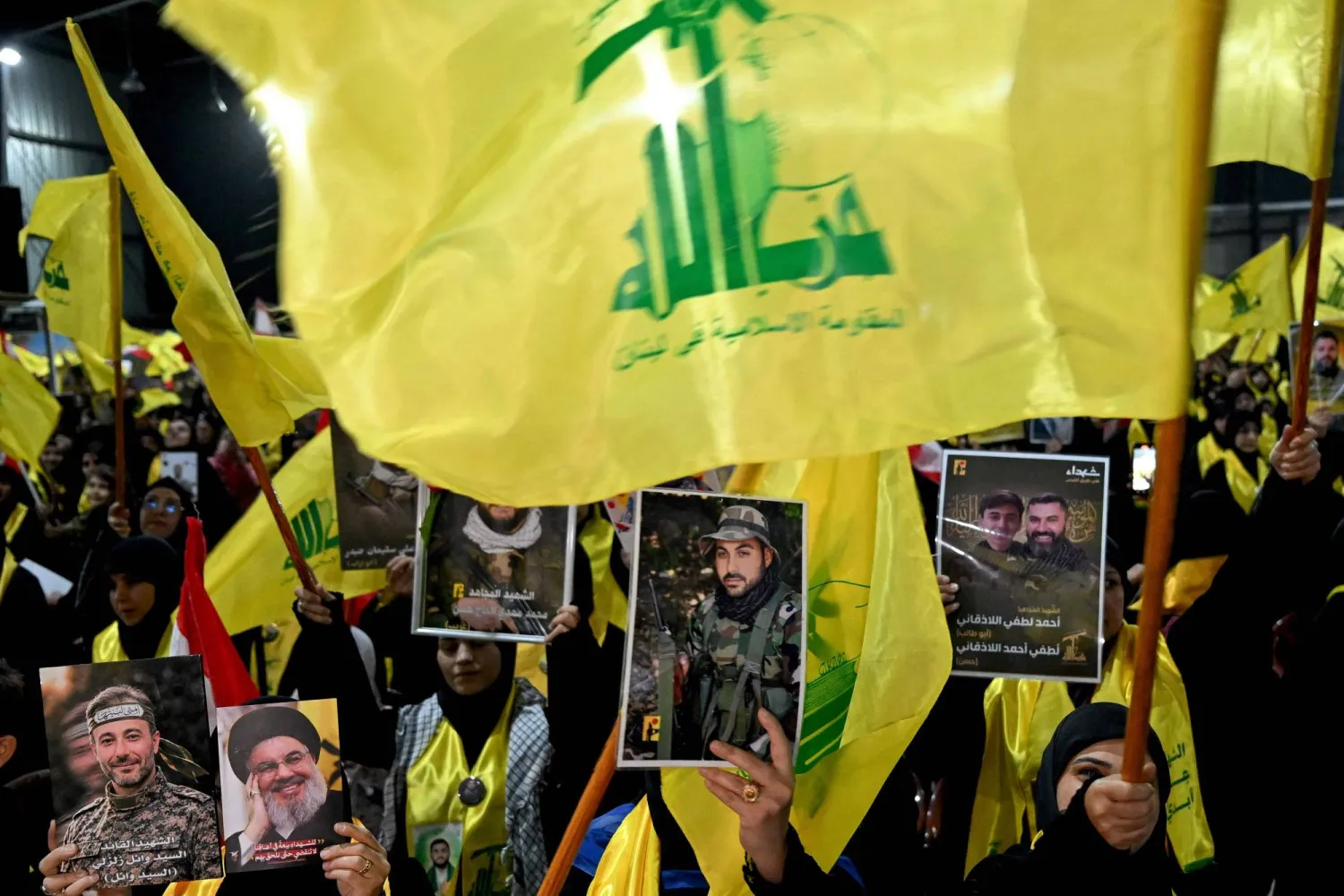

Three recent security operations in Lebanon have raised significant questions about the nature of the targets involved and the areas where the operations took place, bringing renewed attention to the issue of placing all weapons under state control.
The developments have also raised questions about whether Lebanese authorities have begun changing their approach toward Hezbollah amid mounting domestic and international pressure to implement government decisions on the group's weapons.
The operations included the seizure of a shipment of explosives belonging to Hezbollah at an Internal Security Forces checkpoint in Dahr al-Baidar in early October, the arrest of five Hezbollah members carrying maps and written plans in the northern Bsharri area, and an army raid on a weapons and ammunition warehouse in Musharrafieh, in Beirut's southern suburbs.
Although differing in scope, all three operations represent a departure, to varying degrees, from the authorities' traditional approach to dealing with Hezbollah, its members, its weapons and areas under its influence.
The ongoing judicial proceedings against Hezbollah members in the Dahr al-Baidar explosives case and the Bsharri case are considered unprecedented in the history of relations between the Lebanese authorities and the group.
Hezbollah had long enjoyed political, security, military and judicial protection, with successive governments classifying its activities as acts of "resistance."
While these developments may suggest the beginning of a new phase of tighter security measures against Hezbollah, several officials and experts familiar with the security situation say they are not yet sufficient to indicate a fundamental shift in state policy.
They point to the absence of a clear official decision to pursue and arrest Hezbollah members for their affiliation with its military wing, or to launch systematic operations targeting the group's weapons depots beyond the area south of the Litani River.
Limited Measures
Retired Brigadier General Dr. Hisham Jaber, director of the Middle East Center for Strategic Studies, said the government had wasted considerable time implementing its decision to establish exclusive state control over weapons.
He argued that, unable to enforce its decisions concerning Hezbollah, the government was seeking a way to contain domestic and international pressure while saving face through limited measures targeting the group.
Speaking to Asharq Al-Awsat, Jaber said the current actions fall short of a broad security operation or a genuine change in how the authorities deal with Hezbollah.
Instead, he described them as limited measures intended to demonstrate that the state is taking action and implementing its decisions without entering into a direct confrontation with the group.
Jaber dismissed concerns that implementing government decisions would necessarily push Lebanon toward civil war, arguing that there was little reason to fear such a conflict as long as the army remained cohesive and capable of fulfilling its responsibilities.
However, he warned of what he described as Israeli attempts to fuel internal strife, suggesting that the coming period could witness security incidents and assassinations.
He also interpreted campaigns targeting Lebanese Army Commander General Rodolphe Haykal as attempts to undermine his position and pressure him into leaving office, potentially leading to his dismissal.
Government Decisions
The Lebanese government has adopted a series of decisions aimed at placing all weapons under the exclusive control of the state and its legitimate military and security institutions.
Among the most significant was an August 5, 2025, decision instructing the army to prepare a phased plan to withdraw unauthorized weapons and place them under state control.
The government subsequently approved and welcomed the plan on September 5 of the same year.
On March 2, 2026, the government went further, announcing a ban on all Hezbollah military and security activities, declaring them illegal and demanding that the group surrender its weapons to the state and restrict its activities to politics.
The government also instructed the army and security agencies to take the necessary measures to prevent unauthorized military or security activities and pursue violators.
'Individual Initiatives'
Security and defense researcher and writer Dr. Riad Kahwaji said the government and relevant security agencies had failed to implement any of these decisions.
He argued that all the recent incidents had occurred by chance rather than as part of an organized security operation or comprehensive plan.
He also said there had been no systematic raids on Hezbollah weapons depots or storage facilities outside the area south of the Litani River.
Speaking to Asharq Al-Awsat, Kahwaji said the government decisions remained largely unimplemented because President Joseph Aoun and Army Commander General Haykal were unwilling to proceed with their enforcement, citing the need to preserve civil peace and avoid internal confrontation.
He pointed out that the arrest of the five Hezbollah members in Bsharri and the interception of the explosives shipment at the Dahr al-Baidar checkpoint were carried out by Internal Security Forces personnel rather than through a centrally coordinated security operation backed by a clear political decision to pursue Hezbollah members.
Kahwaji argued that the incidents highlighted the considerable freedom of movement and protection Hezbollah had traditionally enjoyed, allowing its members to operate and travel throughout Lebanon without significant restrictions.
He concluded that what had been uncovered so far was merely the tip of the iceberg, suggesting that numerous other security-related cases had yet to be exposed or investigated.


