


Türkiye Warns of Possible Israeli Military Operation in Syria

Turkish Foreign Minister Hakan Fidan. (Reuters)
TT

Türkiye Warns of Possible Israeli Military Operation in Syria

Turkish Foreign Minister Hakan Fidan. (Reuters)

Türkiye has warned that Israel could launch a military operation in Syria, potentially escalating regional tensions, while stressing that Ankara and Damascus share the same position on regional stability.

Turkish Foreign Minister Hakan Fidan accused Israel of supporting a Druze group in southern Syria in an attempt to provoke the Syrian army and create a pretext for military intervention.

In a televised interview late Saturday, Fidan said Ankara “had warned its regional allies, the United States and European countries of the possibility, cautioning that such a move could trigger fresh conflicts and instability across the region.”

He accused Israel “of seeking to keep neighboring countries unstable and divided rather than allowing strong, stable states to emerge along its borders.”

Fidan described Syria’s Druze community as “divided into three major clans, two of which support the Syrian government and oppose Israel.”

“The third receives Israeli support, including weekly deliveries of weapons and ammunition by helicopter,” he revealed.

According to Fidan, the group is seeking to provoke the Syrian army.

He warned that “any Israeli military intervention could have repercussions beyond Syria, urging international actors to closely monitor developments in the country’s south.”

Turning to Syria’s transition following the overthrow of Bashar al-Assad in 2024, Fidan pointed to “genuine progress toward stability and reconstruction, although the process has sometimes been slow because of the scale of the destruction.”

He noted that the “devastation extended beyond buildings to institutions and administrative systems, making the restoration of hope a lengthy process.”

“The return of Syrians to their homeland is essential to reviving the economy,” he stressed, alongside the lifting of international sanctions. He also praised the Syrian government and leadership “for demonstrating responsible conduct toward the international community.”

He urged the international community to take responsibility for halting Israel’s policies toward Syria and emphasized the need to uphold the 1974 Disengagement Agreement between the two countries.

“Preserving stability in Syria remains Türkiye’s top priority,” he added.

His remarks followed talks in Ankara last Tuesday involving Fidan, Turkish Defense Minister Yasar Guler and their Syrian counterparts, Asaad al-Shaibani and Murhaf Abu Qasra.

The discussions focused on developments in Syria, strengthening military and security cooperation, counterterrorism and border security, as well as expanding cooperation in trade, investment, energy, transportation, health, education and other economic sectors.

The ministers also discussed initial steps toward activating the joint high committee responsible for bilateral relations.

Fidan stressed that “Syria’s policies of avoiding instability, terrorism and aggression in the region were fully aligned with Türkiye’s approach.”

However, he acknowledged that Syria continued to face internal challenges, particularly the issue of the Kurdish-led Syrian Democratic Forces (SDF).

The issue is also linked to Türkiye’s ongoing “Terror-Free Türkiye” initiative, centered on the dissolution and disarmament of the Kurdistan Workers’ Party (PKK), a process the Kurdish side refers to as the “Peace and Democratic Society Process.”

Fidan outlined two dimensions to the SDF issue: one tied to developments within Türkiye and the other to the process underway in Syria.

He suggested that both were moving toward an outcome that could benefit the two countries, referring to efforts to integrate the SDF into Syrian state institutions.

Against this backdrop, Fidan stressed that “the withdrawal of US forces from Syria and Iraq was crucial to Türkiye’s goal of establishing a terrorism-free region.”


Türkiye Warns of Possible Israeli Military Operation in Syria

Turkish Foreign Minister Hakan Fidan. (Reuters)
TT

Türkiye Warns of Possible Israeli Military Operation in Syria

Turkish Foreign Minister Hakan Fidan. (Reuters)

Türkiye has warned that Israel could launch a military operation in Syria, potentially escalating regional tensions, while stressing that Ankara and Damascus share the same position on regional stability.

Turkish Foreign Minister Hakan Fidan accused Israel of supporting a Druze group in southern Syria in an attempt to provoke the Syrian army and create a pretext for military intervention.

In a televised interview late Saturday, Fidan said Ankara “had warned its regional allies, the United States and European countries of the possibility, cautioning that such a move could trigger fresh conflicts and instability across the region.”

He accused Israel “of seeking to keep neighboring countries unstable and divided rather than allowing strong, stable states to emerge along its borders.”

Fidan described Syria’s Druze community as “divided into three major clans, two of which support the Syrian government and oppose Israel.”

“The third receives Israeli support, including weekly deliveries of weapons and ammunition by helicopter,” he revealed.

According to Fidan, the group is seeking to provoke the Syrian army.

He warned that “any Israeli military intervention could have repercussions beyond Syria, urging international actors to closely monitor developments in the country’s south.”

Turning to Syria’s transition following the overthrow of Bashar al-Assad in 2024, Fidan pointed to “genuine progress toward stability and reconstruction, although the process has sometimes been slow because of the scale of the destruction.”

He noted that the “devastation extended beyond buildings to institutions and administrative systems, making the restoration of hope a lengthy process.”

“The return of Syrians to their homeland is essential to reviving the economy,” he stressed, alongside the lifting of international sanctions. He also praised the Syrian government and leadership “for demonstrating responsible conduct toward the international community.”

He urged the international community to take responsibility for halting Israel’s policies toward Syria and emphasized the need to uphold the 1974 Disengagement Agreement between the two countries.

“Preserving stability in Syria remains Türkiye’s top priority,” he added.

His remarks followed talks in Ankara last Tuesday involving Fidan, Turkish Defense Minister Yasar Guler and their Syrian counterparts, Asaad al-Shaibani and Murhaf Abu Qasra.

The discussions focused on developments in Syria, strengthening military and security cooperation, counterterrorism and border security, as well as expanding cooperation in trade, investment, energy, transportation, health, education and other economic sectors.

The ministers also discussed initial steps toward activating the joint high committee responsible for bilateral relations.

Fidan stressed that “Syria’s policies of avoiding instability, terrorism and aggression in the region were fully aligned with Türkiye’s approach.”

However, he acknowledged that Syria continued to face internal challenges, particularly the issue of the Kurdish-led Syrian Democratic Forces (SDF).

The issue is also linked to Türkiye’s ongoing “Terror-Free Türkiye” initiative, centered on the dissolution and disarmament of the Kurdistan Workers’ Party (PKK), a process the Kurdish side refers to as the “Peace and Democratic Society Process.”

Fidan outlined two dimensions to the SDF issue: one tied to developments within Türkiye and the other to the process underway in Syria.

He suggested that both were moving toward an outcome that could benefit the two countries, referring to efforts to integrate the SDF into Syrian state institutions.

Against this backdrop, Fidan stressed that “the withdrawal of US forces from Syria and Iraq was crucial to Türkiye’s goal of establishing a terrorism-free region.”


Ukraine Claims Strikes on Two Russian Boats off Libya

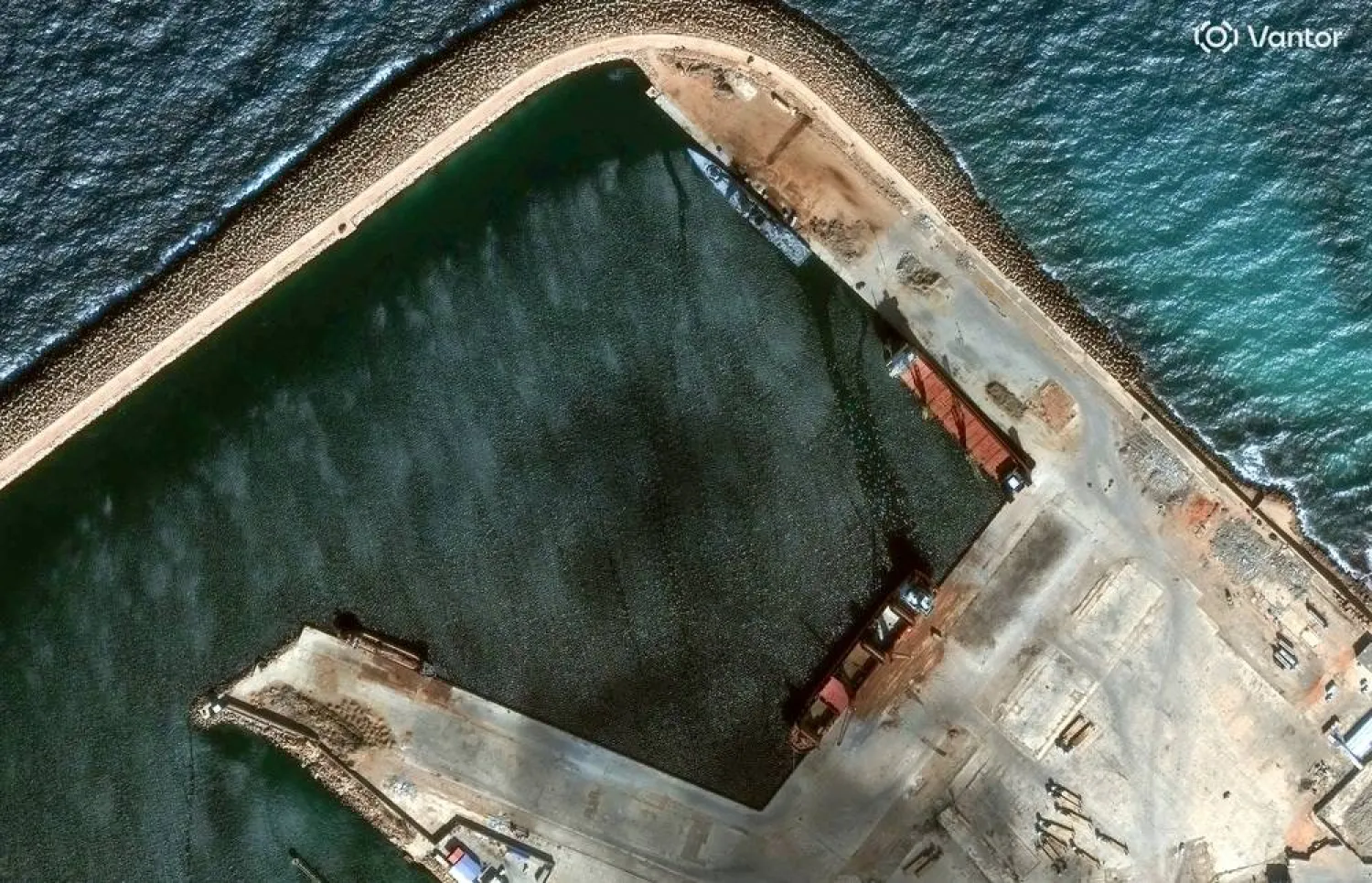
A satellite image shows a Russian naval ship and the northern port area before an explosion aboard a Russian ship docked at the Benghazi naval base, in Benghazi, Libya, November 21, 2026. (Vantor/Handout via Reuters)
TT

Ukraine Claims Strikes on Two Russian Boats off Libya

A satellite image shows a Russian naval ship and the northern port area before an explosion aboard a Russian ship docked at the Benghazi naval base, in Benghazi, Libya, November 21, 2026. (Vantor/Handout via Reuters)

Ukrainian President Volodymyr Zelenskyy said his country was behind an attack on a Russian warship off Libya on Sunday, claiming Ukrainian naval drones sank the vessel. 

Zelenskyy said Monday in a post on X that Ukrainian forces deployed seven domestically made naval drones in the operation, which sank a Russian corvette. The Ukrainian leader described the ship as one of Russia’s newest vessels commissioned in 2023 during the invasion. 

“We continue our operations in designated waters. We are responding to Russia’s aggression. We are developing Ukrainian weapons,” he said. 

Ukrainian forces also struck the Russian dry cargo ship MV Angara, which Zelenskyy said Moscow used to transport weapons. He added that a Ka-27 military helicopter was destroyed in the attack. 

Zelenskyy thanked the Security Service of Ukraine, known as the SBU, and other Ukrainian defense forces that took part in what he described as “an exemplary Ukrainian operation in response to Russia’s war.” 

Zelenskyy said he received detailed briefings on Sunday and Monday and that “the targets we set were achieved.” 

The strike by sea drones severely damaged the Russian navy corvette at the Benghazi Naval Base in eastern Libya, according to two Libyan officials. 

Residents in Benghazi heard loud explosions and saw fire at the base early Sunday. Civil defense rushed to the site and extinguished t the fire, authorities in eastern Libya said. 

The vessel had docked to refuel and take on supplies as part of a cooperation agreement between Russia and the eastern-based government in Libya, the statement said without providing details about the vessel or its cargo. 


Yemen Demands Int’l Accountability for Houthi Violations against Children

A boy carries a jerrycan as he walks at a makeshift camp for internally displaced people near Mukalla, Yemen November 3, 2026. (Reuters)
TT

Yemen Demands Int’l Accountability for Houthi Violations against Children

A boy carries a jerrycan as he walks at a makeshift camp for internally displaced people near Mukalla, Yemen November 3, 2026. (Reuters)

The scope of Houthi violations against children in Yemen has grown amid the ongoing war and military escalation to include killing, injury, recruitment, and detention, in addition to the targeting of schools and healthcare facilities and the deprivation of hundreds of thousands of basic life necessities, reflecting the mounting humanitarian toll paid by an entire generation due to the protracted conflict.

In the latest international move regarding these violations, the Yemeni government sent a letter to United Nations Secretary-General António Guterres, Security Council President Ambassador Sanita Pavļuta-Deslandes, and the United Nations Children's Fund (UNICEF), calling for urgent international action to halt what it described as grave violations committed by the Houthi group against children and to hold those responsible accountable.

The letter, delivered by Yemen's Permanent Representative to the United Nations Ambassador Abdullah Al-Saadi, coincided with World Children's Day and drew on a documented tally prepared by the Yemeni Ministry of Human Rights, which recorded 3,334 violations against civilians and civilian objects across 15 governorates between August 1 and November 15.

According to government data, the civilian casualty toll included 215 children killed and injured, while the ministry documented the deaths of 260 children previously recruited by the Houthi group and sent to the battlefronts, in an indication of the growing dangers facing children, both in areas close to the fighting and inside territories under the terrorist militia's control.

Recruitment begins at schools

The letter also highlights systematic practices to attract and recruit minors, including exploiting the school environment, exerting social pressure on families, and utilizing summer centers, as well as cultural and religious activities in mobilization efforts.

The government said that the killing of 260 children, who had been recruited and thrust onto the battlefronts during the documented period, underscores the danger of turning children into part of the war effort rather than providing them with the necessary protection.

It warned that the continuation of these practices threatens their lives and leaves lasting psychological and social impacts.

Attacks on displacement sites

The Ministry of Human Rights also documented violations in the Marib and Taiz governorates where children came under attack in residential areas and displacement sites.

In Marib, Houthi shelling targeting a displacement site in the Raghwan district on September 8 killed two children and injured 15 civilians, including eight children.

In Taiz, the ministry documented the killing of three children in the village of Al-Turairah on September 17. Shelling targeting the Wadi Al-Qadi neighborhood on September 24 also a killed three-year-old boy and injured five others.

The repercussions of the escalation extend beyond human casualties, with government data revealing that 93 educational facilities were targeted or damaged in attacks and unlawful use. Classes were suspended at 243 schools due to restrictions and military escalation. disrupting the education of more than 137,000 children.

Health sector

In the healthcare sector, the Ministry of Human Rights documented 517 violations involving medical facilities and resources, including hospitals, clinics, health centers, medicine warehouses, and ambulances, compounding the difficulty for children and families in accessing medical care and medication.

The government warned that obstructing the work of health institutions or preventing civilians from reaching them undermines the health system's ability to respond to recurring needs, particularly in areas affected by clashes and displacement.

The letter also raised the issue of banning vaccination campaigns and obstructing the arrival of vaccines in Houthi-controlled areas. Restrictions imposed on basic immunizations heighten the risks of the spread of infectious diseases, especially polio and measles, and expose children's lives to preventable dangers.

Faced with these figures, the Yemeni government called on the UN and the Security Council to strengthen monitoring, verification, and reporting mechanisms on grave violations, in coordination with the Office of the Special Representative of the Secretary-General for Children and Armed Conflict, and to ensure accountability for those responsible.

It also demanded that the Houthis be compelled to halt the recruitment of children, release detainees, rehabilitate and reintegrate child recruits, respect the legal protection of schools and hospitals, and bolster support for protection, healthcare, and educational institutions in Yemen.

It stressed the need for the full implementation of Security Council resolutions concerning Yemen, adding that protecting children requires moving beyond documenting violations to practical measures that curb the abuses and end impunity.