


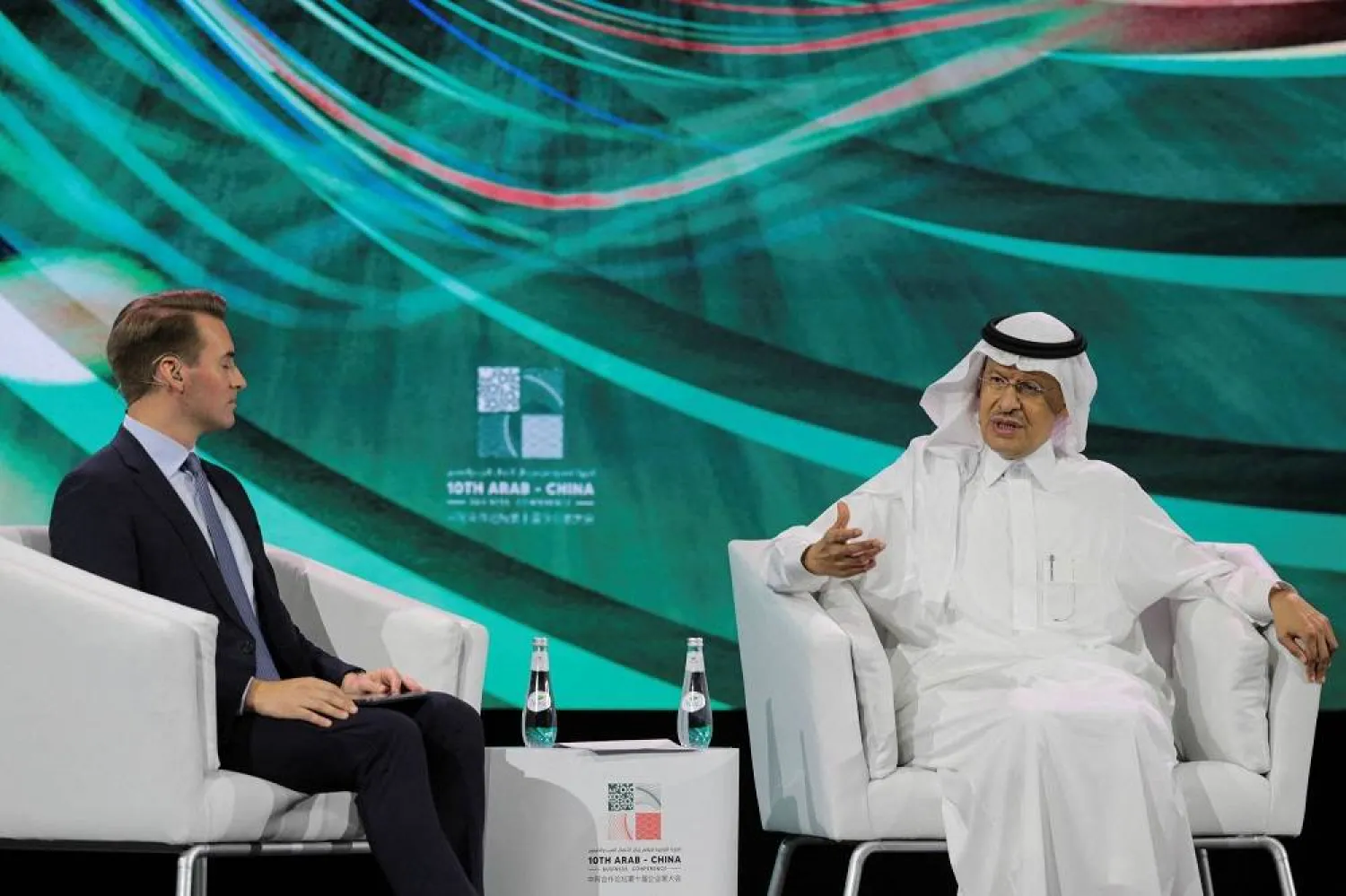

In front of a giant screen, with the 10th Arab and Chinese Businessmen Conference on display, Dan Murphy, the American CNBC anchor, interviewed Saudi Minister of Energy Prince Abdulaziz bin Salman on how to enhance cooperation between Arab countries and China.
Murphy appeared alone among dozens of Arab and Chinese officials, who filled the halls of the King Abdulaziz Conference Center in Riyadh on Sunday, drawing attention to the greater influence of China in the region.
The energy minister’s speech and his answers to Murphy’s questions gave another indication of the growing Chinese role and its importance in Saudi Arabia and many other Arab countries.
In remarks during the session, Prince Abdulaziz said there were synergies between the two countries, as the Kingdom is progressing steadily with its Vision 2030 plan, while China is pursuing its Belt and Road Initiative.
He added: “We believe that there are so many global opportunities, as Saudi Arabia is in a pivotal geographical position that could enable us to reach out to so many parties, be engaged, and be involved with everybody. Those who would like to invest with them, we are here. Those who would like to invest with us, we are also here.”
The minister’s statements came two days after US Secretary of State Antony Blinken’s assertion that Washington “will not leave the Middle East.” He spoke at a press conference with his Saudi counterpart during his visit to Riyadh.
Blinken added that the China-sponsored agreement to restore relations between Saudi Arabia and Iran was “a good thing” if it helps reduce tensions.
The Saudi energy minister, who stressed that he ignores criticism about his country’s growing relations with China, said the Kingdom goes where the opportunities are.
“(...) The demand for oil in China is still increasing… So we have to get part of it, and we also want to invest in China. The reality today is that China has taken the lead, and it will continue to do so. We do not have to compete with China, we have to cooperate with it,” he stated.
Abdulaziz bin Sager, head of the Gulf Research Center, believes that China was “presenting itself as the alternative that can be resorted to” when positions are at odds with the United States.
Despite his assertion that there are great opportunities to develop the Arab-Chinese partnership, he criticized the Arab and Chinese participants’ use of English to discuss Arab-Chinese affairs.
He said: “Language is not just a means of communication, but a cultural component, awareness and perception.”
“Arabs and Chinese need to think about how they perceive each other. If language is a cultural component, we wonder if Arabs and Chinese see each other through a Western cultural lens,” he added.


