


Oil Climbs, Rouble Falls as Markets Take Mutiny in Stride

FILE PHOTO: A pump jack operates in front of a drilling rig at sunset in an oilfield in Midland, Texas US August 22, 2018. REUTERS/Nick Oxford/File Photo
TT

Oil Climbs, Rouble Falls as Markets Take Mutiny in Stride

FILE PHOTO: A pump jack operates in front of a drilling rig at sunset in an oilfield in Midland, Texas US August 22, 2018. REUTERS/Nick Oxford/File Photo

Oil was slightly higher on Monday and the rouble lower as an abortive weekend mutiny by Russian mercenaries raised questions about Russian stability and crude supply, but left investors hesitant to draw any further conclusions.

Brent crude futures were last up 0.2% at $74.02 a barrel having earlier fetched as much as $74.80. The rouble dropped to a 15-month low early in Moscow, Reuters said.

MSCI's index of Asia-Pacific shares outside Japan slipped to a three-week low, as small falls in China, Taiwan and Australia offset minor gains in South Korea.

Japan's Nikkei eased 0.1%. The battered yen rose marginally on hints at looming government intervention to support it and after a summary showing a central bank board called for an early revision of yield curve control.

European futures gained 0.3%, S&P 500 futures rose 0.2% and FTSE futures added 0.1%.

Russian mercenaries made a short-lived rebellion on Saturday, seizing the southern city of Rostov and advancing on Moscow demanding the removal of Russian military commanders in charge of the war in Ukraine.

The private Wagner army then withdrew after striking a deal guaranteeing their safety and the passage of their leader, Yevgeny Prigozhin, to Belarus.

The consequences for the Ukraine war were not clear, though the challenge to Russian President Vladimir Putin's authority was the starkest in decades of his leadership.

"I don't think the market can get its head around working out if there are implications," said Ray Attrill, head of foreign exchange strategy at National Australia Bank in Sydney.

Analysts at RBC Capital Markets said one concern was the possibility of martial law in Russia and its effect on the workforce at ports and oil production facilities.

Gold, which had hit a three-month low on Friday, rose 0.2% to $1,925 an ounce. US Treasuries were firm with yields, which fall when prices rise, marginally lower.

Two-year yields fell 2 basis points to 4.731%. Ten-year yields fell 1.8 bps to 3.721%.

"This putsch ... has revealed cracks and fragilities that now cannot be unseen," said Mizuho economist Vishnu Varathan.

"It undeniably amplifies global geopolitical risks."

CHINA FOCUS

With the mutiny being on the watchlist rather than driving action in Asia, investors were left to pore over the latest signs of China's recovery stalling, which on Monday was softer-than-hoped-for travel figures for last week's holiday.

S&P Global also followed most Wall Street banks and cut its 2023 GDP growth forecast for China on Sunday.

Blue chip stocks fell 0.7% in Shanghai.

The yuan slid to catch up offshore falls during the break on Thursday and Friday, but the People's Bank of China fixed the midpoint of its trading band surprisingly strong, suggesting it might not be so tolerant of further weakness.

The yuan was last at a seven-month low of 7.2199 per dollar.

The risk-sensitive Australian dollar was steady at $0.6683. The euro nursed last week's modest drop at $1.0903 and sterling held at $1.2730.

The yen, down nearly 9% this year as global interest rate expectations rise and Japan's central bank stays dovish, bounced as much as 0.3% to 143.27 per dollar, partly thanks to speculation around intervention or a policy shift.

Japan's top currency diplomat Masato Kanda toughened his tone on Monday, describing recent moves as "rapid and one-sided" in a possible prelude to intervening to buy yen.

A Bank of Japan policymaker also called for revision to its yield curve control policy, a summary of opinions at the June meeting showed on Monday, suggesting the central bank's ultra-loose monetary settings may be at a crossroads.



Riyadh to Host Middle East’s Largest General Aviation Airshow in November 

The AERO Middle East x Sand & Fun 2026 will be held in Riyadh from November 24 to 28. (SPA)
TT

Riyadh to Host Middle East’s Largest General Aviation Airshow in November 

The AERO Middle East x Sand & Fun 2026 will be held in Riyadh from November 24 to 28. (SPA)

The Saudi Aviation Club announced that it will organize the AERO Middle East x Sand & Fun 2026 in Riyadh from November 24 to 28, reported the Saudi Press Agency on Tuesday.

The event is set to be the largest of its kind for general aviation in the Middle East, combining international business, investment, and innovation with live flying displays and interactive public experiences. It is being held in partnership with Messe Frankfurt Saudi Arabia.

Held at Thumamah Airport, the exhibition will bring together leading global companies operating in the general aviation industry, including aircraft and components manufacturers, avionics and navigation systems providers, as well as maintenance, repair, and overhaul (MRO) companies, offering an integrated platform that covers the full value chain of the sector.

The event will also spotlight startups in advanced air mobility (AAM) and innovators of electric vertical take-off and landing (eVTOL) aircraft, showcasing technologies and business models shaping the future of aviation.

General Supervisor of the Saudi Aviation Club Dr. Ahmed Alfahaid stated that AERO Middle East x Sand & Fun 2026 represents a qualitative leap for the Kingdom’s aviation sector and reinforces its positioning as a global hub for general aviation and advanced air mobility.

The partnership with Messe Frankfurt Saudi Arabia goes beyond presenting global innovations to providing a vital platform for international investment and strategic collaboration, he stressed.

Moreover, the event contributes to achieving Saudi Vision 2030 objectives, including the Kingdom’s ambition to rank among the world’s top 10 general aviation markets, he added.


Saudi Arabia, Kazakhstan Agree to Establish Coordination Council

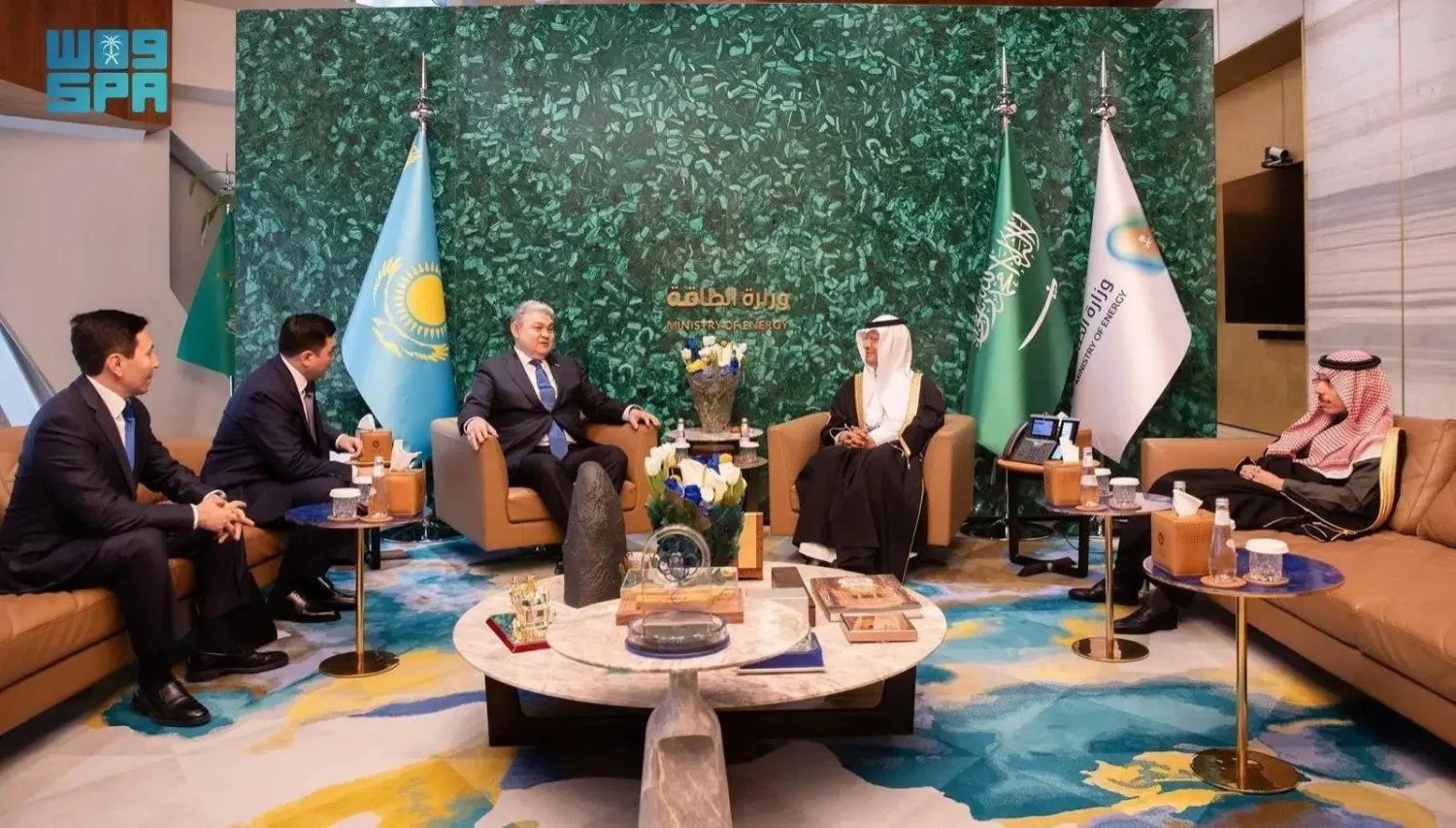
Saudi Minister of Energy Prince Abdulaziz bin Salman bin Abdulaziz receives Kazakhstan’s Foreign Minister Yermek Kosherbayev in Riyadh. (SPA)
TT

Saudi Arabia, Kazakhstan Agree to Establish Coordination Council

Saudi Minister of Energy Prince Abdulaziz bin Salman bin Abdulaziz receives Kazakhstan’s Foreign Minister Yermek Kosherbayev in Riyadh. (SPA)

Saudi Arabia and Kazakhstan agreed to establish a Saudi-Kazakh Coordination Council, reported the Saudi Press Agency on Tuesday.

Saudi Minister of Energy Prince Abdulaziz bin Salman bin Abdulaziz received in Riyadh Kazakhstan’s Foreign Minister Yermek Kosherbayev. Saudi FM Prince Faisal bin Farhan bin Abdullah and Minister of Energy of Kazakhstan Yerlan Akkenzhenov also attended the meeting.

The talks tackled the establishment of the coordination council, which will be chaired by the Saudi minister of energy and Kazakhstan’s foreign minister. The council reflects the two countries’ commitment to strengthening cooperation and expanding their bilateral partnership.

Prince Abdulaziz and Kosherbayev signed an agreement on the establishment of the council, which aims to boost coordination and consultation between the two countries and develop frameworks for cooperation across various sectors of mutual interest, elevating bilateral relations to broader levels.

Prince Abdulaziz and Kosherbayev discussed relations between their countries and ways to develop them further, especially in the energy field. They tackled opportunities for cooperation and investment in renewable energy and energy storage systems and discussed oil market developments.


Saudi-Qatari Partnership Paves Way for Logistics Corridors to Boost Regional Trade Efficiency 

The MoU was signed by Mawani President Eng. Suliman Almazroua and CEO of Qatar Ports Management Company Captain Abdullah Mohammed Al-Khanji. (QNA)
TT

Saudi-Qatari Partnership Paves Way for Logistics Corridors to Boost Regional Trade Efficiency 

The MoU was signed by Mawani President Eng. Suliman Almazroua and CEO of Qatar Ports Management Company Captain Abdullah Mohammed Al-Khanji. (QNA)

The Saudi Ports Authority (Mawani) and Qatar Ports Management Company signed on Tuesday a memorandum of understanding (MoU) aimed at boosting maritime and logistics cooperation between the two sides.

The agreement will contribute to the development of the ports sector, raising operational efficiency, and supporting regional and international trade flows.

The MoU was signed by Mawani President Eng. Suliman Almazroua and CEO of Qatar Ports Management Company Captain Abdullah Mohammed Al-Khanji. Qatari Ambassador to Saudi Arabia Bandar bin Mohammed Al Attiyah attended the signing ceremony.

The agreement reflects Saudi Arabia and Qatar’s commitment to building effective partnerships, exchanging expertise, establishing an organized framework for cooperation management, and developing joint investment opportunities in line with Saudi Vision 2030 and Qatar National Vision 2030.

The MoU outlines eight key areas of cooperation, including the exchange of best practices in port management and operations, and the study of opportunities for direct maritime and land connectivity between the ports of both countries to enhance trade flow efficiency.

It includes collaboration in logistics services, exploring the establishment of joint maritime corridors serving bilateral and regional trade, and assessing the feasibility of creating shared regional distribution centers.

In the fields of digital transformation and artificial intelligence, the two sides agreed to deepen cooperation on developing smart systems, data governance, and the unified maritime window, thereby boosting operational efficiency and keeping pace with technological advancements in the maritime sector.

The MoU places strong emphasis on maritime safety and environmental protection, including exchanging expertise in combating marine pollution and emergency response; developing joint maritime emergency plans; establishing an emergency communication line between the two countries; and cooperating to ensure compliance with international conventions, conduct joint exercises, and develop risk monitoring systems.

The cooperation also covers human capital development through joint training programs and field-exchange of expertise, as well as academic and research collaboration in maritime transport and logistics.

In terms of joint investment, both sides will study local and global investment opportunities in ports and related services and coordinate with the private sector to support these initiatives.

The MoU further includes cooperation in cruise tourism through enhanced maritime connectivity and joint promotion of Gulf cruise routes, as well as international and regional representation by coordinating positions in international maritime organizations and supporting joint initiatives, notably “Green Ports” and “Safe Sea Corridors.”

The agreement reflects the commitment of Mawani and Qatar Ports Management Company to advancing the ports sector and boosting its role as a key driver of trade and economic growth, contributing to Gulf integration and enhancing regional competitiveness in maritime and marine services.