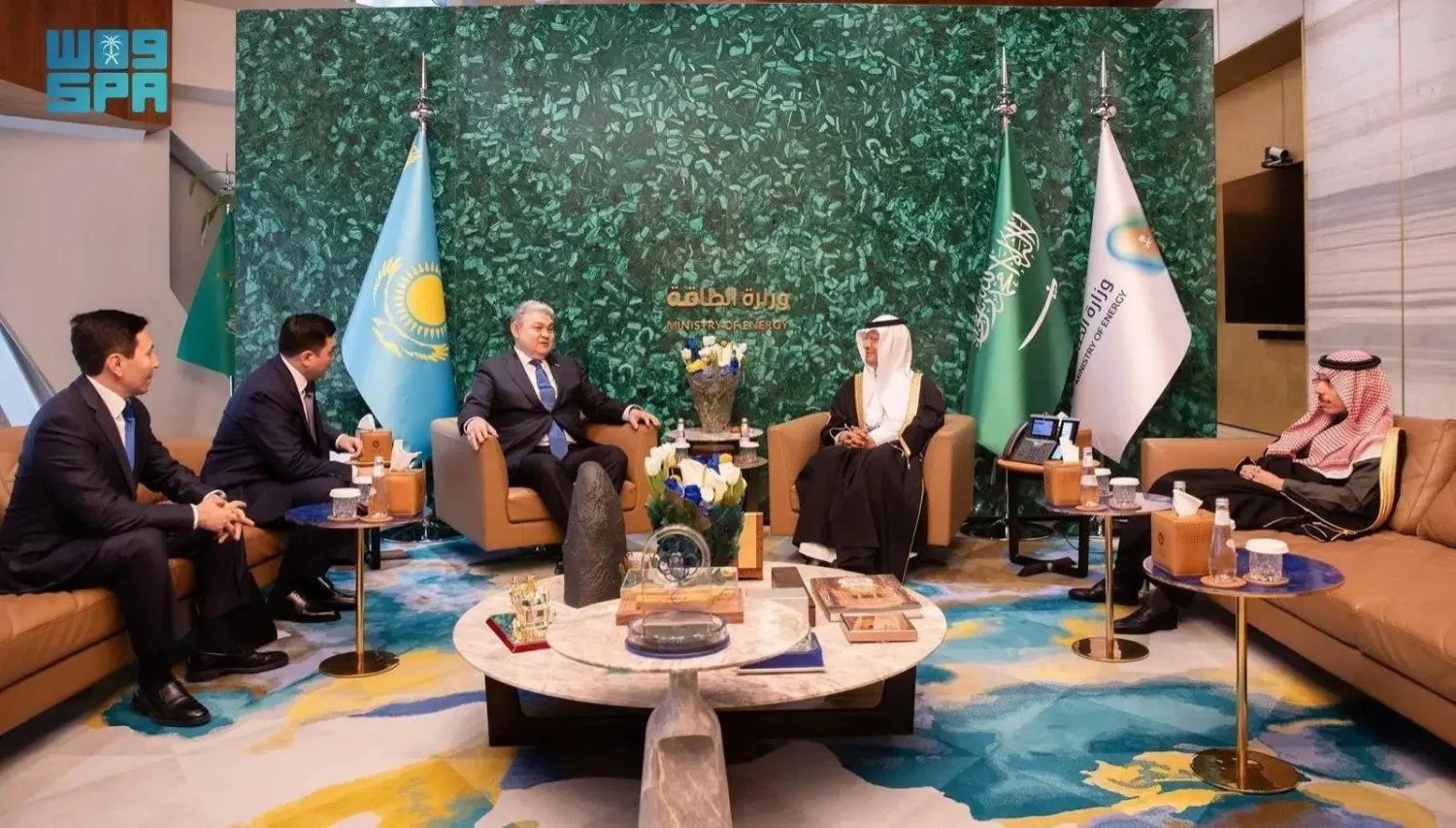
Saudi Arabia, Kazakhstan Agree to Establish Coordination Council

Saudi Minister of Energy Prince Abdulaziz bin Salman bin Abdulaziz receives Kazakhstan’s Foreign Minister Yermek Kosherbayev in Riyadh. (SPA)
TT

Saudi Arabia, Kazakhstan Agree to Establish Coordination Council

Saudi Minister of Energy Prince Abdulaziz bin Salman bin Abdulaziz receives Kazakhstan’s Foreign Minister Yermek Kosherbayev in Riyadh. (SPA)

Saudi Arabia and Kazakhstan agreed to establish a Saudi-Kazakh Coordination Council, reported the Saudi Press Agency on Tuesday.

Saudi Minister of Energy Prince Abdulaziz bin Salman bin Abdulaziz received in Riyadh Kazakhstan’s Foreign Minister Yermek Kosherbayev. Saudi FM Prince Faisal bin Farhan bin Abdullah and Minister of Energy of Kazakhstan Yerlan Akkenzhenov also attended the meeting.

The talks tackled the establishment of the coordination council, which will be chaired by the Saudi minister of energy and Kazakhstan’s foreign minister. The council reflects the two countries’ commitment to strengthening cooperation and expanding their bilateral partnership.

Prince Abdulaziz and Kosherbayev signed an agreement on the establishment of the council, which aims to boost coordination and consultation between the two countries and develop frameworks for cooperation across various sectors of mutual interest, elevating bilateral relations to broader levels.

Prince Abdulaziz and Kosherbayev discussed relations between their countries and ways to develop them further, especially in the energy field. They tackled opportunities for cooperation and investment in renewable energy and energy storage systems and discussed oil market developments.


Saudi Arabia Prepares New Pathways for Its Companies to Enter the Syrian Market

Syrian President Ahmed Al-Sharaa with businesspeople during the Saudi-Syrian Investment Forum in Damascus (SPA)
TT

Saudi Arabia Prepares New Pathways for Its Companies to Enter the Syrian Market

Syrian President Ahmed Al-Sharaa with businesspeople during the Saudi-Syrian Investment Forum in Damascus (SPA)

Asharq Al-Awsat has learned that the Saudi-Syrian Business Council is currently working on around three new pathways that are still being developed as part of an institutional framework aimed at facilitating the entry of Saudi companies into the Syrian market and paving the way for new sector-specific projects in the coming stages.

Saudi-Syrian economic relations have developed since last year, following the arrival in Damascus of a high-level Saudi delegation led by then Investment Minister Khalid Al-Falih. The delegation included more than 130 businesspeople and investors, reflecting the scale of official and economic interest in strengthening trade and investment ties between the two countries.

The visit saw the signing of more than 47 agreements and memorandums of understanding across 11 vital sectors, with total investments exceeding $6.4 billion. They covered real estate, infrastructure, telecommunications and information technology, industry, and other sectors.

Coordination with the “Syrian Sovereign Fund”

According to the information, a mechanism has been established to coordinate with the Syrian Investment Authority to form a joint team to study the development of land and sea logistics corridors. This would include facilitating direct access for exports and temporary admission procedures for equipment used to carry out projects.

In parallel, the Federation of Saudi Chambers has opened a direct channel with the Syrian sovereign fund to follow up on investment opportunities available to the Saudi private sector and support communication with relevant authorities in the Syrian market.

The council was established as Syria prepares for a new phase of reconstruction and development, creating opportunities for the Saudi private sector to participate in investment projects and various economic sectors, drawing on its financing and investment capabilities and its experience in project development.

Since its establishment, the council has begun preparing an action plan for 2025-2030 aimed at strengthening sustainable economic cooperation between Saudi Arabia and Syria, highlighting investment opportunities, supporting strategic partnerships, and facilitating trade and logistics procedures for Saudi companies' exports.

The plan focuses on enabling the Saudi private sector to benefit from reconstruction and development opportunities in Syria by supporting exports, simplifying procedures, and strengthening regulatory frameworks that provide a more favorable environment for investors. It focuses on sectors including infrastructure, trade and export development, real estate development, tourism, industry, and food security.

New Investments

In this context, Mohammed bin Abdullah Abu Nayyan, chairman of the Saudi-Syrian Business Council, said the council includes a number of senior Saudi officials and investors with international business activities, strengthening its ability to support trade and investment relations between the two countries and achieve its objectives.

The Saudi-Syrian Business Council delegation visited the Syrian capital, Damascus, last August, with the participation of 180 Saudi businesspeople. It held joint meetings and more than 15 meetings with government officials, in addition to eight sector-focused meetings and workshops addressing investment opportunities, challenges, and areas of cooperation.

During the visit, the delegation announced the “Sham View” project by Saudi real estate development and investment company Tharaa, with investments exceeding $1 billion. It also launched construction work on the Narcissus Damascus Hotel, owned by Saudi hotel and resort group Boudl.



Iraq Central Bank Devalues Dinar after Mideast War Hurts Oil Exports

An employee arranges stacks of Iraqi dinars at a currency exchange shop in Baghdad on Feb. 14, 2023. (AFP)
TT

Iraq Central Bank Devalues Dinar after Mideast War Hurts Oil Exports

An employee arranges stacks of Iraqi dinars at a currency exchange shop in Baghdad on Feb. 14, 2023. (AFP)

Iraq's central bank devalued the dinar currency against the dollar on Wednesday, with the country facing a deepening crisis brought on by the Middle East war.

Crude oil sales account for nearly 90 percent of Iraq's revenue but its exports have been hurt by the outbreak in February of the conflict between Iran and the United States, which choked off the Strait of Hormuz shipping route.

Consumer prices have also risen, while Iraq's foreign currency reserves have fallen by around $20 billion.

The central bank said in a statement late Tuesday that based on a government decision, "it had decided to adopt... a selling price of the US dollar to the public of 1,520 dinars.”

The rate had been fixed at 1,320 dinars since February 2023.

The bank instructed financial institutions to "stop using the previous rate and adopt the new rate as of the start of the business day on October 7,” AFP reported.

Iraq relies heavily on foreign currency generated by oil sales to finance imports, stabilize the dinar, and pay the salaries of public sector employees and retirees.


Gold Down 1% as Dollar Gains; Fed Minutes in Focus

A worker polishes gold bars at a refinery in Sydney (AFP)
TT

Gold Down 1% as Dollar Gains; Fed Minutes in Focus

A worker polishes gold bars at a refinery in Sydney (AFP)

Gold prices fell on a stronger US dollar on Wednesday, while investors awaited the minutes of the Federal Reserve's September meeting to gauge the degree of support among policymakers for further rate hikes.

Spot gold fell 0.98% to $4,122.73 per ounce by 0905 GMT. US gold futures for December delivery slid 0.91% to $4,149.00, Reuters reported.

The US dollar index rose 0.4%, making greenback-denominated gold more expensive for ⁠holders of other currencies.

"There ⁠is also an element of caution ahead of the release of the latest Federal Open Market Committee minutes later today," said ActivTrades director and CEO Ricardo Evangelista.

"Until there is greater clarity on that (support for rate hikes) front, there is probably some reluctance to take larger positions in gold."

After a softer US jobs ⁠data, markets now largely expect the Fed to stay pat in October, but are still pricing in an 86% chance of a hike in December, according to the CME's FedWatch tool.

Kansas City Fed President Jeff Schmid said rates still need to rise to bring inflation down, while San Francisco Fed President Mary Daly said the decision would rest on whether the factors pushing up inflation fade or persist.

Higher interest rates diminish the attractiveness of non-yielding gold.

"The downside remains supported by geopolitical uncertainty, concerns over ⁠government debt ⁠and inflation, and central bank demand," Evangelista said.

International Monetary Fund Managing Director Kristalina Georgieva warned on Wednesday that the global economy faces risks from persistently high energy prices, record public debt and risks from the AI investment boom.

Separately, delegates attending the London Bullion Market Association's annual conference in Italy forecast that gold could reach $5,013 an ounce over the next 12 months.

China's central bank stepped up its gold purchases in September, extending its buying streak to a 23rd consecutive month, official data showed.

Spot silver fell 2.2% to $60.3638 per ounce, platinum eased 3.0% to $1,650.45, and palladium lost 2.7% to $1,140.89.