


IMF Chief Says Hamas-Israel Conflict Is ‘Darkening the Horizon’ for World Economy

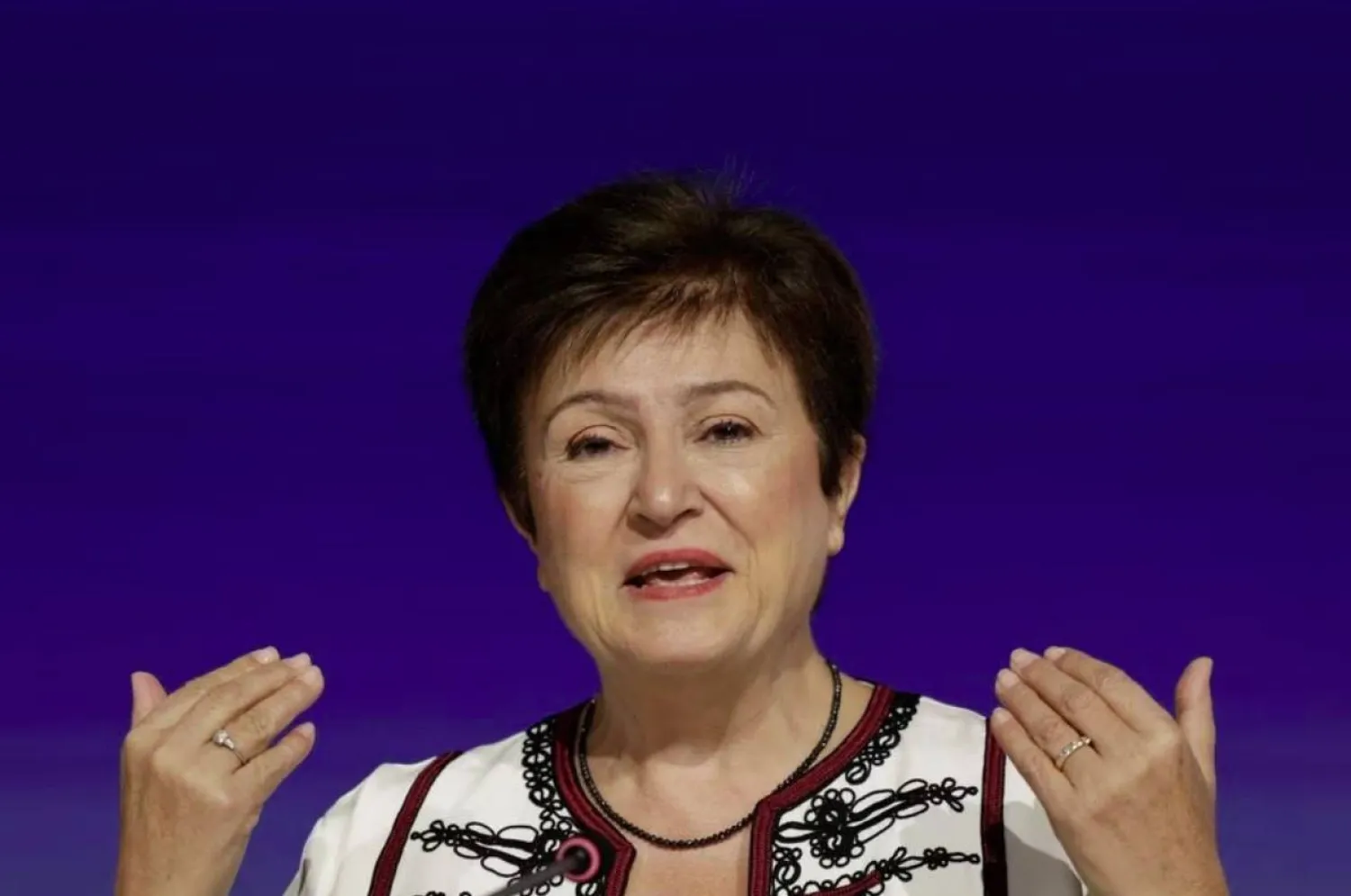
Managing Director of the International Monetary Fund (IMF), Kristalina Georgieva, addresses the media on the fourth day of the annual meeting of the IMF and the World Bank, following last month's deadly earthquake, in Marrakech, Morocco, October 12, 2023. REUTERS/Susana Vera Acquire Licensing Rights
TT

IMF Chief Says Hamas-Israel Conflict Is ‘Darkening the Horizon’ for World Economy

Managing Director of the International Monetary Fund (IMF), Kristalina Georgieva, addresses the media on the fourth day of the annual meeting of the IMF and the World Bank, following last month's deadly earthquake, in Marrakech, Morocco, October 12, 2023. REUTERS/Susana Vera Acquire Licensing Rights

International Monetary Fund managing director Kristalina Georgieva said on Thursday the Israel-Hamas conflict threatened to darken an already murky global economic outlook.

Georgieva said severe shocks were becoming "the new normal" in a global economy characterized by weak growth.

"Very clearly, this is a new cloud on not the safest horizon for the world economy, a new cloud darkening this horizon," she told a news conference at the annual meetings of the IMF and World Bank in Marrakech, Morocco.

The IMF has kept its growth forecast at 3.0 percent for this year but lowered it to 2.9 percent for 2024.

"It's heartbreaking to see innocent civilians dying," an emotional Georgieva told reporters.

"We do need to build our agility in terms of anticipating shocks and being quick to respond," she said.

"We are closely monitoring how the situation evolves, how it is affecting, especially oil markets," Georgieva said. There had been some fluctuations in oil prices and reactions in markets, but it was too early to predict the economic impact, she added.

Jihad Azour, IMF Director of the Middle East and Central Asia Department, said it is difficult to have a ‘clear reading’ about the conflict’s economic impact.

IMF research suggests that if there is something like a 10% increase in oil prices, this would weigh down on global output by about 0.15% in the following year and would increase global inflation by about 0.4 percentage point.

IMF chief economist Pierre-Olivier Gourinchas said it is "too early" to assess its impact on global economic growth.

A financial expert from one of the investment banks, speaking on condition of anonymity, told Asharq Al-Awsat that if this situation continues then prices will increase, including oil prices.

He added that it is impossible to predict any scenarios because they are linked to the updates of the war, like the Russian-Ukrainian war.



Gold Falls 2% as Inflation Fears Bolster Hawkish Fed Bets

Gold bars after being inspected and polished at a refinery in Sydney (AFP)
TT

Gold Falls 2% as Inflation Fears Bolster Hawkish Fed Bets

Gold bars after being inspected and polished at a refinery in Sydney (AFP)

Gold prices fell to a one-month low on Wednesday as investors weighed the risk of a more hawkish US Federal Reserve policy stance, with high oil prices fuelling concerns about inflation.

Spot gold fell 2% to $4,903.19 per ounce as of 1216 GMT, its lowest level since February 18. US gold futures for April delivery also dropped 2% to $4,907.40, according to Reuters.

"Investors are worried about rates staying 'higher-for-longer' due to elevated energy prices ... the longer the Iran conflict goes on, the more likely that scenario," said Jamie Dutta, market analyst at Nemo.money.

While gold is viewed as a hedge against inflation and uncertainty, high interest rates curb its appeal by raising the cost of holding bullion and boosting returns on yield-bearing assets.
The Middle East conflict, in its third week, saw Iran target Tel Aviv with missiles in retaliation for Israel's assassination of its security chief, Ali Larijani, Iranian state television reported on Wednesday.

Benchmark Brent futures prices have been above $100 per barrel for the past four sessions.

Meanwhile, the Fed is widely expected to hold rates steady later in the day.

Investors will parse Fed Chair Jerome Powell's remarks to assess the central bank's policy view for the rest of 2026, with futures markets seeing only one quarter-percentage-point rate cut this year, in September, and another cut in late 2027.

"Long-term drivers like central bank buying, stagflation risks and diversification demand remain. That should mean higher (gold) prices by end of 2026," Dutta said.

Spot silver fell 1.2% to $78.29 per ounce, spot platinum was down 2.9% at $2,063.69, and palladium lost 2.6% to $1,560.50.


UAE Bank Stocks Jump after Central Bank Launches Resilience Package

A man on a boat with an UAE flag near Dubai Creek, in Dubai, United Arab Emirates, March 5, 2026. Picture taken with a mobile phone. REUTERS/Rula Rouhana
TT

UAE Bank Stocks Jump after Central Bank Launches Resilience Package

A man on a boat with an UAE flag near Dubai Creek, in Dubai, United Arab Emirates, March 5, 2026. Picture taken with a mobile phone. REUTERS/Rula Rouhana

The United Arab Emirates central bank (CBUAE) on Tuesday unveiled a package to help bolster banks' liquidity, marking its most significant policy move since the pandemic, as Gulf economies move to weather the impact of the Iran crisis.

UAE banks, whose stocks have seen double-digit losses since the war began last month, jumped on Wednesday morning, with Dubai's Emirates NBD and Abu Dhabi Islamic Bank gaining over 6%, and Abu Dhabi Commercial Bank up over 5%.

First Abu Dhabi Bank was losing around 1% by 0825 GMT.

The war, now in its third week and without tan end in sight, has thrown global energy markets and transport into chaos as the conflict has spread.

The UAE's financial system "has demonstrated resilience during the current extraordinary circumstances affecting the global and regional markets without any material impact on the banking sector's health and payment systems," the CBUAE board said in a statement.

Under the package approved on Tuesday, banks will gain enhanced access to ⁠reserve balances of up to 30% of the cash reserve requirement and term liquidity facilities in both UAE dirhams and US dollars, the CBUAE said.

Other measures include stopgap relief in liquidity and stable funding ratios as well as the temporary release of the countercyclical capital buffer (CCyB) and capital conservation buffer (CCB), it said.

While the measures introduced on Tuesday are larger than a similar package introduced to withstand the impact of the COVID-19 pandemic, "asset quality pressures could still emerge should the conflict persist and its economic effects deepen," the bank said.

Gulf banks could face domestic deposit outflows of $307 billion if the Middle East conflict deepens, S&P Global Ratings said in a report on Monday. The ratings agency said, however, that it had seen no evidence of major outflows of foreign or local funding from banks.

The CBUAE said in Tuesday's statement that the overall stock of liquidity held by UAE banks at the regulator, combined with their net eligible assets for central bank operations, had reached close to $250 billion, of which banks' reserve balances exceed $109 billion.


About 90 Ships Cross the Strait of Hormuz Despite the War

Indian vessel 'Nanda Devi' carrying liquefied petroleum gas (LPG) arrives at Vadinar Port in the Jamnagar district of Gujarat state on March 17, 2026 after Iran allowed it to pass through the Strait of Hormuz. (Photo by AFP)
TT

About 90 Ships Cross the Strait of Hormuz Despite the War

Indian vessel 'Nanda Devi' carrying liquefied petroleum gas (LPG) arrives at Vadinar Port in the Jamnagar district of Gujarat state on March 17, 2026 after Iran allowed it to pass through the Strait of Hormuz. (Photo by AFP)

About 90 ships including oil tankers have crossed the Strait of Hormuz since the outset of the war with Iran and it is still exporting millions of barrels of oil at a time when the waterway has been effectively closed, according to maritime and trade data platforms.

Many of the vessels that passed through the strait were so-called “dark” transits evading Western government sanctions and oversight that likely have ties to Iran, maritime data firm Lloyd’s List Intelligence said. More recently, vessels with ties to India and Pakistan have also successfully crossed the strait as governments stepped up negotiations.

As crude prices spiked above $100 a barrel, US President Donald Trump pressured allies and trade partners to send warships and reopen the strait, hoping to bring oil prices lower.

Most shipping traffic through the Strait of Hormuz, a waterway for global oil and gas transport that supplies roughly one-fifth of the world’s crude oil, has been halted since early March, after the war started. About 20 vessels have been attacked in the area.

However, Iran has still managed to export well above 16 million barrels of oil since the beginning of March, trade data and analytics platform Kpler estimated. Due to Western sanctions and associated risks, China has been the biggest buyer of Iranian oil.

There has been “continued resilience” in Iran's oil export volumes, said Kpler trade risk analyst Ana Subasic.

Iran has managed to profit from oil sales and also “preserve its own export artery” by using control over the chokepoint, said Kun Cao, client director at consulting firm Reddal.

Iran's oil export data estimates are largely aligned with maritime traffic data.

At least 89 ships crossed the Strait of Hormuz between March 1 and 15 – including 16 oil tankers, according to Lloyd’s List Intelligence, down from roughly 100 to 135 vessel passages per day before the war, The Associated Press reported. More than one-fifth of the 89 vessels were believed to be Iran-affiliated, while Chinese and Greece affiliated ships are among the rest, it said.

Other vessels also have been getting through.

The Pakistan-flagged crude oil tanker Karachi, controlled by the Pakistan National Shipping Corp., passed through the strait on Sunday, Lloyd’s List Intelligence said.

Shariq Amin, a spokesman at the Pakistan Port Trust, refused to confirm or deny which route the MT Karachi had used but he said the ship would soon safely reach Pakistan.

The India-flagged liquefied petroleum gas (LPG) carriers Shivalik and Nanda Devi, both owned by state-owned Shipping Corp. of India, also traveled through the strait around March 13 or 14, according to Lloyd’s List Intelligence. LPG is used as a primary cooking fuel by millions of Indian households.

India’s foreign minister, Subrahmanyam Jaishankar, told the Financial Times the two vessels’ were able to pass following talks with Iran. Iraq was also in talks with Iran to allow Iraqi oil tankers through the Strait of Hormuz, its state-run news agency reported.

Vessels may be transiting “with at least some level of diplomatic intervention,” said Richard Meade, editor-in-chief of Lloyd’s List. So, Iran may have “effectively created a safe corridor” with some ships passing close to the Iranian coast.

Some vessels near or in the strait were found to have declared themselves as China-linked or with all Chinese crew to reduce risks of being attacked, based on an earlier analysis on ship tracking platform MarineTraffic. Analysts believe they were taking advantage of China’s closer ties with Iran.

Oil prices have jumped more than 40% to above $100 per barrel since the Iran war began, and Iran has threatened it won't allow “even a single liter of oil” destined for the US, and Israel and their allies to pass through.