


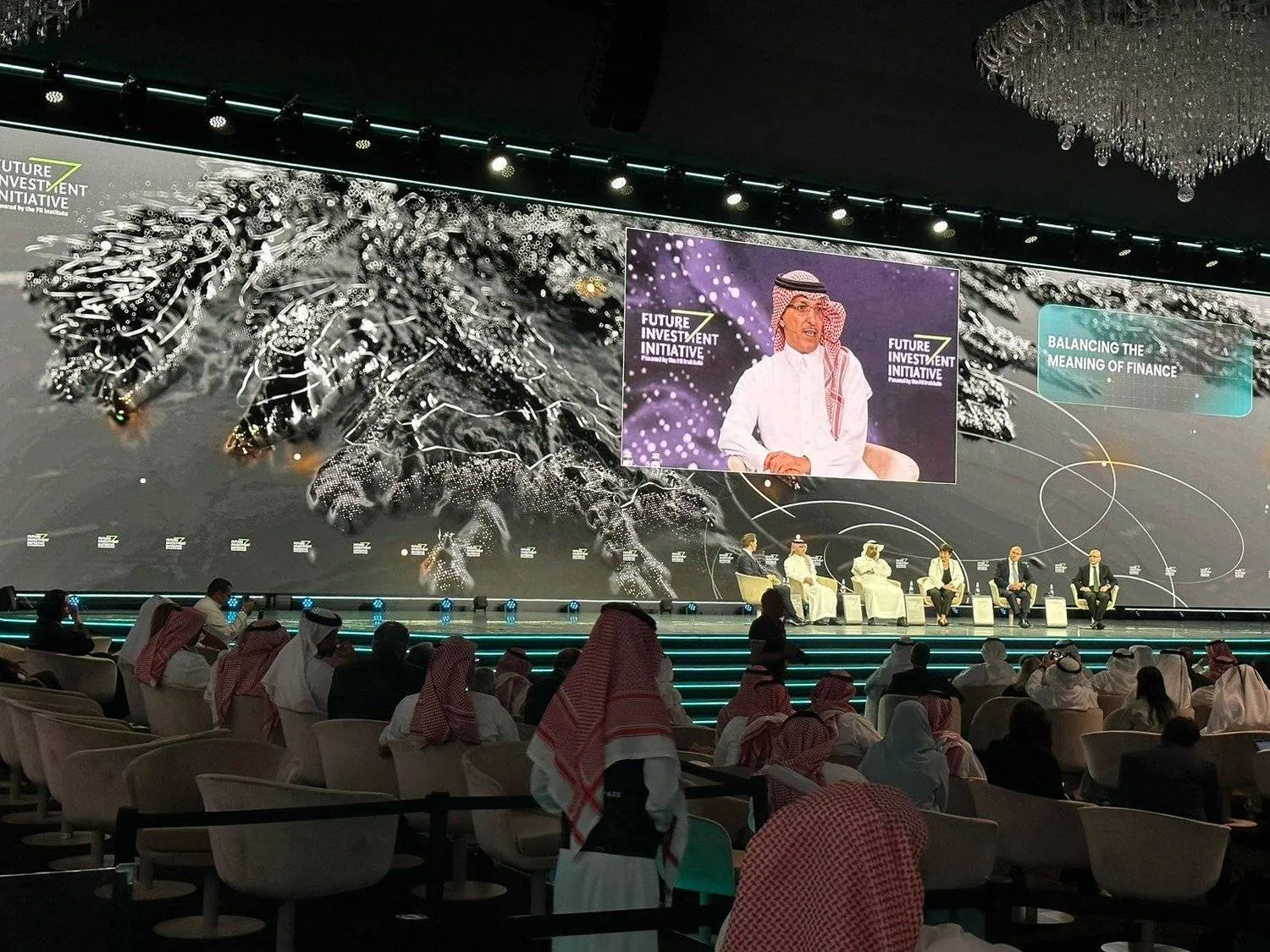

Saudi Arabia is no longer focusing on gross domestic product numbers but instead on the development of the non-oil sector, announced Saudi Finance Minister Mohammed al-Jadaan.
Speaking on the second day of the 7th Future Investment Initiative (FII) conference during a panel discussion, Jadaan said economic fragmentation harms countries' economies, calling for reducing restrictions on international trade.
The session was attended by Bahrain's Finance Minister Salman Al Khalifa, managing director of the International Monetary Fund (IMF) Kristalina Georgieva, and British Economic Secretary to the Treasury Andrew Griffith.
Jadaan underlined the Kingdom's solid and strategic relations with the US and China, its largest economic partner.
"We enjoy a very good strategic relationship with the US while China is our largest trading partner, and so we need to maintain that relationship and to keep building bridges," he said.
He noted that Saudi Arabia wants to have communications even with those with whom it may not agree on everything.
He stressed that the growth of non-oil GDP in the Kingdom has continued healthily and is likely to continue in the medium term.
In the quarter, non-oil growth was 6.1 percent, said Jadaan, adding that Saudi Arabia was likely to end the year with a growth of about 6 percent.
Since the launch of Vision 2030 in 2016, the Kingdom has been working to strengthen its economy by diversifying sources of income to enable it to confront global changes and support other countries, stressed the minister.
Jadaan stated that the results of the annual meeting of the World Bank Group and the International Monetary Fund (IMF), held recently in Marrakesh, Morocco, were optimistic despite the geopolitical events.
He noted that many countries suffer from a high rate of inflation.
"About 24 low-income countries will have to pay more than 10 percent on sovereign interest rates, which is unreasonable," he said, noting that the Kingdom is no longer focusing on the gross domestic product but rather on the development of its non-oil sector.
Regarding the ongoing conflict in the Middle East and its economic impact, Jadaan said that low-income countries currently bear the greatest consequences.
He added that Saudi Arabia is working with its partners to reduce the escalation in the region.
For his part, Bahrain's Finance Minister stated that the diversification of economies created resilience that boosts economic development, noting that non-oil sectors comprised 83 percent of Bahrain's GDP.
Also, Turkish Finance Minister Mehmet Simsek said that Turkiye has come forward with a new economic program and that the ambiguity is gone forever.
"We are concerned about the long-term repercussions of geopolitical developments," he said while adding that the growth rate of the Turkish economy until last July ranged between two percent and 2.5 percent.
At the same session, Economic Secretary to the Treasury, Andrew Griffith, said the British economy has been remarkably resilient and regained its strength before the COVID-19 pandemic.
Griffith noted that the UK was the largest growing economy in the G7 in Europe in the last few years.
- IMF Chief
IMF Chief Kristalina Georgieva said that international cooperation in a fragmented world is vital for growth, which is a top priority.
She also said that the costs of fragmentation were significant.
"We have, on numerous occasions, demonstrated we are talking about chopping about 12 percent off global GDP," she added, without giving a timeframe.
She explained that the global lending institution needs to increase its financial resources by 50 percent from their current levels amid the ongoing international challenges and shocks.
The IMF chief noted that dealing with high inflation rates will be costly next year, warning that the war between Israel and Hamas is already affecting the region's economies.
"You look at the neighboring countries – Egypt, Lebanon, Jordan – there the channels of impact are already visible."
Georgieva explained that there were 3,000 protectionist measures currently hindering global trade, inflation is still high, and interest will continue to increase, leading to a slowdown in growth.


