


Türkiye's Inflation Ticks up to 62%

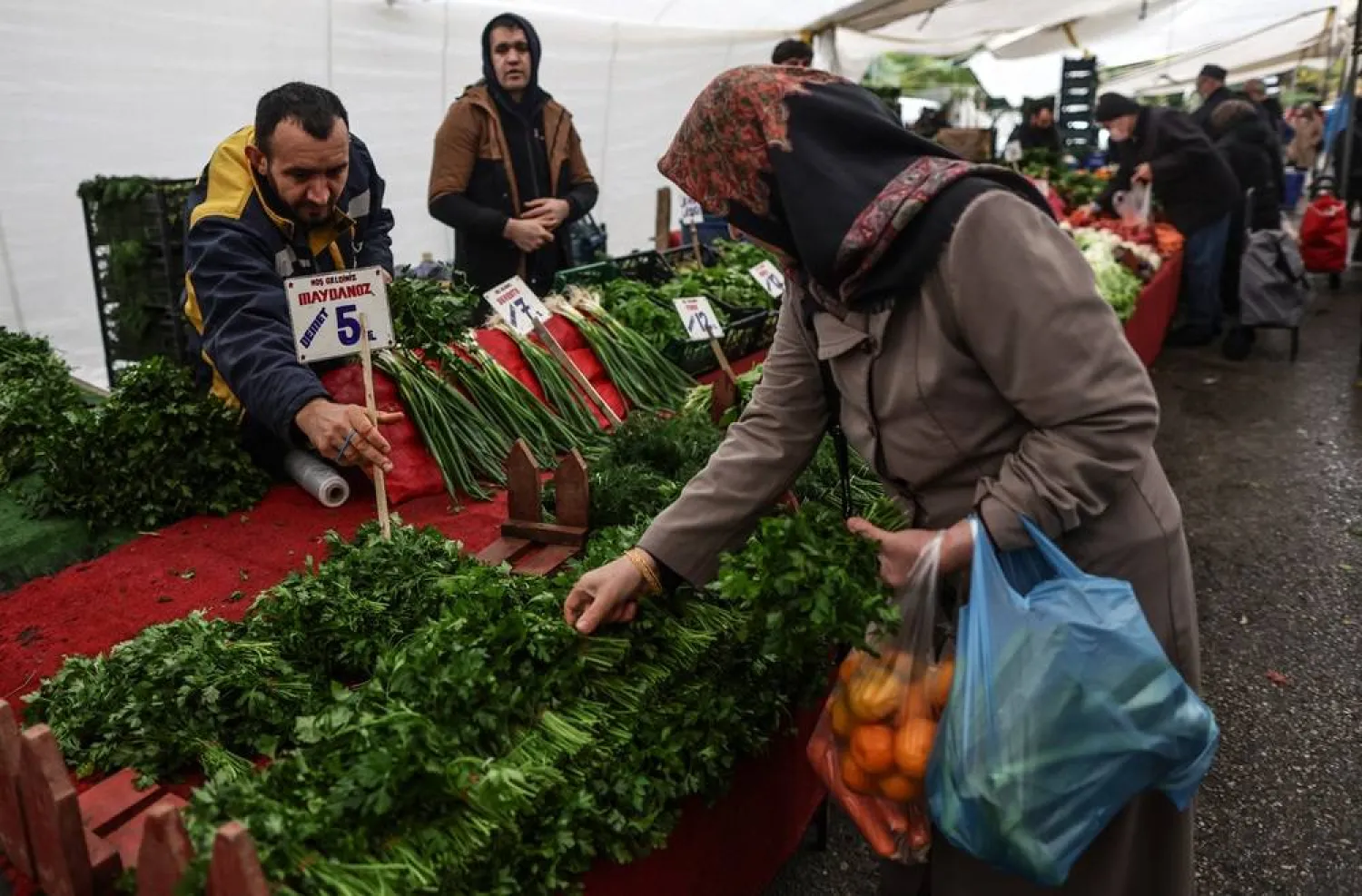
A woman shops at a street market in Istanbul, Türkiye, 04 December 2023. (EPA)
TT

Türkiye's Inflation Ticks up to 62%

A woman shops at a street market in Istanbul, Türkiye, 04 December 2023. (EPA)

Türkiye's annual inflation rate ticked up slightly in November, the state statistics agency said on Monday, showing further signs of levelling off following a series of sharp interest rate hikes.

The rate moved to 61.98 percent last month from 61.36 percent in October, the TUIK state statistics agency said.

The pace at which consumer prices are rising has started to ease, after six successive months of interest rate hikes took borrowing cost to 40 percent from 8.5 percent.

Analysts are penciling in a final rate hike of 2.5 percentage points at the central bank's next policy meeting on December 21.

The latest batch of data show higher borrowing costs starting to slow down consumption -- a key goal of the central bank.

Türkiye's gross domestic product rose by just 0.3 percent between July and September. It had risen by 3.3 between April and June.

"The central bank will welcome these figures as evidence that demand is cooling and inflation pressures continue to soften," said analyst Liam Peach of Capital Economics.

Reset will take time

"However, bringing inflation down to much lower levels will require monetary policy to remain tight for a prolonged period and we expect the central bank to leave interest rates unchanged throughout 2024," Peach said.

Signs of Türkiye's economy starting to emerge from crisis are starting to be noticed by foreign investors, who had pulled out of the market because of President Recep Tayyip Erdogan's unpredictable past policies.

Analysts blame Erdogan for setting off the inflation spiral by forcing the nominally independent central bank to slash borrowing costs far below the rate at which prices were rising.

The official annual inflation rate peaked at 85.51 percent in October 2022.

Standard and Poor's revised Türkiye's long-term sovereign credit rating to positive from stable last month.

"Inflation appears to have peaked, albeit at elevated levels of over 60 percent," the ratings agency said.

But it also warned: "The policy reset will take at least two years to tame inflation."

Türkiye's central bank expects inflation to peak in May of next year at between 70 and 75 percent.



King Salman International Airport Kicks of Construction of 3rd Runway to Boost Operational Efficiency

 The airport will incorporate the King Khalid terminals - SPA
The airport will incorporate the King Khalid terminals - SPA
TT

King Salman International Airport Kicks of Construction of 3rd Runway to Boost Operational Efficiency

 The airport will incorporate the King Khalid terminals - SPA
The airport will incorporate the King Khalid terminals - SPA

King Salman International Airport (KSIA), a PIF company, has commenced construction works on the third runway, marking a strategic step that reflects continued progress in airfield development and enhances the airport’s operational readiness to support long-term growth in air traffic demand.

The third runway forms a key component of the KSIA Master Plan and represents a major milestone in the airport’s expansion journey.
According to a press release issued by the KSIA, the project is being delivered in collaboration with FCC Construcción SA and Al-Mabani General Contractors Company and has been designed in alignment with Riyadh’s prevailing wind patterns to ensure safe and efficient aircraft operations under all operating conditions, SPA reported.

The current operational capacity stands at 65 aircraft movements per hour. With the implementation of operational enhancements and the introduction of the third runway, capacity is expected to increase to 85 aircraft movements per hour, contributing to improved operational efficiency and supporting long-term growth.

The third runway incorporates multiple access taxiways to ensure smooth aircraft flow and will span 4,200 meters in length.

Acting CEO of KSIA Marco Mejia said: “Launching construction of the third runway marks a pivotal step in delivering the KSIA Master Plan and reflects our commitment to developing world-class infrastructure capable of supporting future growth, enhancing operational efficiency, and expanding long-haul connectivity without constraints.”

King Salman International Airport is a strategic and transformative national project that reflects the Kingdom’s ambition to position Riyadh as a global capital and a leading aviation hub. The project was announced by His Royal Highness Prince Mohammed bin Salman bin Abdulaziz, Crown Prince, Prime Minister, Chairman of the Council of Economic and Development Affairs and Chairman of the Board of Directors of King Salman International Airport, underscoring its national significance and its role in advancing the objectives of Saudi Vision 2030.

Located on the existing site of King Khalid International Airport in Riyadh, the airport will incorporate the King Khalid terminals, in addition to three new terminals, residential and leisure assets, six runways, and logistics facilities. Spanning 57 square kilometers, it is designed to accommodate 100 million passengers annually and handle over two million tons of cargo by 2030.

This phase of construction contributes to strengthening King Salman International Airport’s international flight network across multiple global destinations, reinforcing Riyadh’s position as an internationally connected aviation gateway and supporting national development objectives within the air transport sector.


Mawani, Arabian Chemical Terminals Sign Land Lease for Jubail Port Storage Tanks

Mawani, Arabian Chemical Terminals Sign Land Lease for Jubail Port Storage Tanks
TT

Mawani, Arabian Chemical Terminals Sign Land Lease for Jubail Port Storage Tanks

Mawani, Arabian Chemical Terminals Sign Land Lease for Jubail Port Storage Tanks

The Saudi Ports Authority (Mawani) signed a contract with Arabian Chemical Terminals Ltd. to establish storage tanks for chemical and petrochemical materials at Jubail Commercial Port, with an investment exceeding SAR500 million on an area of 49,000 square meters.

The project will contribute to enhancing operational efficiency and increasing handling capacity in line with the objectives of the National Transport and Logistics Strategy to consolidate the Kingdom’s position as a global logistics hub, SPA reported.

This step is part of Mawani’s efforts to strengthen the role of the private sector in supporting the gross domestic product and to reinforce the position of Jubail Commercial Port as a driver of commercial activity. The project’s storage capacity will reach 70,000 cubic tons, boosting the competitiveness of the Kingdom’s ports at both regional and international levels.

The project aims to develop and expand storage capacity and the export of chemical and petrochemical materials in accordance with the highest international standards while supporting supply chains. It includes the establishment and development of specialized facilities for storing and exporting chemical and petrochemical products, as well as the provision of storage and distribution services for local and international import and export of chemicals in line with global quality and safety standards.

The project will contribute to supporting national supply chains, boosting the Kingdom’s chemical logistics capabilities, and raising operational efficiency and capacity, thereby improving customer competitiveness. It also supports the achievement of Saudi Vision 2030 objectives by promoting the development of infrastructure to advance the energy, industry, and supply chain sectors in the Kingdom.


Oil Prices Stable as Investors Seek Clarity on Russia-Ukraine Talks

A view shows the crude oil terminal Kozmino on the shore of Nakhodka Bay near the port city of Nakhodka, Russia August 12, 2022. REUTERS/Tatiana Meel
TT

Oil Prices Stable as Investors Seek Clarity on Russia-Ukraine Talks

A view shows the crude oil terminal Kozmino on the shore of Nakhodka Bay near the port city of Nakhodka, Russia August 12, 2022. REUTERS/Tatiana Meel

Oil prices were little changed on Tuesday as investors took stock of ​dented hopes of a Russia-Ukraine peace deal and rising geopolitical tensions in the Middle East around Yemen, Reuters reported.

Brent crude futures for February delivery, which expire on Tuesday, were up 15 cents at $62.09 a barrel as of 0918 GMT. The more active March contract was at $61.61, up 12 cents.

US West Texas Intermediate ‌crude gained 14 ‌cents to $58.22.

The Brent and ‌WTI ⁠benchmarks ​settled ‌more than 2% higher in the previous session as Saudi Arabia launched airstrikes against Yemen and after Moscow accused Kyiv of targeting Putin's residence, denting hopes of a peace deal.

Kyiv dismissed Moscow's accusation as baseless and designed to undermine peace negotiations. After a phone call ⁠with Putin, US President Donald Trump said he was angered by details ‌of the alleged attack.

"I think the ‍markets are sensing that ‍a deal is going to be very hard ‍to come by," said Marex analyst Ed Meir.

Traders also watched other Middle East developments after Trump said the United States could support another major strike on Iran were Tehran to resume rebuilding its ballistic missile or nuclear weapons programs.

Despite renewed fears of potential supply disruptions, perceptions of an oversupplied global market remain and could cap prices, analysts say.

Marex's Meir said prices would trend downwards in the first quarter of 2026 due to ‌a "growing oil glut".