



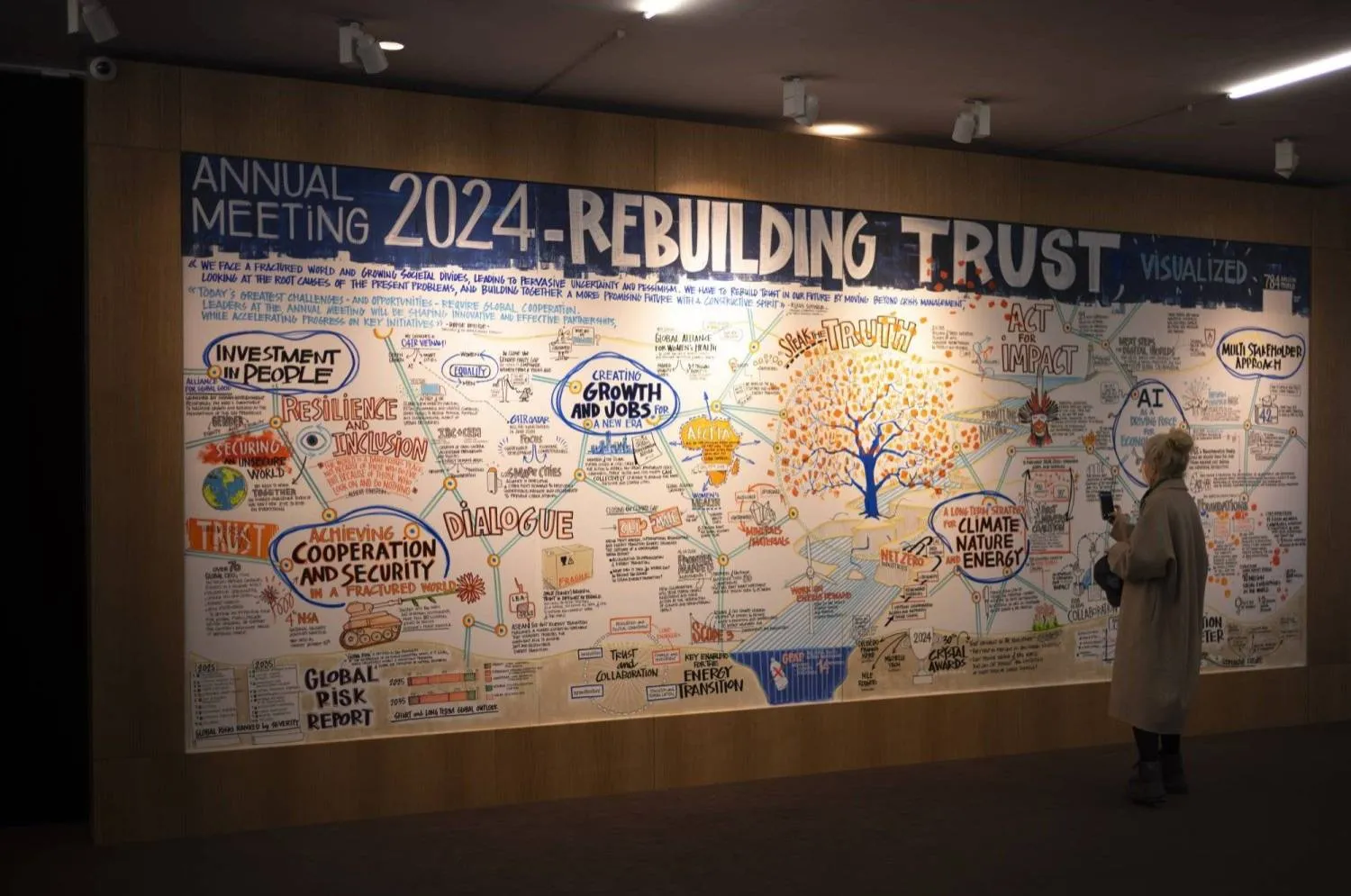

Local business and political leaders emphasized the need to “rebuild trust” in a divided world at the conclusion of the World Economic Forum in Davos on Friday. They acknowledged that there is still a long journey ahead for the world to go.
From full-blown wars in Ukraine and the Middle East to suspicions that corporate chiefs and tech whizzes are out to make a buck off of displacing workers with artificial intelligence, trust is clearly in short supply, The Associated Press (AP) reported.
“It’s unrealistic to think that Davos — or any meeting, anywhere in the world — in one meeting can rebuild trust when it’s fragmented on so many dimensions," said Rich Lesser, chairman of Boston Consulting Group.
But thousands of conversations between the social, private and public sectors help create “a starting point for rebuilding trust,” he said.
A big artistic wall headlined “Rebuilding Trust” that greeted bigwigs from Bill Gates to the Iranian foreign minister was full of phrases like “Growth and Jobs,” “Climate Nature Energy” and “Cooperation and Security” — buzzwords to some.
“What is striking, if not shocking, for me at Davos is this weird commitment on the part of the participants to adopt an optimistic mindset,” said Agnès Callamard, secretary-general of Amnesty International.
The general conclusion, attendees said, was that the global economic picture is a bit brighter than might have been thought — interest rates and inflation seem to have peaked in the richest markets — but it’s still anybody’s guess where intractable wars and looming elections in places like the US, India, the European Union and South Africa will redirect the world.
Apart from geopolitical tensions, discussions on the future and risks of artificial intelligence took center stage in Davos. Some business leaders believe that generative AI can boost productivity and cut down on routine tasks.
Yet, skeptics worry that the rapid technological advancements are outpacing regulators, leading to job losses and the spread of more misinformation on social media. Some argue that humans should retain control and not let technology make important decisions on its own.
“No matter how much AI can do, humans are still the deciding factor. So we have to focus on the training of human resources, especially the highly skilled workers,” Pham Minh Chinh, Vietnam's prime minister, said on a Davos panel.


