American Businessmen in Algeria Discuss Investments amid Growing Political Ties

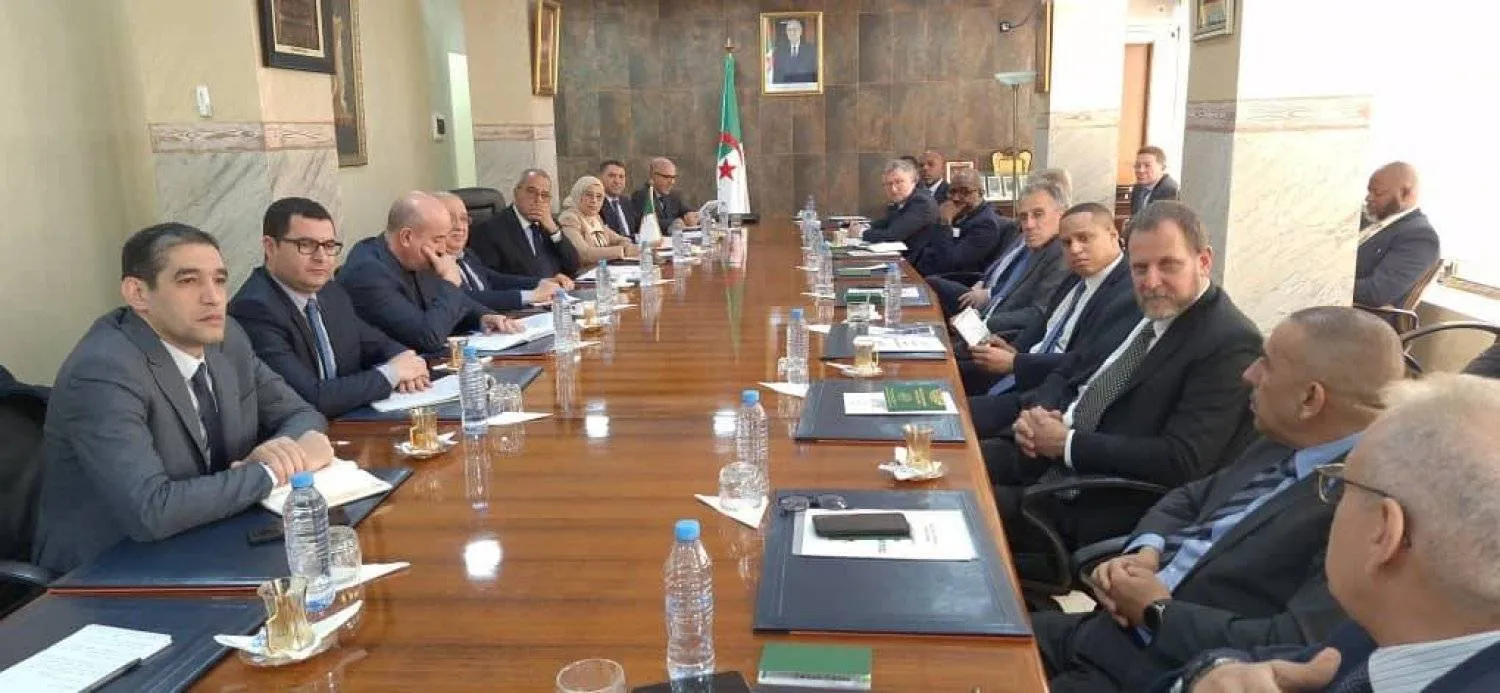
A meeting of the American economic delegation at the Algerian Ministry of Industry. (Ministry of Industry)
TT

American Businessmen in Algeria Discuss Investments amid Growing Political Ties

A meeting of the American economic delegation at the Algerian Ministry of Industry. (Ministry of Industry)

A delegation of American businessmen and CEOs concluded on Tuesday a three-day visit to Algeria, where they discussed with ministers the launching of projects in several sectors, in line with a new Investment Law that promised facilitations and incentives to foreign investors.
The visit reflects a revitalization in US-Algerian political relations, according to analysts.
It comes following a round of bilateral dialogue held at the military level in Algiers last month to address the threat of terrorism in the Sahel and during which Algeria had asked to buy US military equipment.
The delegation of 26 American businessmen is headed by chairman of the US-Algeria Business Council (USABC), David Wilhelms.
Wilhelms noted that members of the US delegation were “impressed by the changes that Algeria has experienced in recent years at the business and investment levels. They were encouraged to prepare for future projects in the North African country and to transfer technology and capital to Algeria, he said.
Meanwhile, President & CEO of the US-Algeria Business Council (USABC), Ismael Chikhoune, said that thanks to the new Investment Law passed recently by the Algerian government, American investors “have shown an interest, for the first time, in investing in Algeria.”
Another group of businessmen, active in the field of agriculture, will visit Algeria next month, Chikhoune revealed, adding that a delegation of Algerian economic operators will visit the US next March to explore investment opportunities.
Following a meeting with the US delegation on Monday, the head of the Algerian Investment Promotion Agency (AAPI), Omar Rekkache, said the financial and business climate in Algeria has seen remarkable development in recent years, through the strengthening of the legislative system for investment, the simplification of procedures related to the launch of projects, and the adoption of transparency in trade.
He stressed that the Agency had assured the US mission that it will provide them with all the favorable conditions for investment.
On Sunday, the US delegation also held talks with Minister of Pharmaceutical Industry, Ali Aoun, who said the current strategy of the industry sector aims to encourage projects that will create wealth and jobs in the country.
He also encouraged American businessmen to focus on investment in renewable energies, the production of spare parts and railways.


Türkiye Cuts Key Interest Rate to 36%, First Cut in Months

Central Bank of Türkiye (Official Website)
TT

Türkiye Cuts Key Interest Rate to 36%, First Cut in Months

Central Bank of Türkiye (Official Website)

Türkiye's central bank cut its key interest rate on Thursday to 36 percent in the first cut in nine months, pointing to a recent slowdown in inflation.

At a policy meeting, the bank "decided to reduce the policy interest rate ... from 37 percent to 36 percent," it said in a statement.

It was the first cut since January when the bank cut the key rate from 38 to 37 percent, a rate which it held until Thursday's meeting.

"Despite monthly fluctuations, recent inflation figures and leading indicators confirm the downward trend," a bank statement said.

"Data on economic activity and the limited impact of supply shocks on domestic prices suggest that the weak trend in domestic demand continues," it added.

However, ongoing geopolitical tensions were keeping energy prices high, which could push inflation higher, it warned, saying the effects of such geopolitical developments "are being closely monitored".

Türkiye's annual inflation rate eased to 29.7 percent in September from 31.5 percent in August - the first time it had fallen below 30 percent in nearly five years, official figures showed.

At the time, Finance Minister Mehmet Simsek said it was at its lowest level since November 2021. "Disinflation is spreading across the board, excluding transportation," he wrote on X.

The official figures are disputed by the ENAG group of independent economists that publishes its own data, which said its figures showed year-on-year inflation stood at 46.6 percent in September.


Saudi Stock Market Drops 2.3% to Lowest Close Since 2021

A person stands in front of a screen showing falling stock prices (Reuters)
TT

Saudi Stock Market Drops 2.3% to Lowest Close Since 2021

A person stands in front of a screen showing falling stock prices (Reuters)

Saudi Arabia's benchmark stock index ended Thursday's session down 2.3 percent, shedding 231 points to close at 9,696, its lowest closing level since 2021, with total trading turnover reaching approximately SAR 4.9 billion.

The Tadawul All Share Index (TASI) fluctuated between an intraday low of 9,640 points and a high of 9,888 points.

Thursday's decline brought the index's weekly losses to more than 400 points, or 4.1 percent, marking its eighth consecutive week of declines.

Most stocks fell during the session, led by Saudi National Bank, which dropped more than 5 percent to SAR 34.62, with approximately 9 million shares traded.

Saudi Aramco and Al Rajhi Bank each declined 1 percent, closing at SAR 25.40 and SAR 59.80, respectively, while Maaden fell 5 percent to SAR 55.90.

Shares of Retal, Al Yamamah Steel, East Pipes, Jahez, Gulf Training and Saudi Steel Pipe ended the session with losses ranging from 5 to 9 percent.

Meanwhile, Electrical Industries, Abo Moati, Umm Al-Qura Cement, Saleh Al-Rashed, Wafrah, Saudi Vitrified Clay Pipe and Watani Iron Steel each fell 10 percent.

On the upside, Al-Etihad rose 10 percent to SAR 6.16, followed by JAZADCO with gains exceeding 9 percent. Shares of Al Arabia, UCIC and Saudi Kayan advanced between 1 and 3 percent.


Barclays Bank to Cut about 5,000 Jobs amid AI Drive

Barclays says the job cuts are due to AI efficiencies. Paul ELLIS / AFP/File
TT

Barclays Bank to Cut about 5,000 Jobs amid AI Drive

Barclays says the job cuts are due to AI efficiencies. Paul ELLIS / AFP/File

British bank Barclays announced Thursday plans to cut around 5,000 jobs, or roughly five percent of its global workforce, by the end of 2026 in an AI efficiency drive.

The announcement came alongside an earnings update that showed Barclays' net profit grew 13 percent in the third quarter, fueled by surging income across its equities division, said AFP.

Barclays said in an earnings presentation that it was implementing "organizational simplification and technology change efficiency driven by AI".

"About 60 percent of the job losses relate to support functions, including fewer developers as AI makes our people more productive," it added.

The bank's profit after tax grew to £1.65 billion ($2.2 billion) in the third quarter from £1.46 billion in the July-September period a year earlier.

Barclays chief executive C. S. Venkatakrishnan noted "ongoing momentum of... operational and financial performance" and said the investment bank division "delivered strong equities performance".

Revenue from equities jumped 47 percent year-on-year, while total group income for the quarter climbed three percent to £7.37 billion.

Barclays' share price was up slightly following the news updates.

The AI "announcement comes as the company failed to match expectations with its third-quarter performance -- with the unveiling of a healthy share buyback failing to entirely ease investors' disappointment", noted AJ Bell investment director Russ Mould.

"Across the wider group, costs went up and Barclays shareholders are also having to contend with two major clouds over the business.

"The first being a widely expected increase in tax on the sector in next week's (UK) budget and the other being a reported probe into possible misrepresentation of risks in its private credit portfolio."