Syria’s Finance Ministry: 2026 Budget Deficit Estimated at $1.8 Billion, Not $2.8 Billion
Syrian Finance Minister Mohammed Yisr Barnieh meets with a World Bank mission for the Public Financial Management Modernization Project on November 28 (Finance Ministry).
Syria’s Finance Ministry: 2026 Budget Deficit Estimated at $1.8 Billion, Not $2.8 Billion
Syrian Finance Minister Mohammed Yisr Barnieh meets with a World Bank mission for the Public Financial Management Modernization Project on November 28 (Finance Ministry).
Syria’s Ministry of Finance has dismissed reports that the country’s 2026 budget deficit is expected to reach $2.8 billion, clarifying that the estimated shortfall stands at approximately $1.8 billion based on conservative projections.
The ministry also said that figures circulating about salaries, pensions and development loans were not all based on official announcements or sources.
In a statement, the ministry stressed that the deficit outlined in the published 2026 budget was based on conservative estimates and did not represent the final fiscal outcome, which would depend on actual budget execution through the end of the financial year.
The budget projected revenues of approximately $8.716 billion and expenditures of $10.516 billion, resulting in an estimated deficit of $1.8 billion.
The ministry explained that its published financial performance report for the first half of 2026 showed a deficit of around $1 billion. However, it noted that government revenues are not evenly distributed between the two halves of the year.
Based on revenue collection patterns in previous years, approximately 30% to 35% of annual revenues are typically collected in the first half, compared with 65% to 70% in the second half.
The ministry attributed its expectation that the year-end deficit would be lower than initially budgeted to improving revenues and government measures to control and rationalize spending.
It emphasized that these projections remain estimates based on specific assumptions and sources and should not be treated as official or final fiscal results.
Regarding reports of salary and pension increases and a new minimum wage, the ministry said the figures and percentages being circulated had not been officially announced by either the ministry or the government.
It confirmed, however, that options for improving salaries and pensions remain under review in coordination with the Ministry of Administrative Development and other relevant authorities, taking into account the direct impact of these measures on the living conditions of employees and retirees.
Ministry Denies Annual Interest on Development Fund Loans
Regarding loans signed with the Saudi Fund for Development, the ministry denied reports circulating on some platforms that the agreements carry annual interest of 3%.
It clarified that the financing consists of concessional development loans that bear no interest and are subject only to modest administrative fees.
The ministry described the arrangements as similar to qard hasan, or interest-free loans, because they do not impose interest charges.
It stressed that the government's policy focuses on controlling public debt, avoiding unjustified borrowing and limiting loans to development purposes under highly concessional terms.
The ministry added that the loan agreements would be submitted to the People's Assembly for approval in accordance with established procedures.
Syrian Finance Minister Mohammed Yisr Barnieh meets with a World Bank mission for the Public Financial Management Modernization Project on November 28 (Finance Ministry).
Syria’s Finance Ministry: 2026 Budget Deficit Estimated at $1.8 Billion, Not $2.8 Billion
Syrian Finance Minister Mohammed Yisr Barnieh meets with a World Bank mission for the Public Financial Management Modernization Project on November 28 (Finance Ministry).
Syria’s Ministry of Finance has dismissed reports that the country’s 2026 budget deficit is expected to reach $2.8 billion, clarifying that the estimated shortfall stands at approximately $1.8 billion based on conservative projections.
The ministry also said that figures circulating about salaries, pensions and development loans were not all based on official announcements or sources.
In a statement, the ministry stressed that the deficit outlined in the published 2026 budget was based on conservative estimates and did not represent the final fiscal outcome, which would depend on actual budget execution through the end of the financial year.
The budget projected revenues of approximately $8.716 billion and expenditures of $10.516 billion, resulting in an estimated deficit of $1.8 billion.
The ministry explained that its published financial performance report for the first half of 2026 showed a deficit of around $1 billion. However, it noted that government revenues are not evenly distributed between the two halves of the year.
Based on revenue collection patterns in previous years, approximately 30% to 35% of annual revenues are typically collected in the first half, compared with 65% to 70% in the second half.
The ministry attributed its expectation that the year-end deficit would be lower than initially budgeted to improving revenues and government measures to control and rationalize spending.
It emphasized that these projections remain estimates based on specific assumptions and sources and should not be treated as official or final fiscal results.
Regarding reports of salary and pension increases and a new minimum wage, the ministry said the figures and percentages being circulated had not been officially announced by either the ministry or the government.
It confirmed, however, that options for improving salaries and pensions remain under review in coordination with the Ministry of Administrative Development and other relevant authorities, taking into account the direct impact of these measures on the living conditions of employees and retirees.
Ministry Denies Annual Interest on Development Fund Loans
Regarding loans signed with the Saudi Fund for Development, the ministry denied reports circulating on some platforms that the agreements carry annual interest of 3%.
It clarified that the financing consists of concessional development loans that bear no interest and are subject only to modest administrative fees.
The ministry described the arrangements as similar to qard hasan, or interest-free loans, because they do not impose interest charges.
It stressed that the government's policy focuses on controlling public debt, avoiding unjustified borrowing and limiting loans to development purposes under highly concessional terms.
The ministry added that the loan agreements would be submitted to the People's Assembly for approval in accordance with established procedures.
Saudi Stock Market Closes 0.9% Higher, Above 10,000 Pointshttps://english.aawsat.com/business/5346953-saudi-stock-market-closes-09-higher-above-10000-points
Saudi Stock Market Closes 0.9% Higher, Above 10,000 Points
A man monitors stock prices in Saudi Arabia (AFP)
The Saudi stock market ended Sunday's session higher, with the Tadawul All Share Index (TASI) rising 0.9% to close at 10,009 points, gaining 86 points. This marked its first close above the 10,000-point threshold since falling below it last week.
The gains came amid improved performance by heavyweight stocks, while trading liquidity fell to its lowest level since January 2026, with turnover reaching approximately SAR 2 billion ($533 million), indicating continued investor caution despite the market's advance.
Al Rajhi Bank shares rose 1.1%, Saudi National Bank gained 1%, and Saudi Aramco advanced 0.4%.
Amana Insurance topped the gainers with a 7.8% increase, followed by Wataniya Insurance at 7.6% and Gulf Insurance Group (GIG) at 6.3%.
Shares of Petro Rabigh, Al Jouf, BCI, Banan, Salama and Gulf General Insurance also rose between 5% and 6%.
Conversely, Budget Saudi, Jahez, SACO and Saudi Ceramics declined between 2% and 4%.
Lebanon: Depositors to Receive Higher Monthly Payments from Tuesday as Rights Remain Unresolvedhttps://english.aawsat.com/business/5346936-lebanon-depositors-receive-higher-monthly-payments-tuesday-rights-remain
Lebanon: Depositors to Receive Higher Monthly Payments from Tuesday as Rights Remain Unresolved
Depositors demand access to funds frozen in banks since the fall of 2019 (File photo - EPA)
As Lebanese depositors continue their long wait for a government plan to break the cycle of stalled recovery efforts, those benefiting from Banque du Liban's circulars will receive a further 20 percent increase in their monthly withdrawal allowances starting Tuesday.
The additional amounts will be available exclusively through payment cards for purchases at merchants, pending the adoption of a comprehensive mechanism for recovering deposits under the proposed Financial Regularization and Deposit Recovery Law.
Under the latest amendments, monthly payments available to beneficiaries of Circular No. 158 will rise to $1,200, comprising $800 in cash and $400 through payment cards. Beneficiaries of Circular No. 166 will receive $600, including $400 in cash and $200 for electronic payments.
The arrangements are expected to remain in place until at least the middle of next year.
Circular No. 158 covers dollar deposits accumulated before the fall of 2019, while Circular No. 166 applies to foreign-currency accounts established before mid-2023 whose holders do not benefit from the first circular.
Although the increase provides some relief to depositors struggling with living expenses, it does not form part of a clear roadmap toward securing their rights and ensuring fair compensation. Instead, it represents a continuation of limited, gradual repayments while a legislative solution to Lebanon's banking crisis remains pending.
Meanwhile, proposals under discussion include separating irregular accounts or those subject to scrutiny and issuing long-term bonds maturing over 10, 15 and 20 years to cover balances exceeding $100,000.
That amount is being discussed as the guaranteed repayment threshold for each depositor. Accounts exceeding the threshold represent the largest share of deposits still trapped in the banking system by value.
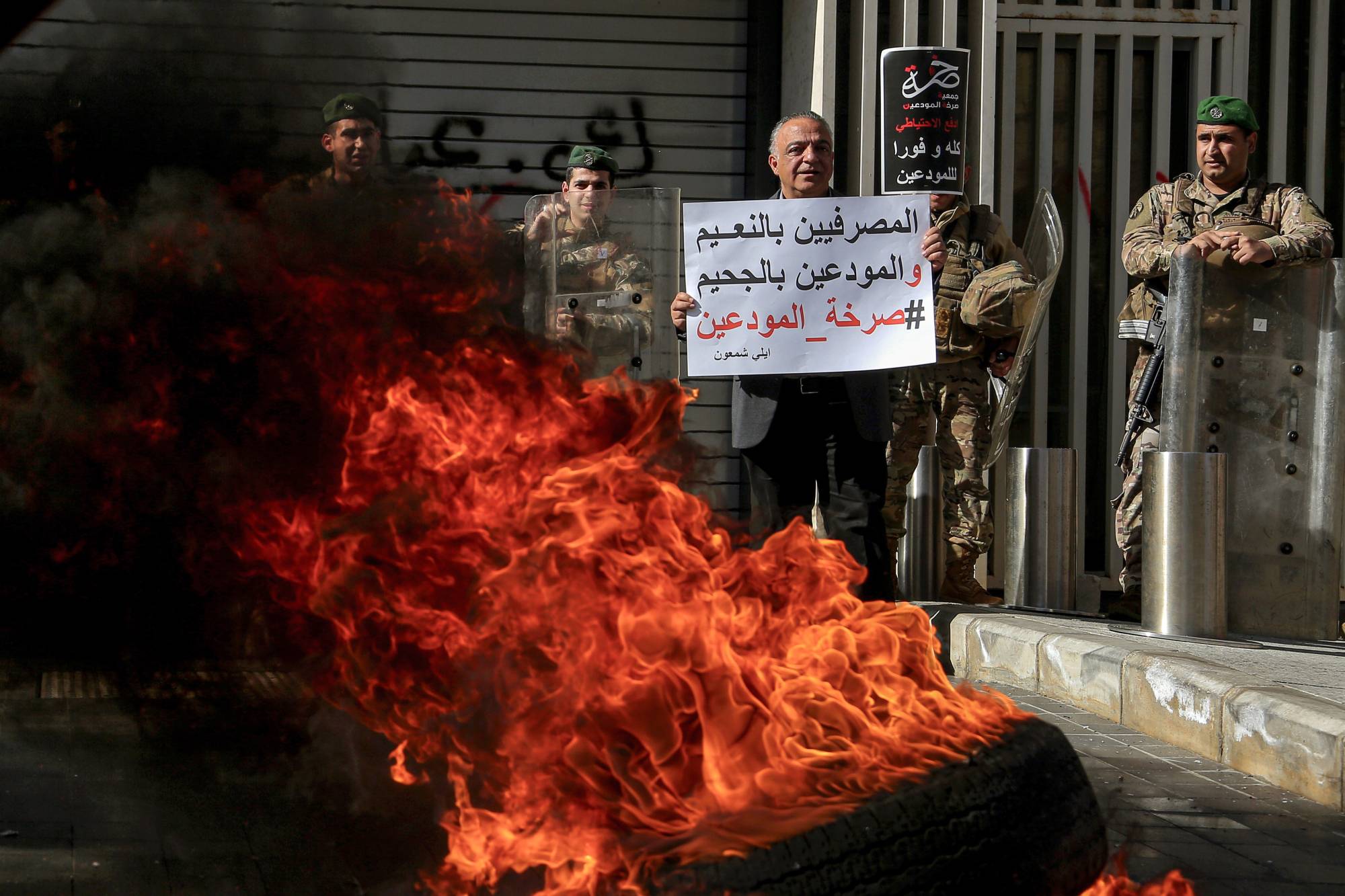
19 January 2024, Lebanon, Beirut: Lebanese soldiers secure a local bank as a depositor, displaying a banner that reads "Bankers live in heaven while depositors live in hell", stand between them and a burning tire during a protest to demand the imposition of a timetable for returning the savings of depositors. Photo: Marwan Naamani/dpa
Banque du Liban maintains that the temporary regulatory measures introduced through circulars issued within its legal authority are intended to facilitate limited repayments to depositors from their accounts, rather than replace the legislative measures needed to resolve the banking crisis.
The central bank stresses that approving the proposed Financial Regularization and Deposit Recovery Law through the relevant constitutional authorities, and establishing a comprehensive framework to restore financial stability and address depositors' rights and claims, remain the responsibility of the competent authorities.
On the surface, the latest amendments represent progress in releasing some liquidity to hundreds of thousands of individual depositors.
Official figures show that more than 775,000 depositors have benefited from the two circulars, with approximately 170,000 recovering their trapped savings in full.
Depositors whose balances fall below $50,000 are also awaiting the completion of their repayments by the end of the first quarter of next year.
However, the approximately $8 billion expected to have been repaid, compared with some $80 billion still trapped in bank accounts, illustrates the limitations of the existing approach.
The disparity is particularly striking nearly five and a half years after the first circular came into effect and as the third anniversary of the second circular approaches.
During that period, inflation has eroded the real value of both the amounts repaid and the balances still outstanding, while banks have stopped paying interest on savings since the outbreak of the crisis, which is entering its eighth year.
Total deposits had peaked on the eve of Lebanon's monetary and financial collapse at approximately $123 billion in foreign currencies, in addition to around $49 billion in Lebanese pounds.
Years of government delays and failed attempts to devise a rescue and recovery plan have turned depositors' concerns into serious fears about the future of their savings.
These concerns have deepened as the proposed guaranteed repayment ceiling has been sharply reduced from an earlier pledge of $500,000 to $100,000 per depositor, regardless of the number of accounts held.
The state's direct contribution to covering the losses also remains contentious. The government cites its limited financial resources and an explicit recommendation from the International Monetary Fund (IMF) to "limit the use of public funds."
Banks' ability to contribute directly, now or in the future, also faces significant constraints because of severe liquidity shortages and the continued freezing of approximately $79 billion in their placements with Banque du Liban.
This has brought renewed attention to the question of responsibility between the actual creditor and the ultimate debtor.
Most customer deposits were placed with the central bank before a substantial portion of those funds effectively became debts owed by the state through withdrawals and financing from Banque du Liban's balance sheet.
A forensic audit conducted by Alvarez & Marsal found that these amounts exceeded $64 billion.
In this context, commercial banks say the monthly repayments are financed through mandatory reserves associated with customer deposits.
Banque du Liban, meanwhile, maintains that a substantial portion of its foreign-currency assets consists of balances deposited by commercial banks to meet mandatory reserve requirements, representing legitimate rights and claims belonging exclusively to depositors.
Adding to depositors' concerns is the central bank's position that amounts already repaid under its circulars should be counted toward any cash payments provided for under the forthcoming deposit recovery mechanism.
In its assessment preceding the latest increase, the central bank's management stressed the need to take previous repayments into account when calculating future cash disbursements under the proposed Financial Regularization and Deposit Recovery Law.
It argued that doing so would ensure fairness and equal treatment among depositors while preventing double counting.
This approach means that amounts depositors have received over the past several years could count toward their final repayment ceiling.
That raises questions about how much each depositor will ultimately recover once the law is enacted and whether the current monthly payments will reduce their future entitlements.
لم تشترك بعد
انشئ حساباً خاصاً بك لتحصل على أخبار مخصصة لك ولتتمتع بخاصية حفظ المقالات وتتلقى نشراتنا البريدية المتنوعة