UN: Global Trade is Being Disrupted by Red Sea Attacks, War in Ukraine and Low Water in Panama Canal

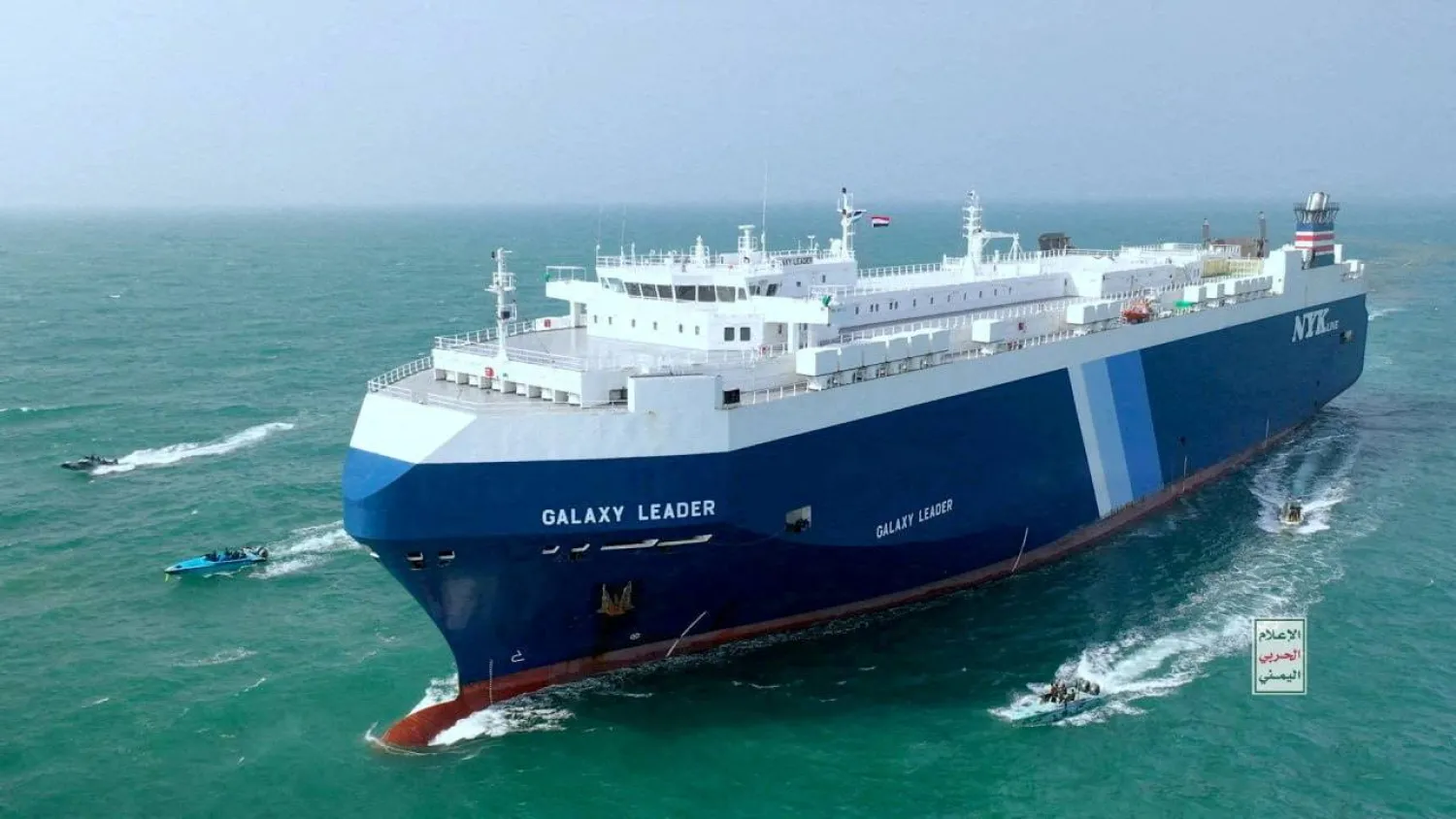
FILE PHOTO: The Galaxy Leader cargo ship is escorted by Houthi boats in the Red Sea in this photo released November 20, 2023. Houthi Military Media/Handout via REUTERS
TT

UN: Global Trade is Being Disrupted by Red Sea Attacks, War in Ukraine and Low Water in Panama Canal

FILE PHOTO: The Galaxy Leader cargo ship is escorted by Houthi boats in the Red Sea in this photo released November 20, 2023. Houthi Military Media/Handout via REUTERS

The UN trade body sounded an alarm Thursday that global trade is being disrupted by attacks in the Red Sea, the war in Ukraine, and low water levels in the Panama Canal.
Jan Hoffmann, a trade expert at the United Nations Conference on Trade and Development known as UNCTAD, warned that shipping costs have already surged and energy and food costs are being affected, raising inflation risks.
Since attacks by Yemen’s Houthi rebels on ships in the Red Sea began in November, he said, major players in the shipping industry have temporarily halted using Egypt’s Suez Canal, a critical waterway connecting the Mediterranean Sea to the Red Sea and a vital route for energy and cargo between Asia and Europe.
The Suez Canal handled 12% to 15% of global trade in 2023, but UNCTAD estimates that the trade volume going through the waterway dropped by 42% over the last two months, Hoffmann said.
Since November, the Iranian-backed Houthis have launched at least 34 attacks on shipping through the waterways leading to the Suez Canal. The Houthis support the Palestinians and have vowed to keep attacking until the Israel-Hamas war ends.
The United States and Britain have responded with strikes against Houthi targets, but the rebels have kept up their attacks.
Hoffmann, who heads the trade logistics branch at Geneva-based UNCTAD, told a video press conference with UN reporters that the Houthi attacks are taking place at a time when other major trade routes are under strain.
The nearly two-year war since Russia’s Feb. 24, 2022 invasion of Ukraine and other geopolitical tensions have reshaped oil and grain trade routes including through the Black Sea, he said.
Compounding difficulties for shipping companies, Hoffmann said, severe drought has dropped water levels in the Panama Canal to their lowest point in decades, severely reducing the number and size of vessels that can transit through it.
Total transits through the Panama Canal in December were 36% lower than a year ago, and 62% lower than two years ago, Hoffmann said.
Ships carry around 80% of the goods in world trade, and the percentage is even higher for developing countries, he said.
But the Red Sea crisis is causing significant disruptions in the shipment of grains and other key commodities from Europe, Russia and Ukraine, leading to increased costs for consumers and posing serious risks to global food security, Hoffmann said.
This is especially true in regions like East Africa, South Asia, Southeast Asia and East Asia, which heavily rely on wheat imports from Europe and the Black Sea area, he said.
Hoffmann said early data from 2024 show that over 300 container vessels, more than 20% of global container capacity, were diverting or planning alternatives to using the Suez Canal. Many are opting to go around the Cape of Good Hope in Africa, a longer and more costly trip.
Hoffmann said ships transporting liquified natural gas have stopped transiting the Suez Canal altogether because of fears of an attack.
As for costs, he said, average container shipping spot rates from Shanghai have gone up by 122% since early December, while rates from Shanghai to Europe went up by 256% and rates to the US west coast by 162%.
“Here you see the global impact of the crisis, as ships are seeking alternative routes, avoiding the Suez and the Panama Canal,” Hoffmann said.



Maritime Alliances Propel Saudi Arabia Toward Building Global Logistics Influence

Containers assembled at a Saudi port (SPA)
TT

Maritime Alliances Propel Saudi Arabia Toward Building Global Logistics Influence

Containers assembled at a Saudi port (SPA)

In a short period, Saudi Arabia has moved into a phase of building global logistics influence through maritime alliances with major international companies. The latest step is the launch of a new shipping route linking the Kingdom with Europe, alongside 18 other maritime services currently in operation, supporting national exports, improving access to markets, and reinforcing the country’s position as a key logistics hub.

The Saudi Ports Authority (Mawani) announced on Saturday the addition of a new shipping service by MSC, the world’s largest container shipping company, named “Europe–Red Sea–Middle East,” to Jeddah Islamic Port and King Abdullah Port in Rabigh, as part of ongoing efforts to strengthen maritime connectivity between the Kingdom and global ports and to support import and export flows in cooperation with leading global shipping lines.

MSC said in a statement on its X platform that the new fast shipping service is designed to meet growing demand and provide reliable and efficient connections in a complex operating environment.

The new service links Jeddah Islamic Port with several major global ports, including Gdansk, Klaipeda, Bremerhaven, Antwerp, Valencia, Barcelona, Gioia Tauro, and Abu Qir, extending to King Abdullah Port, Jeddah, and Aqaba, with a capacity of up to 16,000 TEUs.

The authority also revealed on Sunday the launch of 18 maritime shipping services at present, supporting the growth of national exports, improving their efficient access to international markets, and strengthening the Kingdom’s position as a central logistics hub.

Strategic Shift

Specialists told Asharq Al-Awsat that the Kingdom is undergoing a strategic transformation that strengthens its position as a logistics hub linking three continents and supports the goals of Vision 2030 to position Saudi Arabia as a global logistics platform. They said this reflects cumulative investments in port infrastructure, digital transformation, technical integration, and partnerships with leading global shipping lines.

They added that linking the Kingdom with Europe reduces time and cost and enhances the global reach of Saudi products.

Sovereign Tool

Zaid Al-Jarba, an expert in digital transformation and logistics services, told Asharq Al-Awsat that amid rapid shifts in global supply chains, efficient logistics connectivity is no longer merely an operational advantage but a sovereign tool reshaping economic power balances between countries. He said the launch of the new maritime route to Europe, alongside the addition of 18 services in a short period, signals the Kingdom’s transition to an advanced stage in building its logistics influence.

He added that what distinguishes this step is not only the expansion in the number of routes, but the quality of operational integration across Saudi ports, describing an interconnected system that begins at Jeddah Islamic Port and King Abdullah Port and extends through King Abdulaziz Port in Dammam via feeder vessels, reflecting a unified logistics network rather than separate gateways.

He said the move supports Vision 2030 and the National Transport and Logistics Strategy, which aims to establish the Kingdom as a global logistics platform by improving logistics hub performance, upgrading infrastructure, and adopting modern transport systems.

Operational Capacity

Al-Jarba said recent figures, including the launch of 18 new maritime services within a short timeframe with a total capacity of 123,552 TEUs, reflect high operational capacity and flexibility in responding to global changes.

He noted that the presence of global companies such as MSC, Maersk, and CMA CGM within the operating ecosystem reflects international confidence in Saudi Arabia’s logistics environment, indicating that the sector has moved beyond efficiency improvements toward maximizing economic and competitive impact.

He added that improved maritime connectivity not only supports imports but also serves as a key enabler for national exports by reducing delivery times to European markets, improving reliability, and lowering logistics costs, thereby enhancing the competitiveness of Saudi goods, particularly in industrial, food, and petrochemical sectors.

He said developments in Saudi ports go beyond expanding shipping routes to reflect a broader strategic shift toward building an integrated, globally competitive logistics system, adding that the Kingdom is steadily advancing toward cementing its position as a global logistics hub and a key link in international supply chains.

Logistics Integration

Khaled AlGhamdi, a supply chain and logistics expert, told Asharq Al-Awsat that adding these services expands alternative options that integrate with other logistics modes, including land, rail, and air, as part of broader efforts to enhance integration across the transport and logistics sector through multiple initiatives and international partnerships aimed at reducing time, lowering costs, and boosting productivity.

He said the new Europe link in particular will significantly accelerate cargo movement in both directions, from King Abdulaziz Port in Dammam to Jeddah Islamic Port and King Abdullah Port, reflecting efforts to enhance sector integration through expanded services, improved efficiency, and greater reliability, further cementing the Kingdom’s position as a global hub linking three continents.

He added that since the launch of Vision 2030, Saudi Arabia has seen broad progress in transport and logistics, including the rollout of a national strategy and projects exceeding 280 billion riyals, contributing to the Kingdom’s rise to 17th place in the Logistics Performance Index, underscoring the scale of progress achieved.


Saudi Central Bank Reserve Assets Reach Highest Level in Six Years

Saudi Central Bank logo at the Financial Technology Conference (Photo: Turki Al-Oqaily)
TT

Saudi Central Bank Reserve Assets Reach Highest Level in Six Years

Saudi Central Bank logo at the Financial Technology Conference (Photo: Turki Al-Oqaily)

Reserve assets at the Saudi Central Bank (SAMA) recorded a notable increase in March 2026, reaching 1.86 trillion riyals ($496 billion), the highest level since February 2020, according to central bank data.

On an annual basis, reserve assets rose 9.4 percent from 1.7 trillion riyals ($453 billion) in March 2025. On a monthly basis, they increased 4.5 percent from 1.78 trillion riyals ($474.6 billion) in February 2026.

Foreign securities investments led the components of these assets, accounting for 56.6 percent of the total. They rose 9.2 percent to 1.05 trillion riyals, up from 961.8 billion riyals in March 2025.

In the same context, foreign currency and deposits abroad increased from 649 billion riyals to 714.6 billion riyals year-on-year, while the reserve position at the International Monetary Fund rose slightly from 12.5 billion riyals to 12.8 billion riyals over the same period.


OPEC+ Hikes Oil Production Quotas, Reaffirms Commitment to Market Stability

FILE PHOTO: A view shows the logo of the Organization of the Petroleum Exporting Countries (OPEC) outside its headquarters in Vienna, Austria, May 28, 2024. REUTERS/Leonhard Foeger/File Photo
TT

OPEC+ Hikes Oil Production Quotas, Reaffirms Commitment to Market Stability

FILE PHOTO: A view shows the logo of the Organization of the Petroleum Exporting Countries (OPEC) outside its headquarters in Vienna, Austria, May 28, 2024. REUTERS/Leonhard Foeger/File Photo

The seven OPEC+ countries, which had previously announced additional voluntary adjustments in April and November 2023, namely Saudi Arabia, Russia, Iraq, Kuwait, Kazakhstan, Algeria, and Oman, met virtually on Sunday, deciding a production adjustment of 188,000 barrels per day.

“In their collective commitment to support oil market stability, the seven participating countries decided to implement a production adjustment of 188,000 barrels per day from the additional voluntary adjustments announced in April 2023,” a statement issued after the meeting said.

“The additional voluntary adjustments announced in April 2023 may be returned in part or in full subject to evolving market conditions and in a gradual manner,” it said.

The countries added that they “will continue to closely monitor and assess market conditions.”

While stressing market stability, they reaffirmed the importance of adopting a cautious approach and retaining full flexibility to increase, pause or reverse the phase out of the voluntary production adjustments, including reversing the previously implemented voluntary adjustments announced in November 2023.

The seven OPEC+ countries also noted that this measure will provide an opportunity for the participating countries to accelerate their compensation.

They reiterated their collective commitment to achieve full conformity with the Declaration of Cooperation, including the additional voluntary production adjustments that will be monitored by the Joint Ministerial Monitoring Committee (JMMC). They also confirmed their intention to fully compensate for any overproduced volume since January 2024.

The seven OPEC+ countries said they will meet again on June 7.