


Maritime Alliances Propel Saudi Arabia Toward Building Global Logistics Influence

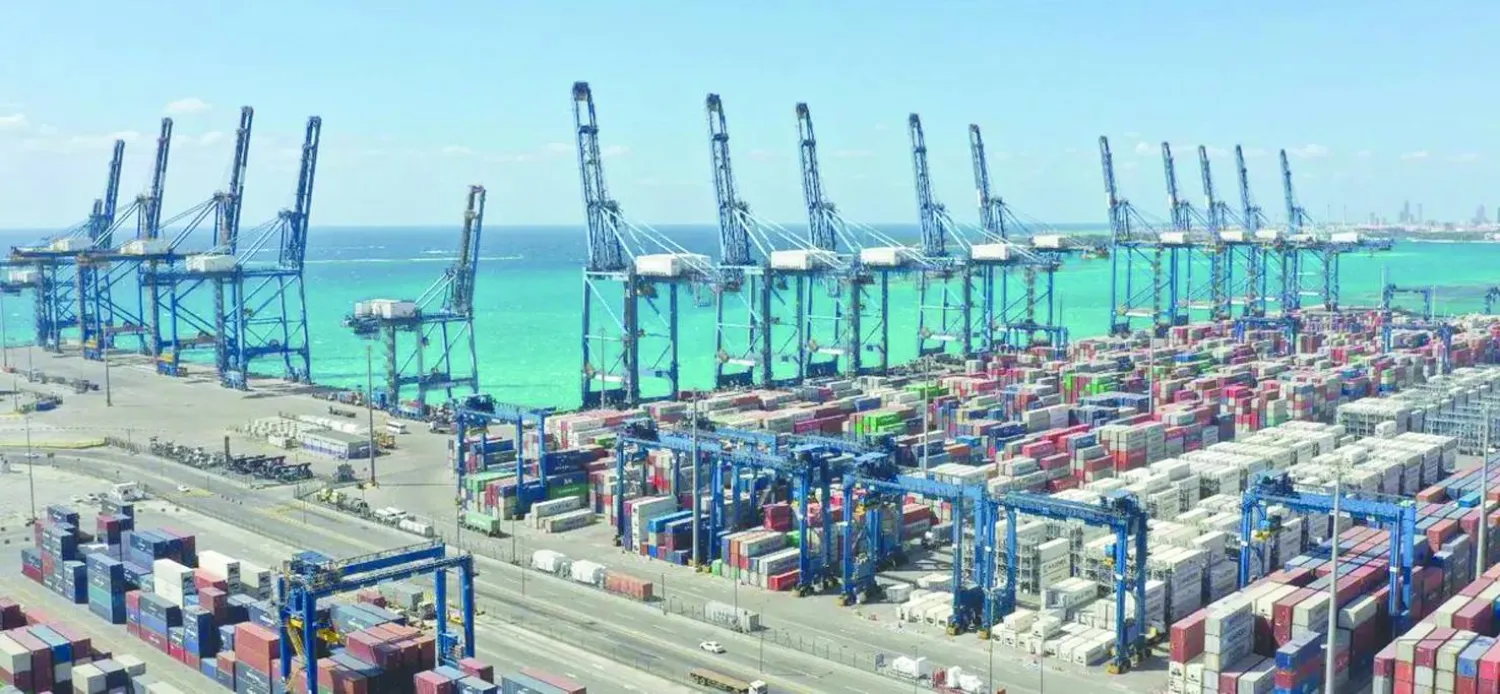
Containers assembled at a Saudi port (SPA)
TT

Maritime Alliances Propel Saudi Arabia Toward Building Global Logistics Influence

Containers assembled at a Saudi port (SPA)

In a short period, Saudi Arabia has moved into a phase of building global logistics influence through maritime alliances with major international companies. The latest step is the launch of a new shipping route linking the Kingdom with Europe, alongside 18 other maritime services currently in operation, supporting national exports, improving access to markets, and reinforcing the country’s position as a key logistics hub.

The Saudi Ports Authority (Mawani) announced on Saturday the addition of a new shipping service by MSC, the world’s largest container shipping company, named “Europe–Red Sea–Middle East,” to Jeddah Islamic Port and King Abdullah Port in Rabigh, as part of ongoing efforts to strengthen maritime connectivity between the Kingdom and global ports and to support import and export flows in cooperation with leading global shipping lines.

MSC said in a statement on its X platform that the new fast shipping service is designed to meet growing demand and provide reliable and efficient connections in a complex operating environment.

The new service links Jeddah Islamic Port with several major global ports, including Gdansk, Klaipeda, Bremerhaven, Antwerp, Valencia, Barcelona, Gioia Tauro, and Abu Qir, extending to King Abdullah Port, Jeddah, and Aqaba, with a capacity of up to 16,000 TEUs.

The authority also revealed on Sunday the launch of 18 maritime shipping services at present, supporting the growth of national exports, improving their efficient access to international markets, and strengthening the Kingdom’s position as a central logistics hub.

Strategic Shift

Specialists told Asharq Al-Awsat that the Kingdom is undergoing a strategic transformation that strengthens its position as a logistics hub linking three continents and supports the goals of Vision 2030 to position Saudi Arabia as a global logistics platform. They said this reflects cumulative investments in port infrastructure, digital transformation, technical integration, and partnerships with leading global shipping lines.

They added that linking the Kingdom with Europe reduces time and cost and enhances the global reach of Saudi products.

Sovereign Tool

Zaid Al-Jarba, an expert in digital transformation and logistics services, told Asharq Al-Awsat that amid rapid shifts in global supply chains, efficient logistics connectivity is no longer merely an operational advantage but a sovereign tool reshaping economic power balances between countries. He said the launch of the new maritime route to Europe, alongside the addition of 18 services in a short period, signals the Kingdom’s transition to an advanced stage in building its logistics influence.

He added that what distinguishes this step is not only the expansion in the number of routes, but the quality of operational integration across Saudi ports, describing an interconnected system that begins at Jeddah Islamic Port and King Abdullah Port and extends through King Abdulaziz Port in Dammam via feeder vessels, reflecting a unified logistics network rather than separate gateways.

He said the move supports Vision 2030 and the National Transport and Logistics Strategy, which aims to establish the Kingdom as a global logistics platform by improving logistics hub performance, upgrading infrastructure, and adopting modern transport systems.

Operational Capacity

Al-Jarba said recent figures, including the launch of 18 new maritime services within a short timeframe with a total capacity of 123,552 TEUs, reflect high operational capacity and flexibility in responding to global changes.

He noted that the presence of global companies such as MSC, Maersk, and CMA CGM within the operating ecosystem reflects international confidence in Saudi Arabia’s logistics environment, indicating that the sector has moved beyond efficiency improvements toward maximizing economic and competitive impact.

He added that improved maritime connectivity not only supports imports but also serves as a key enabler for national exports by reducing delivery times to European markets, improving reliability, and lowering logistics costs, thereby enhancing the competitiveness of Saudi goods, particularly in industrial, food, and petrochemical sectors.

He said developments in Saudi ports go beyond expanding shipping routes to reflect a broader strategic shift toward building an integrated, globally competitive logistics system, adding that the Kingdom is steadily advancing toward cementing its position as a global logistics hub and a key link in international supply chains.

Logistics Integration

Khaled AlGhamdi, a supply chain and logistics expert, told Asharq Al-Awsat that adding these services expands alternative options that integrate with other logistics modes, including land, rail, and air, as part of broader efforts to enhance integration across the transport and logistics sector through multiple initiatives and international partnerships aimed at reducing time, lowering costs, and boosting productivity.

He said the new Europe link in particular will significantly accelerate cargo movement in both directions, from King Abdulaziz Port in Dammam to Jeddah Islamic Port and King Abdullah Port, reflecting efforts to enhance sector integration through expanded services, improved efficiency, and greater reliability, further cementing the Kingdom’s position as a global hub linking three continents.

He added that since the launch of Vision 2030, Saudi Arabia has seen broad progress in transport and logistics, including the rollout of a national strategy and projects exceeding 280 billion riyals, contributing to the Kingdom’s rise to 17th place in the Logistics Performance Index, underscoring the scale of progress achieved.



Asian Shares Mostly Gain and Oil Prices Fall After Trump Says Peace Talks on Iran War Are Proceeding

 People walk in front of an electronic stock board showing Japan's Nikkei index at a securities firm Monday, May 25, 2026, in Tokyo. (AP)
People walk in front of an electronic stock board showing Japan's Nikkei index at a securities firm Monday, May 25, 2026, in Tokyo. (AP)
TT

Asian Shares Mostly Gain and Oil Prices Fall After Trump Says Peace Talks on Iran War Are Proceeding

 People walk in front of an electronic stock board showing Japan's Nikkei index at a securities firm Monday, May 25, 2026, in Tokyo. (AP)
People walk in front of an electronic stock board showing Japan's Nikkei index at a securities firm Monday, May 25, 2026, in Tokyo. (AP)

Asian shares mostly rose Monday and oil prices plunged after US President Donald Trump said talks on ending the war with Iran are progressing.

Japan's benchmark Nikkei 225 surged 2.8% to 65,130.03. Australia's S&P/ASX 200 added 0.4% to 8,692.00. The Shanghai Composite gained 0.8% to 4,143.97.

Trading was closed in South Korea and Hong Kong for local holidays. Markets will be closed in the US on Monday for Memorial Day.

Trump said negotiations with Iran were “proceeding in an orderly and constructive manner.” Meanwhile, regional officials told The Associated Press on Sunday that the United States is close to reaching a deal with Iran that would end the war, reopen the Strait of Hormuz and see Iran give up its stockpile of highly enriched uranium,

Reopening the Strait of Hormuz will help decide the direction of oil prices. The closure has prevented oil tankers from exiting the Gulf and delivering crude to customers worldwide. Japan, for instance, imports almost all its oil, most of it through the strait.

“Markets are rapidly transitioning from pricing geopolitical fear toward pricing a potential peace dividend as Hormuz reopening expectations pressure oil and the dollar lower,” analyst Stephen Innes said in a commentary.

Early Monday, benchmark US crude was down $5.52 at $91.08 a barrel. Brent crude, the international standard, sank $5.56 to $97.08 a barrel.

In currency trading, the US dollar declined to 158.91 Japanese yen from 159.16 yen. The euro cost $1.1639, up from $1.1605.

Friday on Wall Street, stocks finished their eighth straight winning week, the best such streak since 2023. That’s even though a survey showed US consumers are feeling even worse about the economy than before.

The S&P 500 added 0.4% and pulled closer to its all-time high set in the middle of last week. The Dow Jones Industrial Average rose 0.6%, and the Nasdaq composite gained 0.2%.

Recent earnings reports from US companies that topped analysts’ expectations also helped markets. But worries about inflation have pushed bond yields higher worldwide.

The yield on the 10-year Treasury edged down to 4.56% Friday from 4.57% late Thursday, but it remains well above its 3.97% level from before the war.


Vessels Carrying Middle East Oil, LNG Exit Hormuz, Head for Pakistan, China

Vessels in the Strait of Hormuz, Iran, May 22, 2026. Majid Asgaripour/WANA (West Asia News Agency) via Reuters
TT

Vessels Carrying Middle East Oil, LNG Exit Hormuz, Head for Pakistan, China

Vessels in the Strait of Hormuz, Iran, May 22, 2026. Majid Asgaripour/WANA (West Asia News Agency) via Reuters

Two liquefied natural gas tankers are exiting the Strait of Hormuz on Monday, heading to ‌Pakistan and China, while a supertanker with Iraqi crude for China left the Gulf on Saturday after being stranded for nearly three months, shipping data showed.

The US-Israeli war on Iran that began on February 28 has severely curtailed shipping through the Strait of Hormuz, through which around one-fifth of the world's supply of oil and LNG normally flows.

The vessels are among a handful of supertankers exiting the Gulf this month via a transit route ⁠that Iran has ordered ships to use. Last week, three Very Large Crude Carriers (VLCCs) made their way to China and South Korea with 6 million barrels of crude, according to Reuters.

LNG tanker Fuwairit is crossing the Strait of Hormuz on Monday and is expected to discharge its cargo in Pakistan on Tuesday, shipping data on LSEG and Kpler showed. The vessel, sailing under the Bahamas flag, loaded LNG at Qatar's Ras Laffan port around March 28.

Separately, the VLCC Eagle Verona, which exited the strait on Saturday, is expected to reach Ningbo port in eastern China on June 12 to discharge its cargo, ⁠shipping data on LSEG and Kpler showed.

The Singaporean-flagged vessel chartered by Unipec, the trading arm of Asia's largest refiner, Sinopec, loaded nearly 2 million barrels of Basrah crude around February 26, according to the data.

The Eagle Verona was among seven ships Malaysia had sought ⁠permission from Iran to transit, two sources earlier told Reuters. Five of the ships have since exited the waterway, while two more remain in the Gulf.

Before the war began, shipping traffic through the strait averaged 125 to 140 daily passages. Some 20,000 seafarers remain stranded inside the Gulf on board hundreds of ships.


Moody’s Affirms Saudi Arabia ‘Stable’ Outlook Despite Geopolitical Risks

Saudi capital, Riyadh (Reuters) 
TT

Moody’s Affirms Saudi Arabia ‘Stable’ Outlook Despite Geopolitical Risks

Saudi capital, Riyadh (Reuters) 

A Saudi Arabia’s sovereign credit rating affirmed at “Aa3” with a stable outlook by Moody’s last week came as an international testament to the resilience of the Kingdom’s economy and its ability to absorb the region's most violent geopolitical shocks, most notably the closure of the Strait of Hormuz since early March.

Moody’s recent rating did not only observe the Saudi strong fiscal position, but it highlighted the sustained government spending and the continued functioning of key logistics infrastructure, particularly the East–West pipeline, which have allowed the trade flows to be maintained.

The agency affirmed that stronger than expected diversification momentum, especially if supported by a durable reduction in geopolitical tensions, could strengthen Saudi Arabia's growth and fiscal prospects in line with the targets of Vision 2030.

Flexible Logistic Alternatives

In its report, Moody’s explained that the affirmation at Aa3 reflects Saudi Arabia's large and wealthy economy, supported by its vast hydrocarbon endowment, low production costs and highly competitive position in global energy markets, alongside improving institutional and policy effectiveness.

It noted that progress under Vision 2030 has underpinned solid non-hydrocarbon growth, supported by sustained public investment, structural reforms, and gradually improving fiscal and economic transparency.

In an analytical reading of the reality of the current regional conflict, Moody’s placed a key scenario assuming continued disruptions of trade flows in the Strait of Hormuz. It affirmed that its decision to maintain a stable outlook reflects expectation that Saudi Arabia's credit profile will remain resilient thanks to its ability to divert most of its oil exports through the Red Sea and its financial assets.

The credit rating agency noted that the East–West pipeline has been key to the country's ability to continue exporting crude oil since early March.

“The pipeline is already carrying 7 mb/d crude oil and the export terminals on Red Sea have been able to load up to 5 mb/d of crude oil equivalent to two-thirds of pre-conflict export levels,” it wrote.

Oil Revenues

At the financial level, Moody’s said that while oil production and export volumes will remain below pre conflict levels due to the effective closure of the strait, this will be more than offset by significantly higher oil prices, which it expects to average $90–110 per barrel in 2026.

As a result, it noted, Saudi government revenue is likely to exceed pre-conflict expectations, providing the authorities with flexibility to increase spending on economic support measures, subsidies and defense.

Also, Moody’s said it expects an improvement in both fiscal and external positions, despite higher spending and government debt burden to remain moderate at around 32% of GDP in 2026, broadly in line with similarly rated peers.

Sorting

Overall, the rating agency said it expects a contraction in Saudi real GDP of around 1.7% in 2026, reflecting a 10% decline in hydrocarbon output and a slowdown in non oil activity amid weaker confidence and higher costs.

However, Moody’s conservative outlook for 2026 matches with positive Saudi official figures. Flash estimates by the General Authority for Statistics (GASTAT) showed that real GDP increased by 2.8% in Q1of 2026 compared to Q1of 2025. This increase was driven by growth across all main economic activities, as non-oil activities rose by 2.8%, reflecting a robust domestic economy and its resistance to external shocks.

Meanwhile, IMF’s growth forecasts for Saudi Arabia in 2026 seem more optimistic. The Fund said the Kingdom is expected to lead regional growth at about 3.1% this year, supported by alternative pipeline capacity.

It noted that growth is forecast to accelerate to 4.5% in 2027, pointing to stronger medium-term prospects. Saudi Arabia has relied on an east-west pipeline to transport oil overland to the Red Sea, ensuring uninterrupted supply to customers despite disruptions to Gulf shipping routes.

While the IMF favored gradual acceleration, Moody’s offered a more-optimistic scenario for next year, saying that “in 2027, we expect a sharp rebound, with growth around 8%, as trade flows through the Strait normalize, oil production gradually increases and oil prices decline from elevated levels.”

Over the medium term, the rating agency said government debt will rise gradually, approaching around 40% of GDP, broadly in line with similarly rated peers, and supported by the sovereign's sizeable GFAs (which we estimate around 18% of GDP) and continued access to financing.

Non-Oil Economy

Moody’s expects Saudi non-hydrocarbon private sector GDP growth to return to around 4–5% after the conflict subsides, among the strongest rates in the Gulf Cooperation Council (GCC), reflecting ongoing structural reforms, sustained public investment and improving private sector participation.

This trend will, over time, reduce the sovereign's exposure to oil market downturns and long-term carbon transition risks, the agency said.

It noted that large scale projects, particularly those led by the Public Investment Fund (PIF) are entering phases that expand capacity in services sectors such as hospitality, tourism, entertainment, retail and restaurants, supporting demand and employment.

“PIF's new strategic plan 2026-2030 is consistent with the approximately $200 billion invested domestically over 2021–25 or 16% of 2025 nominal GDP,” the agency noted in its report.

Financial Flexibility

At the same time, Moody’s said prior fiscal reforms have improved the resilience of Saudi government finances to oil price fluctuations.

In particular, the introduction of a broad-based 15% value-added tax, with limited exemptions, has significantly increased non-hydrocarbon revenue, which accounted for around 45% of total revenue in 2025 against 36% in 2016, it noted.

This represents a meaningful improvement compared to the past and reduces fiscal sensitivity to oil market cycles.

As a result, Moody’s said, Saudi economy and public finances will continue to be better positioned to absorb oil price shocks than in previous downturns, supporting the credit profile over time.

The agency noted that while the country's debt trend was notably sensitive to oil price and production volatility affecting nominal GDP, the current fiscal position allows the Kingdom to maintain a sustained capital spending on Vision 2030 strategic projects, while benefiting from efficient expenditure controls and a high ability to mitigate domestic and international debt markets, which protects the government's net financial assets and maintains the Kingdom's high creditworthiness.