


International Maritime Organization Deems Cape of Good Hope Navigation Route ‘Unsustainable’

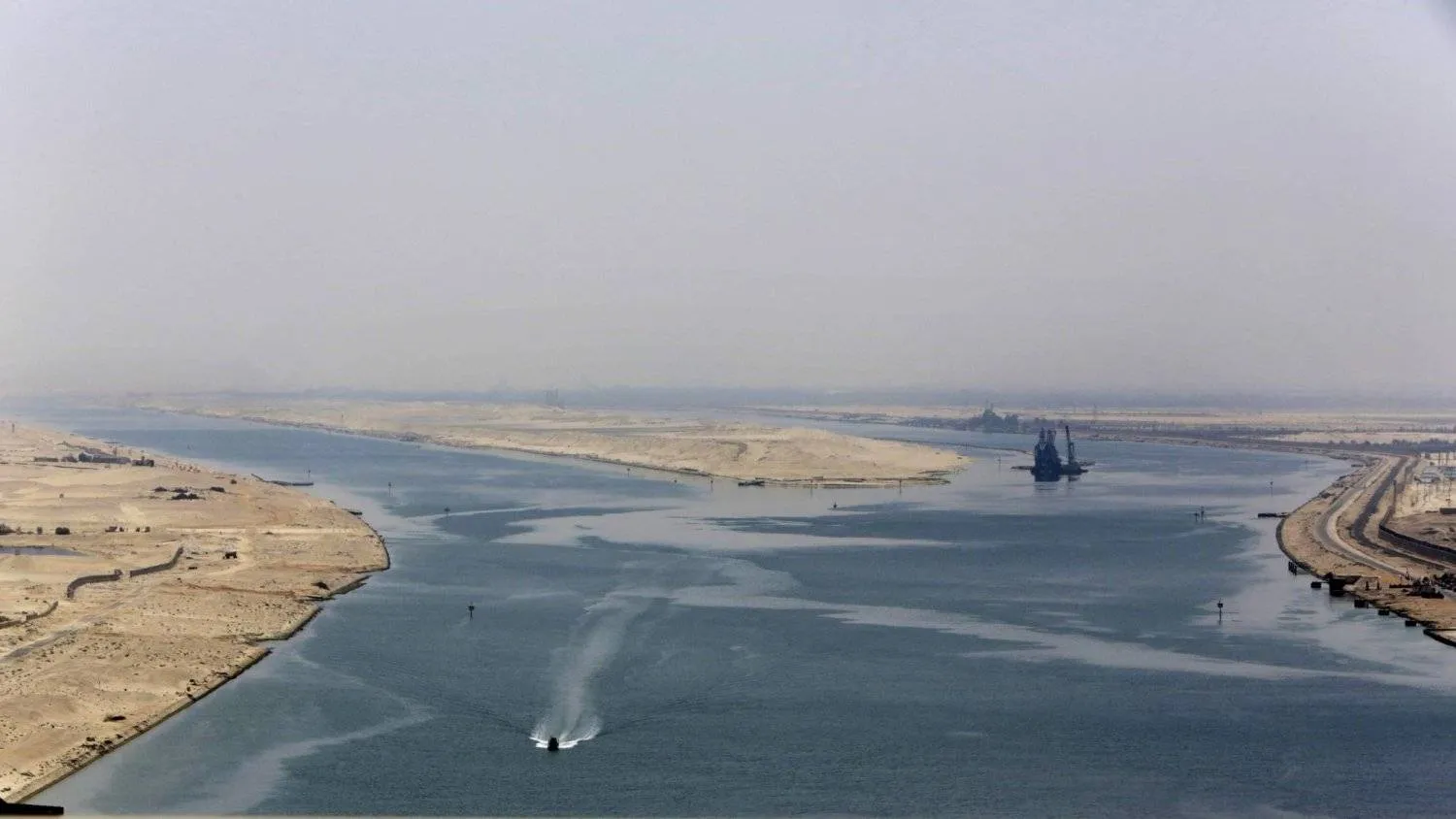
A naval forces boat secures one of the areas of the Suez Canal near the Egyptian city of Ismailia. (AP)
TT

International Maritime Organization Deems Cape of Good Hope Navigation Route ‘Unsustainable’

A naval forces boat secures one of the areas of the Suez Canal near the Egyptian city of Ismailia. (AP)

Secretary-General of the International Maritime Organization Arsenio Dominguez has stressed that the IMO supports freedom of navigation and calls for calm in the Red Sea region.

During his meeting with Chairman of the Suez Canal Authority (SCA) Admiral Ossama Rabie on Thursday, the IMO secretary-general explained that the current situation in the Red Sea region imposes many challenges on the global trade movement, the maritime transport market, the Suez Canal, and the ports in the region.

He affirmed that navigation in the canal is still open to everyone “especially in light of the logistical and security challenges faced by the vessels that go around the Cape of Good Hope,” noting that the “Cape route is deemed unsustainable for navigation traffic as it lacks essential services.”

For his part, Rabie stated that the Suez Canal achieves savings in time and distance compared to alternative routes, and this contributes to reducing fuel consumption by rates ranging from 10 to 90 percent, consequently reducing harmful carbon emissions.

He noted that the Suez Canal reduced carbon emissions by 55.4 million tons in 2023 by saving 16.9 million in fuel consumption.

The SCA Chairman also stressed that navigation in the canal is regular and “has not stopped for a single day” since the outbreak of the crisis, as part of the SCA’s continued efforts to support its clients to mitigate the impact of the current situation.

Additionally, Rabie reviewed the package of navigational and maritime services provided by SCA, which includes, in addition to pilotage services, Bunkering services, ship repair and maintenance services at SCA shipyards, marine ambulance services, marine salvage services, pollution control and other services that the Canal-transiting vessels may need in normal and emergency circumstances.

Yemen’s Houthi movement has been targeting Israel-linked vessels in the Bab Al-Mandab Strait in the Red Sea as an expression of solidarity with the Gaza Strip, which has been under an Israeli attack since October 7.

In response, the US and the UK have hit several Houthi sites to disrupt and degrade the capabilities that the Houthis use to threaten global trade.

Australian mining giant BHP said on Thursday that the Red Sea disruptions are forcing some of its freight service providers to take alternative routes, such as SA's Cape of Good Hope, while others still prefer the Red Sea with additional controls.

“The Red Sea is one of the key shipping routes in the world. However, the majority of BHP’s shipments do not go through this route,” and there have been no major business disruptions so far, the world’s largest listed miner said in a statement.

BHP Group is diverting almost all of its shipments from Asia to Europe away from the Red Sea, the Wall Street Journal reported on Thursday.

It generated $1.96 billion in revenue from Europe in 2023, about 3.6 percent of its total revenue of $53.82 billion.

The move follows reports from companies such as Kuwaiti oil majors BP and Shell that have paused transits through the Red Sea as strikes on commercial vessels by the Iran-aligned Houthis have stymied trade between Europe and Asia.

Some shipping companies have instructed vessels to reroute via a slower and more expensive Cape of Good Hope.

Kuwait Oil Tanker Company (KOTC) said on Thursday it is monitoring and assessing the situation in the Bab Al-Mandeb Strait and Red Sea.

It underlined in a press statement to KUNA that it is following globally applied precautionary measures for the protection and safety of its fleet.

It reiterated that it backs Kuwaiti oil shipments to global markets.

The Kuwaiti newspaper Al-Rai, citing informed sources, said the company has decided to temporarily suspend the passage of its tankers in the Red Sea due to the evolving events in the region.

The newspaper reported that the decision for the temporary suspension is subject to continuous periodic review until the region stabilizes, confirming "the Kuwait Petroleum Corporation's full commitment to implementing its contracts with various countries, using foreign tankers."

Qatar Energy announced on Wednesday that the attacks in the Red Sea “may affect” the scheduling of liquefied natural gas (LNG) shipments, in contrast to production, which it assured was “continuing without interruption.”

In a statement, the company said: “While the ongoing developments in the Red Sea area may impact the scheduling of some deliveries as they take alternative routes, LNG shipments from Qatar are being managed with our valued buyers.”



Saudi Arabia Closes 2025 with Historic Industrial Reform, Global Digital Leadership, Record-Breaking Economic Activity

As 2025 draws to a close, Saudi Arabia records a year defined not merely by statistical growth, but by structural transformation across every major sector. (SPA)
TT

Saudi Arabia Closes 2025 with Historic Industrial Reform, Global Digital Leadership, Record-Breaking Economic Activity

As 2025 draws to a close, Saudi Arabia records a year defined not merely by statistical growth, but by structural transformation across every major sector. (SPA)

The second half of December marked a transformative conclusion to the year for Saudi Arabia, defined by a major policy shift to empower the industrial sector, world-class recognition in digital governance, and unprecedented levels of commercial and religious tourism activity.

Industrial empowerment and economic surge

In a decisive move to boost the competitiveness of the national industry, the Cabinet approved the cancellation of the expat levy for licensed industrial establishments. This decision builds on six years of exemptions that have already driven a 56% increase in industrial GDP to over SAR501 billion and a 74% rise in industrial employment.

Global leadership in tech and health

The Kingdom’s digital transformation strategy achieved a major milestone, ranking second globally in the World Bank’s GovTech Maturity Index with a score of 99.64%, placing it in the "very advanced" category.

In healthcare, the King Faisal Specialist Hospital and Research Center (KFSHRC) was ranked first in the Middle East for oncology and orthopedics and successfully pioneered a novel 3D-printing technique to treat inner ear disorders.

The period by numbers:

SAR30.7 billion: The record value of e-commerce sales in October 2025, marking a 68% annual increase.

68.7 million: The total number of worshippers and visitors received at the two holy mosques during the month of Jumada Al-Akhira.

8 million: The number of visitors to Riyadh Season 2025 since its launch in October.

32.3%: The year-on-year growth in non-oil exports for October 2025.

11.9 million: The number of Umrah performances completed in the month of Jumada Al-Akhira.

95 tons: The quantity of seasonal seeds stored by the Kingdom, setting a new Guinness World Record.

26: The number of awards won by Saudi students at the World Artificial Intelligence Competition for Youth (WAICY), taking 1st place globally.

$160 million: The total value of development loans signed with Mauritania for water and electricity projects.

158,000 tons: The volume of citrus production in the Kingdom as the new season launches.
.9%: The annual inflation rate in Saudi Arabia for November 2025.

12,000+: The number of industrial facilities now operating in the Kingdom, up from 8,822 in 2019.

2: The number of new Dark Sky Reserves accredited in AlUla (Sharaan and Wadi Nakhlah).

As 2025 draws to a close, Saudi Arabia records a year defined not merely by statistical growth, but by structural transformation across every major sector. From welcoming record numbers of tourists and pilgrims to securing top global rankings in digital governance and industrial competitiveness, the Kingdom has effectively translated strategic planning into tangible reality.

These milestones, spanning economic diversification, technological leadership, and international diplomacy, serve as cumulative evidence of a maturing ecosystem.

With every regulatory reform implemented and every global partnership secured this year, Saudi Arabia has done more than catalogue achievements; it has systematically narrowed the distance to its ultimate goals, moving one decisive year closer to the complete realization of Vision 2030.


China’s Factory Activity Snaps Record Slump on Festive Stockpiling

People walk down steps near a residential building area with a view of China Zun, the tallest skyscraper in Beijing, Tuesday, Dec. 23, 2025. (AP)
TT

China’s Factory Activity Snaps Record Slump on Festive Stockpiling

People walk down steps near a residential building area with a view of China Zun, the tallest skyscraper in Beijing, Tuesday, Dec. 23, 2025. (AP)

China's factory activity unexpectedly grew in December, snapping a record eight straight months of decline, lifted by a rise in pre-holiday orders ​as officials seek to spur the $19 trillion economy's manufacturing sector without worsening deflation.

The official purchasing managers' index (PMI) rose to 50.1 in December from 49.2 in November, the National Bureau of Statistics' survey showed on Wednesday, topping the 50-point mark separating growth from contraction and beating a forecast of 49.2 in a Reuters poll.

"Assuming the improvement in the PMIs is borne out in the hard data, we think it will likely be a short-lived upturn in activity on the back of month-to-month swings in fiscal spending rather than the start of a more sustained pick-up," said Julian Evans-Pritchard, head of China economics at Capital Economics.

"The big picture is that the structural headwinds from the property ‌downturn and industrial ‌overcapacity are set to persist in 2026," he added.

Still, the data should ‌give ⁠policymakers ​cause for ‌optimism after choosing to see out 2025 without major additional stimulus to meet the full-year growth target of around 5%.

The production sub-index jumped to 51.7 from 50.0 in November, while new orders climbed to 50.8 from 49.2, marking their strongest performance since March. Supplier delivery times also improved, pushing the production and activity expectations component to 55.5, its highest reading since March 2024.

New export orders remained sluggish, however, edging up to 49.0 from November's 47.6, underscoring the need for officials to boost domestic demand and rely less on US demand, the world's top consumer market, in the face of President Donald Trump's ⁠tariffs.

Huo Lihui, an NBS statistician, said confidence appeared to be improving due to pre-holiday stockpiling, as the world's second-largest economy prepares to celebrate the Lunar ‌New Year in February, pointing to an uptick in the agricultural, food processing ‍and food and beverage sectors.

A separate private-sector PMI ‍published on Wednesday also showed marginal expansion in activity in December, driven by stronger production and domestic demand ‍in the absence of more foreign orders.

DEPRESSED DOMESTIC DEMAND

Ginning up domestic manufacturing without taking further steps to boost consumer demand risks worsening deflationary pressures, however.

In separate data released last week, Chinese industrial firms saw their profits fall 13.1% year-on-year in November, the steepest drop in over a year, suggesting households are not stepping in to pick up the shortfall as a slowing global economy weighs ​on exports.

At an agenda-setting gathering in early December, the ruling Communist Party leadership promised to boost income and stimulate consumption, although similar pledges in the past have struggled to deliver results.

Chinese consumers ⁠have so far been reluctant to spend, held back by an uncertain employment outlook and as a prolonged property crisis drains household wealth.

The official non-manufacturing PMI, which includes services and construction, was at 50.2, after shrinking in November for the first time in nearly three years.

Beijing's policymakers have come to recognize the need to rebalance the economy and transform its production-driven model as tensions with key export markets mount.

"The country's economic development still faces many old problems and new challenges; the impact of changes in the external environment is deepening, and the contradiction between strong supply and weak demand is prominent domestically," the readout of the Central Economic Work Conference said.

In an article published by the flagship party magazine Qiushi Journal in mid-December, President Xi Jinping said there was "overall capacity excess" and that "ultimately consumption is the sustainable driver of economic growth."

Beijing had previously rejected "overcapacity" as unfair criticism by Western governments towards China's industrial policies.

In a nod to those concerns, authorities ‌have this year vowed to crack down on price wars, prune production in some sectors and step up so-called "anti-involution" efforts.

The NBS composite PMI of manufacturing and non-manufacturing was 50.7 in December, compared with November's 49.7.


Xi Says China to Hit 2025 Growth Target of 'Around 5%'

Pedestrians walk along a street in the Central Business District of Beijing, China, 31 December, 2025. (EPA)
TT

Xi Says China to Hit 2025 Growth Target of 'Around 5%'

Pedestrians walk along a street in the Central Business District of Beijing, China, 31 December, 2025. (EPA)

Chinese President Xi Jinping said Wednesday that the country's economy is expected to have grown "around five percent" in 2025, despite "pressure" during a year he described as "very unusual", state media said.

The announcement came in a New Year's Eve speech by Xi to a top political consultative body, reported by state news agency Xinhua.

Such an annual expansion would be in line with the official government target and on par with the five percent growth recorded in 2024.

The world's second-largest economy has come under increasing pressure in recent years, with consumer sentiment having so far failed to recover from a pandemic-induced plunge.

A persistent debt crisis in the property sector, industrial overcapacity and heightened trade conflict with Washington have also darkened the outlook.

"We faced challenges head-on and strived diligently, successfully achieving the main goals of economic and social development," Xi said in his remarks to the Chinese People's Political Consultative Conference, Xinhua reported.

"The growth rate is expected to reach around five percent," he said.

He added that "overall social stability was maintained" and an anti-corruption drive was "relentlessly pursued", according to the report.

Experts widely expect Beijing to announce a similar economic growth target for 2026 at a major annual political gathering in early March.

Data released Wednesday offered a positive sign for policymakers, with factory activity in December inching into expansionary territory to snap an eight-month streak of contraction.