


Gaza’s Economy Could Take Decades to Recover, UN Trade Body Says

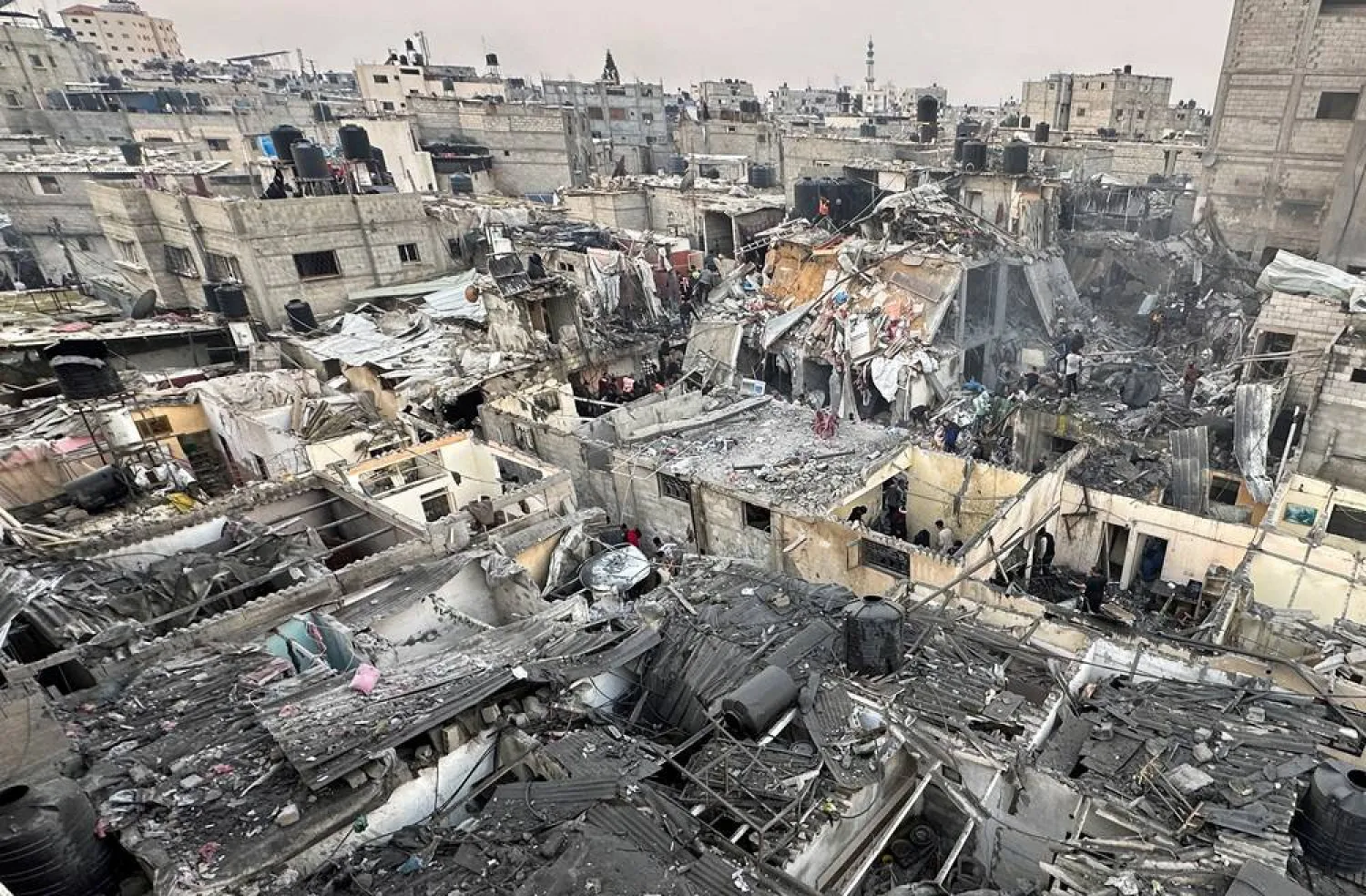
People search through the rubble of damaged buildings following an Israeli air strike on Palestinian houses, amid the ongoing conflict between Israel and the Palestinian group Hamas, in Rafah in the southern Gaza Strip December 12, 2023. (Reuters)
TT

Gaza’s Economy Could Take Decades to Recover, UN Trade Body Says

People search through the rubble of damaged buildings following an Israeli air strike on Palestinian houses, amid the ongoing conflict between Israel and the Palestinian group Hamas, in Rafah in the southern Gaza Strip December 12, 2023. (Reuters)

It could take until the closing years of the century for Gaza's economy to regain its pre-conflict size if hostilities in the Palestinian enclave were to cease immediately, the UN trade body said in a report published on Wednesday.

Israel's offensive in Gaza in the wake of attacks by Hamas gunmen on Oct. 7 have killed more than 26,000 people, according to local authorities, and decimated infrastructure and the livelihoods of its 2.3 million inhabitants.

The United Nations Conference on Trade and Development said the conflict had precipitated a 24% contraction in Gaza's GDP (gross domestic product) and a 26.1% drop in GDP per capita for all of 2023.

UNCTAD said that if the military operation were to end and reconstruction to start immediately - and if the growth trend seen in 2007-2022 persisted, at an annual average rate of 0.4% -- Gaza could restore its pre-conflict GDP levels in 2092.

At best, under a scenario that GDP could grow at 10% annually, it would still take Gaza's GDP per capita until 2035 to reach the level of 2006, before Israel in 2007 made permanent a land, sea and air blockade citing security concerns.

"It will take until 2092 for Gaza to go back to its 2022 level, which wasn't at all a good place for people in Gaza," said Rami Allazeh, an economist who works on the Occupied Palestinian Territories at UNCTAD.

"I think the main takeaway from the report is that the level of destruction that we're witnessing in Gaza is unprecedented. It's going to take a lot of efforts from the international community for the rebuilding and recovery in Gaza."

UNCTAD said that in order to recover following a previous Israeli military intervention in Gaza in 2014, the enclave needs stood at around $3.9 billion. Those needs would be significantly higher following the current conflict, it said.

"Given the level of destruction and the intensity of the damages we're witnessing currently in Gaza, and that the military operation is still ongoing, the number required for recovery in Gaza will be multiple times the $3.9 billion required after the 2014 war," Allazeh said.

Gaza's economy had been in a shambles even prior to the conflict due to the Israeli economic blockade, with the enclave's economy contracting 4.5% in the first three quarters of 2023, according to UNCTAD estimates.

Two-thirds of the population lived in poverty and 45% of the workforce were unemployed before the conflict. As of December, unemployment had surged to a staggering 79.3%, UNCTAD said.

"I don't think the international community or the people in Gaza can afford decades of humanitarian catastrophe," Allazeh said.

"Gaza needs to be part of the development agenda rather than being treated as a humanitarian case."



EU Says US Must Honor a Trade Deal after Court Blocks Trump Tariffs

FILE PHOTO: US President Donald Trump speaks during a press briefing at the White House, in Washington, D.C., US, February 20, 2026. REUTERS/Kevin Lamarque/File Photo
TT

EU Says US Must Honor a Trade Deal after Court Blocks Trump Tariffs

FILE PHOTO: US President Donald Trump speaks during a press briefing at the White House, in Washington, D.C., US, February 20, 2026. REUTERS/Kevin Lamarque/File Photo

The European Union's executive arm requested “full clarity” from the United States and asked its trade partner to fulfill its commitments after the US Supreme Court struck down some of President Donald Trump’s most sweeping tariffs.

Trump has lashed out at the court decision and said Saturday that he wants a global tariff of 15%, up from the 10% he announced a day earlier.

The European Commission said the current situation is not conducive to delivering "fair, balanced, and mutually beneficial” trans-Atlantic trade and investment, as agreed to by both sides and spelled out in the EU-US Joint Statement of August 2025.

American and EU officials sealed a trade deal last year that imposes a 15% import tax on 70% of European goods exported to the United States. The European Commission handles trade for the 27 EU member countries.

A top EU lawmaker said on Sunday he will propose to the European Parliament negotiating team to put the ratifying process of the deal on pause.

“Pure tariff chaos on the part of the US administration,” Bernd Lange, the chair of Parliament’s international trade committee, wrote on social media. “No one can make sense of it anymore — only open questions and growing uncertainty for the EU and other US trading partners.”

The value of EU-US trade in goods and services amounted to 1.7 trillion euros ($2 trillion) in 2024, or an average of 4.6 billion euros a day, according to EU statistics agency Eurostat.

“A deal is a deal,” the European Commission said. “As the United States’ largest trading partner, the EU expects the US to honor its commitments set out in the Joint Statement — just as the EU stands by its commitments. EU products must continue to benefit from the most competitive treatment, with no increases in tariffs beyond the clear and all-inclusive ceiling previously agreed."

Jamieson Greer, Trump’s top trade negotiator, said in a CBS News interview Sunday morning that the US plans to stand by its trade deals and expects its partners to do the same.

He said he talked to his European counterpart this weekend and hasn’t heard anyone tell him the deal is off.

“The deals were not premised on whether or not the emergency tariff litigation would rise or fall,” Greer said. “I haven’t heard anyone yet come to me and say the deal’s off. They want to see how this plays out.”

Europe’s biggest exports to the US are pharmaceuticals, cars, aircraft, chemicals, medical instruments, and wine and spirits. Among the biggest US exports to the bloc are professional and scientific services like payment systems and cloud infrastructure, oil and gas, pharmaceuticals, medical equipment, aerospace products and cars.

“When applied unpredictably, tariffs are inherently disruptive, undermining confidence and stability across global markets and creating further uncertainty across international supply chains,” The Associated Press quoted the commission as saying.

As primarily a trading bloc, the EU has a powerful tool at its disposal to retaliate — the bloc’s Anti-Coercion Instrument. It includes a raft of measures for blocking or restricting trade and investment from countries found to be putting undue pressure on EU member nations or corporations.

The measures could include curtailing the export and import of goods and services, barring countries or companies from EU public tenders, or limiting foreign direct investment. In its most severe form, it would essentially close off access to the EU’s 450-million customer market and inflict billions of dollars of losses on US companies and the American economy.


GCC GDP Jumps to $2.3 Trillion

GCC countries continued to record GDP growth, supported by economic diversification programs and fiscal reforms (Oman News Agency).
TT

GCC GDP Jumps to $2.3 Trillion

GCC countries continued to record GDP growth, supported by economic diversification programs and fiscal reforms (Oman News Agency).

A statistical report published on Sunday showed that the economies of the Gulf Cooperation Council countries recorded growth in gross domestic product, supported by economic diversification programs and fiscal reforms. Combined GDP reached $2.3 trillion, ranking ninth globally, with a growth rate of 2.2 percent.

The report revealed that GCC countries achieved qualitative advances in 2024 across competitiveness, energy, trade, and digitization, driven by growth in non-oil sectors, improved quality of life, the development of digital infrastructure, and a stronger regional and international presence.

In the “GCC in Numbers” report issued by the Statistical Center for the Cooperation Council for the Arab Countries of the Gulf, it was emphasized that GCC states continue to record real GDP growth “thanks to economic diversification programs and fiscal reforms, with GDP reaching $2.3 trillion, ranking ninth globally, and posting growth of 2.2 percent.”

The report also showed improvement in global economic indicators, including competitiveness, resilience, and economic dynamism.

GCC countries ranked first globally in oil reserves at 511.9 billion barrels, third worldwide in natural gas production at 442 billion cubic metres, and second globally in natural gas reserves at 44.3 billion cubic metres.

GCC countries ranked 10th globally in total exports valued at $849.6 billion, 11th in imports at $739.0 billion, 10th in total trade at $1.5895 trillion, and sixth worldwide in trade balance surplus at $109.7 billion.


Algeria Tenders to Buy Nominal 50,000 Metric Tons Soft Milling Wheat

Mature spring wheat awaits harvest on a farm near Beausejour, Manitoba, Canada August 20, 2020. REUTERS/Shannon VanRaes/File Photo
TT

Algeria Tenders to Buy Nominal 50,000 Metric Tons Soft Milling Wheat

Mature spring wheat awaits harvest on a farm near Beausejour, Manitoba, Canada August 20, 2020. REUTERS/Shannon VanRaes/File Photo

Algeria's state grains agency OAIC has issued an international tender to buy soft milling wheat to be sourced from optional origins, European traders said on Sunday.

The tender sought a nominal 50,000 metric tons but Algeria often buys considerably more in its tenders than the nominal volume sought, Reuters reported.

The deadline for submission of price offers in the tender is Tuesday, February 24, with offers having to remain valid until Wednesday, February 25. The wheat is sought for shipment in three periods from the main supply regions including Europe: April 16-30, May 1-15 and May 16-31. If sourced from South America or Australia, shipment is one month earlier.

Algeria is a vital customer for wheat from the European Union, especially France, but Russian and other Black Sea region exporters have been expanding strongly in the Algerian market.