


Gaza’s Economy Could Take Decades to Recover, UN Trade Body Says

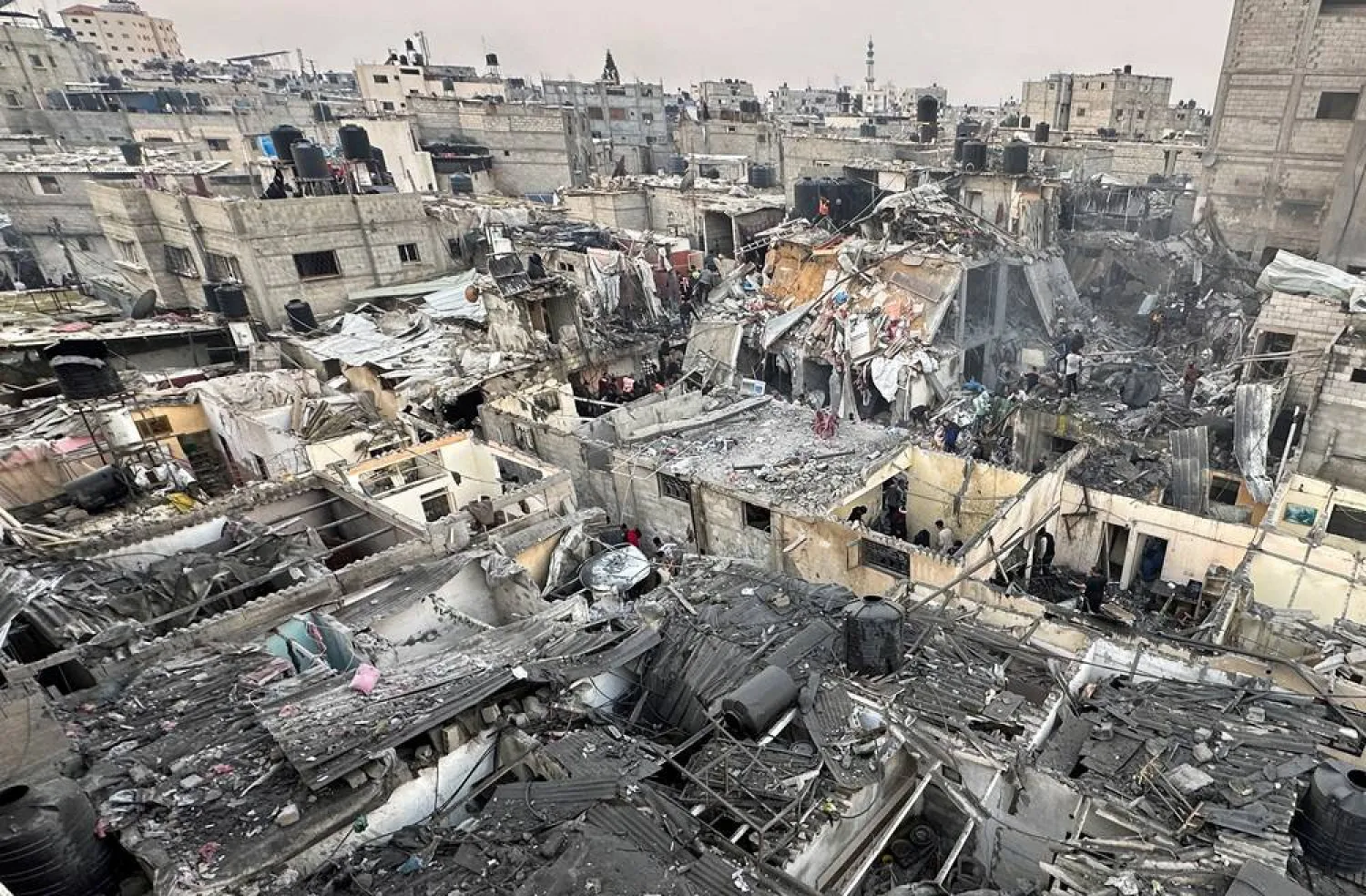
People search through the rubble of damaged buildings following an Israeli air strike on Palestinian houses, amid the ongoing conflict between Israel and the Palestinian group Hamas, in Rafah in the southern Gaza Strip December 12, 2023. (Reuters)
TT

Gaza’s Economy Could Take Decades to Recover, UN Trade Body Says

People search through the rubble of damaged buildings following an Israeli air strike on Palestinian houses, amid the ongoing conflict between Israel and the Palestinian group Hamas, in Rafah in the southern Gaza Strip December 12, 2023. (Reuters)

It could take until the closing years of the century for Gaza's economy to regain its pre-conflict size if hostilities in the Palestinian enclave were to cease immediately, the UN trade body said in a report published on Wednesday.

Israel's offensive in Gaza in the wake of attacks by Hamas gunmen on Oct. 7 have killed more than 26,000 people, according to local authorities, and decimated infrastructure and the livelihoods of its 2.3 million inhabitants.

The United Nations Conference on Trade and Development said the conflict had precipitated a 24% contraction in Gaza's GDP (gross domestic product) and a 26.1% drop in GDP per capita for all of 2023.

UNCTAD said that if the military operation were to end and reconstruction to start immediately - and if the growth trend seen in 2007-2022 persisted, at an annual average rate of 0.4% -- Gaza could restore its pre-conflict GDP levels in 2092.

At best, under a scenario that GDP could grow at 10% annually, it would still take Gaza's GDP per capita until 2035 to reach the level of 2006, before Israel in 2007 made permanent a land, sea and air blockade citing security concerns.

"It will take until 2092 for Gaza to go back to its 2022 level, which wasn't at all a good place for people in Gaza," said Rami Allazeh, an economist who works on the Occupied Palestinian Territories at UNCTAD.

"I think the main takeaway from the report is that the level of destruction that we're witnessing in Gaza is unprecedented. It's going to take a lot of efforts from the international community for the rebuilding and recovery in Gaza."

UNCTAD said that in order to recover following a previous Israeli military intervention in Gaza in 2014, the enclave needs stood at around $3.9 billion. Those needs would be significantly higher following the current conflict, it said.

"Given the level of destruction and the intensity of the damages we're witnessing currently in Gaza, and that the military operation is still ongoing, the number required for recovery in Gaza will be multiple times the $3.9 billion required after the 2014 war," Allazeh said.

Gaza's economy had been in a shambles even prior to the conflict due to the Israeli economic blockade, with the enclave's economy contracting 4.5% in the first three quarters of 2023, according to UNCTAD estimates.

Two-thirds of the population lived in poverty and 45% of the workforce were unemployed before the conflict. As of December, unemployment had surged to a staggering 79.3%, UNCTAD said.

"I don't think the international community or the people in Gaza can afford decades of humanitarian catastrophe," Allazeh said.

"Gaza needs to be part of the development agenda rather than being treated as a humanitarian case."




Capricorn Energy Sees Production Boost, Driven by Growth in Egypt

People run to catch a tram in the coastal city of Alexandria, on February 18, 2026. (Photo by Khaled DESOUKI / AFP)
TT

Capricorn Energy Sees Production Boost, Driven by Growth in Egypt

People run to catch a tram in the coastal city of Alexandria, on February 18, 2026. (Photo by Khaled DESOUKI / AFP)

Oil producer Capricorn Energy said on Monday it expects higher production in 2026 compared with last year, supported by the expansion of its Egypt operations.

In May, the Scottish company and Egyptian General Petroleum Corporation (EGPC) agreed to merge eight concessions ⁠in Egypt into a ⁠single deal under a joint venture with Cheiron Oil and Gas.

Capricorn expects 2026 production in the range of 18,000-22,000 barrels ⁠of oil equivalent per day (boepd), boosted by the agreement with EGPC and growth in the region.

Capricorn CEO Randy Neely said, "We have entered 2026 with strong momentum as our 2025 exit rate of 21,003 boepd and robust balance sheet ⁠position ⁠us to capitalize on development opportunities on the merged concession."

According to Reuters, Capricorn Energy also said it continues to evaluate M&A opportunities in the UK North Sea, Egypt and general MENA region.

The company forecast 2025 production between 17,000 and 21,000 boepd.


US to Stop Collecting Tariffs Deemed Illegal by Supreme Court on Tuesday

LOS ANGELES, CALIFORNIA - FEBRUARY 20: Shipping containers stand stacked while others rest on truck transport chassis at the Port of Los Angeles on February 20, 2026 in Los Angeles, California. Mario Tama/Getty Images/AFP
TT

US to Stop Collecting Tariffs Deemed Illegal by Supreme Court on Tuesday

LOS ANGELES, CALIFORNIA - FEBRUARY 20: Shipping containers stand stacked while others rest on truck transport chassis at the Port of Los Angeles on February 20, 2026 in Los Angeles, California. Mario Tama/Getty Images/AFP

The US Customs and Border Protection agency said it will halt collections of tariffs imposed under the International Emergency Economic Powers Act at 12:01 a.m. EST (0501 GMT) on Tuesday, more than three days after the Supreme Court declared the duties illegal.

The agency said in a message to shippers on its Cargo Systems ‌Messaging Service (CSMS) ‌that it will de-activate all tariff ‌codes ⁠associated with President ⁠Donald Trump's prior IEEPA-related orders as of Tuesday.

The IEEPA tariff collection halt coincides with Trump's imposition of a new, 15% global tariff under a different legal authority to replace the ones struck down by the Supreme ⁠Court on Friday.

CBP gave no reason why ‌it was continuing ‌to collect the tariffs at ports of entry days ‌after the Supreme Court's ruling, and its message ‌offered no information about possible refunds for importers.

The message noted that the collection halt does not affect any other tariffs imposed by Trump, including ‌those under the Section 232 national security statute and the Section 301 unfair ⁠trade practices ⁠statute.

"CBP will provide additional guidance to the trade community through CSMS messages as appropriate," the agency said.

Reuters reported on Friday that the Supreme Court decision made more than $175 billion in US Treasury revenue generated by the IEEPA tariffs subject to potential refunds, based on an estimate by Penn-Wharton Budget Model economists.

Their estimate from a ground-up forecasting model showed that IEEPA-based tariffs were generating more than $500 million per day in gross revenue.


Gold Climbs to 3-week High as US Tariff Ruling Stokes Uncertainty

A vendor displays gold bracelets for sale in a gold shop at the Grand Bazaar in Istanbul (AFP)
TT

Gold Climbs to 3-week High as US Tariff Ruling Stokes Uncertainty

A vendor displays gold bracelets for sale in a gold shop at the Grand Bazaar in Istanbul (AFP)

Gold climbed to a three-week high on Monday as uncertainty stoked by the US Supreme Court's decision to strike down a vast swathe of President Donald Trump's tariffs pressured the dollar and pushed investors to the safety of bullion.

Spot gold climbed 1.1% to $5,158.29 per ounce by 0558 GMT, having earlier hit its highest since January 30. ‌US gold futures for ‌April delivery were up 2% at $5,180.40.

"The court's ‌tariff ⁠ruling has, aside ⁠from earning the ire of the US president, added another layer of uncertainty to global markets, with traders again turning to gold as a defensive play," said Tim Waterer, chief market analyst at KCM Trade.

The US Supreme Court struck down Trump's sweeping tariffs that he pursued under a law meant for use in national emergencies, ⁠handing the Republican president a stinging defeat in ‌a landmark ruling on Friday ‌with major implications for the global economy.

After the court ruling, Trump said ‌he would raise a temporary tariff from 10% to 15% ‌on US imports from all countries.

Wall Street futures and the dollar slid in Asia on Monday as murkiness around US tariffs revived the "sell America" trade, Reuters reported.

"Whether gold can claw its way back above $5,400 in the near-term ‌may rest on how long tariff uncertainty lingers and whether the US engages in military action ⁠against Iran," Waterer ⁠said.

Iran has indicated it is prepared to make concessions on its nuclear program in talks with the US in return for the lifting of sanctions and recognition of its right to enrich uranium, as it seeks to avert a US attack.

Meanwhile, data on Friday showed that underlying US inflation increased more than expected in December, and signs are pointing to a further acceleration in January, which would strengthen expectations that the Federal Reserve won't cut interest rates before June.

Spot silver climbed 2.9% to $86.98 per ounce, a more than two-week high.
Spot platinum edged 0.1% higher to $2,158.55 per ounce, while palladium slipped 0.2% to $1,745.09.