

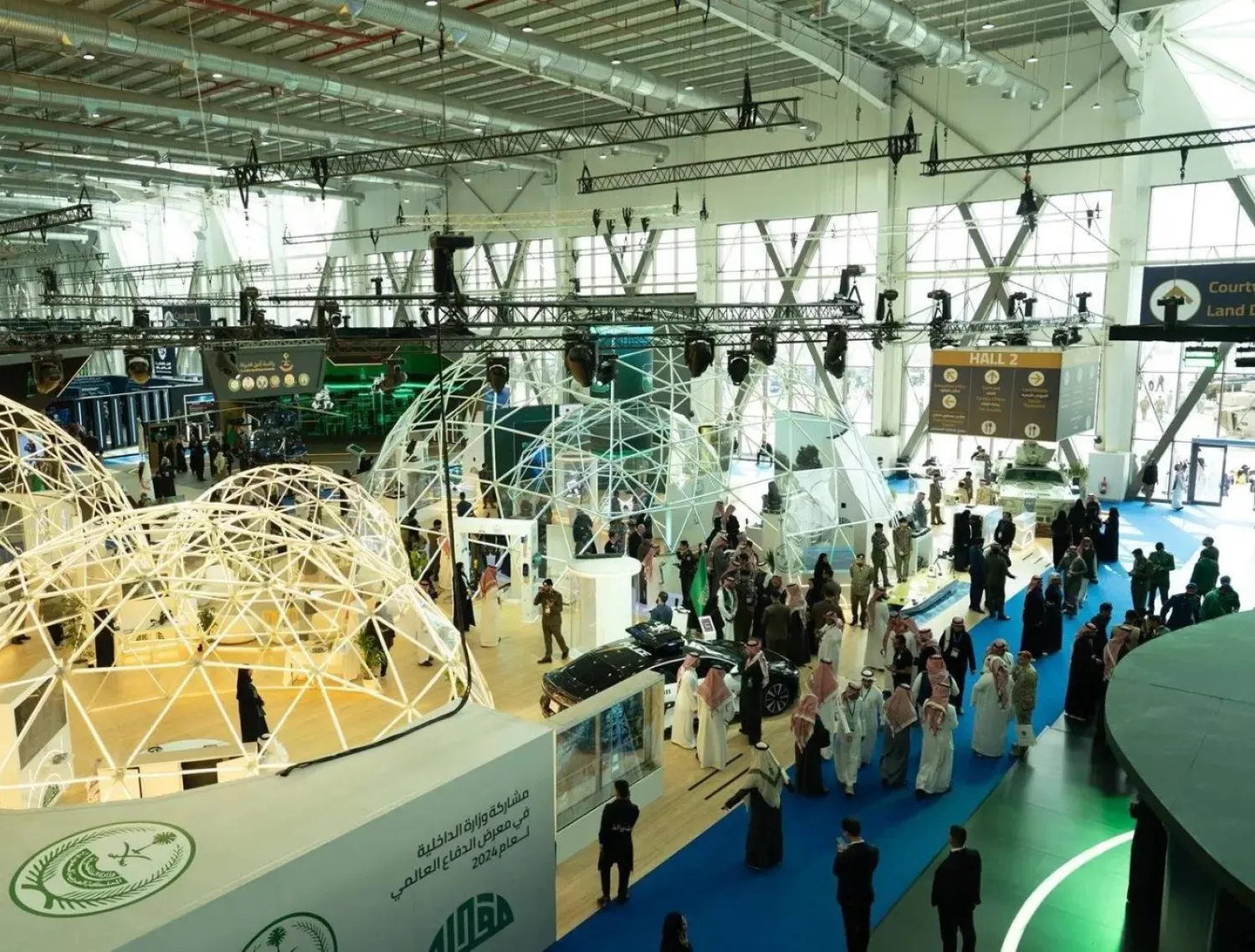

World Defense Show Concludes in Riyadh with $7 Bn Contracts

World Defense Show 2024 in Riyadh (SPA)
TT

World Defense Show Concludes in Riyadh with $7 Bn Contracts

World Defense Show 2024 in Riyadh (SPA)

The second edition of the World Defense Show 2024 concluded in Riyadh with the signing of 61 purchase contracts worth $7 billion.

Over 773 participants and more than 441 Saudi delegations representing 116 countries participated in the show, and more than 106,000 visitors arrived at the pavilion.

The show also witnessed the signing of 73 agreements, including 17 industrial participation agreements.

Governor of General Authority for Military Industries (GAMI) Ahmed al-Ohali asserted that the event succeeded in linking industry leaders with innovators worldwide.

Several Saudi investors participating in the show stressed the importance of the event, describing it as a platform for building alliances with international companies specialized in the defense and military industries.

They also indicated that it represented a chance for foreign investors to learn about Saudi projects and witness the changes and qualitative renaissance in the Kingdom.

The investors pointed out that this edition paved the way for global markets to enter the defense and security industry in the Kingdom.

The exhibition has also become an influential global platform for achieving communication, exchanging knowledge, and building business relationships worldwide.

It also enables exhibitors and investors to learn about this field's latest innovations and technologies.

Asharq Al-Awsat met with local company representatives on the sidelines of the event.

During the exclusive interviews, they stated that the pavilion brings together several major companies that lead the global defense industries.

They stressed that such a category accelerates the sector's localization process by more than 50 percent, according to the targets of Vision 2030 to reduce military spending.

GAMI governor said at the event's inauguration that the Kingdom has begun to reap the fruits of government support to increase and develop military-industrial capabilities to 13.6 percent by the end of 2022.

- Explore opportunities

The CEO of Aircraft Accessories and Components Company (AACC), Mansour al-Eid, told Asharq Al-Awsat that the exhibition is an opportunity to build alliances with international companies, as it brings all investors and those interested in the sector under one roof.

Eid noted that the event saves time, effort, and money, allowing local companies to search for partnerships with international capitals specialized in military industries.

He noted that 70% of the AACC alliances with its global counterparts occurred during this exhibition and other exhibitions in this field, including cooperation with Chinese, European, and Turkish companies.

Eid stressed that the second edition brought together many specialized international companies, providing an excellent opportunity for its local counterparts.

He pointed out that this edition allowed global markets to enter the defense and security industry market in the Kingdom.

- Artificial intelligence

Eid explained that localization of the industry boils down to qualifying Saudis to specialize in this industry, adding that the government is working in this direction.

The private sector has a significant role, said Eid, adding that it is the engine of the economy and develops the industry, asserting that "investing in mind" will positively impact national companies.

The CEO added that the percentage of Saudization in his company reached 67%, and Saudi youth are attracted to artificial intelligence and aircraft operations.

He added that employment in artificial intelligence is one of the jobs that most require a period to invest and develop human resources.

- Integration between entities

For his part, the Director of Aeronautical and Mechanical Engineering at Intra Defense Technologies, Asim al-Rebdi, told Asharq Al-Awsat that the exhibition in its current edition has many positive revenues centered around integration between relevant authorities, customers, and legislative authorities.

Rebdi indicated that Intra displayed national solutions, which the company worked to develop and manufacture to cover the needs of the armed forces and security agencies.

According to the expert, Intra relies on its national cadres to develop and manufacture drones to achieve the vision of localizing 50% of military spending by 2030.

It also highlights national capabilities in the military and security fields by including local companies.

He told Asharq Al-Awsat about Intra's Samoum, saying the Unmanned Aircraft System (UAS) is an operational-class drone equipped with advanced payloads and sensors, including radars and optical systems.

Samoum is the final developed model, and the device is now in the testing stages, said Rebdi, noting that the company aims to complete the project during the next year to be ready to enter into the service.



Oil Edges Lower after Trump Signals Dialogue with Iran over Nuclear Program

A view shows a pressure gauge near oil pump jacks outside Almetyevsk, in the Republic of Tatarstan, Russia July 14, 2025. REUTERS/Stringer
TT

Oil Edges Lower after Trump Signals Dialogue with Iran over Nuclear Program

A view shows a pressure gauge near oil pump jacks outside Almetyevsk, in the Republic of Tatarstan, Russia July 14, 2025. REUTERS/Stringer

Oil prices slipped on Friday on signs that the US may engage in dialogue with Iran over its nuclear program, reducing concern over potential supply disruptions from a US attack.

Brent crude futures were down 21 cents, or 0.3%, at $70.50 a barrel by 1219 GMT. The March contract expires later on Friday. The more active April contract lost 45 cents, or 0.65%, to $69.14.

US West Texas Intermediate crude fell 38 cents, or 0.6%, to $65.04 a barrel, Reuters reported.

"President Trump’s willingness to give diplomacy a chance regarding Iran seemingly makes a US military intervention less likely than yesterday," said PVM Oil Associate analyst Tamas Varga.

Middle East tensions and oil prices had increased this week as the US strengthened its military presence in the region. US President Donald Trump urged Iran on Wednesday to make a deal on nuclear weapons or face an attack but on Thursday said he was planning to speak to the country's leaders.

Despite Friday's declines, benchmark prices remained on track for large monthly gains. Brent crude was set for its biggest monthly jump since January 2022 and WTI was poised for its largest monthly gain since July 2023.

Price pressure also came from a rise in the dollar after it hit a four-year low earlier in the week. Friday's dollar strength followed Trump's announcement that he would pick former Federal Reserve Governor Kevin Warsh to head the US central bank when Jerome Powell's leadership term ends in May.

A stronger dollar can limit demand from oil buyers paying in other currencies.

"Rising US crude oil output after shutdowns and Kazakhstan nearing the resumption of production at the Tengiz oilfield also contribute to the change in sentiment, and given the week’s bullish performance, it is reasonable to expect some profit-taking ahead of the weekend," Varga added.

Meanwhile, peak maintenance periods for Russian primary oil refining this year are expected this month and in September, based on Reuters calculations using estimates from industry sources.

A Reuters poll of 32 analysts found that most expect prices to hold near $60 a barrel this year as the prospect of oversupply offsets potential disruption from geopolitical tensions.


Syrians Decry Soaring Electricity Prices

Syria's electricity infrastructure was hammered by years of civil war © LOUAI BESHARA / AFP
TT

Syrians Decry Soaring Electricity Prices

Syria's electricity infrastructure was hammered by years of civil war © LOUAI BESHARA / AFP

When Hani Massalkhi went to pay his electricity bill in Damascus this week, he discovered that, under the new tariffs, the amount due was higher than his monthly income.

Massalkhi, a retired agricultural engineer who lives on a $70-a-month pension, left without paying.

"My bill used to vary between 15,000 and 20,000 pounds (less than $2). Now, it has surpassed 800,000 pounds", or $72, he told AFP.

In October, Syria's energy ministry hiked prices by up to 6,000 percent, sending shockwaves through a population already reeling from more than 13 years of war.

"Where are we supposed to get this money from?" Massalkhi wondered.

"People are emerging from a crisis, exhausted...they can't even put food on the table."

Authorities said the increase comes "within the framework of a project to reform the electricity sector, achieve sustainability, and improve service".

But, with most of Syria's population living below the poverty line and the minimum wage at around $75, many have found themselves unable to pay the new tariffs.

An official at the energy ministry did not respond to an AFP request for comment on the new prices.

- 'Electricity is a right' -

Since the ousting of longtime ruler Bashar al-Assad in 2024, the new Syrian authorities have repeatedly vowed to increase electricity production in a country where power cuts can last up to 20 hours a day.

Over the past year, they have signed contracts and memoranda of understanding to import gas from Turkey and Qatar to increase production.

They also hope to attract funding and investments to rehabilitate Syria's dilapidated infrastructure.

The World Bank estimates that post-war reconstruction will cost more than $216 billion.

However, citizens have yet to feel noticeable changes in their living conditions.

Damascus residents now receive up to six hours of state-provided electricity daily, but those outside the capital remain mostly in the dark.

Mohamad Ahmad, an economist and energy specialist at the Syria-focused consultancy Karam Shaar Advisory, told AFP that the price increase "primarily aims to prevent the financial collapse of the electricity sector".

"The core problem is not the tariff increase itself, but rather the erosion of wage purchasing power, particularly given that some employees earn less than $100 per month," he added.

On Thursday, a handful of people gathered outside the energy ministry in Damascus to protest the new tariffs, something unimaginable under the former government.

They held placards that read "we won't pay", condemning the widening gap between incomes and bills.

Protester Mohammed Daher, a retired public employee, told AFP that he now receives only two hours of electricity a day in the Tadamon suburb of Damascus.

He said that although he carefully rations his power use at home, he was "shocked to find out that my bill has surpassed 350,000 pounds ($31)," when it used to be less than $2.

"Where am I supposed to get that money from?" he added, saying his income was just $62 a month.

Feminist activist Sawsan Zakzak, 65, said she had been limiting her electricity consumption because she and her husband live on low pensions.

"We do not use air conditioning, and this year we did not use the boiler," she said as she held a placard that read "electricity service is a right".

"We also only watch television for a short period of time, fearing high tariffs."


Gold Tumbles Below $5,000, Dragging other Metals Lower

Gold and silver ingots at the Austrian "Ogussa" factory in Vienna (Reuters)
TT

Gold Tumbles Below $5,000, Dragging other Metals Lower

Gold and silver ingots at the Austrian "Ogussa" factory in Vienna (Reuters)

Gold prices tumbled by more than 7% to break below the $5,000 mark on Friday as the dollar strengthened on the imminent appointment of a new US Federal Reserve Chair, though the safe-haven metal remained set for its biggest monthly gain since 1999 after chalking up multiple record peaks.

Other precious metals also dropped sharply as profit-taking kicked in, said Reuters.

Spot gold lost 7.5% to $4,992.05 an ounce by 0947 GMT. US gold futures for February delivery fell 6.4% to $4,985.

Gold scaled ‌a record peak ‌of $5,594.82 on Thursday and is still on ‌track ⁠for a more ‌than 15% gain this month, heading for a sixth straight monthly gain and largest since 1999.

"I still believe several gold-supportive drivers remain in place, but after the strong rally in recent weeks a consolidation is healthy," said UBS analyst Giovanni Staunovo, adding that the likely nomination of a new Fed chair is applying immediate pressure on prices. US President Donald Trump said on Thursday ⁠that he will reveal his pick for the next Fed chair on Friday, with former ‌Fed Governor Kevin Warsh seen as a frontrunner. ‍Warsh has pushed for a smaller ‍Fed balance sheet, contrasting with Trump's inclination towards looser monetary policy.

The US ‍dollar rose on Friday, clawing back some of this week's slide to a four-year low. A stronger US currency makes dollar-priced gold more expensive for overseas buyers. Physical gold premiums in India rose to their highest in more than a decade on strong investment demand ahead of a likely duty increase. Premiums in China jumped after a pickup in investment and ⁠jewelry demand.

"We see gold dipping far lower than today but see a recovery and an average of $5,375 for 2026, reaching a peak of $6,400 during the fourth quarter," said independent analyst Ross Norman.

Among other precious metals, spot silver was down 14.1% at $99.77 an ounce after hitting a record $121.64 on Thursday. The metal has surged 42% this month, on track for its best monthly performance.

"Although a significant part of the move in the rise in silver has been based upon sound fundamentals, there was clearly a speculative excess within the market and I think that's getting blown off," Norman added.

Spot platinum lost ‌15.7% to $2,216.55 an ounce after hitting a record high of $2,918.80 on Monday. Palladium, meanwhile, plunged 13.4% to $1,737.50.