Lebanese President Meets Delegation Chief ahead of Direct Israel Talks

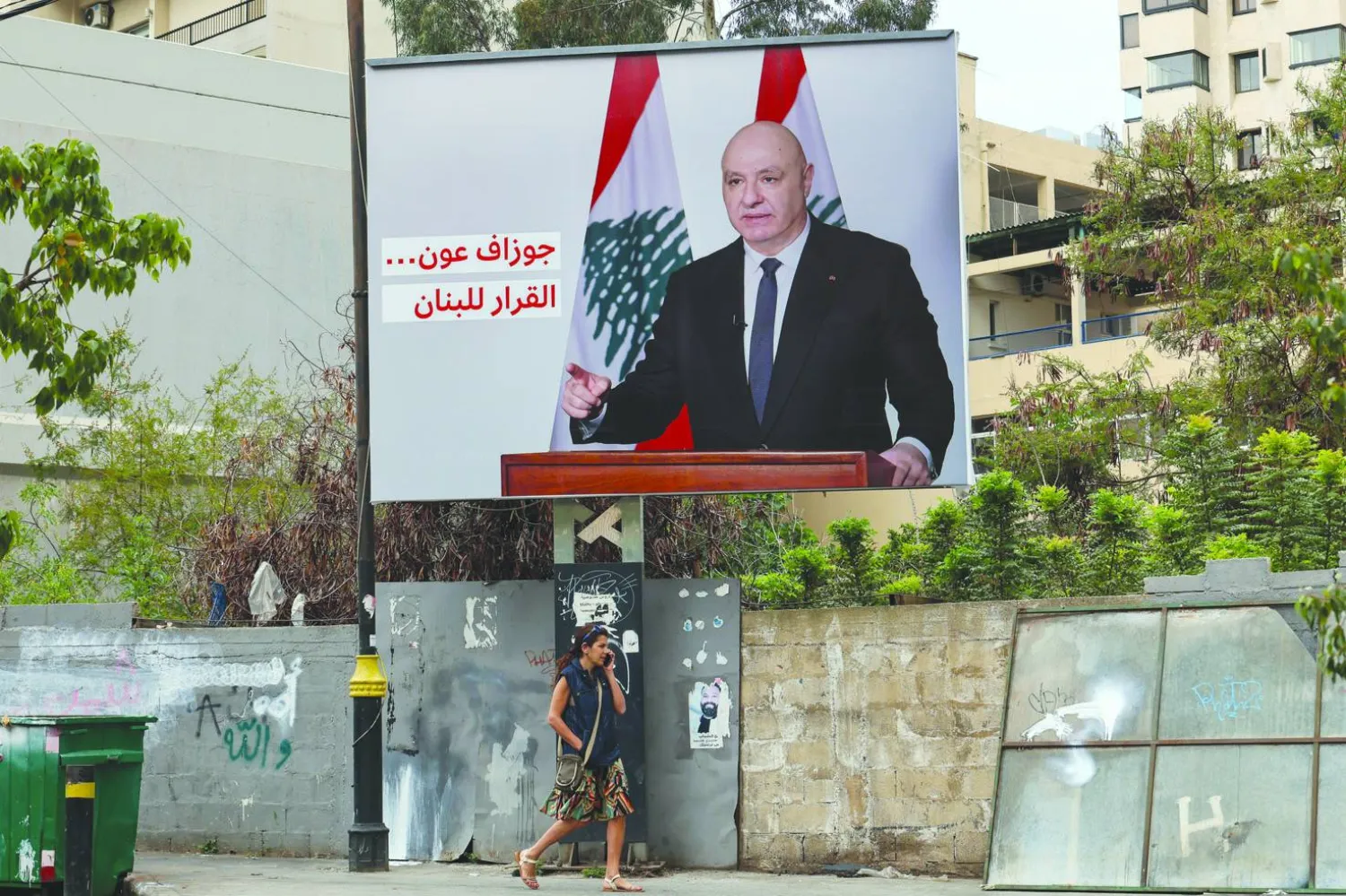
A woman walks past a billboard depicting Lebanese President Joseph Aoun and sentence reading in Arabic 'The decision is up to Lebanon' EPA/WAEL HAMZEH
TT

Lebanese President Meets Delegation Chief ahead of Direct Israel Talks

A woman walks past a billboard depicting Lebanese President Joseph Aoun and sentence reading in Arabic 'The decision is up to Lebanon' EPA/WAEL HAMZEH

Lebanese President Joseph Aoun on Friday met with veteran diplomat Simon Karam, the head of the delegation headed to Washington for planned talks with Israel next week.

Lebanon and Israel's US ambassadors had previously met twice in Washington over the past weeks, in an attempt to end the war that started when Hezbollah drew Lebanon into the Middle East conflict on March 2.

Foreign Minister Youssef Raggi said in a statement Friday that Lebanon's goals from the negotiations were "consolidating the ceasefire, securing Israel's withdrawal from occupied Lebanese territory, and restoring the state's full sovereignty over its national territory".

Despite a truce that has been in place since April 17, Israel has repeatedly bombed Lebanon, mostly the country's south, and retained control over border areas.

In a statement from the presidency, Aoun said he and Karam discussed "preparations for the meeting scheduled for next Thursday in Washington between the Lebanese, American and Israeli delegations".

Aoun provided Karam with "directives outlining Lebanon's firm positions regarding the negotiations", the statement added.

A Lebanese official who requested anonymity told AFP that Karam "will head to Washington soon" to lead the Lebanese delegation.

The Lebanese ambassador to the US, the deputy chief of mission and a military representative will also be part of the delegation, the official added.

The ambassador-level meeting on April 14 was the first of its kind in decades, as the two countries have officially been at war since 1948.

Following the first round of talks, US President Donald Trump announced a 10-day ceasefire, with a three-week extension announced after the second round.

Trump also said he expected Aoun and Israeli Prime Minister Benjamin Netanyahu to meet jointly with him at the White House "over the next couple of weeks".

But Aoun said on Monday that "we must first reach a security agreement and stop the Israeli attacks on us before we raise the issue of a meeting between us".

US Secretary of State Marco Rubio, at a news conference on Tuesday, said "there's no problem between the Lebanese government and the Israeli government" and that Hezbollah was the issue.

"By and large, I think a peace deal between Lebanon and Israel is eminently achievable and should be," Rubio said.

Hezbollah is strongly opposed to the direct talks, calling them a "sin" and urging Beirut to withdraw from them.

Israeli strikes have killed more than 2,700 in Lebanon since March 2, including dozens since the ceasefire was announced.


Lebanon-Israel Talks Head for Stalemate

The US Embassy in Rome, Italy, where the seventh round of Lebanese-Israeli negotiations was held. (AP)
TT

Lebanon-Israel Talks Head for Stalemate

The US Embassy in Rome, Italy, where the seventh round of Lebanese-Israeli negotiations was held. (AP)

Lebanese-Israeli negotiations appear headed for a period of drift, with no serious signs that political and technical discussions will translate into practical steps.

The seventh round, held in Rome last week, ended without tangible results.

The next round will be held next month, a State Department official announced Tuesday.

"The political track will reconvene in Rome in early September, and conversations will continue in Beirut, Jerusalem, and Washington in the interim," the official said on condition of anonymity.

Lebanese ministerial sources following the negotiations said the deadlock was driven mainly by Israeli and US political calculations, making a meaningful breakthrough unlikely in the near term.

Israeli Prime Minister Benjamin Netanyahu does not appear ready to make concessions or take major steps before Israel’s elections in October, the sources told Asharq Al-Awsat.

With the outcome uncertain, they said, Netanyahu would be reluctant to approve a withdrawal from areas in southern Lebanon that could carry domestic political costs or be used against him during the campaign.

Limited US pressure

The sources said Washington was also unlikely to put heavy pressure on Netanyahu at this stage, despite continuing to sponsor the negotiations.

They linked that caution to US domestic politics ahead of the midterm elections and the administration’s desire to maintain strong ties with Israel and segments of the Jewish American electorate.

That leaves Washington with limited room to push the Israeli government, the sources said.

The United States appears keen to keep the talks alive and prevent their collapse, but not to press Israel into major steps before the Israeli political picture becomes clearer.

Talks, but no implementation

The seventh round underscored the limits of the current process, the sources said.

“If there had been a serious desire to make progress, it would at least have been possible to agree on the pilot areas and identify them by name as a prelude to implementation,” they said.

Instead, discussions shifted to border issues, working mechanisms and technical arrangements.

No practical steps were agreed, including Lebanon’s demand for an end to the war and destruction, the sources said.

The problem, they added, is that the talks are increasingly focused on mechanisms and details while the political decisions needed to begin implementation remain absent.

That risks turning the negotiations into an open-ended process with no tangible outcome.

Prisoners and remains

The sources said bringing the issue of Israeli remains into the talks and linking it to the prisoners’ file was also pulling attention away from the core issues.

If there were a serious and positive effort to address the prisoners’ issue, they said, the International Committee of the Red Cross should at least be allowed to meet them, something Israel continues to refuse.

Raising such issues without taking clear steps only prolongs the negotiations, the sources said, rather than moving toward the issues Lebanon wants addressed.

Against that backdrop, Beirut is using its channels with US officials to press Israel, at least to halt the continuing bulldozing and destruction in the south.

Lebanon is stressing to Washington that ongoing destruction, alongside negotiations, makes it difficult to portray the process as serious or capable of producing a settlement, the sources said.

Beirut hopes for some progress on that front in the near term.

Could Lebanon walk away?

On whether Lebanon might suspend its participation, the sources pointed to an episode during the seventh round in Rome.

Lebanese delegation head Ambassador Simon Karam wanted to withdraw after Israel threatened to strike the town of Mansouri and called for its evacuation, they said.

The Lebanese presidency, however, favored continuing the talks.

Its view was that any suspension should come from the other side, not Lebanon, so Beirut would not be blamed for derailing the negotiations.

Iran remains a factor

The US-Iranian negotiations are also feeding into the Lebanese-Israeli track, alongside Israel’s elections, the sources said.

Any progress between Washington and Tehran could affect the situation in Lebanon.

The main impact, they said, would be on efforts to disarm Hezbollah, ease tensions and push the group toward a more positive approach to Lebanon’s negotiating track.


Sources to Asharq Al-Awsat: Gaza Factions Assured Political Work after Disarmament

Members of Hamas’ Qassam Brigades. (Reuters file)
TT

Sources to Asharq Al-Awsat: Gaza Factions Assured Political Work after Disarmament

Members of Hamas’ Qassam Brigades. (Reuters file)

Israel has repeatedly vowed to eliminate Hamas and keep the group out of Gaza’s political, administrative and security future. But that goal, along with others, appears increasingly difficult to achieve.

Sources in Hamas and other Palestinian factions told Asharq Al-Awsat that months of talks in Cairo, particularly those held in recent days and weeks, included assurances that the factions would face no obstacle to continuing political activity in the Palestinian territories.

A Hamas source based abroad said the assurances amounted to guarantees from several parties, including mediators and the US administration, that Palestinian factions would be free to exercise their political rights under Palestinian law.

Their members and activists would also not be targeted or pursued over their political activity or previous political or security-related activities, the source said.

Another senior Hamas source said the issue had been clear since negotiations began around US President Donald Trump’s initiative in September and October 2025.

The negotiating team, the source said, had rejected Israeli efforts to dismantle Hamas completely, exclude it from Palestinian political life, and force its leaders into exile.

Those understandings were reaffirmed in the latest talks as Hamas agreed to the inventorying and storage of weapons, the source said.

Some factions had nevertheless raised concerns that parties could later use the new arrangements to launch unjustified campaigns against activists for their affiliations or political activity, particularly after the weapons inventory process was completed.

A source from a Palestinian faction that took part in the Cairo talks said the agreed roadmap contained nothing to prevent factions from operating politically as usual.

Those concerns have gained importance after Palestinian President Mahmoud Abbas set Nov. 28 as the date for legislative elections, including in parts of the Gaza Strip where voting can be held, particularly central Gaza.

Palestinian sources told Asharq Al-Awsat more than a month ago that Arab and Islamic countries, along with other parties, were working to bridge differences between the factions and the Palestinian Authority so the elections could take place under broad national consensus in line with the new phase in Palestinian internal politics.

Hamas on Tuesday urged Palestinians to register or update their details on the electoral roll to secure their right to take part in the coming elections.


Syria Condemns Colombia's Recognition of Israeli Sovereignty over Golan Heights

Israeli soldiers operate in the Israeli-occupied Golan Heights near the border with Syria, amid the conflict between Israel and the Palestinian group Hamas, December 28, 2023. (Reuters)
TT

Syria Condemns Colombia's Recognition of Israeli Sovereignty over Golan Heights

Israeli soldiers operate in the Israeli-occupied Golan Heights near the border with Syria, amid the conflict between Israel and the Palestinian group Hamas, December 28, 2023. (Reuters)

Syria strongly condemned on Tuesday the Colombian government's statement recognizing what it described as "Israeli sovereignty" over the occupied Syrian Golan Heights, saying the position, which was reportedly based on security considerations, contradicts international law and relevant United Nations resolutions.

The Syrian Ministry of Foreign Affairs and Expatriates categorically rejected Colombia's position, reaffirming that the Golan Heights are an integral part of Syrian territory, said Syria’s state news agency SANA.

The ministry said the Colombian statement is a flagrant violation of the UN Charter and contradicts the position of the UN Secretary-General affirming that the Golan Heights are Syrian territory, as well as the established principle prohibiting the acquisition of territory by force and relevant UN Security Council resolutions.

The ministry welcomed growing international support for Syria's legitimate rights over the Golan Heights, saying this reflects continued international rejection of attempts to legitimize the occupation or recognize its consequences.

It stressed that the Golan Heights remain subject to the principles of international law and the relevant UN resolutions.

The Syrian foreign ministry also condemned the continued Israeli attacks and incursions into Syrian territory, calling on states and international organizations to uphold their responsibilities under international law and respect UN resolutions.

Syria will continue to employ diplomatic and legal means to defend its sovereignty, territorial integrity and established rights, and to work toward the restoration of its occupied territories, it vowed.