


World Government Summit: AI Readiness is Imperative

Opening session of World Government Summit (WAM)
TT

World Government Summit: AI Readiness is Imperative

Opening session of World Government Summit (WAM)

Participants in the World Government Summit (WGS) 2024 on Monday unanimously agreed that the rapid progress in artificial intelligence technologies has become a pivotal point in preparing for the future, emphasizing the necessity of establishing strategies for this transformative wave.
The summit stressed the importance of clarifying the multifaceted dimensions of AI impact, starting with its ability to revolutionize industries and increase human capabilities.
Participants called for setting positive frameworks that help benefit from this technology.
The event also witnessed discussions about global economy and the challenges facing it.
- $17 trillion
UAE Minister of Cabinet Affairs and WGS Chairman Mohammed al-Gergawi announced that $17 trillion is the cost of disputes, conflicts, and violence around the world last year alone. He said six percent of this number could cover the cost of major challenges facing humanity in one year.
“For example, it could eliminate hunger and literacy, treat cancer and provide clean water. Imagine what could be achieved if we invested more in addressing other challenges facing humanity,” he said.
He pointed out that poverty rates are constantly declining in the world, noting that “poverty rate has been reduced by 50% in 20 years,” adding: if we look throughout history, we will find out that we are living in the best, safest, most prosperous, and healthiest human era.”
- Artificial intelligence
He stressed that the clear shifts in international trade portend a decline in globalization, and may cost up to 7% of the world's gross domestic product, represented by high inflation, labor shortages, and disintegration in the global financial system.
Gergawi cautioned that this technology is a double-edged sword, as “media misinformation” and the spread of misleading and false information will be one of the biggest challenges facing humanity.
The number of fabricated videos in 2023 has tripled from the previous year, and half a million fabricated content has spread in the digital space, he added.
The Minister pointed out that 50% of global growth comes from China and India alone, as these two countries emerge to shape the future of global economic growth.
China has surpassed the United States in the number of patents in AI and investment in clean energy, and India has the largest number of patents in the world.
With the rest of the Asia-Pacific region contributing up to 25% of global growth, this means that more than 70% of global economic growth will come from the East.
Gergawi called for cooperation to benefit from this emerging new global economic engine instead of confronting it and trying to obstruct it.
- Infrastructure
Meanwhile, Nvidia CEO Jensen Huang said on Monday that every country needs to have its own artificial intelligence infrastructure in order to take advantage of the economic potential while protecting its own culture.
"You cannot allow that to be done by other people," Huang said at the World Government Summit in Dubai.
Huang, whose firm has catapulted to a $1.73 trillion stock market value due to its dominance of the market for high-end AI chips, said his company is "democratizing" access to AI due to swift efficiency gains in AI computing.
"The rest of it is really up to you to take initiative, activate your industry, build the infrastructure, as fast as you can."
He said fears about the dangers of AI are overblown and some interests aim to "scare people about this new technology, to mystify this technology, to encourage other people to not do anything about that technology and rely on them to do it. And I think that's a mistake."
Huang stressed that investing in AI is a cornerstone of the economic future, noting that building the right infrastructure is essential to protecting local culture and maximizing economic benefits.

He emphasized the importance of joint efforts to make access to AI more democratic and how to improve the efficiency of AI computing.
The expert called on Arab countries to invest in strong AI industries and infrastructure, pointing to its enormous potential.
He underlined that the focus should be on the responsible development and application of AI, taking into account the principles of safety, transparency, and inclusivity.
Huang downplayed concerns about AI risks and pointed to the need for strategic investments in smart infrastructure and comprehensive policies that encourage open-source development.
- Egypt’s economy
For his part, Egypt’s Prime Minister Mustafa Madbouly said that the summit is being held amid delicate global circumstances, in light of the successive global economic crises and influential geopolitical developments that affect all nations.
He explained that the challenges include the widespread inflation, which necessitated changes in the priorities of economic policies, most notably monetary policy.
The PM explained that today’s governments face many challenges and threats to their traditional roles, including the economic repercussions of successive and complex global crises, which have led to higher inflationary waves.
He also referred to a significant decline in global economic growth, which is expected to remain during the current and next years lower than its historical records during 2000-2019, according to International Monetary Fund (IMF) estimates.



Riyadh to Host Middle East’s Largest General Aviation Airshow in November 

The AERO Middle East x Sand & Fun 2026 will be held in Riyadh from November 24 to 28. (SPA)
TT

Riyadh to Host Middle East’s Largest General Aviation Airshow in November 

The AERO Middle East x Sand & Fun 2026 will be held in Riyadh from November 24 to 28. (SPA)

The Saudi Aviation Club announced that it will organize the AERO Middle East x Sand & Fun 2026 in Riyadh from November 24 to 28, reported the Saudi Press Agency on Tuesday.

The event is set to be the largest of its kind for general aviation in the Middle East, combining international business, investment, and innovation with live flying displays and interactive public experiences. It is being held in partnership with Messe Frankfurt Saudi Arabia.

Held at Thumamah Airport, the exhibition will bring together leading global companies operating in the general aviation industry, including aircraft and components manufacturers, avionics and navigation systems providers, as well as maintenance, repair, and overhaul (MRO) companies, offering an integrated platform that covers the full value chain of the sector.

The event will also spotlight startups in advanced air mobility (AAM) and innovators of electric vertical take-off and landing (eVTOL) aircraft, showcasing technologies and business models shaping the future of aviation.

General Supervisor of the Saudi Aviation Club Dr. Ahmed Alfahaid stated that AERO Middle East x Sand & Fun 2026 represents a qualitative leap for the Kingdom’s aviation sector and reinforces its positioning as a global hub for general aviation and advanced air mobility.

The partnership with Messe Frankfurt Saudi Arabia goes beyond presenting global innovations to providing a vital platform for international investment and strategic collaboration, he stressed.

Moreover, the event contributes to achieving Saudi Vision 2030 objectives, including the Kingdom’s ambition to rank among the world’s top 10 general aviation markets, he added.


Saudi Arabia, Kazakhstan Agree to Establish Coordination Council

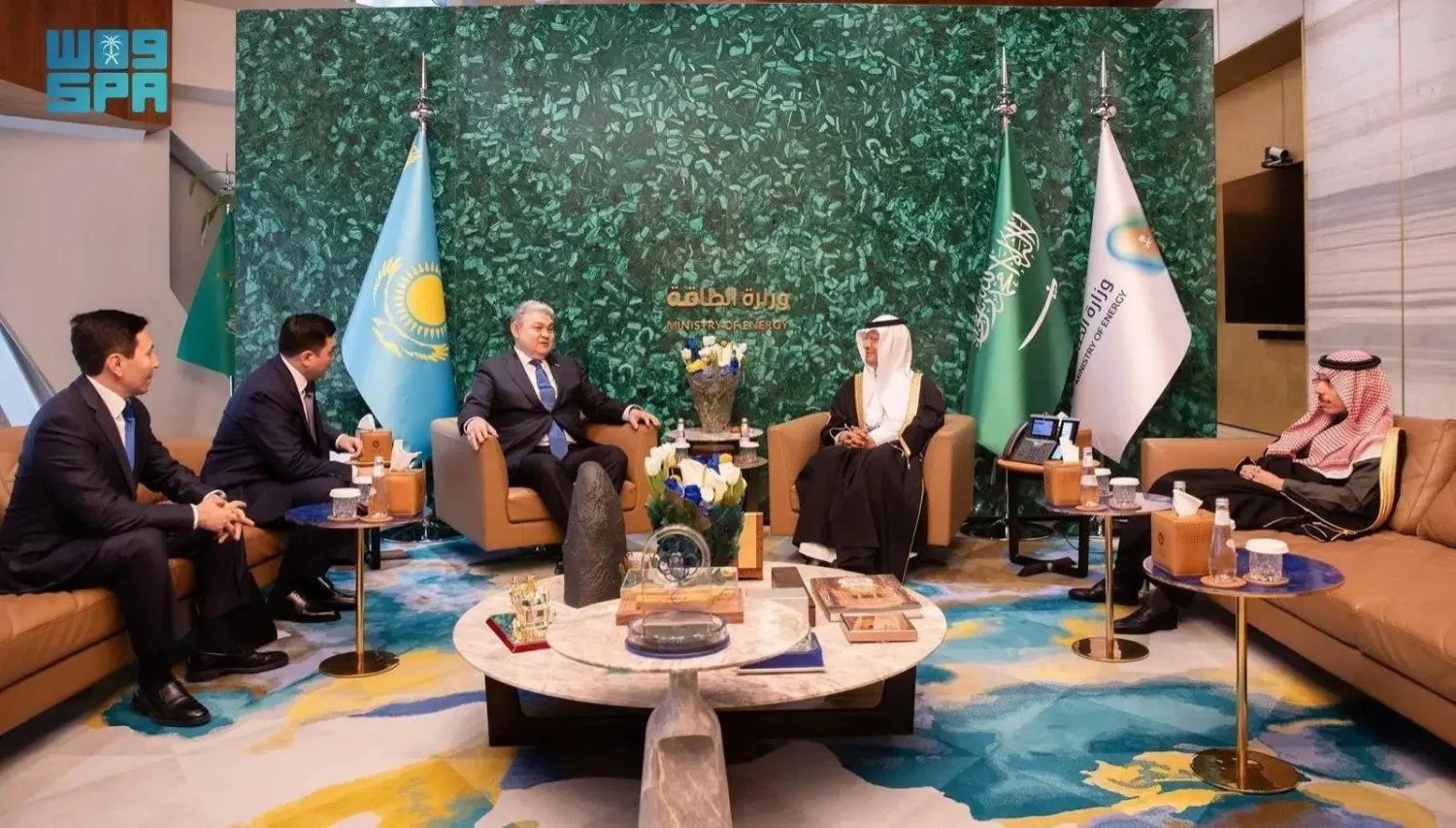
Saudi Minister of Energy Prince Abdulaziz bin Salman bin Abdulaziz receives Kazakhstan’s Foreign Minister Yermek Kosherbayev in Riyadh. (SPA)
TT

Saudi Arabia, Kazakhstan Agree to Establish Coordination Council

Saudi Minister of Energy Prince Abdulaziz bin Salman bin Abdulaziz receives Kazakhstan’s Foreign Minister Yermek Kosherbayev in Riyadh. (SPA)

Saudi Arabia and Kazakhstan agreed to establish a Saudi-Kazakh Coordination Council, reported the Saudi Press Agency on Tuesday.

Saudi Minister of Energy Prince Abdulaziz bin Salman bin Abdulaziz received in Riyadh Kazakhstan’s Foreign Minister Yermek Kosherbayev. Saudi FM Prince Faisal bin Farhan bin Abdullah and Minister of Energy of Kazakhstan Yerlan Akkenzhenov also attended the meeting.

The talks tackled the establishment of the coordination council, which will be chaired by the Saudi minister of energy and Kazakhstan’s foreign minister. The council reflects the two countries’ commitment to strengthening cooperation and expanding their bilateral partnership.

Prince Abdulaziz and Kosherbayev signed an agreement on the establishment of the council, which aims to boost coordination and consultation between the two countries and develop frameworks for cooperation across various sectors of mutual interest, elevating bilateral relations to broader levels.

Prince Abdulaziz and Kosherbayev discussed relations between their countries and ways to develop them further, especially in the energy field. They tackled opportunities for cooperation and investment in renewable energy and energy storage systems and discussed oil market developments.


Saudi-Qatari Partnership Paves Way for Logistics Corridors to Boost Regional Trade Efficiency 

The MoU was signed by Mawani President Eng. Suliman Almazroua and CEO of Qatar Ports Management Company Captain Abdullah Mohammed Al-Khanji. (QNA)
TT

Saudi-Qatari Partnership Paves Way for Logistics Corridors to Boost Regional Trade Efficiency 

The MoU was signed by Mawani President Eng. Suliman Almazroua and CEO of Qatar Ports Management Company Captain Abdullah Mohammed Al-Khanji. (QNA)

The Saudi Ports Authority (Mawani) and Qatar Ports Management Company signed on Tuesday a memorandum of understanding (MoU) aimed at boosting maritime and logistics cooperation between the two sides.

The agreement will contribute to the development of the ports sector, raising operational efficiency, and supporting regional and international trade flows.

The MoU was signed by Mawani President Eng. Suliman Almazroua and CEO of Qatar Ports Management Company Captain Abdullah Mohammed Al-Khanji. Qatari Ambassador to Saudi Arabia Bandar bin Mohammed Al Attiyah attended the signing ceremony.

The agreement reflects Saudi Arabia and Qatar’s commitment to building effective partnerships, exchanging expertise, establishing an organized framework for cooperation management, and developing joint investment opportunities in line with Saudi Vision 2030 and Qatar National Vision 2030.

The MoU outlines eight key areas of cooperation, including the exchange of best practices in port management and operations, and the study of opportunities for direct maritime and land connectivity between the ports of both countries to enhance trade flow efficiency.

It includes collaboration in logistics services, exploring the establishment of joint maritime corridors serving bilateral and regional trade, and assessing the feasibility of creating shared regional distribution centers.

In the fields of digital transformation and artificial intelligence, the two sides agreed to deepen cooperation on developing smart systems, data governance, and the unified maritime window, thereby boosting operational efficiency and keeping pace with technological advancements in the maritime sector.

The MoU places strong emphasis on maritime safety and environmental protection, including exchanging expertise in combating marine pollution and emergency response; developing joint maritime emergency plans; establishing an emergency communication line between the two countries; and cooperating to ensure compliance with international conventions, conduct joint exercises, and develop risk monitoring systems.

The cooperation also covers human capital development through joint training programs and field-exchange of expertise, as well as academic and research collaboration in maritime transport and logistics.

In terms of joint investment, both sides will study local and global investment opportunities in ports and related services and coordinate with the private sector to support these initiatives.

The MoU further includes cooperation in cruise tourism through enhanced maritime connectivity and joint promotion of Gulf cruise routes, as well as international and regional representation by coordinating positions in international maritime organizations and supporting joint initiatives, notably “Green Ports” and “Safe Sea Corridors.”

The agreement reflects the commitment of Mawani and Qatar Ports Management Company to advancing the ports sector and boosting its role as a key driver of trade and economic growth, contributing to Gulf integration and enhancing regional competitiveness in maritime and marine services.