


Riyadh Air, AlUla Partner to Promote Saudi Tourism Attractions Worldwide

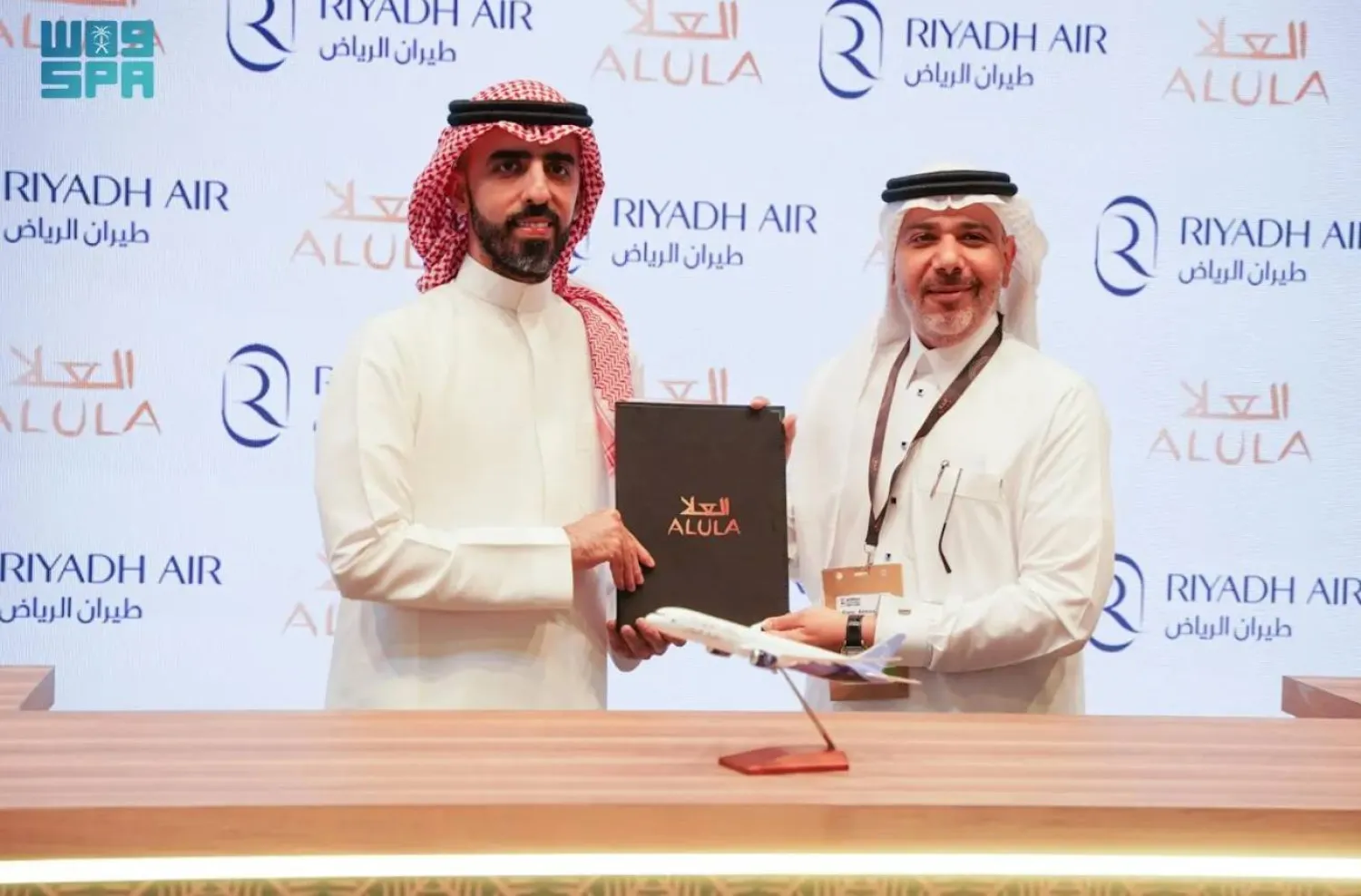
AlUla entered into a strategic partnership with Riyadh Air. SPA
TT

Riyadh Air, AlUla Partner to Promote Saudi Tourism Attractions Worldwide

AlUla entered into a strategic partnership with Riyadh Air. SPA

AlUla entered into a strategic partnership with Riyadh Air, Saudi Arabia's new world-class airline that has announced an ambitious target to fly to over 100 destinations by 2030.
Under the partnership deal, which was signed on the sidelines of the Arabian Travel Market (ATM) in Dubai, AlUla and the Public Investment Fund-owned Riyadh Air will collaborate on multiple initiatives to raise the profile of AlUla and the new carrier to discerning travelers from across Saudi Arabia and around the globe. Ultimately, the partnership aims to increase tourist volumes to AlUla from key global markets.
"Today marks the start of an exciting new partnership for AlUla and Riyadh Air, which has already made a notable impact on the global aviation landscape, notwithstanding its status as a relatively new airline," said Royal Commission for AlUla (RCU) vice president of destination management and marketing Rami AlMoallim.

"By working together, we can leverage the growing global excitement about AlUla as the Kingdom's premier luxury boutique heritage destination while also making a significant contribution to the Kingdom's broader tourism landscape."

Riyadh Air senior vice president of marketing and communications Osamah Alnuaiser said that as a major Saudi tourist destination, AlUla already offers such rich and unique experiences to visitors.

“At Riyadh Air, we have no doubt that we are both working towards a shared goal of increasing travelers' numbers to the Kingdom."
The cooperation between the two sides will see the delivery of multiple initiatives, including seamless and immersive digital experiences across multiple touch points. In addition, both entities will share and leverage data insights to produce refined content and product strategies for optimal campaign performance, enabling both sides to identify trends and behavioral patterns to produce data-driven decision making and strategies.



Oil Falls 1% as Investors Focus on Hormuz Flows after Peace Talks

FILE PHOTO: Storage tanks and oil refineries in Jurong Island, Singapore, March 24, 2026. REUTERS/Edgar Su/File Photo
TT

Oil Falls 1% as Investors Focus on Hormuz Flows after Peace Talks

FILE PHOTO: Storage tanks and oil refineries in Jurong Island, Singapore, March 24, 2026. REUTERS/Edgar Su/File Photo

Oil prices fell more than 1% on Tuesday, extending losses from the previous session, on signs of some progress in restoring crude flows through the Strait of Hormuz following US-Iran peace talks.

Brent crude futures fell $1.09, or 1.4%, to $76.81 a barrel and US West Texas Intermediate declined to $72.99 a barrel, down 87 cents, or 1.2%, as of 0607 GMT.

Prices fell more than 3% on Monday after the United States granted Iran a 60-day sanctions waiver following initial peace talks, and as officials reported a ‌lull in hostilities ‌in Lebanon under the broader agreement, Reuters said.

"The gradual increase ‌in ⁠oil flows through ⁠the Strait of Hormuz continues to weigh on the market," said ING analysts in a note.

Two crude tankers with just under 2 million barrels of oil sailed through the Strait of Hormuz on Monday, ship-tracking data showed, in a sign that traffic was picking up following weaker flows on Sunday due to concerns over passage through ⁠the waterway.

"Transits over recent days look to have ‌risen sharply, (which) the market will ‌treat as a proxy for both physical oil, perhaps paper oil, and diplomatic ‌progress," said Sparta Commodities' head of research Neil Crosby in ‌a note. "It feels like we will be stuck in this bearish risk-off/optimistic mood until such time as something changes."

The price declines come after a weekend that had appeared to put the week-old accord in jeopardy, including ‌threats from US President Donald Trump to restart the war if Iran disrupted shipping through the Strait ⁠of Hormuz ⁠after Tehran declared the strategic waterway closed.

"There remains a prevailing dose of market skepticism, rooted in deep-seated mistrust between Washington and Tehran, suggesting that any return to pre-war oil prices is likely to be delayed rather than immediate," said Tim Waterer, chief market analyst at KCM Trade.

Separately, analysts in a Reuters poll expect US crude inventories to have fallen last week, along with distillate and gasoline inventories.

On Monday, government data showed US crude stocks in the Strategic Petroleum Reserve fell to 331.2 million barrels last week, the lowest since June 1983, as supplies tightened in the wake of the US-Iran conflict.


China Lines Up Second LNG Terminal For Sanctioned Russian Cargoes

Chinese and Russian flags fly at an airport in Tianjin, China August 31, 2025. Sputnik/Vladimir Smirnov/Pool via REUTERS 
TT

China Lines Up Second LNG Terminal For Sanctioned Russian Cargoes

Chinese and Russian flags fly at an airport in Tianjin, China August 31, 2025. Sputnik/Vladimir Smirnov/Pool via REUTERS 

China is preparing a second import terminal to handle liquefied natural gas cargoes from Russia's sanctioned Arctic LNG 2 project, expanding a ‌route that so far relies on a single facility, three sources with knowledge of the matter said.

The newly built Longkou LNG terminal in eastern China's Shandong province, operated by state pipeline giant PipeChina, is being lined up to receive Arctic LNG 2 cargoes, the sources told Reuters.

The move would provide a lifeline to the $21 billion project, which is under heavy sanctions, and to Moscow, whose gas exports have been hit by Europe's decision to halt purchases and ⁠whose oil sector faces pressure from Ukrainian attacks.

A second import terminal would allow China to take larger volumes of sanctioned Russian LNG, while giving Arctic LNG 2 - designed to produce 19.8 million metric tons a year - another export outlet.

China, the only known buyer of sanctioned Arctic LNG 2 cargoes, has so far received shipments through PipeChina's Beihai terminal in Guangxi. That facility took the project's first delivery to an offtaker in August 2025 aboard the Arctic Mulan tanker.

Since then, Beihai has received 41 cargoes, or 2.6 million tons, of LNG from Arctic LNG 2 - many via two floating storage units in Russia - according to ship-tracking data and Kpler estimates. It ‌has also ⁠received three LNG cargoes from Russia's sanctioned Portovaya terminal.

China needs an additional terminal to absorb more sanctioned cargoes, one of the sources said. All declined to be named as they were not authorized to speak to media.

The world's largest LNG importer, China bought 7.57 million tons from Russia last year, according to Chinese customs data.

Longkou is seen as a logical choice because, like Beihai, it is operated by PipeChina ⁠and is closer to the Koryak floating storage unit in Russia's Far East, where Arctic LNG 2 cargoes are stored and reloaded, the sources said.

An industry executive said Longkou has completed its mechanical build phase and should be ready before October, in time for peak winter ⁠demand.

Under its completed first phase, the Longkou terminal in the coastal city of Yantai has an annual receiving capacity of 5 million tons, compared with 6 million tons at Beihai.

PipeChina's Dalian LNG terminal in northeastern China is also being discussed as ⁠a potential future receiving point, a fourth source said.

Novatek has recently stepped up hiring in China, a separate source said.

Reuters reported last year that Novatek has cut cargo prices by 30% to 40% since August 2025 to attract Chinese buyers despite sanctions.


BofA Expects Fed to Hike Interest Rates 75 Basis Points in 2026

The Federal Reserve building in Washington. (Reuters)
TT

BofA Expects Fed to Hike Interest Rates 75 Basis Points in 2026

The Federal Reserve building in Washington. (Reuters)

Bank of America (BofA) expects the Federal Reserve to hike interest rates by 75 basis points in 2026, it said on Monday, citing resilient economic data and rising expectations of a hawkish Fed under new Chair Kevin Warsh.

BofA Global Research said in a note it expects the US central bank to raise rates in September, October, and December, compared with its prior forecast ⁠for no change this year, according to Reuters.

BofA's view is contrary to current 2026 outlooks of top Wall Street brokerages and comes after the Fed left its benchmark rate unchanged earlier this month, even as almost half of Fed policymakers indicated that they now expect rates to rise this year.

The policymakers' more hawkish outlook is accompanied by strength in the labor market and elevated inflation concerns.

“June Summary of Projections and ⁠Warsh's comments indicate that the Fed's reaction function is much more hawkish than we thought,” analysts at BofA said in a note.

In contrast to BofA's call, markets are pricing in 42 bps of hikes ⁠in 2026, according to London Stock Exchange Group (LSEG) data.

After three rate hikes this year, BofA analysts expect the central bank to keep interest rates on hold in ⁠2027.

“Inflation is likely to remain sticky, keeping the real policy rate from becoming overly restrictive,” they said.

Brokerages including BNP Paribas ⁠and Macquarie are also among the minority that expect the central bank to start hiking rates this year.