

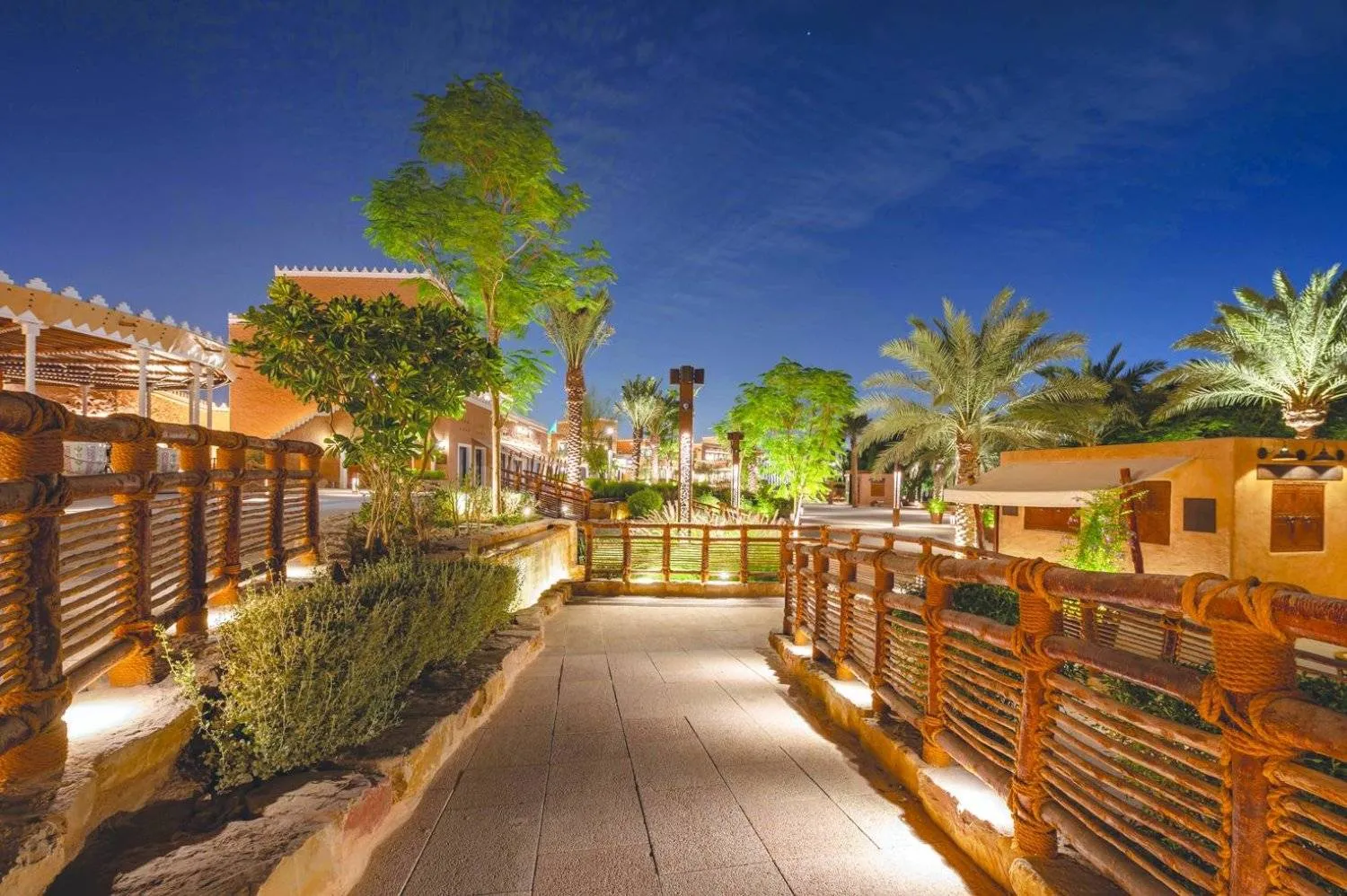

Diriyah Development Company President: We Plan to Establish Diriyah as Global Tourist Destination

One of the development projects in Diriyah, Saudi Arabia. (Asharq Al-Awsat)
TT

Diriyah Development Company President: We Plan to Establish Diriyah as Global Tourist Destination

One of the development projects in Diriyah, Saudi Arabia. (Asharq Al-Awsat)

Mohamed Saad, President of Diriyah Company, emphasized the company’s steadfast and advanced strides towards executing its comprehensive plans to establish a major tourist destination in Diriyah, located northwest of Saudi Arabia's capital, Riyadh.

The project aims to create a global gathering hub spread over 14 square kilometers, becoming a place to live, work, and entertain approximately 100,000 people by 2030.

Speaking to Asharq Al-Awsat, Saad detailed the company’s ambitious blueprint to essentially develop a new city on this land.

He highlighted that his company is adopting a holistic development model to ensure the establishment of adequate infrastructure to support urban development plans.

These include residential units, office spaces, new hotels, arts and cultural centers, shopping areas, clubs, restaurants, and world-class cafes.

Saad affirmed that these initiatives align with the goals of Saudi Arabia’s national transformation plan, Vision 2030, showcasing Diriyah Development’s role in fostering a vibrant and diverse economy in the Kingdom.

He stressed the importance of having a detailed strategy as the main factor in the success of a large-scale project like Diriyah.

He noted that such planning attracts top talent in architecture, construction, and global services, especially those focusing on sustainable practices, thus aiding in achieving project goals.

Saad added that Diriyah has partnered with over 100 international firms.

“We always welcome collaboration, especially since our project is now considered one of the most attractive in the world,” he said.

Regarding Diriyah’s potential to be both a historic and cultural center while also developing a new city, he highlighted the project's responsibility in careful planning.

“We fully understand the immense responsibility we bear as the developers of the Diriyah project,” he asserted.

“We are committed to a meticulously planned approach, combining a unique blend of celebrating the past, embracing the present, and looking forward to a prosperous future,” he explained.

Saad also stated that Diriyah’s charm lies not only in its cultural significance but also in its historical buildings, some dating back 300 years, showcasing Najdi architectural heritage.

Moreover, he highlighted the importance of a comprehensive investment strategy for Diriyah's success, citing recent developments like the Diriyah Square shopping area and the Royal Opera House.

“We have a comprehensive investment strategy covering all development aspects, from modern infrastructure to tangible assets,” affirmed Saad.

He also noted the upcoming Diriyah Arena that is “set to become one of the largest entertainment and cultural venues in the Middle East, spanning 76,000 square meters with 20,000 seats.”

Saad highlighted investment opportunities in newly opened areas like Al-Turaif and Al-Bujairi waterfront, which have already attracted millions of visitors.

Diriyah’s expansion plans include hotels, residential units, a golf course, and more. Saad announced further massive assets to be unveiled by the end of the year at the Diriyah Outlook 2024 event.

As a project supported by Saudi Arabia’s Public Investment Fund (PIF), Diriyah aims to create job opportunities, expecting to provide around 178,000 positions for Saudi youth across various sectors.

Saad further revealed his company’s aim of attracting 50 million annual visits to support Vision 2030’s goal of tripling the GDP to 10% of Saudi Arabia's economy by 2030, with Diriyah contributing over 70 billion riyals ($18.6 billion).

“We’re creating a place for people to live, work, and enjoy life, committed to boosting prosperity and making a big impact on the economy,” Saad underlined.

Regarding Diriyah’s role and balancing returns with development, Saad said: “Diriyah is a major project owned by the PIF. As a company, we have commercial goals and global partnerships, aiming to provide significant investment opportunities.”

“These projects will generate revenues that contribute to economic and social development,” he confirmed.



Lebanese Cabinet Approves Draft Law on Financial Crisis Losses

A photograph released by the Lebanese Government Press Office on December 26, 2025, show Prime Minister Nawaf Salam speaking during a press conference after a cabinet session in Beirut on December 26, 2025. (Photo by Handout / Lebanese Government Press Office / AFP)
TT

Lebanese Cabinet Approves Draft Law on Financial Crisis Losses

A photograph released by the Lebanese Government Press Office on December 26, 2025, show Prime Minister Nawaf Salam speaking during a press conference after a cabinet session in Beirut on December 26, 2025. (Photo by Handout / Lebanese Government Press Office / AFP)

Lebanon's government on Friday approved a draft law to distribute financial losses from the 2019 economic crisis that deprived many Lebanese of their deposits despite strong opposition to the legislation from political parties, depositors and banking officials.

The draft law will be submitted to the country's divided parliament for approval before it can become effective.

The legislation, known as the "financial gap" law, is part of a series of reform measures required by the International Monetary Fund (IMF) in order to access funding from the lender.

The cabinet passed the draft bill with 13 ministers in favor and nine against. It stipulates that each of the state, the central bank, commercial banks and depositors will share the losses accrued as a result of the financial crisis.

Prime Minister Nawaf Salam defended the bill, saying it "is not ideal... and may not meet everyone's aspirations" but is "a realistic and fair step on the path to restoring rights, stopping the collapse... and healing the banking sector.”

According to government estimates, the losses resulting from the financial crisis amounted to about $70 billion, a figure that is expected to have increased over the six years that the crisis was left unaddressed.

Depositors who have less than $100,000 in the banks, and who constitute 85 percent of total accounts, will be able to recover them in full over a period of four years, Salam said.

Larger depositors will be able to obtain $100,000 while the remaining part of their funds will be compensated through tradable bonds, which will be backed by the assets of the central bank.

The central bank's portfolio includes approximately $50 billion, according to Salam.

The premier told journalists that the bill includes "accountability and oversight for the first time.”

"Everyone who transferred their money before the financial collapse in 2019 by exploiting their position or influence... and everyone who benefited from excessive profits or bonuses will be held accountable and required to pay compensation of up to 30 percent of these amounts," he said.

Responding to objections from banking officials, who claim components of the bill place a major burden on the banks, Salam said the law "also aims to revive the banking sector by assessing bank assets and recapitalizing them.”

The IMF, which closely monitored the drafting of the bill, previously insisted on the need to "restore the viability of the banking sector consistent with international standards" and protect small depositors.

Parliament passed a banking secrecy reform law in April, followed by a banking sector restructuring law in June, one of several key pieces of legislation aimed at reforming the financial system.

However, observers believe it is unlikely that parliament will pass the current bill before the next legislative elections in May.

Financial reforms in Lebanon have been repeatedly derailed by political and private interests over the last six years, but Salam and Lebanese President Joseph Aoun have pledged to prioritize them.


Türkiye Says Russia Gave It $9 Billion in New Financing for Akkuyu Nuclear Plant

Türkiye’s Energy Minister Alparslan Bayraktar talks during a meeting in Ankara, Türkiye, September 14, 2023. (Reuters)
TT

Türkiye Says Russia Gave It $9 Billion in New Financing for Akkuyu Nuclear Plant

Türkiye’s Energy Minister Alparslan Bayraktar talks during a meeting in Ankara, Türkiye, September 14, 2023. (Reuters)

Türkiye's energy minister said Russia had provided new financing worth $9 billion for the Akkuyu nuclear power plant being built by ​Moscow's state nuclear energy company Rosatom, adding Ankara expected the power plant to be operational in 2026.

Rosatom is building Türkiye's first nuclear power station at Akkuyu in the Mediterranean province of Mersin per a 2010 accord worth $20 billion. The plant was expected ‌to be operational ‌this year, but has been ‌delayed.

"This (financing) ⁠will ​most ‌likely be used in 2026-2027. There will be at least $4-5 billion from there for 2026 in terms of foreign financing," Alparslan Bayraktar told some local reporters at a briefing in Istanbul, according to a readout from his ministry.

He said ⁠Türkiye was in talks with South Korea, China, Russia, and ‌the United States on ‍nuclear projects in ‍the Sinop province and Thrace region, and added ‍Ankara wanted to receive "the most competitive offer".

Bayraktar said Türkiye wanted to generate nuclear power at home and aimed to provide clear figures on targets.


China Bets on Advanced Technologies to Revive Tepid Industrial Sector

A humanoid robot Tiangong by Beijing Innovation Center of Humanoid Robotics Co, moves an orange as a demonstration at its company, during an organized media tour to Beijing Robotics Industrial Park, in Beijing Economic-Technological Development Area, also known as Beijing E-Town, China May 16, 2025. (Reuters)
TT

China Bets on Advanced Technologies to Revive Tepid Industrial Sector

A humanoid robot Tiangong by Beijing Innovation Center of Humanoid Robotics Co, moves an orange as a demonstration at its company, during an organized media tour to Beijing Robotics Industrial Park, in Beijing Economic-Technological Development Area, also known as Beijing E-Town, China May 16, 2025. (Reuters)

China pledged on Friday to double down on upgrading its manufacturing base and ​promised capital to fund efforts targeting technological breakthroughs, after its industrial sector delivered an underwhelming performance this year.

China's industry ministry expects output of large industrial companies to have increased 5.9% in 2025 compared with 2024, state broadcaster CCTV said on Friday, almost unchanged from the 5.8% pace in 2024.

It would also be less than the ‌6% pace ‌of the first 11 months of ‌2025, ⁠based ​on ‌data released by the National Bureau of Statistics, as a weak Chinese economy suppressed domestic demand.

Industrial output, which covers industrial firms with annual revenue of at least 20 million yuan ($2.85 million), recorded growth of 4.8% in November, the weakest monthly year-on-year rise since August 2024.

Chinese policymakers have been looking ⁠to create new growth drivers in the economy by focusing on advancing ‌its industrial sector.

China has also vowed stronger ‍efforts to achieve technological self-reliance ‍amid intensifying rivalry with the United States over dominance ‍in advanced technology.

At the annual two-day national industrial work conference in Beijing that ended on Friday, officials pledged to deliver major breakthroughs in building a "modern industrial system" anchored by advanced manufacturing.

The ​focus will be on sectors such as integrated circuits, low-altitude economy, aerospace and biomedicine, an industry ministry ⁠statement showed.

The statement comes after China launched on Friday a national venture capital fund aimed at guiding billions of dollars of capital into "key hard technologies" such as quantum technology and brain-computer interfaces.

On artificial intelligence, the industry ministry said it will expand efforts to help small and medium-sized enterprises adopt the technology, while fostering new intelligent agents and AI-native companies in key industries.

Officials also vowed to "firmly curb" deflationary price wars, dubbed "involution", referring to excessive and low-return competition among ‌firms that erodes profits.