


Notable Shift in Agriculture, Food World Map Expected in Next Decade

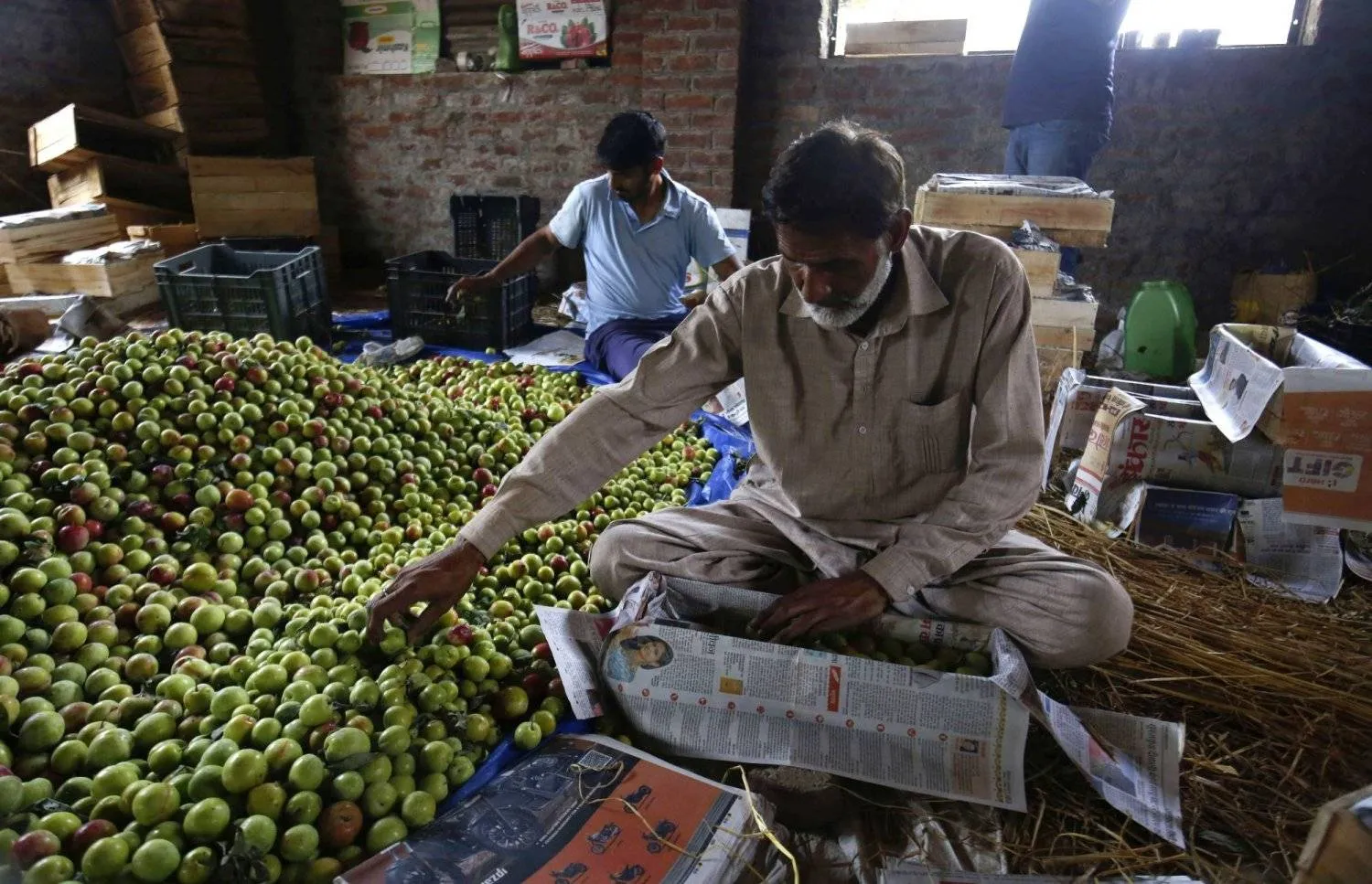
Kashmiri farmers assemble freshly harvested plums to pack the fruit for export, at an orchard on the outskirts of Srinagar, India (EPA)
TT

Notable Shift in Agriculture, Food World Map Expected in Next Decade

Kashmiri farmers assemble freshly harvested plums to pack the fruit for export, at an orchard on the outskirts of Srinagar, India (EPA)

Emerging economies have increasingly driven global agricultural market developments over the last 20 years and are projected to continue to do so over the next decade, but with regional shifts linked to changing demographics and new economic affluence, according to a report released on Tuesday by the Food and Agriculture Organization of the UN (FAO) and the Organization for Economic Cooperation and Development (OECD).

The OECD-FAO Agricultural Outlook 2024-2025 is the key global reference for medium-term prospects for agricultural commodity markets, and this year’s edition marks the 20th edition of the joint publication.

For two decades, the report has analyzed trends in the demographic and economic drivers of agricultural commodity supply and demand, projected the shifts in production and consumption locations, and assessed the resulting changes in international agricultural trade patterns.

According to the report, seen by Asharq Al-Awsat, a notable shift expected over the coming decade is the increasing role of India, Southeast Asia and Sub-Saharan Africa and the declining role played by China.

It said that while China accounted for 28% of growth in global consumption of agriculture and fisheries in the previous decade, its share of additional demand over the coming decade is projected to fall to 11%, attributed not only to a declining population and slower income growth but also to a stabilization of nutrition patterns.

Also, India and Southeast Asian countries are projected to account for 31% of global consumption growth by 2033, driven by their growing urban population and increasing affluence.

Among predominantly low-income regions, the report said Sub-Saharan Africa is projected to contribute a sizeable share of additional global consumption (18%), primarily due to population growth-driven demand for food.

Total agricultural and fisheries consumption (as food, feed, fuel and other industrial raw materials) is projected to grow by 1.1% annually over the next decade, with nearly all of the additional consumption projected to occur in low- and middle-income countries.

The report noted that food calorie intake is expected to increase by 7% in middle-income countries, largely due to greater consumption of staples, livestock products and fats.

Meanwhile, calorie intake in low-income countries will grow at 4%, too slowly to achieve the Sustainable Development Goal target of zero hunger by 2030.

“The Outlook confirms the need to implement strategies that bridge productivity gaps in low- and middle-income countries to increase domestic production and boost farmers’ incomes,” said FAO Director-General QU Dongyu.

For his part, OECD Secretary-General Mathias Cormann said, “This Outlook has served as a valuable reference for policy planning, providing a sound evidence base and data for medium-term prospects for agricultural commodity markets. Over the coming decade, the volumes of agricultural commodities traded globally is expected to increase between net exporting regions and net importing regions, but with regional shifts reflecting increased global consumption in India and Southeast Asian countries.”

He added, “Well-functioning agricultural markets, reducing food loss and waste, and more productive and less polluting forms of production will remain critically important for global food security and to ensure rural livelihoods can and do benefit from global agrifood value chains.”

Reducing food loss and waste

According to the report, growth in crop production is projected to be driven primarily by productivity increases on existing land rather than an expansion of the cultivated area, leading to a decline in agriculture’s global greenhouse gas (GHG) emissions intensity.

Similarly, it said a significant proportion of the growth in livestock and fish production is also expected to result from productivity improvements, although herd expansions will also contribute to production growth.

Meanwhile, direct emissions from agriculture are therefore projected to increase by 5% over the projection period.
The report said that despite these expected productivity improvements, particularly in least productive countries in Africa and Asia, significant productivity gaps are projected to persist, challenging farm incomes and food security and increasing countries’ requirements for food imports.

Also, technological gaps, limited input use and natural climatic conditions remain some of the key factors underpinning disparities in agricultural productivity, it noted.
The report also said that well-functioning international agricultural commodity markets will remain important for global food security, as 20% of calories are traded and rural livelihoods can benefit from participation in markets and global agrifood value chains.
It then revealed that the underlying causes behind the peaks in international agricultural prices experienced in 2022 are subsiding and real international reference prices for main agricultural commodities are projected to resume their slight declining trend over the next 10 years.

However, this report notes that this may not be reflected in local retail food prices.
Also, this year's Outlook features a scenario that simulates the impact of halving food losses along supply chains and food waste at the retail and consumer levels by 2030.

It said the scenario projects a potential 4% reduction in global agricultural GHG emissions by 2030, distributed relatively evenly across countries regardless of income levels.



ECB President Lagarde Reportedly Plans to Quit Before Macron's Term Ends

FILE PHOTO: European Central Bank (ECB) President Christine Lagarde addresses the press following the ECB's Governing Council meeting, at the ECB headquarters in Frankfurt, Germany, February 5, 2026. REUTERS/Jana Rodenbusch/File Photo
TT

ECB President Lagarde Reportedly Plans to Quit Before Macron's Term Ends

FILE PHOTO: European Central Bank (ECB) President Christine Lagarde addresses the press following the ECB's Governing Council meeting, at the ECB headquarters in Frankfurt, Germany, February 5, 2026. REUTERS/Jana Rodenbusch/File Photo

European Central Bank President Christine Lagarde plans to leave her job before next year's French presidential election to allow Emmanuel Macron to have an input into picking her successor, the Financial Times reported on Wednesday.

Lagarde's term is due to end in October 2027 but some fear that the far right may win the French presidential race ‌in the spring of ‌2027, complicating the selection for the ‌new ⁠leader of Europe's most ⁠important financial institution.

Citing a person familiar with the matter, the FT said Lagarde has not yet decided on the exact timing of her departure but was keen on Macron and German Chancellor Friedrich Merz to be the key deciders in who succeeds her. Macron cannot run again for a third term.

"President Lagarde is ⁠totally focused on her mission and has not ‌taken any decision regarding the end ‌of her term," Reuters quoted an ECB spokesperson as saying.

The FT report comes only ‌a week after Bank of France Governor Francois Villeroy de Galhau ‌said he would step down in June this year, more than a year before the end of his term, allowing Macron to name his replacement before the presidential election that the far-right could win.

While it ‌will be up to all leaders from the 21-nation euro zone to pick Lagarde's successor, ⁠past practice ⁠suggests that any successful candidate must have both German and French support to clinch the role.

There are no formal candidates for the job yet but several names have been floating among ECB circles as potential ECB presidents. The most prominent among these are former Dutch central bank chief Klaas Knot and Bank for International Settlements General Manager Pablo Hernandez de Cos.

Lagarde's non-renewable term at the ECB runs until October 31, 2027. Prior to heading the ECB, she was managing director of the International Monetary Fund from 2011 to 2019 and before that, the French finance minister.


UK Inflation Falls to 3.0% in January

Pedestrians cross Westminster Bridge in front of Parliament during the early morning hours in London, Tuesday, Feb. 10, 2026.(AP Photo/Kin Cheung)
TT

UK Inflation Falls to 3.0% in January

Pedestrians cross Westminster Bridge in front of Parliament during the early morning hours in London, Tuesday, Feb. 10, 2026.(AP Photo/Kin Cheung)

Britain's annual ‌rate of consumer price inflation fell to 3.0% in January from 3.4% in December, official figures showed on Wednesday.

A Reuters poll of economists had shown a median forecast of 3.0% in January and the Bank of England projected earlier this month that the headline measure of inflation would slow to ‌2.9%.

British inflation ‌has run higher than in ‌the ⁠United States and in ⁠the euro zone where it stood at 2.4% and 1.7% respectively in January.

But the BoE expects the pace of price rises to slow sharply to almost its 2% target in ⁠April as last year's rises ‌in utility costs and ‌other government-controlled tariffs fall out of ‌the annual comparison.

Investors expect the central bank ‌to cut its benchmark interest rate to 3.5% at its next meeting in March after a tight vote to keep borrowing costs ‌on hold in February although some policymakers remain worried about underlying ⁠inflation ⁠pressure.

Financial markets on Tuesday also priced a second quarter-point interest rate cut by the BoE by the end of in 2026.

ONS data last week painted a downbeat picture of Britain's economy at the end of 2025 with output barely growing. Figures released on Tuesday showed the labor market was still losing jobs although there were some signs of a stabilization.


Riyadh to Host Middle East’s Largest General Aviation Airshow in November 

The AERO Middle East x Sand & Fun 2026 will be held in Riyadh from November 24 to 28. (SPA)
TT

Riyadh to Host Middle East’s Largest General Aviation Airshow in November 

The AERO Middle East x Sand & Fun 2026 will be held in Riyadh from November 24 to 28. (SPA)

The Saudi Aviation Club announced that it will organize the AERO Middle East x Sand & Fun 2026 in Riyadh from November 24 to 28, reported the Saudi Press Agency on Tuesday.

The event is set to be the largest of its kind for general aviation in the Middle East, combining international business, investment, and innovation with live flying displays and interactive public experiences. It is being held in partnership with Messe Frankfurt Saudi Arabia.

Held at Thumamah Airport, the exhibition will bring together leading global companies operating in the general aviation industry, including aircraft and components manufacturers, avionics and navigation systems providers, as well as maintenance, repair, and overhaul (MRO) companies, offering an integrated platform that covers the full value chain of the sector.

The event will also spotlight startups in advanced air mobility (AAM) and innovators of electric vertical take-off and landing (eVTOL) aircraft, showcasing technologies and business models shaping the future of aviation.

General Supervisor of the Saudi Aviation Club Dr. Ahmed Alfahaid stated that AERO Middle East x Sand & Fun 2026 represents a qualitative leap for the Kingdom’s aviation sector and reinforces its positioning as a global hub for general aviation and advanced air mobility.

The partnership with Messe Frankfurt Saudi Arabia goes beyond presenting global innovations to providing a vital platform for international investment and strategic collaboration, he stressed.

Moreover, the event contributes to achieving Saudi Vision 2030 objectives, including the Kingdom’s ambition to rank among the world’s top 10 general aviation markets, he added.