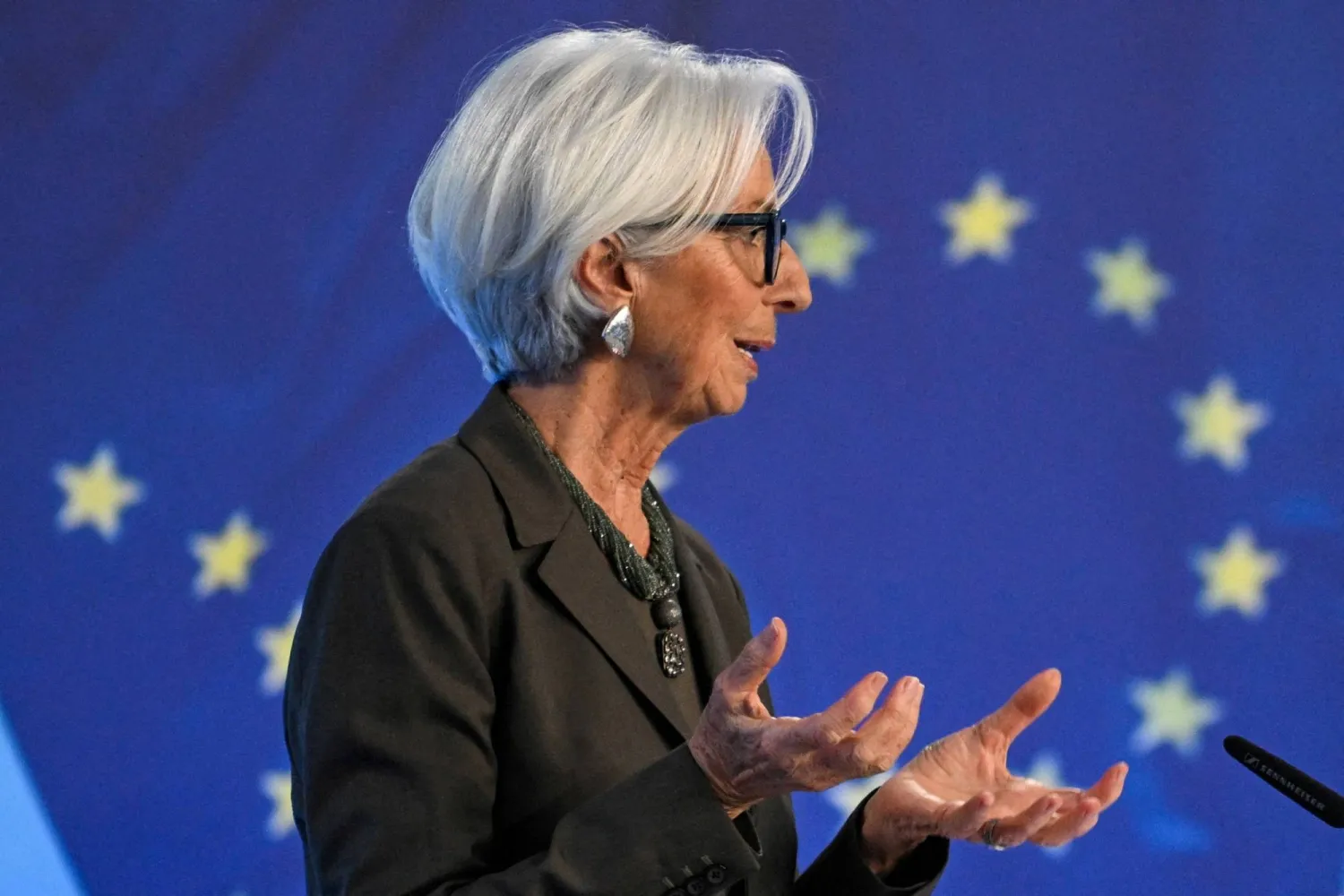
ECB President Lagarde Reportedly Plans to Quit Before Macron's Term Ends

FILE PHOTO: European Central Bank (ECB) President Christine Lagarde addresses the press following the ECB's Governing Council meeting, at the ECB headquarters in Frankfurt, Germany, February 5, 2026. REUTERS/Jana Rodenbusch/File Photo
TT

ECB President Lagarde Reportedly Plans to Quit Before Macron's Term Ends

FILE PHOTO: European Central Bank (ECB) President Christine Lagarde addresses the press following the ECB's Governing Council meeting, at the ECB headquarters in Frankfurt, Germany, February 5, 2026. REUTERS/Jana Rodenbusch/File Photo

European Central Bank President Christine Lagarde plans to leave her job before next year's French presidential election to allow Emmanuel Macron to have an input into picking her successor, the Financial Times reported on Wednesday.

Lagarde's term is due to end in October 2027 but some fear that the far right may win the French presidential race ‌in the spring of ‌2027, complicating the selection for the ‌new ⁠leader of Europe's most ⁠important financial institution.

Citing a person familiar with the matter, the FT said Lagarde has not yet decided on the exact timing of her departure but was keen on Macron and German Chancellor Friedrich Merz to be the key deciders in who succeeds her. Macron cannot run again for a third term.

"President Lagarde is ⁠totally focused on her mission and has not ‌taken any decision regarding the end ‌of her term," Reuters quoted an ECB spokesperson as saying.

The FT report comes only ‌a week after Bank of France Governor Francois Villeroy de Galhau ‌said he would step down in June this year, more than a year before the end of his term, allowing Macron to name his replacement before the presidential election that the far-right could win.

While it ‌will be up to all leaders from the 21-nation euro zone to pick Lagarde's successor, ⁠past practice ⁠suggests that any successful candidate must have both German and French support to clinch the role.

There are no formal candidates for the job yet but several names have been floating among ECB circles as potential ECB presidents. The most prominent among these are former Dutch central bank chief Klaas Knot and Bank for International Settlements General Manager Pablo Hernandez de Cos.

Lagarde's non-renewable term at the ECB runs until October 31, 2027. Prior to heading the ECB, she was managing director of the International Monetary Fund from 2011 to 2019 and before that, the French finance minister.


SABIC Swings to Q1 Profit

A SABIC manufacturing site in Jubail (SABIC)
TT

SABIC Swings to Q1 Profit

A SABIC manufacturing site in Jubail (SABIC)

Saudi Basic Industries Corporation (SABIC), a global leader in chemicals, said on Wednesday it returned to profit in the first quarter of 2026, posting net earnings of SAR13.2 million ($3.52 million) compared to a SAR1.21 billion ($322 million) loss a year earlier.

This increase is mainly attributed to a SAR1.05 billion decline in non-recurring restructuring costs, and a SAR384 million reduction in general, administrative, research and development expenses, the company said in a filing to the Saudi bourse, Tadawul, on Wednesday.

Although revenue declined 11% year-on-year to SAR26.15 billion ($6.97 billion) due to lower sales volumes, the company said it increased its operating profit by 338% to reach SAR1.45 billion ($386.6 million), mainly due to a SAR1.05 billion ($280 million) decline in operating expenses.

“In Q1 2026, we continued to make meaningful progress according to our strategic agenda of portfolio optimization, corporate transformation, and selective growth,” said SABIC CEO and executive board member Dr. Faisal Alfaqeer.

“We are following through on the two agreements announced at the start of the quarter to divest our European Petrochemicals business and our Engineering Thermoplastics business in the Americas and Europe,” he noted.

“These decisive actions are aligned with our strategy to enhance capital allocation, strengthen SABIC’s financial resilience, and position the company for growth in profitable markets,” Alfaqeer added.

At the same time, he said SABIC’s transformation journey continues to deliver performance improvements that unlock greater value for our shareholders.

“We realized $220 million at the EBITDA level on a recurring basis during the first quarter of 2026, in line with our planned improvement rate. This keeps us on track toward our cumulative 2030 annual target of $3 billion, consisting of $1.40 billion in cost excellence and $1.60 billion in value creation.”

In terms of selective growth, Alfaqeer also said the company is advancing a number of capital projects in a disciplined way. The execution of the SABIC Fujian project continues as planned, now reaching approximately 98% completion.

He noted that the Ministry of Energy’s announced feedstock-allocation approval “enables the potential expansion of our annual urea production capacity from approximately 4.8 million tons to 7.4 million tons—a 54% increase.”

SABIC has forecast a capital investment of $3.5 to $4 billion in 2026.

Alfaqeer said the company signed a strategic agreement with the Public Investment Fund–Pirelli joint venture, enabling the joint venture to manufacture 3.5 million tires annually in the Kingdom.

“This agreement supports the localization agenda of our NUSANED program, while contributing to long-term economic growth and industrial development in Saudi Arabia,” he affirmed.


Saudi Arabia, France Discuss Enhancing Mining Sector Partnership

Saudi Minister of Industry and Mineral Resources Bandar Alkhorayef has met with France’s Interministerial Delegate for Strategic Minerals and Metals Supplies Benjamin Gallezot. SPA
TT

Saudi Arabia, France Discuss Enhancing Mining Sector Partnership

Saudi Minister of Industry and Mineral Resources Bandar Alkhorayef has met with France’s Interministerial Delegate for Strategic Minerals and Metals Supplies Benjamin Gallezot. SPA

Saudi Minister of Industry and Mineral Resources Bandar Alkhorayef has met with France’s Interministerial Delegate for Strategic Minerals and Metals Supplies Benjamin Gallezot to discuss strengthening the strategic partnership between the two countries in the mining and minerals sector.

The two sides affirmed the strength of bilateral relations and explored opportunities for cooperation in mineral exploration, mining investment, and the localization of mineral industries.

They also discussed ways to leverage advanced technologies and innovative solutions to improve sector efficiency and enhance sustainability, as well as the importance of integrating value chains for strategic minerals.

The meeting was held in Istanbul on the sidelines of the Critical Minerals Forum, organized on April 28 and 29 by the Organization for Economic Co-operation and Development (OECD).

The forum was attended by government and industry leaders, as well as international organizations, to discuss challenges and opportunities related to critical minerals supply chains.


Shehbaz Sharif: We Repaid $3.5 Billion in Debt Thanks to Saudi Arabia’s 'Pivotal' Support

Saudi Crown Prince Mohammed bin Salman holding talks with Pakistan's Prime Minister Shehbaz Sharif in Jeddah on March 12, 2026 (SPA).
TT

Shehbaz Sharif: We Repaid $3.5 Billion in Debt Thanks to Saudi Arabia’s 'Pivotal' Support

Saudi Crown Prince Mohammed bin Salman holding talks with Pakistan's Prime Minister Shehbaz Sharif in Jeddah on March 12, 2026 (SPA).

Pakistan’s Prime Minister Shehbaz Sharif announced on Wednesday that his country had successfully repaid $3.5 billion in mandatory bilateral debt, affirming that this achievement came thanks to the “pivotal” support of the Custodian of the Two Holy Mosques, King Salman bin Abdulaziz, and Crown Prince Mohammed bin Salman.

He clarified that this repayment did not affect the stability of foreign exchange reserves; rather, it strengthened market confidence in Pakistan’s ability to meet its international obligations.

The Kingdom had announced the provision of substantial financial support to Pakistan, including the extension of the term of a previous $5 billion deposit and the provision of an additional $3 billion deposit, aimed at enhancing economic stability and addressing global changes.

On Friday, the State Bank of Pakistan announced that Islamabad had completed the repayment of $3.45 billion in deposits to the United Arab Emirates, settling a final tranche worth $1 billion. The bank had also announced that it had received the Saudi deposit worth $3 billion.

This came after the United Arab Emirates requested that Pakistan return the funds it had deposited in the State Bank of Pakistan in 2018 to bolster its foreign exchange reserves.

This qualitative support aims to enable the Pakistani economy to confront global economic changes and strengthen its financial resilience, in a way that positively reflects on the living conditions of the Pakistani people. It also reaffirms the Kingdom’s consistent and ongoing position of standing alongside Pakistan under all circumstances, embodying the sincere bonds of brotherhood between the leaderships and the peoples.

In an address before the cabinet, the Pakistani Prime Minister clarified the current financial situation, stating: “We have repaid our mandatory external debts (amounting to approximately $3.5 billion in bilateral loans). Our foreign exchange reserves are stable at their current level, and we have fulfilled our obligations and repaid our debts.”

These developments constitute a key pillar in Pakistan’s relationship with international institutions; the stability of liquid reserves at around $20.6 billion (including $15.1 billion held by the central bank) contributes to strengthening Islamabad’s negotiating position with the International Monetary Fund. Pakistan’s success in repaying its bilateral debts, alongside adherence to the requirements of the Fund’s financing program, is seen as a vote of international confidence in the Pakistani economy’s ability to meet its immediate and future financial commitments.

The central bank indicated that its success in managing the outflows required to repay these billions was achieved without causing any shock to the value of the local currency, as the Pakistani rupee remained stable thanks to supportive deposits and cautious monetary policies.

For his part, Sharif explained that this repayment did not come at the expense of monetary stability; rather, it resulted from a coordinated plan between the Ministry of Finance and the central bank to ensure that foreign exchange reserves remained at safe levels, which strengthens Pakistan’s position in its ongoing negotiations with international financial institutions.

Regarding the role played by the Kingdom in securing this financial passage, the Prime Minister expressed his country’s deep appreciation, saying: “We are extremely grateful to the Custodian of the Two Holy Mosques, King Salman bin Abdulaziz, and His Royal Highness Crown Prince Mohammed bin Salman; they played a pivotal role in this matter. I am confident that these major issues will also be resolved, and Pakistan’s peace efforts continue uninterrupted and without relent.”

Sharif noted that this Saudi support was not merely temporary financial assistance, but rather a reflection of the depth of historical ties, adding: “Just as we have strengthened mutual cooperation by removing obstacles at both the joint and institutional levels, positive results have emerged from this.”

It is worth noting that this new Saudi move is not unprecedented. In 2018, the Kingdom provided a $6 billion support package, which included a $3 billion deposit in the State Bank of Pakistan, in addition to deferred oil payment facilities of the same value.