


Riyadh, Brasilia Seek to Boost Economic Integration and Joint Work

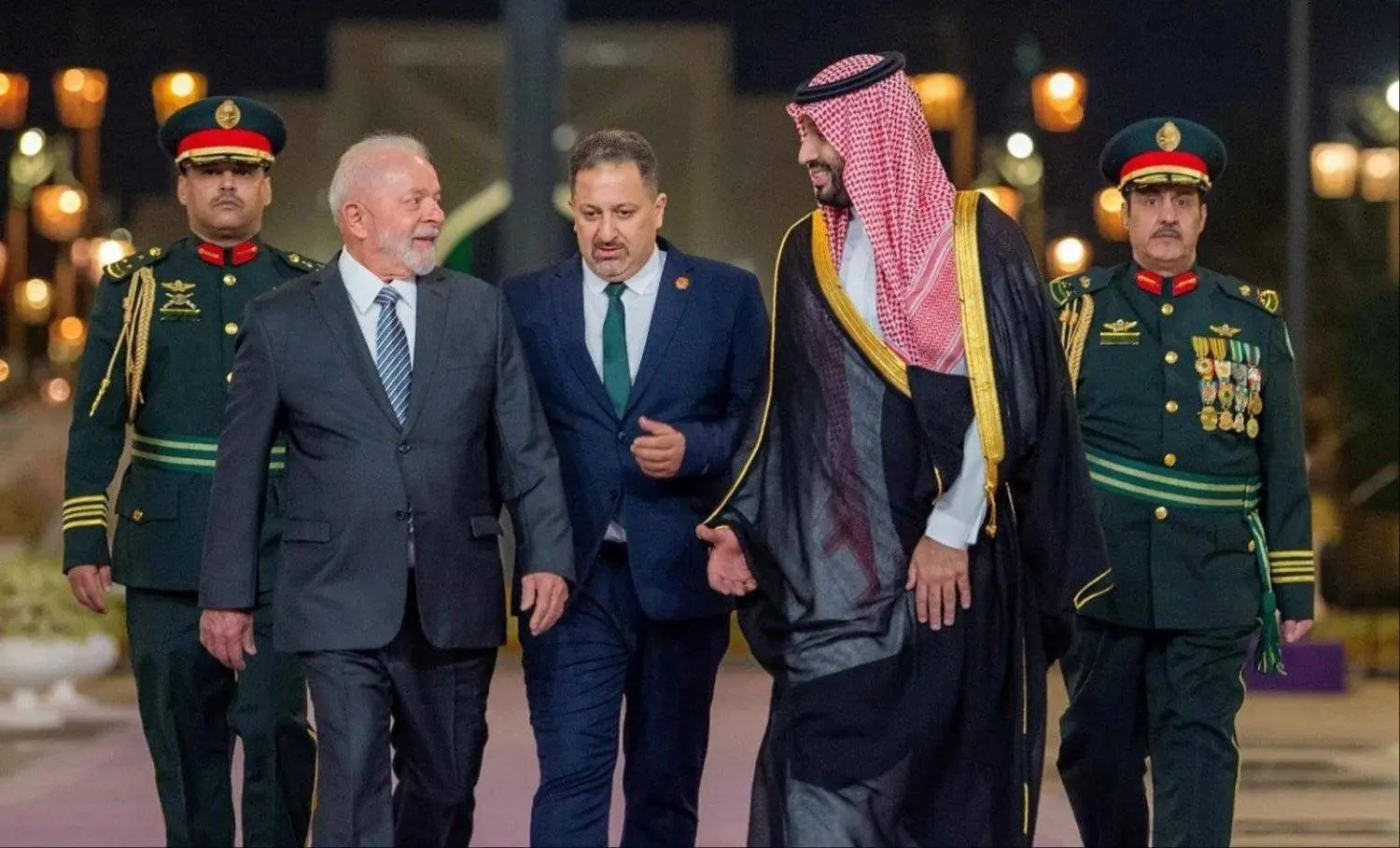
Saudi Crown Prince Mohammed bin Salman receives Brazilian President Lula da Silva in Riyadh on November 28, 2023 (SPA)
TT

Riyadh, Brasilia Seek to Boost Economic Integration and Joint Work

Saudi Crown Prince Mohammed bin Salman receives Brazilian President Lula da Silva in Riyadh on November 28, 2023 (SPA)

Brazilian Ambassador to Saudi Arabia Sergio E. Bath said that the exchange of high-level visits between the two countries highlight their common vision and their desire to deepen bilateral relations and cooperation at the regional and multilateral levels.

During an interview with Asharq Al-Awsat, Bath said that in 2018, Brazil and Saudi Arabia, two members of the G20, celebrated the 50th anniversary of the establishment of their diplomatic ties.

He explained that Saudi-Brazilian relations have witnessed tremendous growth since 1968, especially under the current leadership of the Custodian of the Two Mosques, King Salman bin Abdulaziz, and Crown Prince Mohammed bin Salman.

Brazil officially assumed the presidency of the G20 in December 2023. The group’s summit will be held this year in Rio de Janeiro on Nov. 18-19.

According to the ambassador, Saudi Arabia and Brazil are considered economic powers in their regions, and maintain ideal relations with neighboring states, which include respect for each other’s sovereignty, dissociation from regional disputes and cooperation in various fields to achieve mutual benefit, in addition to facilitating the free flow of intra- and internal trade and investments within economic blocs and regions.

The interview coincided with the visit of Saudi Minister of Industry and Mineral Resources Bandar Al-Khorayef to Brazil as part of a tour that will also take him to Chile.

Bath said that the Saudi minister’s trip confirms the Kingdom’s growing interest in strengthening bilateral relations with Brazil.

The delegation, according to the Brazilian diplomat, is exploring opportunities for cooperation in the industrial and mining sectors, exchange of expertise, and the latest developments in industrial technologies and joint investments.

He pointed out that the delegation is focusing primarily on developing supply chains, enhancing technological exchange, and driving innovation to achieve sustainable development and economic flexibility, as well as discussing opportunities for cooperation in the fields of food manufacturing, medicine and aviation.

Agreements

During the Brazilian-Saudi Investment Forums held in Brazil in 2023, $9 billion were made available for new bilateral investment projects until 2030, according to Bath, who noted that during one of these events in Sao Paulo, the two countries signed agreements worth around $3.5 billion.

Economic cooperation

Bath told Asharq Al-Awsat that Saudi Arabia and Brazil are the two largest economies within their regions, adding that commong stances have created enormous potential for cooperation in various sectors to achieve mutual benefits.

“In 2019, the Saudi Crown Prince announced the allocation of $10 billion to invest in Brazil, and since then significant progress has been made. For example, but not limited to, approximately $765 million was invested in Minerva Foods and BRF through SALIC, a subsidiary of the Public Investment Fund (PIF),” he stated.

The Brazilian diplomat added that Al-Manara Metals Company, supported by PIF, concluded a deal worth $2.6 billion to acquire a 10 percent stake in the basic metals division of Vale SA, while PIF has $400 million worth of investments in the Brazilian financial sector.

He further stressed that the Kingdom has shown interest in many sectors in which Brazilian companies are competitive, including defense and space, agriculture and fresh food, medicines and medical devices, clean energy and green hydrogen, communications, science and technology, and digital economy and innovation.

Regarding investments in Saudi Arabia, Bath said that the joint venture agreement between BRF and the Halal Products Development Company, a subsidiary of PIF, is another example of the work of Brazilian companies and their long-term engagement and commitment to this country.

Areas of cooperation

“During President Luiz Inacio Lula da Silva’s visit to the Kingdom, in November 2023, Embraer signed three cooperation agreements with the Saudi government and companies in the fields of civil aviation, defense and security, and air mobility in urban areas,” the ambassador told Asharq Al-Awsat.

He went on to say that the Brazilian Ministry of Mines and Energy signed a memorandum of understanding to promote cooperation in the field of energy, including oil and gas, electricity, renewable energy, energy efficiency, petrochemicals, hydrogen, and the circular carbon economy.

Bath explained that the MoU covers digital transformation and innovation, strategic partnership development, supply chain, technology enhancement, and localization of industry-specific materials, products and services.

On trade exchange, the ambassador said: “Brazil’s exports to Saudi Arabia are still traditionally dominated by poultry, beef, soybeans, corn and sugar, representing about 80 percent (of exports), while the share of other food and non-food products stands at only 20 percent.”

“However, when looking at Brazil’s total exports to the world, about 60 percent of those consist of manufactured consumer and industrial products, which indicates that Saudi Arabia has not yet explored the comparative advantages and competitiveness of food and non-food products manufactured in Brazil.”

Bath emphasized that Saudi Arabia has recognized his country as a strategic partner for its food security, and has undertaken some important initiatives and investments.

“However, the great potential for further cooperation remains untapped, which I hope will be embodied through all the visits made by high-level delegations,” he remarked.

Apart from the food, non-food consumer goods and industrial sectors, Bath pointed to great potential for cooperation in various sectors, such as healthcare, defense, clothing and footwear, chocolate and confectionery, other processed foods, household, electrical and mechanical appliances, heavy products and equipment.

Volume of bilateral trade

According to the diplomat, Saudi Arabia is Brazil’s first trading partner in the region, and Brazil is the Kingdom’s largest trading partner in South America, with total bilateral trade in 2023 amounting to about $6.7 billion.

“Although Brazil’s exports to the Kingdom mainly consist of animal proteins and agricultural products, a gradual change in patterns has been observed in exports of manufactured industrial and consumer goods. The most important food exports from Brazil to Saudi Arabia are chicken, sugar, corn, soybean products and beef,” he underlined.

Non-food exports, according to Bath, include iron and other ores, wood and its products, weapons and ammunition, machinery and equipment, and transportation equipment. The main exports from the Kingdom to Brazil are crude oil, fertilizers, plastic products, aluminum products, and other petrochemicals.


Saudi Tourism Development Fund Partnerships Exceed $1.1 Billion  

The view of the Saudi capital, Riyadh. (Asharq Al-Awsat)
TT

Saudi Tourism Development Fund Partnerships Exceed $1.1 Billion  

The view of the Saudi capital, Riyadh. (Asharq Al-Awsat)

The Saudi Tourism Development Fund (TDF) has signed new partnerships with government and private entities with a financial impact exceeding SAR 4 billion ($1.1 billion), as part of its role in expanding financing for small and medium-sized tourism enterprises across the Kingdom.

Speaking to Asharq Al-Awsat, Fahad Al-Ashgar, General Manager of Business Development at TDF, said the fund offers tailored empowerment programs for micro, small, and medium enterprises (MSMEs).

“We have a clear success story,” he said, noting that the fund has financed 2,500 enterprises with the support of its partners in recent years. This financing has helped create and sustain 74,000 jobs in Saudi Arabia’s tourism sector.

Al-Ashgar made these remarks during the Development Finance Conference held last week under the patronage of Crown Prince Mohammed bin Salman, Prime Minister and Chairman of the National Development Fund, as part of the Momentum 2025 platform themed “Leading Development Transformation,” in the Saudi capital.

Empowering tourism

Al-Ashgar added that TDF acts as an enabler of the tourism sector and has signed six agreements under its Tourism Enablement Programs, targeting MSMEs across all regions of the Kingdom.

These initiatives complement the fund’s direct financing, which supports both foreign and domestic investment, in addition to a memorandum of understanding signed with the Small and Medium Enterprises Bank.

Established in 2020, the Tourism Development Fund aims to enable and attract tourism investment and stimulate sectoral development by creating more profitable projects that contribute to developing tourism destinations.

The fund is one of six newly established funds created to support Saudi Vision 2030 goals, according to National Development Fund Governor Stephen Paul Groff in earlier remarks.

TDF CEO Qusai Al-Fakhri said the average annual number of beneficiaries has increased tenfold, while the volume of financing has more than doubled compared to previous years.

The fund goes beyond financing to build an integrated enablement ecosystem that creates new investment opportunities, strengthens development finance, empowers the private sector, and ensures inclusive growth across all regions, enabling MSMEs to contribute to national development, he added.

Partnership details

Recent partnerships include the launch of a new financing program with the Kafalah Program, with a market value estimated at SAR 700 million ($190 million), in cooperation with more than 45 financing entities. Previous collaboration enabled over 2,000 enterprises to obtain financing guarantees exceeding SAR 2 billion ($530 million).

The fund also signed a new SAR 300 million ($80 million) financing agreement with the Arab National Bank, adding to a similar agreement signed last year that benefited 249 enterprises within one year.

TDF confirmed that more than 10,000 enterprises have benefited to date from the Tourism Enablement Programs, as part of broader efforts to increase MSME participation in tourism and diversify projects across the Kingdom, in line with Vision 2030 growth objectives.


Gulf Development Boom Redefines the Consulting Industry

The consulting market in the Gulf is undergoing rapid transformation, driven by rising expectations, intensifying competition, and the pursuit of long-term value (Asharq Al-Awsat). 
TT

Gulf Development Boom Redefines the Consulting Industry

The consulting market in the Gulf is undergoing rapid transformation, driven by rising expectations, intensifying competition, and the pursuit of long-term value (Asharq Al-Awsat). 

The rapid acceleration of development programs across the Gulf, powered by national visions and landmark mega-projects, is transforming not only the region’s economies but also the consulting industry that supports them.

As governments and companies pursue unprecedented scale and ambition, they are increasingly seeking advisory partners capable of delivering measurable impact, practical execution, and long-term capability building, rather than strategies that remain confined to paper.

Recent studies indicate that as investment levels rise and expectations intensify, the central challenge is no longer the formulation of bold strategies, but their translation into tangible economic and institutional outcomes.

This shift has reshaped the consulting landscape, raising the bar for performance at a time when traditional advisory models are no longer sufficient. Clients now demand integrated solutions that generate real change, embed knowledge, and create value that extends well beyond theoretical recommendations.

According to a study by Strategy&, obtained by Asharq Al-Awsat, governments and companies across the region are increasingly prioritizing multidisciplinary expertise that combines global perspective with deep local understanding. In this new environment, a consulting firm’s credibility is defined by its ability to convert recommendations into measurable, on-the-ground results.

Jad Hajj, Managing Director and Regional Leader of Strategy& Middle East, part of the PricewaterhouseCoopers network, said ambitious transformation agendas will remain central to the region’s future.

“What distinguishes the current phase is the growing emphasis on sustainable value,” he said. “Governments and private-sector companies are looking for partners who can deliver outcomes, integrate knowledge transfer across the value chain, and bring a deep understanding of local priorities.”

The sector’s growth has attracted a broader range of players, from specialized local firms and in-house advisory teams within government entities and corporations, to technology companies offering innovative consulting services. This diversification is reshaping the market and intensifying competition. “This environment compels all participants to clearly demonstrate the value they bring,” Hajj added.

Mega-Projects and Integrated Ecosystems

Mega-projects and economic diversification initiatives across the Gulf underscore the importance of value creation in this phase, as they reshape regional economies at scale. The central challenge lies in execution, ensuring that investments translate into lasting economic impact by building integrated ecosystems, strengthening institutional and industrial capabilities, and embedding technology and artificial intelligence to support long-term growth.

These dynamics are most evident in Saudi Arabia, the largest and fastest-growing consulting market in the Gulf. Flagship developments such as the Red Sea destination and Qiddiya continue to advance the Kingdom’s diversification agenda and drive transformation across multiple sectors.

This fast-evolving environment requires consulting firms to strengthen coordination during execution, apply rigorous performance measurement, and deliver targeted insights aligned with national priorities to maximize impact.

“We are experiencing a fundamental transformation across all sectors, and consulting is no exception,” Hajj stated, adding: “Clients now expect a seamless link between strategy and execution, which requires close collaboration with local partners and sustained capability building. At the same time, innovations such as artificial intelligence are reshaping delivery models and governance to ensure lasting results.”

Technology and Gulf Talent

Artificial intelligence sits at the center of the consulting sector’s evolution, offering both efficiency gains and structural change. Hajj noted that AI enables faster and deeper analysis, allowing consultants to devote more time to stakeholder engagement and long-term strategic design.

AI is also narrowing the gap between strategy and execution by overcoming scale and capability constraints and enabling firms to provide practical tools that help clients implement strategies and track outcomes. While AI enhances speed and quality, Hajj emphasized that critical judgment, accountability, and sector insight remain core human responsibilities.

Alongside technological change, firms are investing in local talent development to ensure sustainable impact. Strategy& has launched initiatives such as the 10-month “Qadat Program for Gulf Nationals,” aimed at equipping high-potential graduates with hands-on experience and leadership skills to support national visions.

A Rapidly Evolving Market

The Gulf consulting market is undergoing rapid change, driven by higher expectations, intensifying competition, and a growing focus on long-term value. Success is no longer measured by advice alone, but by the tangible outcomes delivered and the capabilities embedded within organizations after projects conclude.

Hajj underlined: “This region is redefining what it means to be a trusted advisor... Clients expect measurable results, capability building, and sustained engagement. While the journey continues, this is a pivotal moment to contribute meaningfully to the region’s long-term ambitions.”


Innovation Center for Electric Vehicles Inaugurated in Saudi Arabia

The new center, inaugurated in Riyadh, will carry out high-level research into electric vehicle technology (Asharq Al-Awsat) 
TT

Innovation Center for Electric Vehicles Inaugurated in Saudi Arabia

The new center, inaugurated in Riyadh, will carry out high-level research into electric vehicle technology (Asharq Al-Awsat) 

King Abdulaziz City for Science and Technology (KACST) and Lucid Group, the manufacturer of some of the world’s most advanced electric vehicles, announced on Sunday the inauguration of the first Electric Vehicle Innovation Center in the Middle East, located in Saudi Arabia.

The new center, inaugurated in the presence of President of KACST Dr. Munir bin Mahmoud Eldesouki, serves as a key platform bringing together local, regional, and global research expertise.

It reflects KACST’s ongoing commitment to innovation and reinforces Lucid’s leadership in advanced technologies.

The center is also focused on enhancing the efficiency, functionality, and performance across Lucid’s product portfolio, contributing to their accelerated development, strengthening their leadership within their segment, and supporting the growth of the Kingdom’s future mobility sector.

“This new innovation center embodies our ongoing commitment to leading the advancement of electric vehicle technology, and our support toward strengthening Saudi Arabia a hub for technological innovation,” said Interim CEO at Lucid, Marc Winterhoff.

“By combining Lucid’s engineering expertise with KACST’s advanced research capabilities, we will continue to push the boundaries of what’s possible. Our teams are eager to begin the planned work together, recognizing this research will help shape the future of sustainable mobility,” he noted.

Senior Vice President for Research and Development at KACST, Dr. Talal bin Ahmed Alsedairy, emphasized that the center represents a pivotal step in enabling Saudi talent to develop future technologies in electric vehicles, batteries, and smart systems.

“The center enhances local content and bolsters the Kingdom’s capabilities in advanced industries, supporting the goals of Vision 2030 and broader national aspirations,” he said.

Alsedairy said this cooperation contributes to the transfer and localization of advanced, high-impact technologies, the establishment of new industrial value chains, and the strengthening of integration between the research, development, and innovation system, the industrial strategy, and the investment strategy, thereby accelerating the transformation of knowledge into products and technologies that support the future of sustainable mobility and enhance the competitiveness of the national economy.

For his part, President of Lucid Middle East, Faisal Sultan, said the opening of this center is a major step forward in Lucid’s commitment to the Kingdom.

“This collaboration strengthens our regional presence, nurtures local talent, and contributes to building a vibrant technology ecosystem aligned with Vision 2030,” he noted.

The center was developed in collaboration with KACST, one of the Kingdom’s leading research, development, and innovation institutions, forming the second phase of the ongoing strategic partnership between the two parties.

Its purpose is to advance scientific research, support innovation, and develop sustainable technologies by leveraging specialized Saudi expertise.

The center began its operations as a specialized facility for testing and validation and has since evolved to cover all stages of electric vehicle development. It represents a qualitative leap in the collaborative efforts between the two parties and serves as an extension of Lucid's comprehensive network of facilities in the US.

It will dedicate its efforts to advanced research, support the dissemination of the company’s world-leading technologies, and play a pivotal role in developing future products and will serve as a key pillar of the Kingdom’s national research and development infrastructure and actively contribute to the innovation and industrial application of future technologies within the country.
