Fed Policymakers Signal Rate Cuts Ahead, But Not Because of Market Rout

The Federal Reserve Board building on Constitution Avenue is pictured in Washington, US, March 27, 2019. REUTERS/Brendan McDermid/File Phot
TT

Fed Policymakers Signal Rate Cuts Ahead, But Not Because of Market Rout

The Federal Reserve Board building on Constitution Avenue is pictured in Washington, US, March 27, 2019. REUTERS/Brendan McDermid/File Phot

Federal Reserve policymakers are increasingly confident that inflation is cooling enough to allow interest-rate cuts ahead, and they will take their cues on the size and timing of those rate cuts not from stock-market turmoil but from the economic data.
That was the shared message of three US central bankers speaking on Thursday who otherwise had slightly different takes on exactly where the economy stands a week and a day after they decided to hold the policy rate steady but signaled a reduction as soon as next month, Reuters said.
A jump in the July US unemployment rate reported on Friday helped spark a global stock market rout that continued into Monday before equities partially recovered, as investors and analysts worried the US was headed for a recession and the Fed would need to react aggressively.
"It's hard to make the case that something has just happened that is monumental on the equity side," Richmond Federal Reserve Bank President Thomas Barkin said on Thursday, noting major US stock-market indices are still up from the start of the year.
More to the point on policy, he said at a virtual event put on by the National Association for Business Economics, is "all the elements of inflation seem to be settling down (and) I'm relatively hopeful based on the conversations I'm having that that's going to continue."
Those same conversations with business leaders also suggest the cooling in the US labor market is coming from slower hiring rather than a rise in layoffs, he said.
"I think you've got some time in a healthy economy to figure out whether this is an economy that's gently moving into a normalizing state that will allow you to, in a steady deliberate way, normalize rates or ... is this one where you really do have to lean into it."
Kansas City Fed President Jeff Schmid, one of the US central bank's more hawkish policymakers, also took note of the recently roiled financial markets.
"Financial conditions can both reveal important information on the trajectory of the economy and can also spillover to impact the real economy," he said in remarks prepared for delivery to the Kansas Bankers Association's annual meeting in Colorado Springs, Colorado. "However, the Fed has to remain focused on achieving its dual mandate" of full employment and price stability.
On that score, he said, recent "encouraging" data showing inflation around 2.5% gives him more confidence inflation is headed to the Fed's 2% goal.
"If inflation continues to come in low, my confidence will grow that we are on track to meet the price stability part of our mandate, and it will be appropriate to adjust the stance of policy," he said.
Schmid described the economy as resilient, consumer demand as strong, and the labor market as noticeably cooling but still "quite healthy," and said he views the current policy stance as "not that restrictive."
"With the tremendous shocks that the economy has endured so far this decade, I would not want to assume any particular path or endpoint for the policy rate," he said.
Chicago Fed President Austan Goolsbee on Thursday reiterated his view the central bank's policy is tight, and that to leave borrowing costs where they are even as inflation falls is to make it even tighter, risking harm to the labor market.
But like his more hawkish counterparts, Goolsbee said the stock market, and the upcoming presidential election, would not determine Fed policy.
"The Fed's out of the election business. The Fed is in the economic business," Goolsbee said in an interview on Fox News. "We're not in the business of responding to the stock market. We're in the business of maximizing employment and stabilizing prices."



Oil Prices Extend Gains on Concerns of Potential US-Iran Conflict

FILE PHOTO: The Phillips 66 Lake Charles Refinery is pictured in West Lake, Louisiana, US, June 12, 2018. REUTERS/Jonathan Bachman/File Photo
TT

Oil Prices Extend Gains on Concerns of Potential US-Iran Conflict

FILE PHOTO: The Phillips 66 Lake Charles Refinery is pictured in West Lake, Louisiana, US, June 12, 2018. REUTERS/Jonathan Bachman/File Photo

Oil prices rose on Thursday as the US and Iran attempted to ease a standoff in talks over Tehran's nuclear program while both sides heightened military activity in the key oil-producing region.

Brent futures climbed 23 cents, or 0.3% to $70.58 a barrel by 0735 GMT, while US West Texas Intermediate (WTI) crude gained 25 cents, or 0.4%, to trade at $65.44 a barrel.

Both benchmarks settled more than 4% higher on Wednesday, posting their highest settlements since January 30, as traders priced in the risk of supply disruptions in the event of ‌a conflict.

"Oil prices are ‌rallying as the market becomes increasingly concerned over the potential ‌for ⁠imminent US action ⁠against Iran," said ING analysts in a Thursday note.

Iranian state media reported the country had shut down the Strait of Hormuz for a few hours on Tuesday, without making clear whether the waterway had fully reopened. About 20% ⁠of the world's oil supply passes through the waterway.

"Tensions between Washington ‌and Tehran remain high, but the prevailing view ‌is that full-scale armed conflict is unlikely, prompting a wait-and-see approach," said Hiroyuki Kikukawa, chief strategist of ‌Nissan Securities Investment, a unit of Nissan Securities.

"US President Donald Trump does not ‌want a sharp rise in crude prices, and even if military action occurs, it would likely be limited to short-term air strikes," Kikukawa added.

A degree of progress was made during Iran talks in Geneva this week but distance remained on some issues, the White House said on Wednesday, ‌adding that it expected Tehran to come back with more details in a couple of weeks.

Iran issued a notice to ⁠airmen (NOTAM) that ⁠it plans rocket launches in areas across its south on Thursday from 0330 GMT to 1330 GMT, according to the US Federal Aviation Administration website.

At the same time, the US has deployed warships near Iran, with US Vice President JD Vance saying Washington was weighing whether to continue diplomatic engagement with Tehran or pursue "another option".

Meanwhile, two days of peace talks in Geneva between Ukraine and Russia ended on Wednesday without a breakthrough, with Ukrainian President Volodymyr Zelenskiy accusing Moscow of stalling US-mediated efforts to end the four-year-old war.

US crude and gasoline and distillate inventories fell last week, market sources said, citing American Petroleum Institute figures on Wednesday, contrary to expectations in a Reuters poll that crude stocks would rise by 2.1 million barrels in the week to February 13.

Official US oil inventory reports from the Energy Information Administration are due on Thursday.


Madinah Sees Tourism Surge Ahead of Ramadan, Spending Tops $13.9 Billion

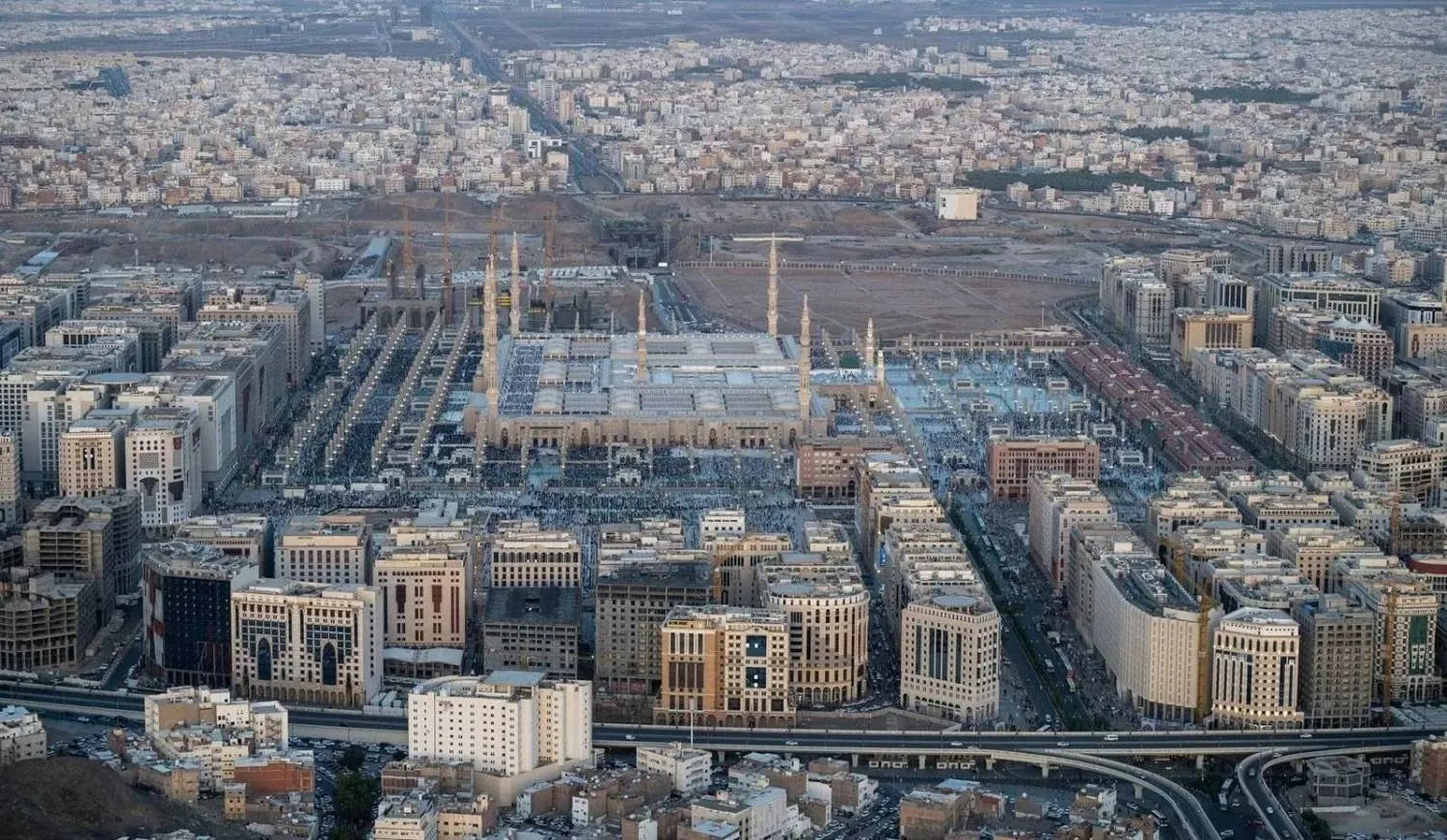
A cluster of buildings and hotels surrounding the Prophet’s Mosque (SPA). 
TT

Madinah Sees Tourism Surge Ahead of Ramadan, Spending Tops $13.9 Billion

A cluster of buildings and hotels surrounding the Prophet’s Mosque (SPA). 

Saudi Arabia’s Minister of Tourism, Ahmed Al-Khateeb, has toured hospitality facilities and visitor services in Madinah as part of the “Spirit of Ramadan” inspection tour, which also included Jeddah and Makkah.

New data show visitor numbers exceeded 21 million over the past year, a 12 percent increase from 2024, while total tourism spending reached SAR 52 billion (about $13.9 billion), up 22 percent.

The visit focused on assessing the sector’s readiness for the Ramadan season, evaluating service quality, and supporting ongoing and upcoming tourism projects.

Madinah posted strong tourism performance in 2025, driven by higher visitor inflows and expanded hospitality capacity, reinforcing its position as a leading religious destination within Saudi Arabia’s tourism landscape.

Demand growth has been matched by a sharp rise in supply. Licensed hospitality facilities increased to 610, up 35 percent, while the number of licensed rooms surpassed 76,000, a 24 percent gain, strengthening the city’s ability to accommodate during peak seasons such as Ramadan and Hajj.

Travel and tourism offices also grew to more than 240, reflecting a 29 percent expansion in supporting services.

Al-Khateeb said the entry of international hospitality brands and new projects over the past five years underscores both sectoral growth and rising investor confidence in the Kingdom’s tourism ecosystem.

“The landscape today is different. The sector is growing steadily, supported by a system that empowers investors and facilitates their journey, with a promising future ahead,” he said.

To expand hotel capacity, the minister inaugurated the Radisson Hotel Madinah, a project worth more than SAR 39 million (around $10 million) and financed by the Tourism Development Fund.

The 2025 performance signals a shift from traditional seasonal growth toward more sustainable expansion built on diversified offerings, improved service quality, and a stronger contribution to the local economy.


Airbus Planning Record Commercial Aircraft Deliveries in 2026

An Airbus A350-1000 at the Singapore Airshow on February 4. The company said Thursday it aims to deliver a record number of aircraft this year. Roslan RAHMAN / AFP/File
TT

Airbus Planning Record Commercial Aircraft Deliveries in 2026

An Airbus A350-1000 at the Singapore Airshow on February 4. The company said Thursday it aims to deliver a record number of aircraft this year. Roslan RAHMAN / AFP/File

Plane maker Airbus aims to deliver a record number of commercial aircraft this year, the company said Thursday, capitalizing on "strong demand" and a jump in profit in 2025.

"2025 was a landmark year, characterized by very strong demand for our products and services across all businesses," CEO Guillaume Faury said in a press release announcing annual results.

The European manufacturer said it received 1,000 orders for commercial planes in 2025, with net orders of 889 after taking cancellations into account, and 793 delivered.

Last year, its overall profit jumped 23 percent to 5.2 billion euros ($6.1 billion).

The company said it is targeting "around 870 commercial aircraft deliveries" this year.

"As the basis for its 2026 guidance, the Company assumes no additional disruptions to global trade or the world economy, air traffic, the supply chain, its internal operations, and its ability to deliver products and services," it said in its outlook.

Both Airbus and its rival Boeing have struggled to return to pre-pandemic production levels after their entire network of suppliers was disrupted, even as airlines are eager to modernize their fleets with more fuel-efficient aircraft and expand to meet an expected increase in passenger numbers over the coming decades.