China Vows 'Necessary Spending' to Hit Economic Growth Target

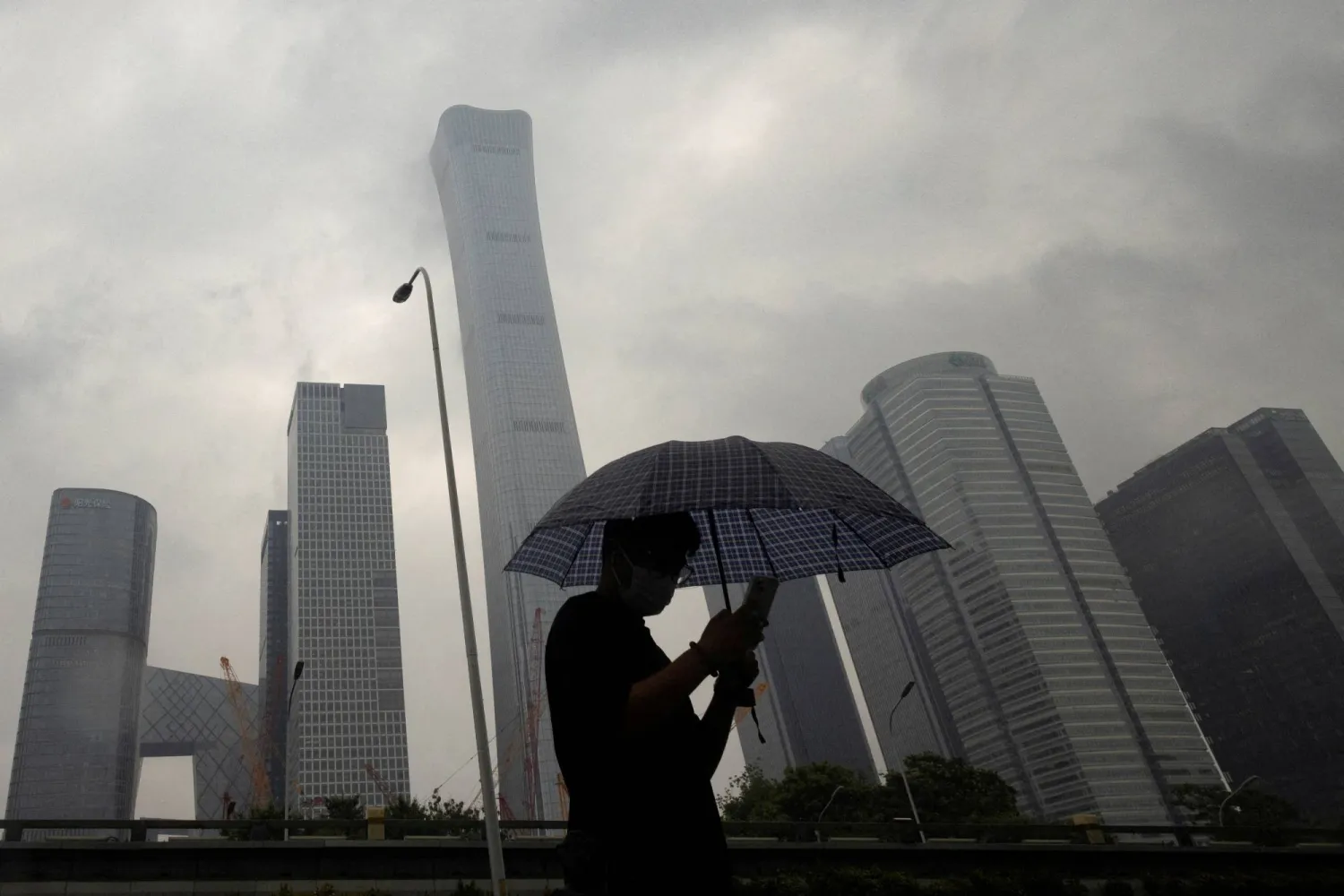
FILE PHOTO: A man walks in the Central Business District on a rainy day, in Beijing, China, July 12, 2023. REUTERS/Thomas Peter/File Photo
TT

China Vows 'Necessary Spending' to Hit Economic Growth Target

FILE PHOTO: A man walks in the Central Business District on a rainy day, in Beijing, China, July 12, 2023. REUTERS/Thomas Peter/File Photo

Chinese leaders pledged on Thursday to deploy "necessary fiscal spending" to meet this year's economic growth target of roughly 5%, acknowledging new problems and raising market expectations for fresh stimulus on top of measures announced this week.
The remarks, which included guidance to the government to support household consumption and stabilize the troubled real estate market, came in an official readout of a monthly meeting of top Communist Party officials, the Politburo. The September meeting is not usually a forum for macroeconomic discussions, which suggests growing anxiety over slowing growth momentum.
The world's second-largest economy faces strong deflationary pressures due to a sharp property market downturn and frail consumer confidence, which has exposed its over-reliance on exports in an increasingly tense global trade environment.
A wide range of economic data in recent months has missed forecasts, raising concerns among economists that the growth target was at risk and that a longer-term structural slowdown could be in play.
"New situations and problems" demand a sense of "responsibility and urgency," state media reported, citing the Politburo meeting.
China's central bank on Tuesday unveiled its most aggressive monetary easing since the pandemic, flagging cuts to a broad range of interest rates and a 1 trillion yuan ($140 billion) liquidity injection into the financial system, among other steps.
Beijing is considering pumping up to 1 trillion yuan into its biggest state banks to increase their capacity to support the struggling economy, primarily by issuing new special sovereign bonds, Bloomberg News reported on Thursday.
Chinese real estate shares jumped more than 8% and their Hong Kong peers soared 9% after the Politburo announcement, leading broader gains in the stock market. The yuan and Chinese bond yields also rose.
The Politburo said the government should "promote the stabilization of the real estate market", expand a whitelist of housing projects that can receive further financing and revitalize idle land, according to the readout.
Officials "will respond to people's concerns, adjust home purchase restriction policies, lower existing mortgage rates and improve land, fiscal, tax and financial policies as soon as possible to push forward the new model of property development", it said.

The Politburo's endorsement of further stimulus "represents a strategic shift in macro policy, from piecemeal policies to a highly orchestrated package in the right direction," said Bruce Pang, chief economist China at Jones Lang LaSalle.
"A pick-up in government spending will probably be sufficient to drive a turnaround in business confidence, market sentiment and economic activities, helping China to catch up with potential trend growth."
China will make good use of its ultra-long special sovereign bonds and local government special bonds to support government investment, the Politburo vowed, according to Reuters. It pledged to boost income for low- and middle-income groups and support consumption as well as improve childbirth support policies.
The ministries of finance and civil affairs said on Wednesday they would distribute a one-time allowance to disadvantaged people ahead of a national holiday in early October. They vowed to prioritize employment and promote wage growth in response to steep pay cuts in some sectors and soaring youth unemployment.
"Falling inflation and private sector deleveraging mean that rate cuts alone won't dramatically boost domestic demand," said Capital Economics analyst Julian Evans-Pritchard. "Doing so would require more substantial fiscal support. There are some hints of that in the (Politburo) communique."
As flagged by central bank Governor Pan Gongsheng on Tuesday, top policymakers said China would lower the reserve requirement ratio and implement "forceful" interest rate cuts.


World Food Prices Dip in October, but Remain Higher Than a Year Ago

A worker carries loaves of bread for sale at a bakery in the capital city of Cairo, Egypt November 4, 2026. (Reuters)
TT

World Food Prices Dip in October, but Remain Higher Than a Year Ago

A worker carries loaves of bread for sale at a bakery in the capital city of Cairo, Egypt November 4, 2026. (Reuters)

World food prices edged lower in October as weaker import demand contributed to monthly declines in cereal, dairy and meat prices, but were still nearly 6% higher than a year earlier, the United Nations' Food and Agriculture Organization said on Friday.

The FAO Food Price Index, which tracks monthly changes in international prices for a basket of food commodities, ‌averaged 133.9 points ‌in October, down from a revised ‌135.6 ⁠in September.

The index ⁠was 5.9% higher than a year earlier, but remained 16.4% below its March 2022 peak.

FAO's cereal price index fell 4.5% from September and was 12.6% lower than a year ago, as wheat and maize quotations declined. Wheat prices eased on weak import demand ⁠and improved production prospects, especially in Argentina.

"Expectations of ‌easing constraints on Black ‌Sea export flows added to the downward pressure on prices, ‌although continued disruptions to Black Sea logistics limited the decline," ‌FAO said in a statement.

Maize prices also eased after reaching a three-year high in September, pressured by the US harvest, expectations of ample supplies in South America and renewed ‌prospects of easing tensions in the Black Sea region.

Vegetable oil prices edged up 0.3%, ⁠as ⁠higher soybean and sunflower oil prices more than offset a fall in rapeseed oil prices.

Sugar prices rose 6.6%, their fourth straight monthly increase, to the highest level since December 2024, after rainfall disrupted harvesting in Brazil. They were now 28.8% above a year ago.

The dairy index fell 1.1%, as lower butter and cheese prices linked to ample supplies and subdued demand outweighed gains in milk powder.

The meat index declined 1.2%, while still slightly above its year-earlier level, as ovine and bovine meat prices fell.


Copper Falls, Set for Worst Week Since March on AI Rout

Copper at the Aurubis copper smelting and refining plant in Hamburg, Germany. (Reuters)
TT

Copper Falls, Set for Worst Week Since March on AI Rout

Copper at the Aurubis copper smelting and refining plant in Hamburg, Germany. (Reuters)

Copper dropped on Friday and was set for its biggest weekly drop in London since March, as a rout in technology stocks battered markets.

Benchmark three-month copper on the London Metal Exchange was down 1.3% at $13,663 a metric ton by 0700 GMT. That placed it on track to fall 3.44% in the week, Reuters said.

The most-traded copper contract on the Shanghai Futures Exchange fell 1.08% to 106,830 yuan ($16,018.17) a ton.

The weakness reflects worries over AI investment, ‌with copper increasingly ‌influenced by "sentiment towards data center expansion," said ‌Craig ⁠Lang, principal analyst ⁠at CRU.

Technology shares were battered after Democratic wins in the US midterms fueled concerns that new regulatory oversight could cap the AI buildout.

On the other hand, supply constraints cushioned copper's decline.

"I would be cautious about calling this a sustained correction, given ongoing mine supply challenges and exceptionally tight ⁠metal availability outside the US," Lang said.

Copper stocks ‌in SHFE-monitored warehouses <CU-STX-SGH> fell by ‌over 24% this week to just 33,848 tons — the lowest ‌in almost three years. The closely watched Yangshan copper ‌premium <SMM-CUYP-CN>, a gauge of appetite for imports into key consumer China, increased to $210 a ton on Thursday, matching its record high.

Smelters in the country are facing a double squeeze of negative treatment ‌charges and lower sulfuric acid prices.

Meanwhile, warehouse inventories outside the US have been drawn ⁠down as ⁠material was pulled into the country ahead of a potential tariff on imports of refined copper.

"These physical constraints should provide some support against weaker investor sentiment," Lang said.

Among LME metals, aluminium lost 0.54%, zinc lost 1.42%, lead lost 0.45%, nickel dipped 0.23% and tin gained 0.83%.

On the SHFE, aluminium nudged down only 0.04%, zinc lost 1.35%, lead was little changed, down only 0.03%, nickel rose 2.14% and tin dropped 3.45%.

SHFE inventories were down across the board this week, led by sharp drops in aluminium <AL-STX-SGH> and lead <PB-STX-SGH>.


Emerging Economies Set to Match Advanced Nations’ Renewable Capacity Additions, IEA Says

Workers walk at Kalyon Karapinar solar power plant in Karapinar, Konya province, Türkiye, Oct. 14, 2026. (AP)
TT

Emerging Economies Set to Match Advanced Nations’ Renewable Capacity Additions, IEA Says

Workers walk at Kalyon Karapinar solar power plant in Karapinar, Konya province, Türkiye, Oct. 14, 2026. (AP)

Emerging ‌and developing economies outside China are expected to add as much new renewable energy capacity as advanced economies for the first time over the next five years, driven by the current energy crisis, the International Energy Agency said on Friday.

Gas and oil prices have soared this year as the US-Iran war disrupts traffic through the Strait of Hormuz, a key route for global oil and gas trade.

Global renewable energy ‌capacity is forecast ‌to increase by almost 4,800 gigawatts ‌between ⁠2026 and 2031, ⁠the IEA said in its annual outlook.

Emerging and developing economies are expected to add about 1,100 GW, roughly the same as advanced economies, with China adding around 2,550 GW, the agency said.

Capacity growth in Southeast Asia, Africa and the Middle East is ⁠expected to triple over the period, ‌led mainly by solar installations, ‌the IEA said.

China will remain the biggest contributor to ‌global renewable energy growth, although its share is ‌forecast to fall to 53% by 2031 from 60% in 2025.

India is emerging as the world's second-fastest deployer of renewables and is expected to more than double its contribution ‌to global growth by 2031 to nearly 8.5%.

Grid connection delays remain ⁠a major ⁠challenge, with projects awaiting connections worldwide rising 60% over the past year, equivalent to four times the wind and solar capacity connected to grids during the same period.

Grid constraints are expected to slow growth in advanced economies, with annual additions in Europe through 2031 forecast to remain broadly in line with 2025 levels.

Renewable energy is expected to meet 6% of global transport energy demand by 2031, while higher fuel-blending mandates prompted the IEA to raise its biofuels forecast by 40% from last year's report.