


Year of War Creates Cracks in Israel's Borrowing Strength

The Bank of Israel building is seen in Jerusalem June 16, 2020. REUTERS/Ronen Zvulun/File Photo
TT

Year of War Creates Cracks in Israel's Borrowing Strength

The Bank of Israel building is seen in Jerusalem June 16, 2020. REUTERS/Ronen Zvulun/File Photo

Israel's economy has for almost a year ridden out the chaos of a war that risks spiralling into a regional conflict, but rising borrowing costs are starting to strain its financial architecture.

The direct cost of funding the war in Gaza through August was 100 billion shekel ($26.3 billion), according to the finance ministry. The Bank of Israel reckons the total could rise to 250 billion shekel by the end of 2025, but that estimate was made before Israel's incursion into Lebanon, which will add to the tally.

That has led to credit ratings downgrades, which are amplifying economic effects that could reverberate for years, while the cost of insuring Israel's debt against default is near a 12-year high and its budget deficit is ballooning, Reuters reported.

"As long as the war continues, the sovereign debt metrics will continue to worsen," said Sergey Dergachev, portfolio manager at Union Investment.

Although Israel's debt-to-GDP, a core metric for economic health, stood at 62% last year, borrowing needs have blown out.

"Even if Israel has a relatively good base, still it will be painful on the fiscal side," Dergachev said, adding: "And over time, it will put pressure on the rating."

Israel's finance minister has said the economy is strong, and the country's credit ratings should rebound once the war has ended.

The cost of the war is steep due to Israel's Iron Dome air defenses, large-scale troop mobilization and intensive bombing campaigns. This year, debt-to-GDP hit 67%, while the government deficit is 8.3% of GDP, well above the 6.6% previously expected.

While the core buyers of Israel's international bonds - pension funds or major asset managers lured by its relatively high sovereign debt rating - are unlikely to shed the assets at short notice, the investor base has narrowed.

Privately, investors say there is increasing interest in offloading Israel's bonds, or not purchasing them, due to concerns over the ESG implications of how the war is conducted.

Norges Bank sold a small holding in Israeli government bonds in 2023 "given increased uncertainty in the market," a spokesperson for Norway's sovereign wealth fund said.

"What you do see reflecting these concerns is obviously the valuations," said Trang Nguyen, Global Head of Emerging Markets Credit Strategy at BNP Paribas, adding Israeli bonds were trading at far wider spreads than similarly rated countries.

Asked about rising borrowing costs and investors' ESG concerns for this story, Israel's finance ministry did not immediately respond to a request for comment.

While Israel's domestic bond market is deep, liquid and expanding rapidly, foreign investors have pulled back.

Central bank data shows the share held by non-residents declined to 8.4%, or 55.5 billion shekels, in July from 14.4%, or nearly 80 billion shekels, in September last year. Over the same period, the amount of outstanding bonds grew by more than a fifth.

"Israeli institutions actually are buying more during the last few months and I guess some global investors sold bonds because of geopolitics and uncertainty," a finance ministry official said, declining to be named.

Equity investors are also cutting back. Data from Copley Fund Research showed that international investors' cuts to Israel funds, which began in May 2023 amid disputed judicial reforms, accelerated after the Oct. 7 Hamas attacks.

Global funds' ownership of Israeli stocks is now at its lowest in a decade.

Foreign direct investment into Israel dropped by 29% year-on-year in 2023, according to UNCTAD - the lowest since 2016. While 2024 figures are not available, ratings agencies have flagged the war's unpredictable impact on such investment as a concern.

All this has amplified the need for local investment, and government support.

The government in April pledged $160 million in public money to boost venture capital funding for the crucial tech sector, which accounts for some 20% of Israel's economy.

This adds to other costs, including housing thousands displaced by the fighting, many in hotels vacant due to the steep drop in tourists.

The displacements, worker shortages due to mobilization and Israel's refusal to allow Palestinian workers in, are hindering its agriculture and construction sectors.

The latter has been a key factor curtailing economic growth - which plunged more than 20% in the fourth quarter of last year and has yet to recover. Data from the three months to end-June show seasonally adjusted GDP remained 1.5% below pre-attack levels, Goldman Sachs calculations show.

Israel has thus far had little trouble raising money. It sold some $8 billion of debt on international capital markets this year. Its diaspora bond vehicle, Israel Bonds, is targeting a second annual record haul above $2.7 billion.

But rising borrowing costs, coupled with rising spending and economic pressure, loom.

"There is room for Israel to continue muddling through, given a large domestic investor base that can continue to fund another sizeable deficit," said Roger Mark, analyst in the Fixed Income team at Ninety One.

"However, local investors are looking for at least some signs of consolidation efforts from the government."



Riyadh to Host Middle East’s Largest General Aviation Airshow in November 

The AERO Middle East x Sand & Fun 2026 will be held in Riyadh from November 24 to 28. (SPA)
TT

Riyadh to Host Middle East’s Largest General Aviation Airshow in November 

The AERO Middle East x Sand & Fun 2026 will be held in Riyadh from November 24 to 28. (SPA)

The Saudi Aviation Club announced that it will organize the AERO Middle East x Sand & Fun 2026 in Riyadh from November 24 to 28, reported the Saudi Press Agency on Tuesday.

The event is set to be the largest of its kind for general aviation in the Middle East, combining international business, investment, and innovation with live flying displays and interactive public experiences. It is being held in partnership with Messe Frankfurt Saudi Arabia.

Held at Thumamah Airport, the exhibition will bring together leading global companies operating in the general aviation industry, including aircraft and components manufacturers, avionics and navigation systems providers, as well as maintenance, repair, and overhaul (MRO) companies, offering an integrated platform that covers the full value chain of the sector.

The event will also spotlight startups in advanced air mobility (AAM) and innovators of electric vertical take-off and landing (eVTOL) aircraft, showcasing technologies and business models shaping the future of aviation.

General Supervisor of the Saudi Aviation Club Dr. Ahmed Alfahaid stated that AERO Middle East x Sand & Fun 2026 represents a qualitative leap for the Kingdom’s aviation sector and reinforces its positioning as a global hub for general aviation and advanced air mobility.

The partnership with Messe Frankfurt Saudi Arabia goes beyond presenting global innovations to providing a vital platform for international investment and strategic collaboration, he stressed.

Moreover, the event contributes to achieving Saudi Vision 2030 objectives, including the Kingdom’s ambition to rank among the world’s top 10 general aviation markets, he added.


Saudi Arabia, Kazakhstan Agree to Establish Coordination Council

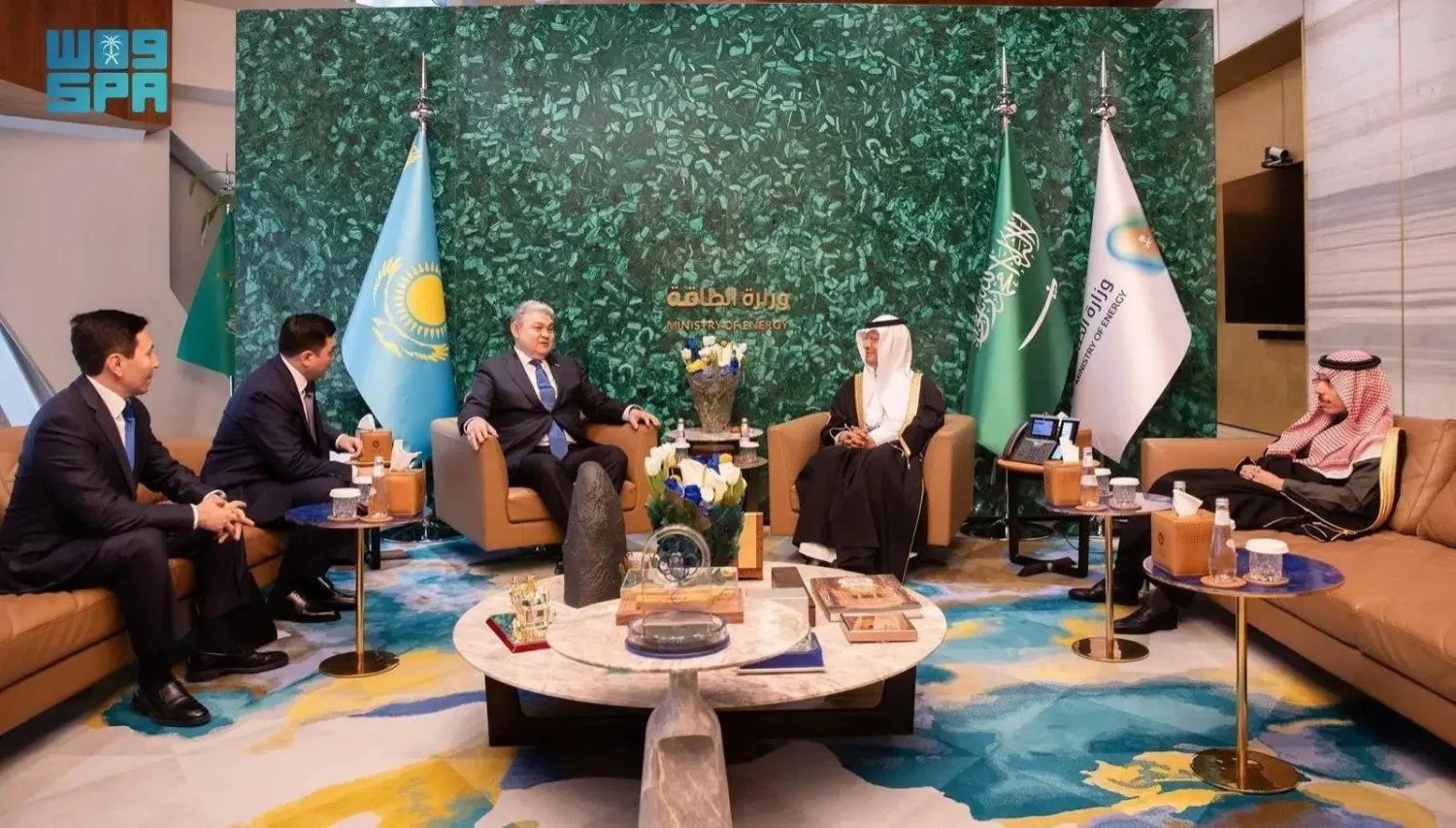
Saudi Minister of Energy Prince Abdulaziz bin Salman bin Abdulaziz receives Kazakhstan’s Foreign Minister Yermek Kosherbayev in Riyadh. (SPA)
TT

Saudi Arabia, Kazakhstan Agree to Establish Coordination Council

Saudi Minister of Energy Prince Abdulaziz bin Salman bin Abdulaziz receives Kazakhstan’s Foreign Minister Yermek Kosherbayev in Riyadh. (SPA)

Saudi Arabia and Kazakhstan agreed to establish a Saudi-Kazakh Coordination Council, reported the Saudi Press Agency on Tuesday.

Saudi Minister of Energy Prince Abdulaziz bin Salman bin Abdulaziz received in Riyadh Kazakhstan’s Foreign Minister Yermek Kosherbayev. Saudi FM Prince Faisal bin Farhan bin Abdullah and Minister of Energy of Kazakhstan Yerlan Akkenzhenov also attended the meeting.

The talks tackled the establishment of the coordination council, which will be chaired by the Saudi minister of energy and Kazakhstan’s foreign minister. The council reflects the two countries’ commitment to strengthening cooperation and expanding their bilateral partnership.

Prince Abdulaziz and Kosherbayev signed an agreement on the establishment of the council, which aims to boost coordination and consultation between the two countries and develop frameworks for cooperation across various sectors of mutual interest, elevating bilateral relations to broader levels.

Prince Abdulaziz and Kosherbayev discussed relations between their countries and ways to develop them further, especially in the energy field. They tackled opportunities for cooperation and investment in renewable energy and energy storage systems and discussed oil market developments.


Saudi-Qatari Partnership Paves Way for Logistics Corridors to Boost Regional Trade Efficiency 

The MoU was signed by Mawani President Eng. Suliman Almazroua and CEO of Qatar Ports Management Company Captain Abdullah Mohammed Al-Khanji. (QNA)
TT

Saudi-Qatari Partnership Paves Way for Logistics Corridors to Boost Regional Trade Efficiency 

The MoU was signed by Mawani President Eng. Suliman Almazroua and CEO of Qatar Ports Management Company Captain Abdullah Mohammed Al-Khanji. (QNA)

The Saudi Ports Authority (Mawani) and Qatar Ports Management Company signed on Tuesday a memorandum of understanding (MoU) aimed at boosting maritime and logistics cooperation between the two sides.

The agreement will contribute to the development of the ports sector, raising operational efficiency, and supporting regional and international trade flows.

The MoU was signed by Mawani President Eng. Suliman Almazroua and CEO of Qatar Ports Management Company Captain Abdullah Mohammed Al-Khanji. Qatari Ambassador to Saudi Arabia Bandar bin Mohammed Al Attiyah attended the signing ceremony.

The agreement reflects Saudi Arabia and Qatar’s commitment to building effective partnerships, exchanging expertise, establishing an organized framework for cooperation management, and developing joint investment opportunities in line with Saudi Vision 2030 and Qatar National Vision 2030.

The MoU outlines eight key areas of cooperation, including the exchange of best practices in port management and operations, and the study of opportunities for direct maritime and land connectivity between the ports of both countries to enhance trade flow efficiency.

It includes collaboration in logistics services, exploring the establishment of joint maritime corridors serving bilateral and regional trade, and assessing the feasibility of creating shared regional distribution centers.

In the fields of digital transformation and artificial intelligence, the two sides agreed to deepen cooperation on developing smart systems, data governance, and the unified maritime window, thereby boosting operational efficiency and keeping pace with technological advancements in the maritime sector.

The MoU places strong emphasis on maritime safety and environmental protection, including exchanging expertise in combating marine pollution and emergency response; developing joint maritime emergency plans; establishing an emergency communication line between the two countries; and cooperating to ensure compliance with international conventions, conduct joint exercises, and develop risk monitoring systems.

The cooperation also covers human capital development through joint training programs and field-exchange of expertise, as well as academic and research collaboration in maritime transport and logistics.

In terms of joint investment, both sides will study local and global investment opportunities in ports and related services and coordinate with the private sector to support these initiatives.

The MoU further includes cooperation in cruise tourism through enhanced maritime connectivity and joint promotion of Gulf cruise routes, as well as international and regional representation by coordinating positions in international maritime organizations and supporting joint initiatives, notably “Green Ports” and “Safe Sea Corridors.”

The agreement reflects the commitment of Mawani and Qatar Ports Management Company to advancing the ports sector and boosting its role as a key driver of trade and economic growth, contributing to Gulf integration and enhancing regional competitiveness in maritime and marine services.