


China State Media Warn Trump against Mutually Destructive Tariff War

A shopper walks with his purchases at Plaza Las Americas Mall near the US-Mexico border in San Ysidro, California, on November 26, 2024. (AFP)
TT

China State Media Warn Trump against Mutually Destructive Tariff War

A shopper walks with his purchases at Plaza Las Americas Mall near the US-Mexico border in San Ysidro, California, on November 26, 2024. (AFP)

China's state media warned US President-elect Donald Trump his pledge to slap additional tariffs on Chinese goods over fentanyl flows could drag the world's top two economies into a mutually destructive tariff war.

Trump, who takes office on Jan. 20, said on Monday he would impose "an additional 10% tariff, above any additional tariffs" on imports from China until Beijing clamped down on trafficking of the chemical precursors used to make the deadly drug.

The two superpowers are setting out their positions ahead of the former president's return to the White House. Trump's first term resulted in a trade war that uprooted global supply chains and hurt every economy as inflation and borrowing costs shot up.

Editorials in Chinese communist party mouthpieces China Daily and the Global Times late on Tuesday warned the next occupant of 1600 Pennsylvania Avenue to not make China a "scapegoat" for the US' fentanyl crisis or "take China's goodwill for granted regarding anti-drug cooperation."

"The excuse the president-elect has given to justify his threat of additional tariffs on imports from China is farfetched," China Daily said.

"There are no winners in tariff wars. If the US continues to politicize economic and trade issues by weaponizing tariffs, it will leave no party unscathed."

Economists have begun downgrading their growth targets for China's $19 trillion economy for 2025 and 2026 in anticipation of further tariffs promised by Trump during the election campaign, and are warning Americans to brace for an increase in the cost of living.

"For now, the only thing we know for sure is that the risks in this area are high," said Louis Kuijs, chief Asia economist at S&P Global Ratings, which on Sunday lowered its China growth forecast for 2025 and 2026 to 4.1% and 3.8%, respectively.

"What we assumed in our baseline is an across-the-board (tariff) increase from around 14% now to 25%. Thus, what we assumed is a bit more than the 10% on all imports from China."

Trump is threatening Beijing with far higher tariffs than the 7.5%-25% levied on Chinese goods during his first term.

"China already has a template for dealing with the previous US tariff policy," the Global Times quoted Gao Lingyun, an analyst at the Chinese Academy of Social Sciences in Beijing, as saying.

"Using counternarcotics issues to increase tariffs on Chinese goods is untenable and unpersuasive," Gao added.

Chinese President Xi Jinping told former Singaporean Prime Minister Lee Hsien Loong that China's economy would continue to grow and develop in the long-term during a meeting in Beijing on Tuesday after Trump's comments, state news agency Xinhua said.

Lee reportedly told Xi "no one should underestimate the Chinese people's determination for their nation to succeed and stand tall in the world," a remark which a separate Global Times piece said was "also meant for some people in (the) international community."

Profits at Chinese firms fell 10% year-on-year in October, data showed on Wednesday, showing how companies are struggling to remain profitable in an economy that is far more vulnerable to trade shocks this time around.

Economists in a Reuters poll last week expected additional US tariffs ranging from 15% to 60%. Most said Beijing will need to inject more stimulus to boost economic growth and offset pressure on exports.

TRADE WAR TWO

Trump previously said he would introduce tariffs in excess of 60% on Chinese goods.

The threat is rattling China's industrial complex, which sells goods worth more than $400 billion annually to the US and hundreds of billions more in components for products Americans buy from elsewhere.

His pick of trade lawyer Jamieson Greer as new US trade representative elevates a key veteran of Trump's first term trade war against China and points to a bruising four years for trade negotiators the world over.

Greer served as chief of staff to Trump's former US Trade Robert Lighthizer, the architect of Trump's original tariffs on some $370 billion worth of Chinese imports and the renegotiation of the North American free trade deal with Canada and Mexico.

The president-elect looks set to tear up that agreement on his first day in office.

Trump on Monday also pledged 25% tariffs on goods from Mexico and Canada, saying the US' neighbors were not doing enough to stop drugs and migrants crossing their borders.

But China can expect to bear the brunt of Trump's efforts to bring down the US' trade deficit and bring about the "manufacturing renaissance" he promised on the campaign trail.

"What the future will bring on this front is hard to say," S&P Global's Kuijs said. "There are many uncertainties. There is still a large increase to go to get to 60%."


Moody’s Establishes Regional HQ in Riyadh, Deepening Presence in Region

(FILES) Signage for Moody's Corporation is displayed at their headquarters at 7 World Trade Center on March 18, 2025 in New York City. (Photo by ANGELA WEISS / AFP)
TT

Moody’s Establishes Regional HQ in Riyadh, Deepening Presence in Region

(FILES) Signage for Moody's Corporation is displayed at their headquarters at 7 World Trade Center on March 18, 2025 in New York City. (Photo by ANGELA WEISS / AFP)

Moody’s Corporation announced that it has established its regional headquarters in Riyadh, reflecting ongoing commitment to support the development of the Kingdom’s capital markets and economy.

“This investment aligns to the Kingdom's Vision 2030 initiative and underscores its dynamism and growth,” Moody’s said in a statement this week.

The new regional headquarters marks an expansion of Moody’s presence in Saudi Arabia, where the company first opened an office in 2018, and reflects its longstanding commitment to the Middle East.

“The headquarters will strengthen Moody’s engagement with Saudi institutions and enable broader access to Moody’s decision grade data, analytics and insights,” said the statement.

“Our decision to establish a regional headquarters in Riyadh reflects our confidence in Saudi Arabia’s strong economic momentum, as well as our commitment to helping domestic and international investors unlock opportunities with our expertise and insights,” said President and Chief Executive Officer of Moody’s Rob Fauber.

“We are well positioned to provide the analytical capabilities and market intelligence that investors and institutions need to navigate evolving markets across the Middle East,” the statement quoted him as saying.

Mahmoud Totonji will lead the regional headquarters as General Manager.


Saudi Arabia Launches First Endowment Fund for Environmental, Water and Agricultural Sustainability

The launch of the Namaa Endowment Fund (Asharq Al-Awsat)
TT

Saudi Arabia Launches First Endowment Fund for Environmental, Water and Agricultural Sustainability

The launch of the Namaa Endowment Fund (Asharq Al-Awsat)

Saudi Arabia has launched its first endowment fund dedicated to advancing environmental, water and agricultural sustainability, reinforcing efforts to strengthen the Kingdom’s non-profit sector and long-term development.

Minister of Environment, Water and Agriculture Eng. Abdulrahman Al-Fadhli on Tuesday inaugurated the Namaa Endowment Fund at the ministry’s headquarters, in the presence of senior officials and stakeholders.

The fund is designed to support economic and social development goals, address community needs, increase the non-profit sector’s contribution to GDP, and promote sustainable management of environmental, water and agricultural resources.

Al-Fadhli said the fund represents a new model of institutional endowment work and a practical mechanism to expand developmental impact while ensuring the sustainability of non-profit initiatives.

Developed in partnership with the General Authority for Awqaf, the fund aims to build assets commensurate with its ambitions, enabling higher returns and a wider impact over the long term.

It will pursue carefully structured investments that balance financial performance with developmental outcomes, with the potential to own or benefit from real estate assets that can be used by non-profit organizations.

Encouraging Private-Sector Participation

Al-Fadhli added that the ministry, in cooperation with the General Authority for Awqaf, the Capital Market Authority and AlAhli Capital, will support the fund and encourage contributions from the private sector, business leaders and the wider public.

Contributions will be made through a licensed digital platform under strict financial governance. He called on all segments of society to contribute in support of sustainable development across the environment, water and agriculture sectors.

Namaa will finance endowment initiatives within the ministry’s ecosystem, including the non-profit institutions Reef, Morooj and Saqaya. Its focus areas include water provision and conservation, afforestation, biodiversity protection, vegetation cover, the circular economy, sustainable agriculture and irrigation, and reducing food loss and waste.

Emad Alkharashi, Governor of the General Authority for Awqaf, announced an initial contribution of SAR100 million, describing it as a foundation for a sustainable endowment model.

He said the fund combines the legacy of endowments with modern investment practices to protect natural resources, strengthen food security and ensure lasting developmental impact.

Alkharashi added that the partnership with the ministry maximizes results and positions the fund as a model for directing endowments toward high-impact, long-term priorities through a transparent, well-governed institutional framework.


Makkah Gears Up for Ramadan with Tourism Drive, Record Hospitality Growth  

Tourism Minister Ahmed Al-Khateeb and other officials during his inspection tour on Tuesday. (Asharq Al-Awsat)
TT

Makkah Gears Up for Ramadan with Tourism Drive, Record Hospitality Growth  

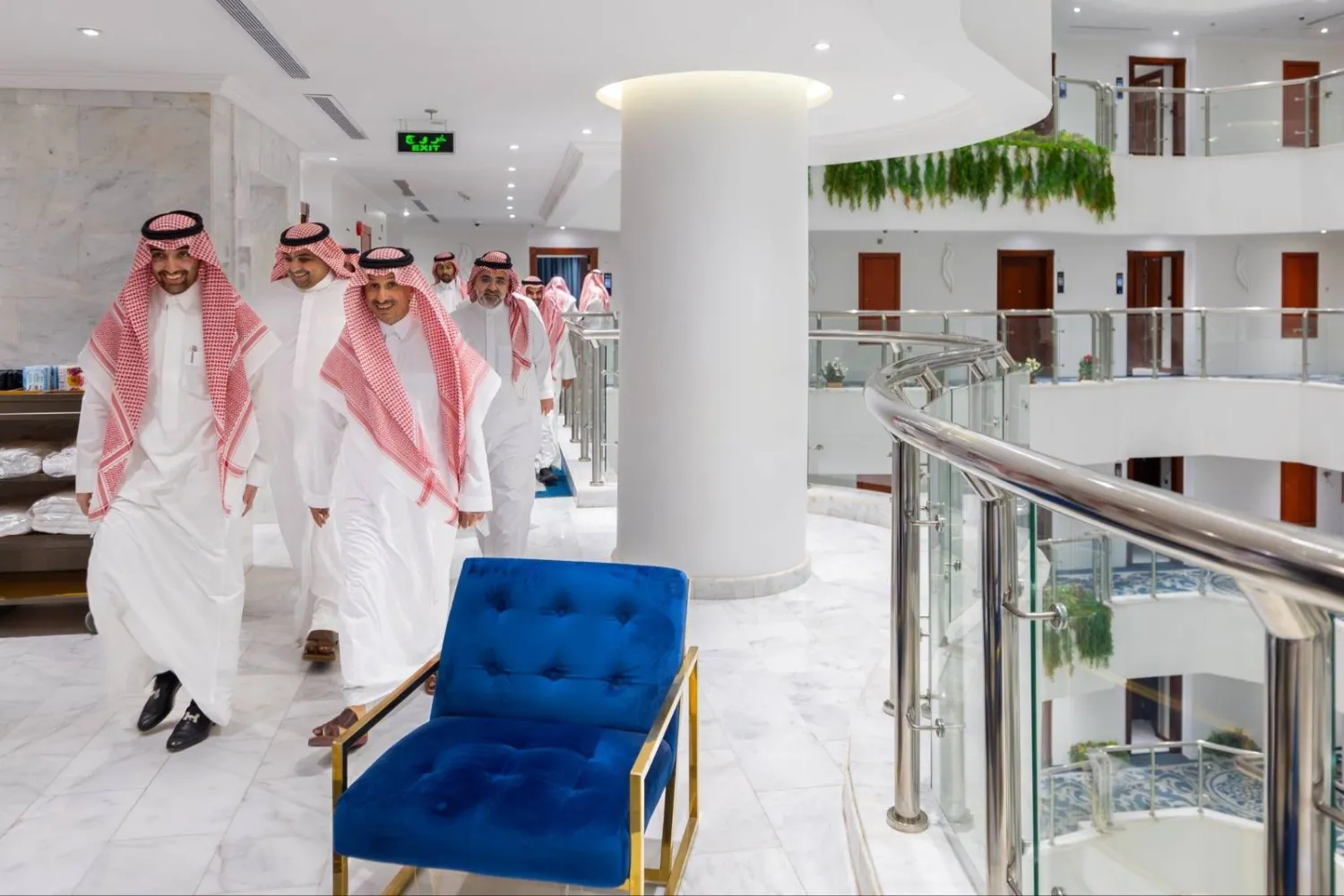
Tourism Minister Ahmed Al-Khateeb and other officials during his inspection tour on Tuesday. (Asharq Al-Awsat)

Saudi Arabia’s Ministry of Tourism has raised the readiness of Makkah’s hospitality sector to its highest level ahead of the holy month of Ramadan, stressing that serving pilgrims and visitors remains a top national priority.

Makkah is preparing to receive worshippers and visitors amid a marked expansion in hospitality capacity. The city now has more than 2,200 licensed accommodation facilities, reflecting growth of 35 percent over the past year. The number of licensed hotel rooms has exceeded 380,000, up 25 percent, while total domestic and inbound tourism spending is projected to surpass SAR 143 billion ($38.1 billion) in 2025.

The wider Makkah region recorded unprecedented performance indicators last year, both in visitor numbers and tourism spending, underscoring sustained growth and operational readiness.

Total domestic and international visitors exceeded 50 million, marking a 14 percent increase compared with 2024.

Tourism Minister Ahmed Al-Khateeb announced the figures during an annual inspection tour on Tuesday, stressing that the indicators reflect a major expansion in accommodation capacity and record growth in visitor numbers.

The tour included inspections of temporary lodging facilities designated for pilgrims, part of a proactive plan to increase capacity during peak seasons, alongside early preparations for the upcoming Hajj.

Vision 2030 targets surpassed

Official data has shown that Saudi Arabia has exceeded its Vision 2030 targets for the Umrah. The number of pilgrims arriving from abroad rose from 8.5 million in 2019 to more than 18 million in 2025, surpassing the original goal of 15 million by 2030.

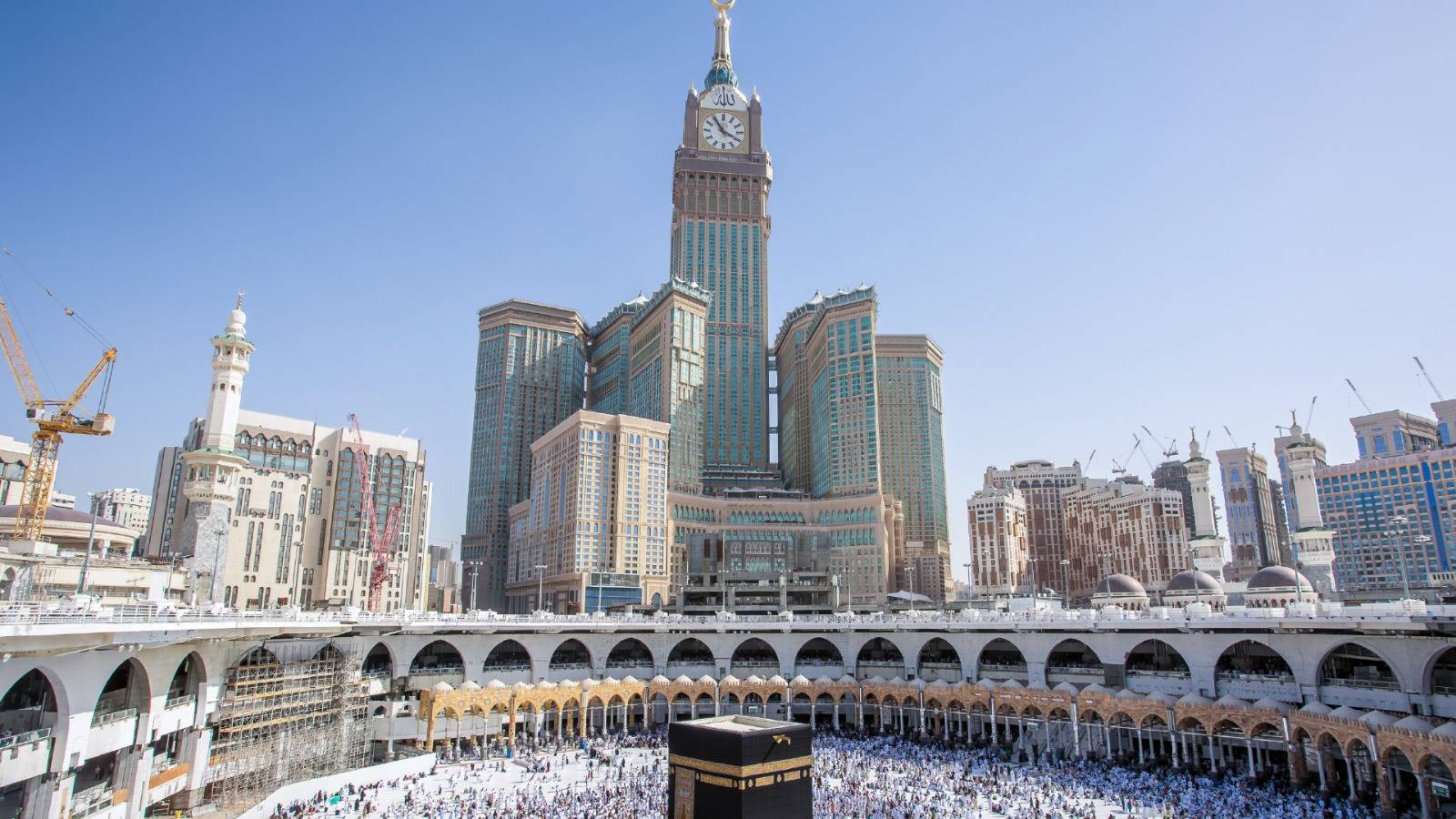
A number of hotels surrounding the Grand Mosque in Makkah. (General Authority for Awqaf)

Service quality indicators improved as well, with pilgrim satisfaction reaching 94 percent, exceeding Vision 2030 benchmarks.

Workforce development kept pace with demand, as the number of licensed tour guides rose to more than 980, a 23 percent increase.

Masar Mall project

Al-Khateeb announced a joint financing agreement between the Tourism Development Fund and the Arab National Bank with Hamat Holding to support the Masar Mall project. The development carries a total cost of SAR 936 million (about $250 million).

The project is expected to become the largest shopping center in Makkah with the capacity to accommodate around 20 million visitors annually.

Its location near the Haramain High-Speed Railway station and a direct pedestrian link to the Grand Mosque are expected to strengthen the city’s commercial and tourism infrastructure.

Jeddah: Gateway to pilgrims

Meanwhile, Jeddah continues to consolidate its position as a complementary destination to Makkah and a primary gateway for pilgrims, while also expanding its role as a coastal tourism hub.

The city welcomed more than 13 million domestic and international visitors in 2025, a 10 percent increase from 2024. Tourism spending reached SAR 28 billion ($7.47 billion), up 6 percent year on year.

Jeddah’s hospitality sector also expanded, with more than 500 licensed facilities and over 33,000 licensed rooms.

The city is currently developing 46 tourism projects valued at SAR 21 billion ($5.6 billion) and expected to add more than 11,000 hotel rooms and further strengthen its tourism infrastructure and economic value.
