Political Turmoil Shakes South Korea’s Economy

Protesters take part in a rally calling for the ouster of South Korea's impeached President Yoon Suk Yeol in front of the Gwanghwamun Gate of Gyeongbokgung Palace in Seoul on December 28, 2024. (Yonhap/AFP)
TT

Political Turmoil Shakes South Korea’s Economy

Protesters take part in a rally calling for the ouster of South Korea's impeached President Yoon Suk Yeol in front of the Gwanghwamun Gate of Gyeongbokgung Palace in Seoul on December 28, 2024. (Yonhap/AFP)

After South Korea's president and his replacement were both deposed over a failed bid to impose martial law, deepening political turmoil is threatening the country's currency and shaking confidence in its economy.

The won, which plunged Friday to its lowest level against the dollar since 2009, has been in near-constant decline since President Yoon Suk Yeol's attempt to scrap civilian rule in early December.

Business and consumer confidence in Asia's fourth-largest economy have also taken their biggest hit since the start of the Covid-19 pandemic, according to figures released by the Bank of Korea.

Lawmakers impeached Yoon in mid-December on charges of insurrection, and on Friday they impeached his successor, acting president and prime minister Han Duck-soo, arguing that he refused demands to complete Yoon's removal from office and bring him to justice.

That thrust Finance Minister Choi Sang-mok into the additional roles of acting president and prime minister.

Choi has pledged to do all he can to end "this period of turmoil" and resolve the political crisis gripping the country.

- Constitutional question -

At the heart of the stalemate is the Constitutional Court, which will decide whether to uphold parliament's decision to impeach Yoon.

It must do so by a two-thirds majority, however. And because three of the court's nine seats are currently vacant, a unanimous vote is required to confirm the suspended president's removal.

Otherwise, Yoon will be automatically returned to office.

Lawmakers on Thursday nominated three judges to fill the vacant seats, but acting president Han refused to approve them, precipitating his own impeachment.

After an acrimonious day in which lawmakers from Yoon's party erupted in protest, the country's newest acting president sought to project calm.

"Although we are facing unexpected challenges once again, we are confident that our robust and resilient economic system will ensure rapid stabilization," Choi said Friday.

The 61-year-old career civil servant has inherited a 2025 budget -- adopted by the opposition alone -- which is 4.1 trillion won ($2.8 billion) less than the government had hoped for.

"There are already signs the crisis is having an impact on the economy," Gareth Leather of Capital Economics wrote in a note to clients, citing the dip in consumer and business confidence.

"The crisis is unfolding against a backdrop of a struggling economy," he added, with GDP growth expected to be just two percent this year, weighed down by a global slowdown in demand for semiconductors.

"Longer term, political polarization and resulting uncertainty could hold back investment in Korea," Leather wrote, citing the example of Thailand, another ultra-polarized country whose economy has stagnated since a coup in 2014.

- Democratic resilience? -

But other economists noted that the South Korean economy has so far weathered the chaos well.

As early as December 4, the day after Yoon declared martial law following a budget tussle with the opposition, the central bank promised to inject sufficient liquidity to stabilize the markets, and the Kospi Index has lost less than four percent since the start of the crisis.

"Like everyone, I was surprised when Yoon took those crazy measures," Park Sang-in, a professor of economics at Seoul National University, told AFP. "But there was a resilience of democracy."

"We come from being an underdeveloped country to one of the world's most dynamic economies in very few years, and Yoon Suk Yeol is a side effect of the growth," he added.

"Korean society was mature enough to counter his crazy actions."


Oil Prices Extend Gains on Concerns of Potential US-Iran Conflict

FILE PHOTO: The Phillips 66 Lake Charles Refinery is pictured in West Lake, Louisiana, US, June 12, 2018. REUTERS/Jonathan Bachman/File Photo
TT

Oil Prices Extend Gains on Concerns of Potential US-Iran Conflict

FILE PHOTO: The Phillips 66 Lake Charles Refinery is pictured in West Lake, Louisiana, US, June 12, 2018. REUTERS/Jonathan Bachman/File Photo

Oil prices rose on Thursday as the US and Iran attempted to ease a standoff in talks over Tehran's nuclear program while both sides heightened military activity in the key oil-producing region.

Brent futures climbed 23 cents, or 0.3% to $70.58 a barrel by 0735 GMT, while US West Texas Intermediate (WTI) crude gained 25 cents, or 0.4%, to trade at $65.44 a barrel.

Both benchmarks settled more than 4% higher on Wednesday, posting their highest settlements since January 30, as traders priced in the risk of supply disruptions in the event of ‌a conflict.

"Oil prices are ‌rallying as the market becomes increasingly concerned over the potential ‌for ⁠imminent US action ⁠against Iran," said ING analysts in a Thursday note.

Iranian state media reported the country had shut down the Strait of Hormuz for a few hours on Tuesday, without making clear whether the waterway had fully reopened. About 20% ⁠of the world's oil supply passes through the waterway.

"Tensions between Washington ‌and Tehran remain high, but the prevailing view ‌is that full-scale armed conflict is unlikely, prompting a wait-and-see approach," said Hiroyuki Kikukawa, chief strategist of ‌Nissan Securities Investment, a unit of Nissan Securities.

"US President Donald Trump does not ‌want a sharp rise in crude prices, and even if military action occurs, it would likely be limited to short-term air strikes," Kikukawa added.

A degree of progress was made during Iran talks in Geneva this week but distance remained on some issues, the White House said on Wednesday, ‌adding that it expected Tehran to come back with more details in a couple of weeks.

Iran issued a notice to ⁠airmen (NOTAM) that ⁠it plans rocket launches in areas across its south on Thursday from 0330 GMT to 1330 GMT, according to the US Federal Aviation Administration website.

At the same time, the US has deployed warships near Iran, with US Vice President JD Vance saying Washington was weighing whether to continue diplomatic engagement with Tehran or pursue "another option".

Meanwhile, two days of peace talks in Geneva between Ukraine and Russia ended on Wednesday without a breakthrough, with Ukrainian President Volodymyr Zelenskiy accusing Moscow of stalling US-mediated efforts to end the four-year-old war.

US crude and gasoline and distillate inventories fell last week, market sources said, citing American Petroleum Institute figures on Wednesday, contrary to expectations in a Reuters poll that crude stocks would rise by 2.1 million barrels in the week to February 13.

Official US oil inventory reports from the Energy Information Administration are due on Thursday.


Madinah Sees Tourism Surge Ahead of Ramadan, Spending Tops $13.9 Billion

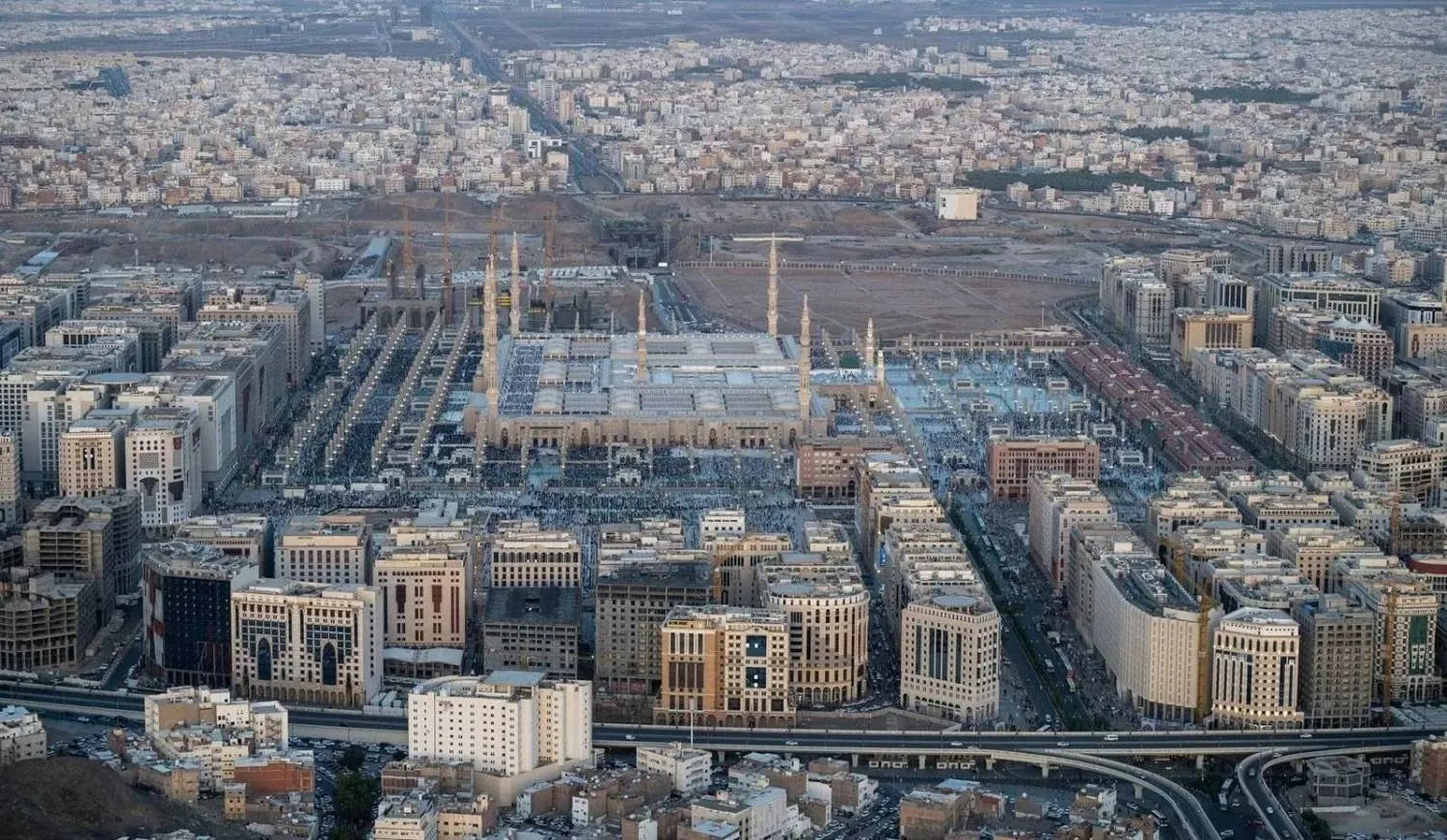
A cluster of buildings and hotels surrounding the Prophet’s Mosque (SPA). 
TT

Madinah Sees Tourism Surge Ahead of Ramadan, Spending Tops $13.9 Billion

A cluster of buildings and hotels surrounding the Prophet’s Mosque (SPA). 

Saudi Arabia’s Minister of Tourism, Ahmed Al-Khateeb, has toured hospitality facilities and visitor services in Madinah as part of the “Spirit of Ramadan” inspection tour, which also included Jeddah and Makkah.

New data show visitor numbers exceeded 21 million over the past year, a 12 percent increase from 2024, while total tourism spending reached SAR 52 billion (about $13.9 billion), up 22 percent.

The visit focused on assessing the sector’s readiness for the Ramadan season, evaluating service quality, and supporting ongoing and upcoming tourism projects.

Madinah posted strong tourism performance in 2025, driven by higher visitor inflows and expanded hospitality capacity, reinforcing its position as a leading religious destination within Saudi Arabia’s tourism landscape.

Demand growth has been matched by a sharp rise in supply. Licensed hospitality facilities increased to 610, up 35 percent, while the number of licensed rooms surpassed 76,000, a 24 percent gain, strengthening the city’s ability to accommodate during peak seasons such as Ramadan and Hajj.

Travel and tourism offices also grew to more than 240, reflecting a 29 percent expansion in supporting services.

Al-Khateeb said the entry of international hospitality brands and new projects over the past five years underscores both sectoral growth and rising investor confidence in the Kingdom’s tourism ecosystem.

“The landscape today is different. The sector is growing steadily, supported by a system that empowers investors and facilitates their journey, with a promising future ahead,” he said.

To expand hotel capacity, the minister inaugurated the Radisson Hotel Madinah, a project worth more than SAR 39 million (around $10 million) and financed by the Tourism Development Fund.

The 2025 performance signals a shift from traditional seasonal growth toward more sustainable expansion built on diversified offerings, improved service quality, and a stronger contribution to the local economy.


Airbus Planning Record Commercial Aircraft Deliveries in 2026

An Airbus A350-1000 at the Singapore Airshow on February 4. The company said Thursday it aims to deliver a record number of aircraft this year. Roslan RAHMAN / AFP/File
TT

Airbus Planning Record Commercial Aircraft Deliveries in 2026

An Airbus A350-1000 at the Singapore Airshow on February 4. The company said Thursday it aims to deliver a record number of aircraft this year. Roslan RAHMAN / AFP/File

Plane maker Airbus aims to deliver a record number of commercial aircraft this year, the company said Thursday, capitalizing on "strong demand" and a jump in profit in 2025.

"2025 was a landmark year, characterized by very strong demand for our products and services across all businesses," CEO Guillaume Faury said in a press release announcing annual results.

The European manufacturer said it received 1,000 orders for commercial planes in 2025, with net orders of 889 after taking cancellations into account, and 793 delivered.

Last year, its overall profit jumped 23 percent to 5.2 billion euros ($6.1 billion).

The company said it is targeting "around 870 commercial aircraft deliveries" this year.

"As the basis for its 2026 guidance, the Company assumes no additional disruptions to global trade or the world economy, air traffic, the supply chain, its internal operations, and its ability to deliver products and services," it said in its outlook.

Both Airbus and its rival Boeing have struggled to return to pre-pandemic production levels after their entire network of suppliers was disrupted, even as airlines are eager to modernize their fleets with more fuel-efficient aircraft and expand to meet an expected increase in passenger numbers over the coming decades.