


Biden Blocks Takeover of US Steel by Japan's Nippon Steel

FILE PHOTO: The logos of Nippon Steel Corp. are displayed at the company headquarters in Tokyo, Japan March 18, 2019. REUTERS/Yuka Obayashi/File Photo
TT

Biden Blocks Takeover of US Steel by Japan's Nippon Steel

FILE PHOTO: The logos of Nippon Steel Corp. are displayed at the company headquarters in Tokyo, Japan March 18, 2019. REUTERS/Yuka Obayashi/File Photo

US President Joe Biden blocked Nippon Steel's proposed $14.9 billion purchase of US Steel on Friday, citing national security concerns, dealing a potentially fatal blow to the contentious plan after a year of review.

The deal was announced in December 2023 and almost immediately ran into opposition across the political spectrum ahead of the Nov. 5 US presidential election. Both then-candidate Donald Trump and Biden vowed to block the purchase of the storied American company, the first to be valued at more than $1 billion. US Steel once controlled most of the country's steel output but is now the third-largest US steelmaker and 24th biggest worldwide.

"A strong domestically owned and operated steel industry represents an essential national security priority and is critical for resilient supply chains," Reuters quoted Biden as saying. "Without domestic steel production and domestic steel workers, our nation is less strong and less secure."

Nippon, the world's fourth-largest steelmaker, paid a hefty premium to clinch the deal and made several concessions, including a last-ditch gambit to give the US government veto power over changes to output, but to no avail.

In a statement, Nippon and US Steel blasted Biden's decision, calling it a "clear violation of due process" and a political move, and saying they would "take all appropriate action" to protect their legal rights.
Pittsburgh-based US Steel had warned that thousands of jobs would be at risk without the deal.
US Steel CEO David Burritt said late on Friday the company planned to fight Biden's decision, which he termed "shameful and corrupt." He added that the president had insulted Japan and also refused to meet with the US company to learn its point of view.
"The Chinese Communist Party leaders in Beijing are dancing in the streets," Burritt added.
The United Steelworkers union, which opposed the merger from the outset, praised Biden's decision, with USW President David McCall saying the union has "no doubt that it's the right move for our members and our national security."
White House spokesperson John Kirby defended the decision.
"This isn't about Japan. This is about US steelmaking and keeping one of the largest steel producers in the United States an American-owned company," Kirby said, rejecting suggestions the decision could raise questions about the reliability of the US as a partner. Nippon Steel has previously threatened legal action if the deal was blocked. Lawyers have said Nippon Steel's vow to mount a legal challenge against the US government would be tough.
The Committee on Foreign Investment in the United States spent months reviewing the deal for national security risks but referred the decision to Biden in December, after failing to reach consensus.
It is unclear whether another buyer will emerge. US Steel has reported nine consecutive quarters of falling profits amid a global downturn in the steel industry. US-based Cleveland-Cliffs, which previously bid for the company, has seen its share price fall to the point where its market value is lower than that of US Steel.
Shares of US Steel closed down 6.5% at $30.47 on the New York Stock Exchange.
A spokesperson for President-elect Trump, who also vowed to block the deal, did not immediately comment on Friday.



Syria Nears Correspondent Bank Account Deal with Türkiye, Mulls Currency Swap

This picture shows stacks of Syrian lira banknotes at the Commercial Bank of Syria in Damascus, on November 10, 2022. (Photo by LOUAI BESHARA / AFP)
TT

Syria Nears Correspondent Bank Account Deal with Türkiye, Mulls Currency Swap

This picture shows stacks of Syrian lira banknotes at the Commercial Bank of Syria in Damascus, on November 10, 2022. (Photo by LOUAI BESHARA / AFP)

Syria ‌is in the final stages of establishing a correspondent bank account with neighboring Türkiye's central bank and will also discuss a potential currency swap aimed at boosting trade, the Syrian central bank chief said.

Türkiye has been the main backer of the Syrian government of President Ahmed al-Sharaa since the ousting of Bashar al-Assad in late 2024. Al-Sharaa has been seeking to rebuild state institutions and the ‌economy after ‌more than a decade of war, sanctions ‌and ⁠financial isolation, Reuters said.

Trade between ⁠the two countries has surged but businesses say the lack of a cross-border payments system was one of the biggest impediments to further growth and investment. A correspondent bank account would help to facilitate cross-border payments and trade finance transactions ⁠which traders say are currently cash only ‌and handled by traditional ‌money transfer offices.

In written responses to Reuters questions, Syria's ‌central bank Governor AbdulKader AlHussrieh said he expected Syrian-Turkish ‌cooperation to expand "into integrated payment systems, cross-border settlements, and more structured trade finance frameworks".

"Cooperation with Türkiye, particularly between the Central Bank of Syria and Turkish authorities, is accelerating ‌and becoming increasingly institutionalized," said AlHussrieh, who was on a two-day working visit to ⁠ Türkiye ⁠this week.

Turkish state lender Ziraat Bank and smaller private Aktif Bank were also expected to begin Syrian operations "in the near term", he said.

Türkiye 's exports to Syria jumped following Assad's ouster by 60% to $3.5 billion last year, official data show, while Syria's imports were at $235 million. The countries aim to almost triple trade volume to $10 billion over the medium term.

"This ambition will require a fully functioning financial system in Syria, supported by strong correspondent banking relationships," AlHussrieh said.


OPEC Chief Stresses Commitment to Support Market Stability

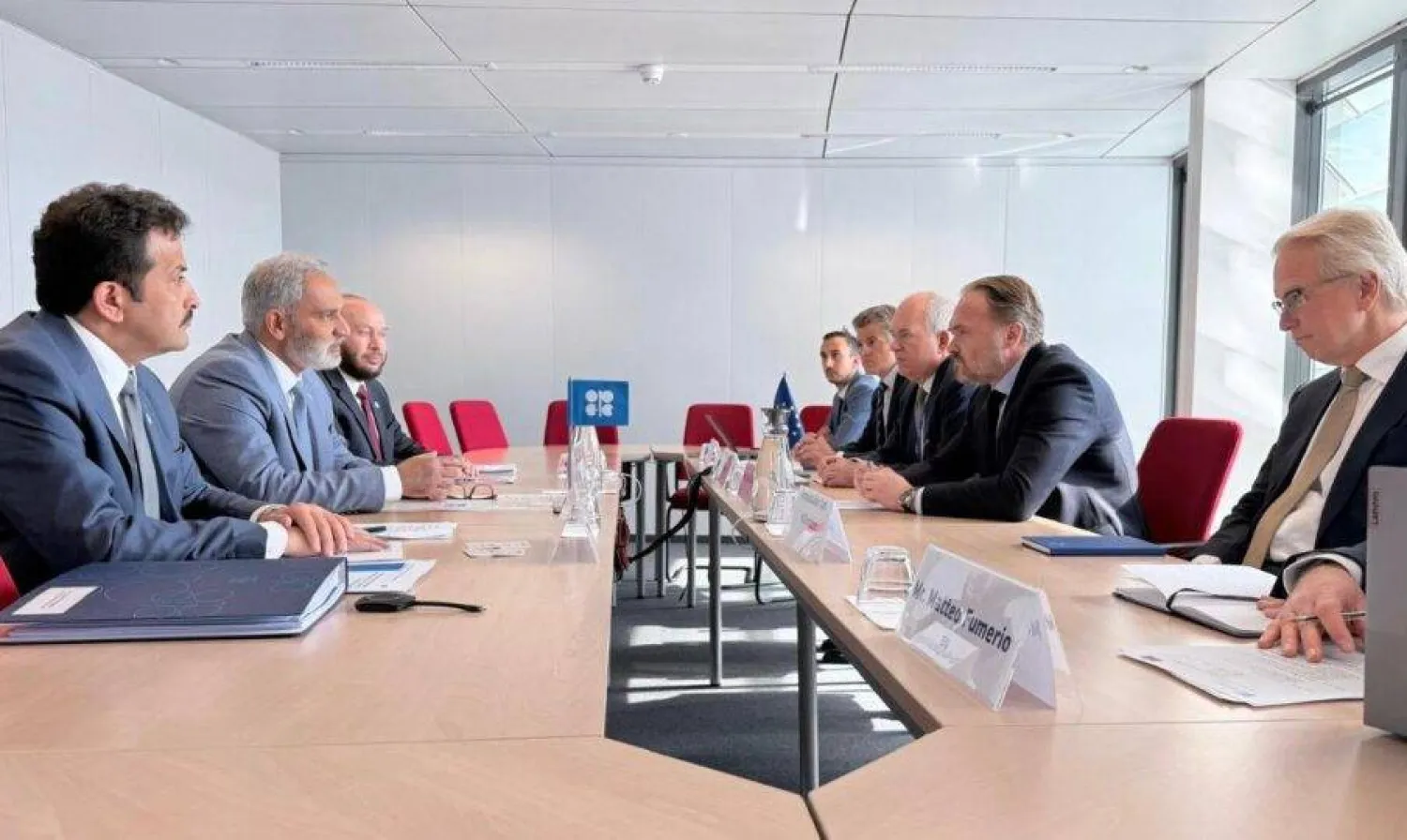
Al Ghais spoke on Thursday at the 16th High-Level Meeting of the Energy Dialogue between OPEC and the EU in Brussels
TT

OPEC Chief Stresses Commitment to Support Market Stability

Al Ghais spoke on Thursday at the 16th High-Level Meeting of the Energy Dialogue between OPEC and the EU in Brussels

OPEC Secretary General Haitham Al Ghais has reiterated the Organization of the Petroleum Exporting Countries’ commitment to support market stability and emphasized the need for long-term investment in all energies to meet expected future demand growth.

Al Ghais spoke on Thursday at the 16th High-Level Meeting of the Energy Dialogue between OPEC and the European Union (EU) at the European Commission Headquarters in Brussels.

The meeting was co-chaired by Al Ghais and European Commissioner for Energy and Housing Dan Jørgensen.

The dialogue was first established in 2005, making it OPEC’s longest-standing dialogue. Since then, the cooperation has included 16 high-level, five technical and numerous bilateral meetings in both Vienna and Brussels, ten joint studies, the co-hosting of numerous workshops and roundtables and the facilitation of valuable exchanges on energy market outlooks.

Al Ghais reflected on the productive collaboration between the two organizations over more than two decades, and emphasized the value of exchanging views on energy issues of common interest.

The importance of the dialogue is evident in a dynamically evolving global environment, which creates challenges for global energy markets and the global economy more broadly, Al Ghais said.

Moreover, he underscored the benefits of dialogue to help navigate market challenges, reiterating OPEC’s commitment to support market stability and emphasizing the need for long-term investment in all energies to meet expected future demand growth.

Discussions focused on the current oil and energy market outlook, including supply and demand dynamics, macroeconomic conditions, the evolving global energy mix and the need for balanced and realistic approaches to future energy pathways. The meeting also highlighted the need for all energies to help deliver energy security and energy availability, and all technologies to help achieve emissions reductions.

OPEC reiterated its commitment to maintaining open and constructive dialogue and to continue strengthening cooperation within the framework of the OPEC-EU Energy Dialogue.

It was agreed that the next High-Level Meeting of the OPEC-EU Energy Dialogue will take place in November 2026 in Vienna.


World Bank Sees Saudi Budget Deficit Halving, Current Account Surplus of 3.3% in 2026

 Riyadh, Saudi Arabia (Reuters)
Riyadh, Saudi Arabia (Reuters)
TT

World Bank Sees Saudi Budget Deficit Halving, Current Account Surplus of 3.3% in 2026

 Riyadh, Saudi Arabia (Reuters)
Riyadh, Saudi Arabia (Reuters)

As regional economies reel from a complex and uncertain geopolitical landscape, with shipping disruptions through the Strait of Hormuz adding pressure, the latest World Bank report points to standout resilience in Saudi Arabia’s economy.

The data show the kingdom on a fiscal consolidation path to strengthen its fiscal position, with the budget deficit set to halve and the current account shifting from deficit to surplus.

April data from the World Bank indicate Saudi Arabia has not only built solid “economic buffers,” but is also leveraging geopolitical pressures to advance structural reforms.

While much of the region faces sharp fiscal strain and negative growth, the kingdom is moving steadily ahead, recording the strongest growth among regional peers and reinforcing its role as a pillar of regional stability.

Despite broad downward revisions, Saudi Arabia remains the region’s top performer. Growth forecasts for the wider region have been cut to 1.8%, while the kingdom is expected to expand by 3.1%.

Current account shifts to a 3.3% surplus

World Bank data point to a shift in Saudi Arabia’s current account. After a projected deficit of 2.7% of GDP in 2025, forecasts for 2026 point to a surplus of 3.3%.

A current account surplus means exports of goods and services exceed imports, strengthening the balance of payments. It also reflects rising net foreign assets and stronger financing capacity, supported by solid export performance and moderate domestic demand.

The shift carries broader weight. Moving from deficit to surplus positions, Saudi Arabia becomes a net lender to the global economy, with oil export revenues, fast-growing non-oil sectors, and returns on foreign investments outpacing spending on imports and services.

Beyond the headline figures, the surplus acts as an external buffer, supporting currency stability and generating strong liquidity flows. This gives financial institutions and sovereign funds greater room to sustain investment in major development projects, while helping shield the economy from disruptions in global supply chains and shipping routes.

Deficit set to halve

Fiscal data show improved expenditure control and revenue growth. The World Bank expects the deficit to narrow from 6.4% of GDP in 2025 to 3.0% in 2026, below the Finance Ministry’s estimate of 3.3%.

The shift reflects tighter fiscal discipline. Despite the cost of regional tensions, the gap between revenue and spending is set to shrink by half in one year.

This reflects effective fiscal policy, including stronger tax collection and public financial management, rising non-oil revenues that reduce reliance on energy price swings, and more efficient public spending focused on high-impact development projects, limiting the need for external borrowing and supporting long-term fiscal balance.

Saudi Arabia leads per capita growth

The April 2026 report also shows a sharp divergence in per capita growth across the region. While countries such as Kuwait (-7.7%) and Qatar (-7.4%) face steep contractions, Saudi Arabia stands out with an expected per capita growth rate of 1.4%.

Inflation remains contained at 2.8%, helping preserve purchasing power despite global increases in energy and shipping costs driven by maritime disruptions. This stability protects the broader economy from imported inflation pressures.