


Syria Nears Correspondent Bank Account Deal with Türkiye, Mulls Currency Swap

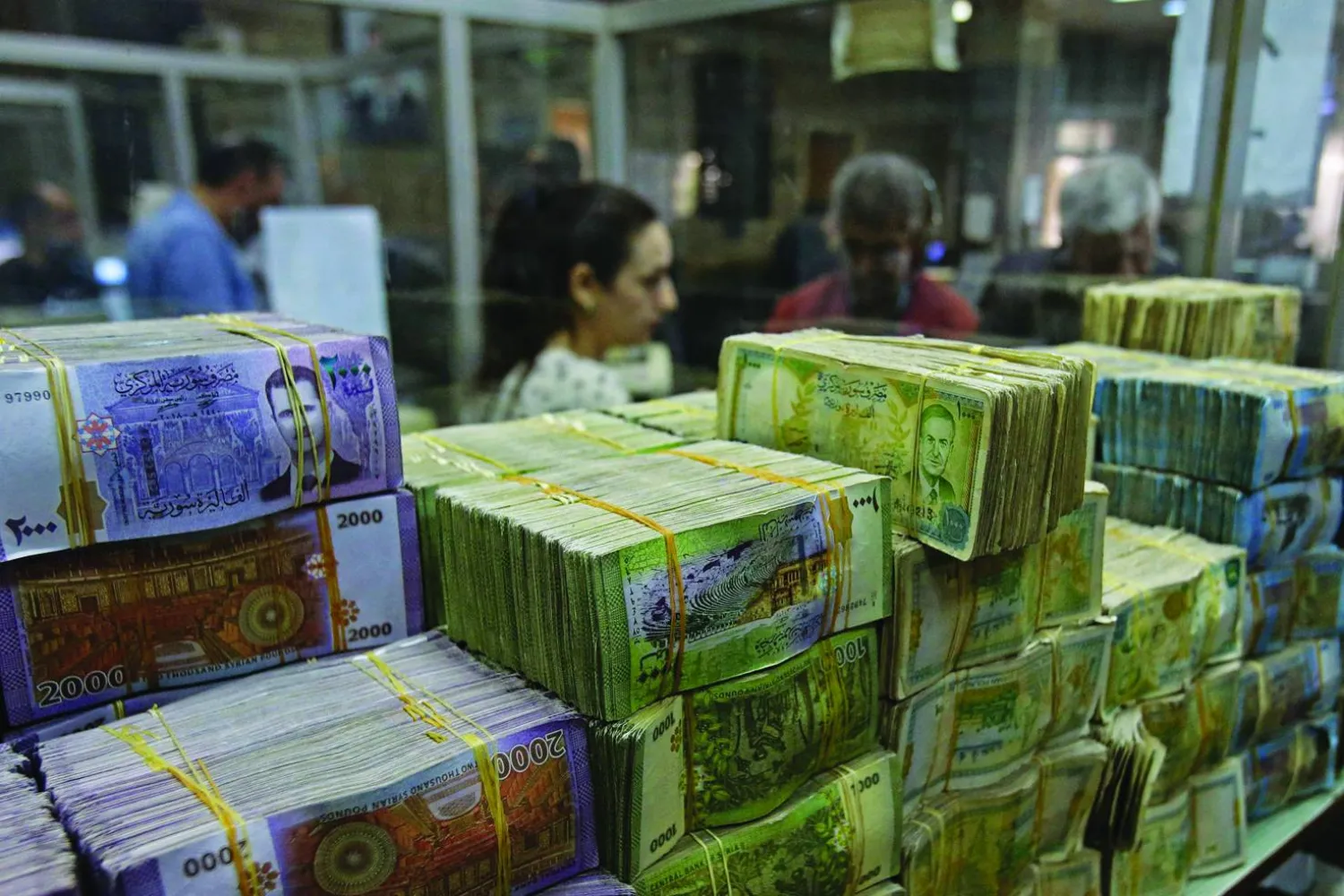
This picture shows stacks of Syrian lira banknotes at the Commercial Bank of Syria in Damascus, on November 10, 2022. (Photo by LOUAI BESHARA / AFP)
TT

Syria Nears Correspondent Bank Account Deal with Türkiye, Mulls Currency Swap

This picture shows stacks of Syrian lira banknotes at the Commercial Bank of Syria in Damascus, on November 10, 2022. (Photo by LOUAI BESHARA / AFP)

Syria ‌is in the final stages of establishing a correspondent bank account with neighboring Türkiye's central bank and will also discuss a potential currency swap aimed at boosting trade, the Syrian central bank chief said.

Türkiye has been the main backer of the Syrian government of President Ahmed al-Sharaa since the ousting of Bashar al-Assad in late 2024. Al-Sharaa has been seeking to rebuild state institutions and the ‌economy after ‌more than a decade of war, sanctions ‌and ⁠financial isolation, Reuters said.

Trade between ⁠the two countries has surged but businesses say the lack of a cross-border payments system was one of the biggest impediments to further growth and investment. A correspondent bank account would help to facilitate cross-border payments and trade finance transactions ⁠which traders say are currently cash only ‌and handled by traditional ‌money transfer offices.

In written responses to Reuters questions, Syria's ‌central bank Governor AbdulKader AlHussrieh said he expected Syrian-Turkish ‌cooperation to expand "into integrated payment systems, cross-border settlements, and more structured trade finance frameworks".

"Cooperation with Türkiye, particularly between the Central Bank of Syria and Turkish authorities, is accelerating ‌and becoming increasingly institutionalized," said AlHussrieh, who was on a two-day working visit to ⁠ Türkiye ⁠this week.

Turkish state lender Ziraat Bank and smaller private Aktif Bank were also expected to begin Syrian operations "in the near term", he said.

Türkiye 's exports to Syria jumped following Assad's ouster by 60% to $3.5 billion last year, official data show, while Syria's imports were at $235 million. The countries aim to almost triple trade volume to $10 billion over the medium term.

"This ambition will require a fully functioning financial system in Syria, supported by strong correspondent banking relationships," AlHussrieh said.

Gold Set for Third Weekly Gain as US Rate Outlook Offsets Dollar Strength

FILE PHOTO: Customers crowd around a jewelry showroom during Akshaya Tritiya, a major gold-buying festival, in Kochi, India April 28, 2017. REUTERS/Sivaram V/File Photo
TT

Gold Set for Third Weekly Gain as US Rate Outlook Offsets Dollar Strength

FILE PHOTO: Customers crowd around a jewelry showroom during Akshaya Tritiya, a major gold-buying festival, in Kochi, India April 28, 2017. REUTERS/Sivaram V/File Photo

Gold steadied on Friday as US-Iran ceasefire uncertainty lingered, but the metal stayed on course for a third consecutive weekly climb as investors priced in earlier and deeper US rate cuts, supporting non-yielding bullion.

Spot gold held its ground at $4,764.54 per ounce by 0532 GMT. The metal, however, has gained 1.8% so far this week.

US gold futures for June delivery fell 0.6% to $4,787.80.

The ‌dollar index strengthened, ‌making greenback-priced bullion more expensive for holders of other currencies, Reuters said.

"There's ‌a ⁠lack of clarity ⁠about the way that the ceasefire is evolving in the Middle East and what that means to energy markets... so we're in sort of a little bit of a holding pattern (with gold) going into the final session of the week," said Kyle Rodda, senior financial market analyst at Capital.com.

Spot gold has fallen about 10% since the US-Israel conflict with Iran ⁠erupted on February 28, with elevated energy prices sparking ‌inflation concerns and the prospect of ‌higher US interest rates.

The fragile two-week ceasefire between the US and Iran showed further ‌strain on Friday, as Washington accused Tehran of breaching promises on ‌the Strait of Hormuz.

Brent crude, however, has slid more than 11% this week on optimism that the ceasefire could reopen the Strait of Hormuz, through which about 20% of the world's oil and liquefied natural gas passes.

"If things break down, (gold) ‌could end up back in mid-$4,000's pretty quickly. But if the ceasefire holds and the peace deal starts ⁠to look more ⁠likely, then we could push through $5,000," Rodda added.

On the data front, the US Personal Consumption Expenditures index, the Federal Reserve's preferred inflation gauge, advanced 2.8% in the 12 months through February, in line with estimates, and likely rose further in March.

Investors are now looking out for March's US Consumer Price Index data, due later in the day, for further clues on Fed's monetary policy direction.

Markets are pricing in a 31% chance for a US rate cut of at least 25 basis points at the Fed's December meeting, according to CME's FedWatch Tool, up from 20% in the prior session.

Among other metals, spot silver rose 1.3% to $76.03 per ounce, platinum lost 2% to $2,061.10, and palladium fell 0.2% to $1,553.92.


Saudi Business Confidence Index Remains Optimistic

A street in the Saudi capital, Riyadh (Reuters)
TT

Saudi Business Confidence Index Remains Optimistic

A street in the Saudi capital, Riyadh (Reuters)

Saudi Arabia’s Business Confidence Index remained in optimistic territory at 52.1 points in March, underscoring private sector resilience despite geopolitical challenges.

The index fell from 60.7 in February but stayed above the neutral 50 threshold, reflecting continued confidence in stable economic activity and sustained growth across key sectors, according to the General Authority for Statistics (GASTAT).

A statement released by GASTAT said that the BCI for the industrial sector recorded 50.8 points, maintaining an optimistic level despite a decline of 15.8 percent compared to February.

The BCI for the services sector recorded 52.0 points, maintaining an optimistic level despite a decline of 14.9 percent compared to February, it said.

Regarding the BCI in the construction sector, the data revealed that in March, it recorded an optimistic level at 53 points, confirming the continued positive confidence among establishments in the sector, the statement added.


OPEC Chief Stresses Commitment to Support Market Stability

Al Ghais spoke on Thursday at the 16th High-Level Meeting of the Energy Dialogue between OPEC and the EU in Brussels
TT

OPEC Chief Stresses Commitment to Support Market Stability

Al Ghais spoke on Thursday at the 16th High-Level Meeting of the Energy Dialogue between OPEC and the EU in Brussels

OPEC Secretary General Haitham Al Ghais has reiterated the Organization of the Petroleum Exporting Countries’ commitment to support market stability and emphasized the need for long-term investment in all energies to meet expected future demand growth.

Al Ghais spoke on Thursday at the 16th High-Level Meeting of the Energy Dialogue between OPEC and the European Union (EU) at the European Commission Headquarters in Brussels.

The meeting was co-chaired by Al Ghais and European Commissioner for Energy and Housing Dan Jørgensen.

The dialogue was first established in 2005, making it OPEC’s longest-standing dialogue. Since then, the cooperation has included 16 high-level, five technical and numerous bilateral meetings in both Vienna and Brussels, ten joint studies, the co-hosting of numerous workshops and roundtables and the facilitation of valuable exchanges on energy market outlooks.

Al Ghais reflected on the productive collaboration between the two organizations over more than two decades, and emphasized the value of exchanging views on energy issues of common interest.

The importance of the dialogue is evident in a dynamically evolving global environment, which creates challenges for global energy markets and the global economy more broadly, Al Ghais said.

Moreover, he underscored the benefits of dialogue to help navigate market challenges, reiterating OPEC’s commitment to support market stability and emphasizing the need for long-term investment in all energies to meet expected future demand growth.

Discussions focused on the current oil and energy market outlook, including supply and demand dynamics, macroeconomic conditions, the evolving global energy mix and the need for balanced and realistic approaches to future energy pathways. The meeting also highlighted the need for all energies to help deliver energy security and energy availability, and all technologies to help achieve emissions reductions.

OPEC reiterated its commitment to maintaining open and constructive dialogue and to continue strengthening cooperation within the framework of the OPEC-EU Energy Dialogue.

It was agreed that the next High-Level Meeting of the OPEC-EU Energy Dialogue will take place in November 2026 in Vienna.
