

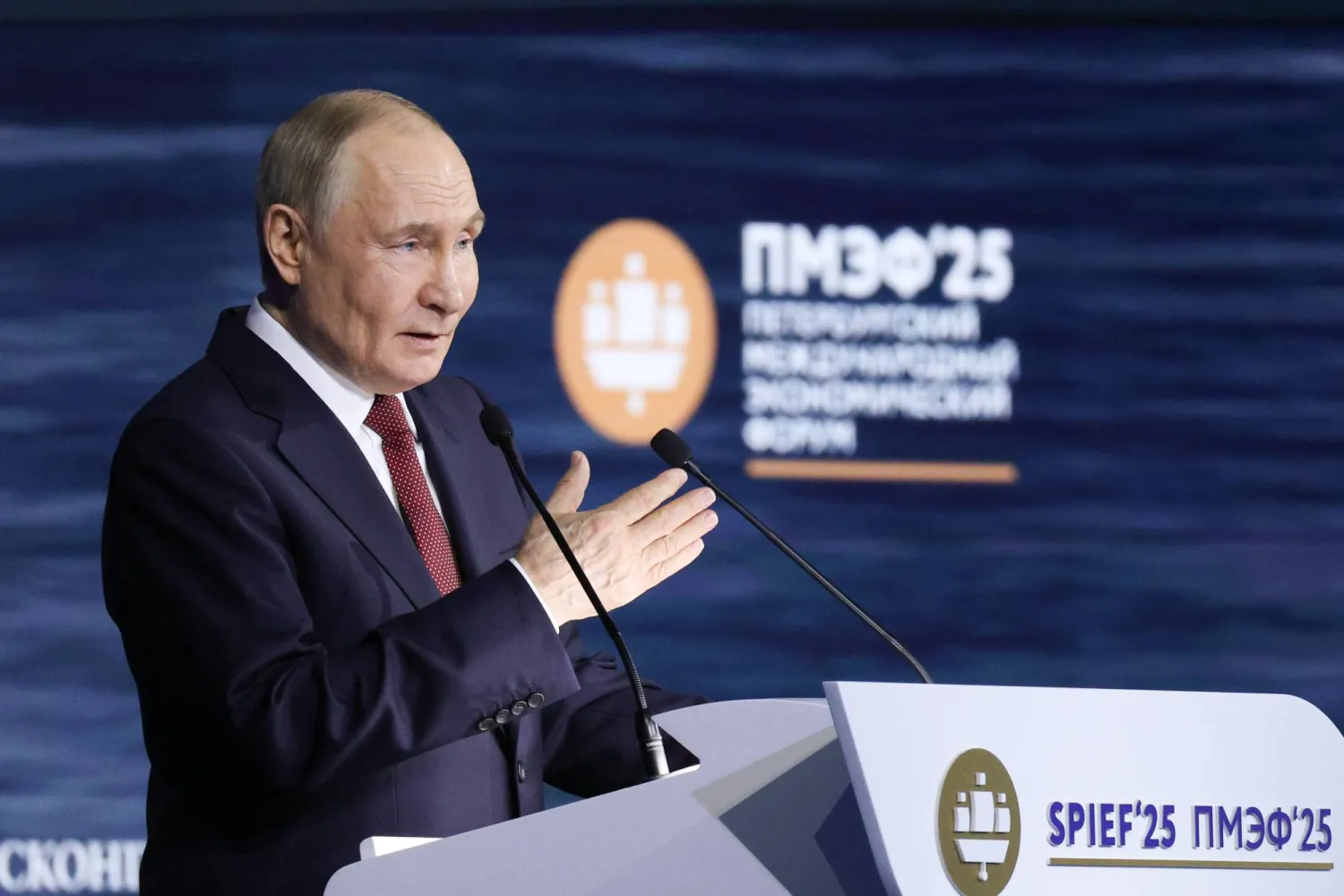

Putin: Russia Remains Integral Part of Global Economic System

Russian President Vladimir Putin speaks at last year’s St Petersburg International Economic Forum (SPIEF)
TT

Putin: Russia Remains Integral Part of Global Economic System

Russian President Vladimir Putin speaks at last year’s St Petersburg International Economic Forum (SPIEF)

Russian President Vladimir Putin on Monday conveyed a strong message to international investors, saying Russia has been and remains an integral part of the global economic system.

Putin’s comments came as his country prepares to host the 29th St Petersburg International Economic Forum (SPIEF), scheduled to convene from June 3 to 6.

The forum will bring together the chief executives of major Russian and international companies, heads of state, political leaders, and prime ministers with Saudi Arabia serving as the guest country for this year’s edition.

“I am confident that your traditionally substantive and results-oriented discussions will help develop new and effective solutions in all areas of economic and social life, including energy, digitalization, food security and human capital development, as well as the strengthening of financial and trade sovereignty,” Putin said in a message to participants, organizers, and guests of SPIEF.

He noted that those efforts “will serve the interests of our states and peoples and contribute to international cooperation, security and stability,” according to Russia’s RT channel.

For his part, Anton Kobyakov, adviser to Putin and Executive Secretary of the SPIEF Organizing Committee, said amid today’s global economic fragmentation, managing sovereign self-development and boosting domestic supply chains are critical national priorities.

He said the forum serves as a premier venue to forge solutions for sustainable development, international cooperation, and restructuring global financial and macroeconomic system.

High-Ranking Saudi Attendance

Saudi Arabia will be the guest country of SPIEF 2026. The Kingdom’s attendance reflects the depth of strategic and economic relations between Riyadh and Moscow and opens new horizons for joint cooperation.

Three Saudi ministers will participate in the forum, according to a document from the Federation of Saudi Chambers of Commerce.

“Among the high-ranking members of the Saudi delegation are Energy Minister Prince Abdulaziz bin Salman Al Saud, Industry Minister Bandar Al-Khorayef, and Investment Minister Fahad Al-Saif,” the document said.

It added that Sultan al-Musallam, Secretary General of the Federation of Saudi Chambers, and Tariq al-Qahtani, head of the Russian-Saudi Business Council, are attending to represent the Kingdom's private sector.

According to the delegation's schedule, the opening day will witness a Saudi-Russian Joint Business Council. The next day, a high-level meeting will be held between the Saudi Energy Minister and Russian Deputy Prime Minister Alexander Novak.

The volume of trade between Saudi Arabia and Russia reached $3.3 billion in 2025 (Russian exports accounted for 98%).

The volume of Russian investments in the Kingdom more than tripled from 2020 to 2024, reaching 332 million riyals per year (about $92 million).

US Surprise

In a notable shift reflecting a renewed cautious American business interest in Russian markets, a US administration-linked official will attend Russia’s St. Petersburg International Economic Forum for the first time since Washington severed ties with Moscow due to the war in Ukraine.

Rodney Mims Cook, head of the US federal Commission of Fine Arts, said he has been invited to attend the plenary session and Russian Putin’s address at the forum.

“The organizing committee of the forum and the US State Department confirmed that I am invited, and I will be present,” Cook said.

Cook, who was appointed head of the Commission of Fine Arts in January, is also the founder of the US National Monument Foundation and a specialist affiliated with the World Monuments Fund.

Robert Agee, president of the American Chamber of Commerce in Russia, said more US companies are expected to attend this year compared to recent editions, but numbers remain significantly lower than before Russia’s full-scale invasion of Ukraine.

“We will have a commercial dialogue between Russia and America,” Agee said, adding that US businesses are still approaching Russia “with caution” to avoid legal and political risks linked to the sanctions.

He also noted efforts to “rebuild cultural ties” between the two countries through business and dialogue.



IEA: Not Discussing 2nd Release of Strategic Oil Reserves

Strategic oil reserve tanks in Texas (Reuters)
TT

IEA: Not Discussing 2nd Release of Strategic Oil Reserves

Strategic oil reserve tanks in Texas (Reuters)

The International Energy Agency is not discussing a second release of strategic oil reserves at this time, IEA chief Fatih Birol told Reuters on Monday.

"Not for the time being," Birol said on the sidelines of an energy conference in Norway ⁠when asked whether ⁠the agency was discussing a second release of strategic reserves.

The IEA is always following the markets "very, very closely", and 80% of strategic reserves remain ⁠after a 400 million-barrel release in March, Birol added.

On gas, Birol expressed concerns Europe's current levels of gas reserves, which are around 62% according to transparency platform AGSI.

The European Union has a target of filling levels to 80% by December 1.

"The stocks are ⁠lower ⁠than historical averages, and we are still hoping to get gas from the Middle East, and at the same time ... Europe has committed itself to nullify the Russian gas imports," he said.

"If we have a harsh winter in Europe, we may have some challenges."


Fewer Than 20 Ships Transited Strait of Hormuz at the Start of the Week

Vessels near the Strait of Hormuz, as seen from Musandam, Oman, August 24, 2026. REUTERS/Stringer
TT

Fewer Than 20 Ships Transited Strait of Hormuz at the Start of the Week

Vessels near the Strait of Hormuz, as seen from Musandam, Oman, August 24, 2026. REUTERS/Stringer

Fewer than 20 commodity vessels transited the Strait of Hormuz at the start of the week, shipping data showed on Monday, as Iranian and US blockades restrict traffic through the chokepoint for energy shipments.

Four vessels crossed the strait on Sunday, initial data from shiptracker Kpler showed by 0228 GMT, with 13 on Saturday. The figures could change as some ships had switched off transponders on their way through.

That compared with Friday's figure of 16 transits, with two empty very large crude carriers (VLCCs) entering the Gulf with the tracking devices switched off, one heading to Iraq and the other to ⁠Bahrain, the data ⁠showed.

A VLCC carrying 2 million barrels of Emirati crude exited the strait on Thursday.

Eight very large gas carriers transited the strait over the past three days, the data showed, according to Reuters, six of them entering empty while the others carried liquefied petroleum gas (LPG) loaded from Iran and exited the Gulf.

Overall traffic volumes remained suppressed ⁠in the week to August 21, as vessels aborted transit plans or switched routes through the strait's north after attacks, the United Kingdom Maritime Trade Operations (UKMTO) agency said in a report.

A total of 89 vessels exited the strait while 103 entered over the seven-day period, the report, based on Automatic Identification System (AIS) data, showed.

"Traffic remains well below normal levels, with AIS-detected transits approximately 90% below pre-conflict baselines and declining since the June 24 to June 26 peak," it added.

Tanker traffic, at 45% of the total, continued ⁠to dominate movement ⁠through the strait, the agency said. Of these, 56% were tankers that carry crude oil, oil products or chemicals while LPG carriers accounted for a further 24%.

Since July 6, the UKMTO has reported 23 incidents of projectile strikes, leading to bridge, engine-room, and structural damage across vessels in the strait and its vicinity.

A total of 24 commodity vessels sailed through the Bab el-Mandeb strait on Sunday, down from Saturday's figure of 32, which was an increase from 22 on Friday, Kpler data showed.

Two VLCCs entered the Red Sea on Saturday with one carrying Iraqi Basrah crude and the other empty, it showed.


Oil Falls as Trump Pledges Economic War on Iran

LOS ANGELES, CALIFORNIA - AUGUST 21: Diesel prices over $7 a gallon are displayed on a pump at a gas station on August 21, 2026 in Los Angeles, California. Justin Sullivan/Getty Images/AFP
TT

Oil Falls as Trump Pledges Economic War on Iran

LOS ANGELES, CALIFORNIA - AUGUST 21: Diesel prices over $7 a gallon are displayed on a pump at a gas station on August 21, 2026 in Los Angeles, California. Justin Sullivan/Getty Images/AFP

Oil prices fell on Monday as investors braced for details of a US plan to isolate the Iranian economy that President Donald Trump billed as the "most crushing" financial operation ever against Tehran.

Asian stocks were mostly down, with South Korea's tech-rich Kospi falling more than three percent after Samsung Electronics said it spent $80 billion to buy back its own shares following weeks of turbulent trading.

The chip giant's shares, along with those of rival SK hynix, peaked in June on optimism for the artificial intelligence boom, but have since fallen amid investor jitters and a broader tech rout.

In an important week for AI, investors are also looking towards an earnings report from Nvidia, the world's most valuable company and a bellwether for the sector.

The recurring question for the US chipmaker is whether the AI boom will continue to accelerate as the technology takes over more corners of the broader economy.

"The spending machine is still running, but the bill is getting heavier," said Stephen Innes of SPI Asset Management.

"Nvidia must now show that the most expensive investment boom in modern market history can still pay its bills."

Chinese tech giant Alibaba is keeping focus on the sector after announcing on Sunday that it plans to issue $10.2 billion in new shares in Hong Kong to fund its global AI ambitions.

The firm, known for its open-source "Qwen" AI models, has been ploughing tens of billions of dollars into the technology, with shareholders eager to see how it will monetize the huge investments.

Tokyo and Shanghai closed down 0.7 percent and 0.6 percent respectively, echoing losses across Asia that included Taipei, Wellington, Bangkok, Mumbai and Jakarta. Sydney, Singapore, Manila and Kuala Lumpur posted marginal gains.

Hong Kong was down nearly two percent despite fast-fashion giant Shein announcing its market debut will take place in the Chinese financial hub on September 1.

The long-awaited listing would value the group -- known for its vast selection of products at stunningly low prices -- at close to $27 billion.

London was flat at the open, while Paris and Frankfurt were down 0.2 percent.

Eyes are also on US Treasury boss Scott Bessent, who said he would give more details in a news conference on Monday on a fresh push to pile economic pressure on Iran.

The United States warned allies and China on Thursday to join Trump's new campaign, which comes as the unpopular war in the Middle East drags toward the six-month mark.

US Vice President JD Vance acknowledged the plan was a "delicate dance" because Iran will "try to apply economic pressure to us".

Asked whether the United States would pressure China, Bessent told CNBC that "many conversations are best to have in private", but he also called on Beijing "to get with the program".

Both main crude contracts were down around two percent, with the Brent benchmark sitting at $92 a barrel, AFP reported.

Traders will also be watching this week's annual gathering of central bankers, economists and finance chiefs in Jackson Hole in the United States, hoping for some clarification on US monetary policy.

The meeting comes after the Treasury bought its own bonds last week in an effort to push down borrowing costs after the 30-year yield surged to levels last seen in 2007, just before the global financial crisis.

Yields have risen on inflation fears and as the United States reported that its federal debt had topped $40 trillion.