


Trump Axes Chevron’s Venezuela Oil License, Citing Lack of Electoral Reforms 

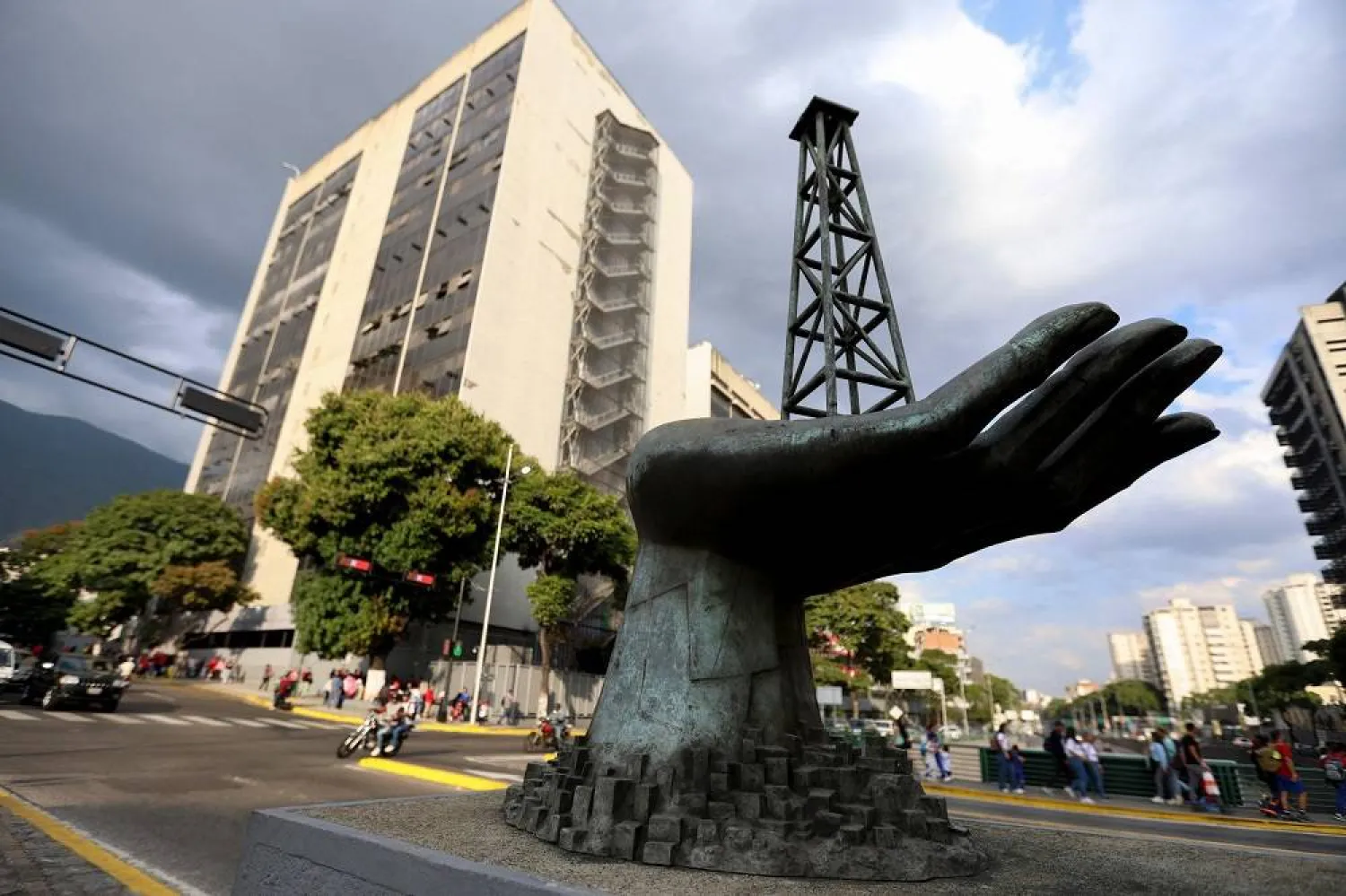
A sculpture of a hand holding an oil drilling rig is pictured outside the state-run oil company Petroleos de Venezuela S.A. (PDVSA) in Caracas on February 26, 2025. (AFP)
TT

Trump Axes Chevron’s Venezuela Oil License, Citing Lack of Electoral Reforms 

A sculpture of a hand holding an oil drilling rig is pictured outside the state-run oil company Petroleos de Venezuela S.A. (PDVSA) in Caracas on February 26, 2025. (AFP)

US President Donald Trump on Wednesday said he was reversing a license given to Chevron to operate in Venezuela by his predecessor Joe Biden more than two years ago, accusing President Nicolas Maduro of not making progress on electoral reforms and migrant returns.

In a post on Truth Social, Trump said he was "reversing the concessions" of the "oil transaction agreement, dated November 26, 2022."

Trump did not name Chevron in his comments, but Washington granted Chevron a license to operate in Venezuela's oil sector on November 26, 2022. It was the only license the administration issued for Venezuela that day.

"The US government has made a damaging and inexplicable decision by announcing sanctions against the US company Chevron," Venezuelan Vice President Delcy Rodriguez said in a statement posted on Telegram.

She said "these kinds of failed decisions" had prompted migration out of Venezuela.

The White House did not immediately respond to requests for further detail on Trump's comments.

US Secretary of State Marco Rubio later said on X he will provide foreign policy guidance to terminate all Biden-era oil and gas licenses "that have shamefully bankrolled the illegitimate Maduro regime."

It was not immediately clear which, if any, other companies that would affect, but the US State and Treasury Departments have granted a number of licenses and authorizations in recent years, including to foreign firms.

Chevron said it was aware of Trump's post and was considering its implications.

Chevron exports about 240,000 barrels per day of crude from its Venezuela operations, over a quarter of the country's entire oil output.

Ending the license means Chevron will no longer be able to export Venezuelan crude. And if Venezuela's state oil company PDVSA exports oil previously exported by Chevron, US refineries will be unable to buy it due to US sanctions.

Since his return to office in January, Trump has repeatedly said the US does not need Venezuelan oil and left open the possibility of revoking Chevron's operating license.

During his first term, Trump pursued a "maximum pressure" sanctions policy against Maduro's government, especially targeting Venezuela's energy business.

After initially easing sanctions to encourage fair and democratic elections, Biden in April reinstated broad oil sanctions, saying Maduro failed to keep his electoral promises. But Biden had left the Chevron license intact, along with US authorizations granted to several other foreign oil companies.

Tax and royalty payments resulting from Chevron's license have provided a steady source of revenue to Maduro's administration since early 2023, a source familiar with Venezuela's oil industry said. The money has lifted Venezuela's economy, especially its oil-and-banking sectors, which expanded last year.

The government take from oil activities covered by all US licenses, to Chevron and a handful of European companies, is estimated between $2.1 billion and $3.2 billion annually, only considering royalties and taxes, said Jose Ignacio Hernandez from consultancy Aurora Macro Strategies.

US Energy Secretary Chris Wright said on Wednesday after Trump's comments that the US is the world's largest oil producer and "small interruptions from other nations" will not affect global supply.

ELECTORAL CONDITIONS 'NOT BEEN MET'

In early February, Trump said Caracas had agreed to receive all Venezuelan migrants in the United States illegally and provide for their transportation back.

That came a day after US envoy Richard Grenell met with Maduro in Caracas and brought six US detainees back.

Trump said in Wednesday's post Maduro had not met "electoral conditions" and that he was not transporting Venezuelans back to the United States at a pace that had been agreed to.

Trump did not detail what he meant by "electoral conditions." Maduro's last two election wins were both disputed by Washington, with Venezuela's opposition saying it won the July 2024 presidential election by a landslide, an assertion backed by the US and other Western countries.

The cancellation of the license proves Trump is on the side of Venezuelans, opposition leader Maria Corina Machado told Trump's son Donald Trump Jr. during an interview on the latter's video and podcast interview show.

"What you just mentioned is proof for me that President Trump is on the side of the Venezuelan people, of democracy, and prosperity of the US and for Venezuela as well," Machado said, adding the question from Trump Jr. was the first she had heard of his father's decision. "This is exactly the path ahead."

The oil concession agreement would be terminated as of the March 1 option to renew, Trump said.

It was not immediately clear what would happen with cargoes of Venezuelan crude currently navigating to US ports or about to depart from Venezuela through the end of the month.

Maduro and his government have always rejected sanctions by the United States and others, saying they are illegitimate measures that amount to an "economic war" designed to cripple Venezuela.

Maduro and his allies have cheered what they say is the country's resilience despite the measures, though they have historically blamed some economic hardships and shortages on sanctions.

When the license was first issued, Chevron was owed about $3 billion by Venezuela. According to the company's debt recovery plan, explained by sources, by the end of 2024 it should have recouped some $1.7 billion as oil output approached an average of 200,000 barrels per day as expected.

Chevron's automatically renewing license allowed it to expand crude output at joint ventures with PDVSA and send some 240,000 bpd to its own refineries and other customers.

Chevron said earlier in February it will lay off up to 20% of its global staff by the end of 2026 as part of an effort to cut costs and simplify the business. Chevron told its employees the company was falling behind competitors and struggled to quickly make decisions.



EU to Vote on Trump Tariff Deal -- but Eyes Rest of World

The European Parliament will vote on whether to cut EU tariffs on some US imports. CHARLY TRIBALLEAU / AFP/File
TT

EU to Vote on Trump Tariff Deal -- but Eyes Rest of World

The European Parliament will vote on whether to cut EU tariffs on some US imports. CHARLY TRIBALLEAU / AFP/File

European Union lawmakers are on track to give a green light -- with conditions -- Thursday to the bloc's tariff deal with US President Donald Trump, which Europe hopes to salvage while also racing to diversify its trade ties around the globe.

Brussels and Washington clinched the deal last summer that had set tariffs at 15 percent for most EU goods.

But Trump's 2025 tariff blitz, including hefty levies on steel, aluminium and car parts, has jolted the 27-country bloc into cultivating trade ties around the world.

From deals signed with South America to Australia, the EU has its eyes on many prizes.

But that doesn't mean the EU intends to walk away from the 1.6 trillion euro ($1.9 trillion) relationship with its main trade partner, the United States, AFP reported.

The European Parliament is voting Thursday on whether to cut EU tariffs on some US imports -- as a first step towards implementing the 2025 deal -- but with additional safeguards.

The potential green light comes after months of delay as lawmakers resisted approving the accord due to transatlantic tensions over Greenland -- and then put it on hold again following the US Supreme Court's ruling striking down Trump's levies.

The ball started rolling again after the European Commission, in charge of EU trade policy, said it would stick to the pact despite the US ruling and called on lawmakers to do the same, having received reassurances from Washington.

Trump, however, retaliated after the ruling with a new tariff regime -- pushing EU lawmakers to tighten the existing agreement with numerous safeguards.

- Losing access to US energy? -

Lawmakers leading on trade have added several provisions: making an EU tariff reduction automatically lapse in March 2028, and tying tariff cuts on steel and aluminium goods to similar reductions by the US side.

Not all members of the parliament are convinced. French EU lawmakers from the centrist Renew group have said they will vote against the agreement.

"The only political value this agreement had to offer was stability and predictability, even if many say it's an unfair deal. If it no longer even provides predictability, there's no reason to support the deal, even if it has been improved," said MEP Pascal Canfin.

The United States has urged the bloc to implement the agreement.

Washington's ambassador to the EU Andrew Puzder told the Financial Times that if the bloc delayed further, it risked losing "favorable" access to US liquefied natural gas at a time when the Middle East war has led to surging energy costs.

Before the US tariff deal is implemented by the bloc, it still needs to be negotiated with EU member states -- although Brussels hopes talks will go quickly.

- 'Trump factor' -

It is the EU's vulnerability to the consequences of wars and other shocks that has pushed Commission chief Ursula von der Leyen to make diversifying trading partners a priority, to cut overdependence on the United States and China.

The frenzy began with a long-awaited accord signed with the South American Mercosur bloc in January. Weeks later, Brussels struck another pact with India and just this week clinched a stalled deal with Australia.

"The Trump factor sped up their conclusion, for us as well as for our partners," economist Andre Sapir said.

Spurred by Trump, Sapir said, the EU has been pushing to create the world's largest network of free trade areas -- a strategy with a "defensive dimension" allowing it to resist trade "coercion".

"This free trade network carries weight in our discussions with the two giants, the United States and China," he said.

"These agreements are part of our arsenal," Sapir, of the Bruegel think tank, added. "Our strategic weapons in the international order."


China Shipping Giant Cosco Resumes Bookings to Some Gulf Countries

A cargo ship operated by Cosco Shipping is docked at the foreign trade container terminal of Qingdao Port, operated by Shandong Port Group, in China's eastern Shandong province on March 25, 2026. (Photo by CN-STR / AFP)
TT

China Shipping Giant Cosco Resumes Bookings to Some Gulf Countries

A cargo ship operated by Cosco Shipping is docked at the foreign trade container terminal of Qingdao Port, operated by Shandong Port Group, in China's eastern Shandong province on March 25, 2026. (Photo by CN-STR / AFP)

Chinese shipping giant Cosco said on Wednesday that it was resuming new bookings for container shipments to some Gulf countries, after a three-week suspension in response to the Middle East war.

The state-owned, Shanghai-based firm was among several major shipping groups to pause operations in the Strait of Hormuz, a key waterway through which one-fifth of the world's oil and gas passes normally.

Tehran has said several times it was not targeting friendly nations, but transits through the Strait had nevertheless largely ground to a halt.

Iran said in a statement circulated by the International Maritime Organization on Tuesday that "non-hostile vessels" would be granted safe passage through the waterway.

Cosco "resumed new bookings for general cargo containers for shipments" from the "Far East" to the UAE, Saudi Arabia, Bahrain, Qatar, Kuwait, and Iraq "with immediate effect", according to a company statement.

It did not mention shipments travelling in the opposite direction, from the Gulf.

"New booking arrangements and the actual carriage are subject to change due to the volatile situation in the Middle East region," it added.

Cosco, which operates one of the world's largest oil tanker fleets, announced on March 4 that it would suspend new bookings for services for routes through the Strait of Hormuz owing to the "escalating conflicts in the Middle East region and resultant restrictions on maritime traffic".


Qatar Emir Makes Minor Changes to QIA Board

People visit a mall in Doha on March 23, 2026. (Photo by AFP)
TT

Qatar Emir Makes Minor Changes to QIA Board

People visit a mall in Doha on March 23, 2026. (Photo by AFP)

Qatar's Emir Sheikh Tamim bin Hamad Al Thani issued a decree on Wednesday ⁠making minor changes to ⁠the board of the ⁠Qatar Investment Authority, while keeping Sheikh Bandar bin Mohammed bin Saud Al Thani as chairman and Sheikh ⁠Mohammed ⁠bin Hamad bin Khalifa Al Thani as deputy chairman.

The decision stipulated that QIA’s Board of Directors would be restructured as follows: Sheikh Bandar bin Mohammed bin Saud Al Thani as Chairman, Sheikh Mohammed bin Hamad bin Khalifa Al Thani as Deputy Chairman, Ali bin Ahmed Al Kuwari as a member, Saad bin Sherida Al Kaabi as a member, Sheikh Faisal bin Thani bin Faisal Al-Thani as a member, Nasser bin Ghanim Al Khelaifi as a member, and Hassan bin Abdullah Al Thawadi as a member.

The decision is effective starting from its date of issue and is to be published in the official gazette.