


US Energy Secretary Says Riyadh and Washington to Sign Civil Nuclear Agreement

He told Asharq Al-Awsat that the tariffs aim to return jobs to the US and encourage investment

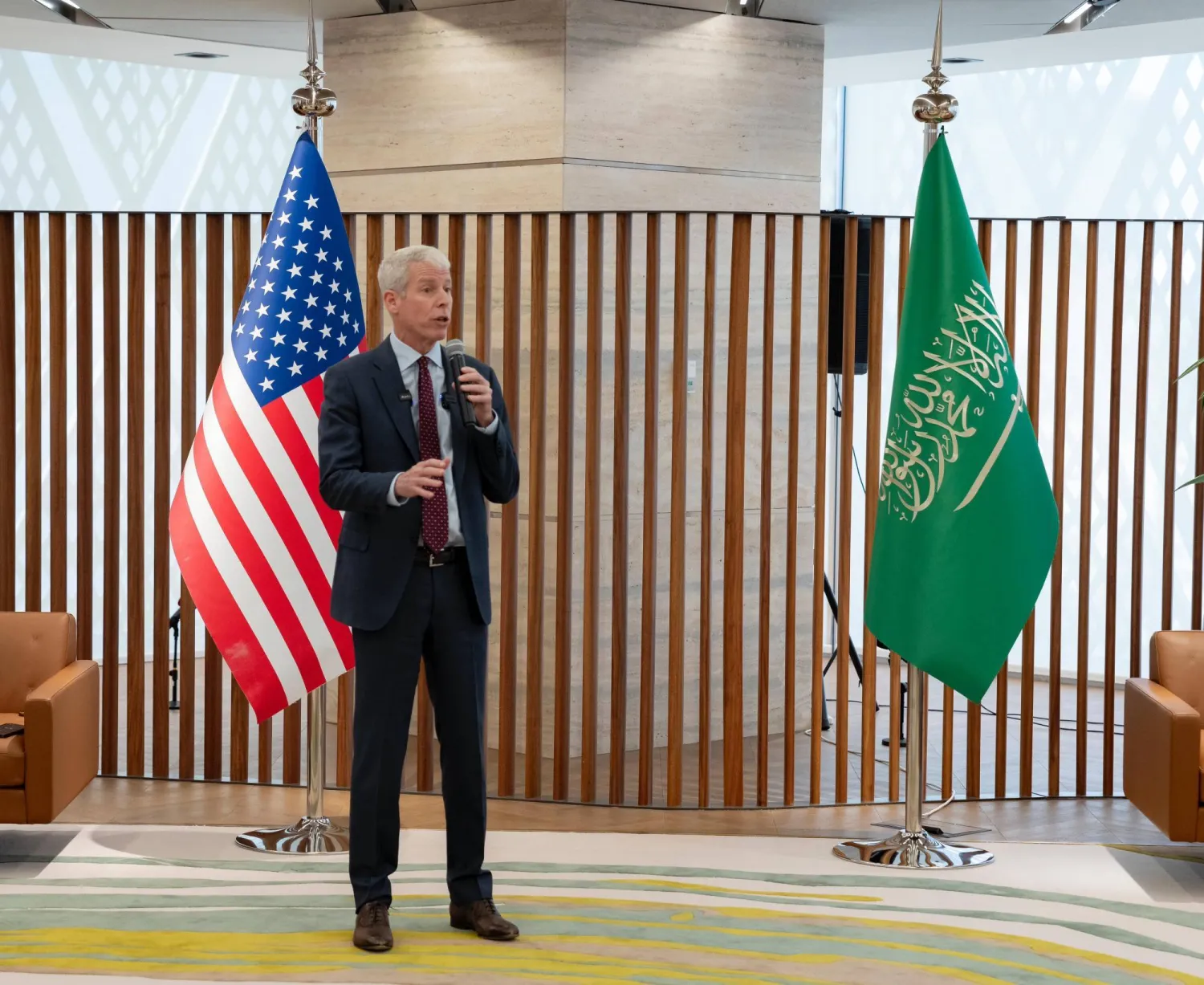
US Energy Secretary Chris Wright speaks at the press conference in the Saudi capital Riyadh. Photo: Turki al-Aqaili
TT

US Energy Secretary Says Riyadh and Washington to Sign Civil Nuclear Agreement

US Energy Secretary Chris Wright speaks at the press conference in the Saudi capital Riyadh. Photo: Turki al-Aqaili

The United States and Saudi Arabia will sign a preliminary agreement on energy cooperation and civilian nuclear technology, US Energy Secretary Chris Wright said on Sunday.

Wright spoke at a press conference in the Saudi capital Riyadh where he arrived from the United Arab Emirates on Saturday as part of a regional tour that will also take him to Qatar.

His visit comes amid world economic turmoil over the tariffs imposed by US President Donald Trump. But Wright said that these tariffs don’t seek to restrict trade, rather they aim for fair and reciprocal trade.

His visit also comes ahead of an expected visit by Trump to the Kingdom, the UAE and Qatar in May to consolidate relations.

The US Energy Secretary told journalists at the Saudi Energy Ministry that Riyadh and Washington were on a "pathway" to reaching an agreement to work together to better develop energy resources and energy infrastructure, in addition to mining cooperation, civilian nuclear technology and energy production.

Wright said further details over a memorandum detailing the energy cooperation between Riyadh and Washington would come later this year.

Saudi Minister of Energy Prince Abdulaziz bin Salman announced last September that the Kingdom is working to develop peaceful uses for nuclear energy across various fields.

In his press conference on Sunday, Wright discussed the meetings he has held in Riyadh. There have “been very wide ranging dialogues for a day and a half now and they're going to continue. We've talked about energy in all aspects of energy. We've talked about mining, critical materials. We've talked about processing in industry. We've talked about climate change. We've talked about human lives and what drives their improvement and how best to achieve those ends,” he said.

On Saturday, Prince Abdulaziz met with Wright at King Abdullah Petroleum Studies and Research Center (KAPSARC) where the US official was briefed on the Center's role in the fields of energy policy research and its transitions, climate change, sustainable transportation, and consultancy services, in addition to the development of models and analytical tools that contribute to finding solutions to current challenges in the energy sector. They also discussed opportunities for cooperation in energy research, exchange of expertise, and strengthening joint research efforts.

Wright said Sunday that he believed “Saudi Arabia will be one of the leading countries in investing in the United States. I think that's a win for the Kingdom here. It's a win for the United States. And for us, most importantly, it's a win for the working class and American citizens to have better job opportunities.”

He added that the “broader objectives” of the US and Saudi Arabia “are prosperity at home and peace abroad.”

Wright also said in response to a question by Asharq Al-Awsat that tariffs are part of Trump's economic agenda.

He said Trump is trying to grow the flow of goods outside the United States into other countries while sustaining imports and engagement with countries from around the world. “So that's a way you could describe this. Fair trade, not restricted trade, just fair trade, reciprocal trade.”

He added that the United States has seen a lot of its intensive industries, particularly energy, move outside of the country and be outsourced somewhere else. “Too many Americans have seen their job opportunities shift overseas.”

“So tariffs are also a way to give a nudge and encourage investment into our country, to make products in our country, to grow economic opportunity and prosperity in America.”



Brazil, India Eye Critical Minerals Deal as Leaders Meet

Brazil's President Luiz Inacio Lula da Silva (L) and Indian Prime Minister Narendra Modi are expected to discuss efforts to increase trade links. Ludovic MARIN / AFP/File
TT

Brazil, India Eye Critical Minerals Deal as Leaders Meet

Brazil's President Luiz Inacio Lula da Silva (L) and Indian Prime Minister Narendra Modi are expected to discuss efforts to increase trade links. Ludovic MARIN / AFP/File

India's Prime Minister Narendra Modi and Brazilian President Luiz Inacio Lula da Silva are set to meet in New Delhi on Saturday, seeking to boost cooperation on critical minerals and rare earths.

Brazil has the world's second-largest reserves of these elements, which are used in everything from electric vehicles, solar panels and smartphones to jet engines and guided missiles.

India, seeking to cut its dependence on top exporter China, has been expanding domestic production and recycling while scouting for new suppliers.

Lula, heading a delegation of more than a dozen ministers as well as business leaders, arrived in New Delhi on Wednesday for a global summit, reported AFP.

Officials have said that in talks with Modi on Saturday, the two leaders are expected to sign a memorandum on critical minerals and discuss efforts to increase trade links.

The world's most populous nation is already the 10th largest market for Brazilian exports, with bilateral trade topping $15 billion in 2025.

The two countries have set a trade target of $20 billion to be achieved by 2030.

With China holding a near-monopoly on rare earths production, some countries are seeking alternative sources.

Rishabh Jain, an expert with the Delhi-based Council on Energy, Environment and Water think tank, said India's growing cooperation with Brazil on critical minerals complements recent supply chain engagements with the United States, France and the European Union.

While these partnerships grant India access to advanced technologies, finance and high-end processing capabilities, "Global South alliances are critical for securing diversified, on-ground resource access and shaping emerging rules of global trade", Jain told AFP.

- 'Challenges' -

Modi and Lula are also expected to discuss global economic headwinds and strains on multilateral trade systems after both of their countries were hit by US tariffs in 2025, prompting the two leaders to call for stronger cooperation.

Washington has since pledged to roll back duties on Indian goods under a trade deal announced earlier this month.

"Lula and Modi will have the opportunity to exchange views on... the challenges to multilateralism and international trade," said Brazilian diplomat Susan Kleebank, the secretary for Asia and the Pacific.

Brazil is India's biggest partner in Latin America.

Key Brazilian exports to India include sugar, crude oil, vegetable oils, cotton and iron ore.

Demand for iron ore has been driven by rapid infrastructure expansion and industrial growth in India, which is on track to become the world's fourth largest economy.

Brazilian firms are also expanding in the country, with Embraer and Adani Group announcing plans last month to build aircraft in India.

Lula addressed the AI Impact summit in Delhi on Thursday, calling for a multilateral and inclusive global governance framework for artificial intelligence.

He will travel on to South Korea for meetings with President Lee Jae Myung and to attend a business forum.


Türkiye, Saudi Arabia Sign Comprehensive Power Purchase Agreement

Saudi Energy Minister Prince Abdulaziz bin Salman Al Saud and Turkish Energy and Natural Resources Minister Alparslan Bayraktar attend the signing of a power purchase agreement between Türkiye and ACWA Power in Istanbul on Friday (photo from the Turkish minister’s account on X).
TT

Türkiye, Saudi Arabia Sign Comprehensive Power Purchase Agreement

Saudi Energy Minister Prince Abdulaziz bin Salman Al Saud and Turkish Energy and Natural Resources Minister Alparslan Bayraktar attend the signing of a power purchase agreement between Türkiye and ACWA Power in Istanbul on Friday (photo from the Turkish minister’s account on X).

Türkiye’s Energy and Natural Resources Ministry signed a comprehensive power purchase agreement with Saudi energy giant ACWA Power to develop solar power plants and projects in Türkiye with major investments.

The agreement, signed in Istanbul on Friday, was attended by Türkiye’s Energy and Natural Resources Minister Alparslan Bayraktar and Saudi Energy Minister Prince Abdulaziz bin Salman Al Saud.

It includes the construction of two solar power plants in the Turkish provinces of Sivas and Karaman with a combined capacity of 2,000 megawatts and investments totaling $2 billion, as well as the implementation of large-scale solar projects with a total capacity of 5,000 megawatts in Türkiye.

Commenting on the agreement, Bayraktar said: “During our president Recep Tayyip Erdogan’s visit to Riyadh on Feb. 3, we signed an intergovernmental agreement on renewable power plant projects with my Saudi counterpart, Mr. Abdulaziz bin Salman Al Saud, which provides for total investments in solar and wind energy in Türkiye of 5,000 megawatts.”

“Today, we reinforced this cooperation by signing the agreement with ACWA Power in Istanbul. In the first phase of the project, two solar power plants with a total capacity of 2,000 megawatts will be built in Sivas and Karaman, with an investment of around $2 billion. This will add capacity to our grid to meet the electricity needs of 2.1 million households,” he added.

Bayraktar said on X that in Sivas, the agreed purchase price is 2.35 euro cents per kilowatt-hour, while in Karaman, electricity will be bought at a fixed price of 1.99 euro cents per kilowatt-hour, the lowest price recorded in Türkiye. The agreed prices will be valid for 25 years.

He said the projects, which are expected to make a significant contribution to the energy sector, require a minimum 50% local content ratio, adding that groundwork is targeted this year, operations are scheduled for 2028, and full production capacity will be reached as soon as possible.

In the second phase of the agreement, with a total capacity of 5,000 megawatts, “we aim to expand our cooperation with additional investments in solar and wind energy amounting to 3,000 megawatts,” Bayraktar said, expressing hope that the move would strengthen confidence in Türkiye’s renewable energy transition and investment climate and benefit the Turkish energy sector.

Two-phase plan

Construction under the first phase of ACWA Power’s investments in Türkiye is scheduled to begin in the first or second quarter of 2027, with electricity supply expected to start by mid-2028.

ACWA Power aims to sign an agreement with Türkiye on the second phase of its renewable energy investments before November.

The first-phase projects offer highly competitive electricity sale prices compared with other renewable power plants in Türkiye. In addition, the plants, valued at about $2 billion, will supply electricity to more than 2 million Turkish households.

A Turkish state-owned company will purchase the electricity generated by the plants for 30 years. During implementation, maximum use will be made of locally sourced equipment and services.

In recent years, Türkiye has sought to attract Gulf investments into its energy sector as it works to raise renewable power generation capacity to 120 gigawatts by 2035. Several previous attempts were not completed due to disagreements over financial valuations and pricing.

ACWA Power announced in June its intention to build two large solar power plants in Türkiye as part of a plan to invest billions of dollars in the Turkish energy sector.

Major investments

While the exact value of ACWA Power’s investment has not been disclosed, Türkiye said two years ago it was in talks with the company over projects worth up to $5 billion.

Türkiye’s Treasury and Finance Minister Mehmet Simsek described the intergovernmental energy agreement signed during Erdogan’s visit to Riyadh as a major boost for foreign direct investment inflows into Türkiye.

He said the pace of foreign direct investment in Türkiye is accelerating, reflecting growing confidence in its economic program, adding that the inflow of $2 billion in foreign direct investment into renewable energy projects through the agreement with Saudi Arabia would accelerate the green transition, strengthen energy security, and structurally reduce dependence on energy imports.

ACWA Power’s portfolio, 44% owned by Saudi Arabia’s Public Investment Fund, includes a gas-fired power plant in Türkiye. The company also expanded its solar energy projects in 2024 in Malaysia, Indonesia, and Uzbekistan.


Lagarde Dampens ECB Exit Talk, Expects to Finish her Term

FILE PHOTO: European Central Bank (ECB) President Christine Lagarde reacts during an address to the media after the ECB's Governing Council meeting, at the ECB headquarters in Frankfurt, Germany, December 18, 2025. REUTERS/Heiko Becker/File Photo
TT

Lagarde Dampens ECB Exit Talk, Expects to Finish her Term

FILE PHOTO: European Central Bank (ECB) President Christine Lagarde reacts during an address to the media after the ECB's Governing Council meeting, at the ECB headquarters in Frankfurt, Germany, December 18, 2025. REUTERS/Heiko Becker/File Photo

European Central Bank President Christine Lagarde has attempted to calm speculation about her stepping down early that has called into question the central bank's separation from politics, telling the Wall Street Journal she expects to complete her term.

Lagarde's status as leader of Europe's most important financial institution
was plunged into doubt this week after the Financial Times reported she planned to leave her job ahead of next spring's French presidential election, giving outgoing leader
Emmanuel Macron a say in picking her successor.

In an interview with the WSJ on Thursday, Lagarde dampened speculation about an imminent exit but still left the door slightly ajar to the possibility that she might leave before the end of her contract in October 2027.

“When I look back at all these years, I ‌think that we have ‌accomplished a lot, that I have accomplished a lot,” she told the ‌paper. “We ⁠need to consolidate ⁠and make sure that this is really solid and reliable. So my baseline is that it will take until the end of my term.”

Reuters exclusively reported that Lagarde had sent a private message to fellow policymakers reassuring them that she was still concentrating on her job and that they would hear it from her, rather than the press, if she wanted to step down.

The ECB has said that Lagarde has not made a decision about the end of her term, but stopped short of denying the FT report.

Some analysts thought an ⁠early exit risked tangling the ECB up in European politics as it could ‌give the impression of trying to make sure France's eurosceptic far ‌right, which could win next year's presidential vote, had no say in her succession.

Lagarde said last year she intended ‌to complete her term, a commitment she has conspicuously failed to repeat this week.

Bank of France Governor Francois ‌Villeroy de Galhau announced plans to step down from his job last week, in a move that gives President Macron a chance to pick the next French central bank chief, drawing sharp criticism from the far-right who called the move anti-democratic.

Villeroy's early departure and the confusion about Lagarde's future come just as US President Donald Trump is attacking the Federal Reserve, ‌further stoking debates about central bank independence from politics.

"After the recent events in the US, this is another reminder that although central banks are nominally ⁠independent, who leads them and ⁠their worldview is a matter for high politics," economists at Oxford Economics wrote on Friday.

As the head of the euro zone's second largest economy, the French president plays an important role in wider negotiations to select the head of the ECB.

Polls show either far-right National Rally leader Marine Le Pen, or her protege Jordan Bardella, could win the French presidency.

While the party has long dropped a call for France to leave the euro, it is still seen as something of an unknown quantity in central banking circles.

According to Reuters, Lagarde told the WSJ that she viewed her mission as price and financial stability, as well as "protecting the euro, making sure that it is solid and strong and fit for the future of Europe."

She also said that the World Economic Forum was "one of the many options" she was considering once she left the central bank.

When Lagarde's name first emerged as a possible candidate for ECB president in 2019, she said she had no interest in the job and would not leave the International Monetary Fund, where she was the managing director.