IMF Projects Pessimistic Outlook on MENA Economies

Traffic moves during a sandstorm in Doha on April 15, 2025. (AFP)
TT

IMF Projects Pessimistic Outlook on MENA Economies

Traffic moves during a sandstorm in Doha on April 15, 2025. (AFP)

The International Monetary Fund (IMF) on Tuesday gave a pessimistic outlook for economic growth in the Middle East and North Africa (MENA) for the next two years, the second similar projection in a row in 2025.

The IMF released an update to its World Economic Outlook compiled in just 10 days after US President Donald Trump announced universal tariffs on nearly all trading partners and higher rates - currently suspended - on many countries.

Across the broader MENA region, the IMF anticipated economic growth to average 2.6% in 2025, before climbing to 3.4% in 2026, representing a decrease by around 0.9 percentage points and 0.5 percentage points compared to previous forecasts.

The IMF had downgraded its growth forecast for the region last January from its October projection. According to figures from the fund, the region's economy grew by 1.8% last year.

Within MENA, IMF projected oil exporters including Saudi Arabia, the UAE, Iraq, Algeria and Qatar, to witness a 2.6% growth this year and 3.1% next year.

In return, in oil-importing nations such as Egypt, Jordan, Morocco and Tunisia, economies are projected to grow to 3.6% in 2025 and to 4.1% in 2026.

The Fund said futures markets indicate that oil prices will average $66.9 per barrel in 2025, a 15.5% decline, before falling to $62.4 in 2026.

The IMF cut the forecast for Saudi Arabia's GDP growth in 2025 to 3% versus a January estimate of a 3.3% increase. IMF also reduced the projection for growth in 2026 by 0.4 percentage point to 3.7%.

In Iraq, the IMF expected a modest rebound in 2026, with growth forecast at 1.4%. This marks a steep downgrade from October 2024, when it had projected 4.1% growth for Iraq in 2025.

In Egypt, it saw growth coming in at a 3.8% y-o-y clip this fiscal year, up 0.2 percentage points from its January forecast.

In Morocco, IMF said the economy could grow by 3.9% in 2025 and maintain steady momentum with 3.7% the following year.


Iran's Currency Sinks to a New Record Low

FILE PHOTO: People walk past a sign at a currency exchange as the value of the Iranian Rial drops, in Tehran, Iran, October 5, 2025. Majid Asgaripour/WANA (West Asia News Agency) via REUTERS
TT

Iran's Currency Sinks to a New Record Low

FILE PHOTO: People walk past a sign at a currency exchange as the value of the Iranian Rial drops, in Tehran, Iran, October 5, 2025. Majid Asgaripour/WANA (West Asia News Agency) via REUTERS

Iran's currency slipped to the lowest level in its history on Monday, nearing 1,250,000 rial to the US dollar on the open rate market, various outlets including the semi-official Tasnim news agency reported.

The Iranian rial stood around 55,000 to the US dollar in 2018, when US sanctions were reimposed by the first Trump administration to force Tehran to the negotiating table by limiting its oil exports and access to foreign currency.

Iranian media blamed the government's recent economic liberalization policies for adding pressure to the open rate market, Reuters.

The open rate market is where ordinary Iranians buy foreign currency, whereas businesses typically use state-regulated rates.

However, the government's recent decision to allow importers to tap into the open market to import essential goods has added pressure on the market and increased the dollar's price, semi-official Fars news agency said.

Iran's economy is at risk of recession, with the World Bank forecasting an economic shrinkage of 1.7% in 2025 and 2.8% in 2026. The risk is compounded by rising inflation, with Iran's Statistical Center announcing monthly inflation of 48.6% in October, the highest in 40 months. Despite inflationary pressures, Iran said last month it would increase fuel prices in December under certain conditions, primarily impacting drivers using more than 100 liters per month.


Gold Rises on Fed Rate Cut Expectations, Weaker Dollar

A one-ounce gold bar is displayed at Witter Coins on October 07 2025 in San Francisco. (AFP)
TT

Gold Rises on Fed Rate Cut Expectations, Weaker Dollar

A one-ounce gold bar is displayed at Witter Coins on October 07 2025 in San Francisco. (AFP)

Gold prices rose on Monday, driven by growing expectations of a US interest rate cut that pressured the dollar, ahead of a Federal Reserve policy meeting this week.

Spot gold rose 0.3% to $4,209.43 per ounce by 0851 GMT. US gold futures for December delivery fell 0.1% to $4,239.40 per ounce.

The dollar index edged lower, hovering near the one-month low reached on December 4, making dollar-priced gold more affordable for overseas buyers.

"Gold is benefiting from a weaker U.S. dollar and market participants expecting the Fed to cut interest rates this week," said UBS analyst Giovanni Staunovo.

Data last week showed that US consumer spending grew moderately in September. That reflected a slowdown in economic momentum amid rising costs and weakness in the labor market as private payrolls saw their steepest decline in over two-and-a-half years in November.

According to CME's FedWatch tool, markets are pricing in an 87% probability of a 25-basis-point rate cut at the Fed's December 9-10 policy meeting, following the release of weak economic data and dovish remarks from several Fed officials.

Lower interest rates typically bolster demand for non-yielding assets like gold.

"We still look for more rate cuts next year, which should push gold to $4,500/oz next year," added Staunovo.

Silver was up 0.3% at $58.43 per ounce, after hitting a record high of $59.32 on Friday.

"Silver is benefiting from the same factor as gold. Additionally the expectation of improving industrial demand as a result of monetary and fiscal stimulus helped silver to outperform gold in recent weeks," Staunovo said.

The white metal has doubled in price this year, driven by supply deficits and its designation as a critical mineral by the US.

Elsewhere, platinum gained 0.6% to $1,650.90 and palladium rose 1% to $1,471.26.


Saudi Arabia’s Mawani, ARASCO to Establish Logistics Center at King Abdulaziz Port

Saudi Arabia’s Mawani, ARASCO to Establish Logistics Center at King Abdulaziz Port
TT

Saudi Arabia’s Mawani, ARASCO to Establish Logistics Center at King Abdulaziz Port

Saudi Arabia’s Mawani, ARASCO to Establish Logistics Center at King Abdulaziz Port

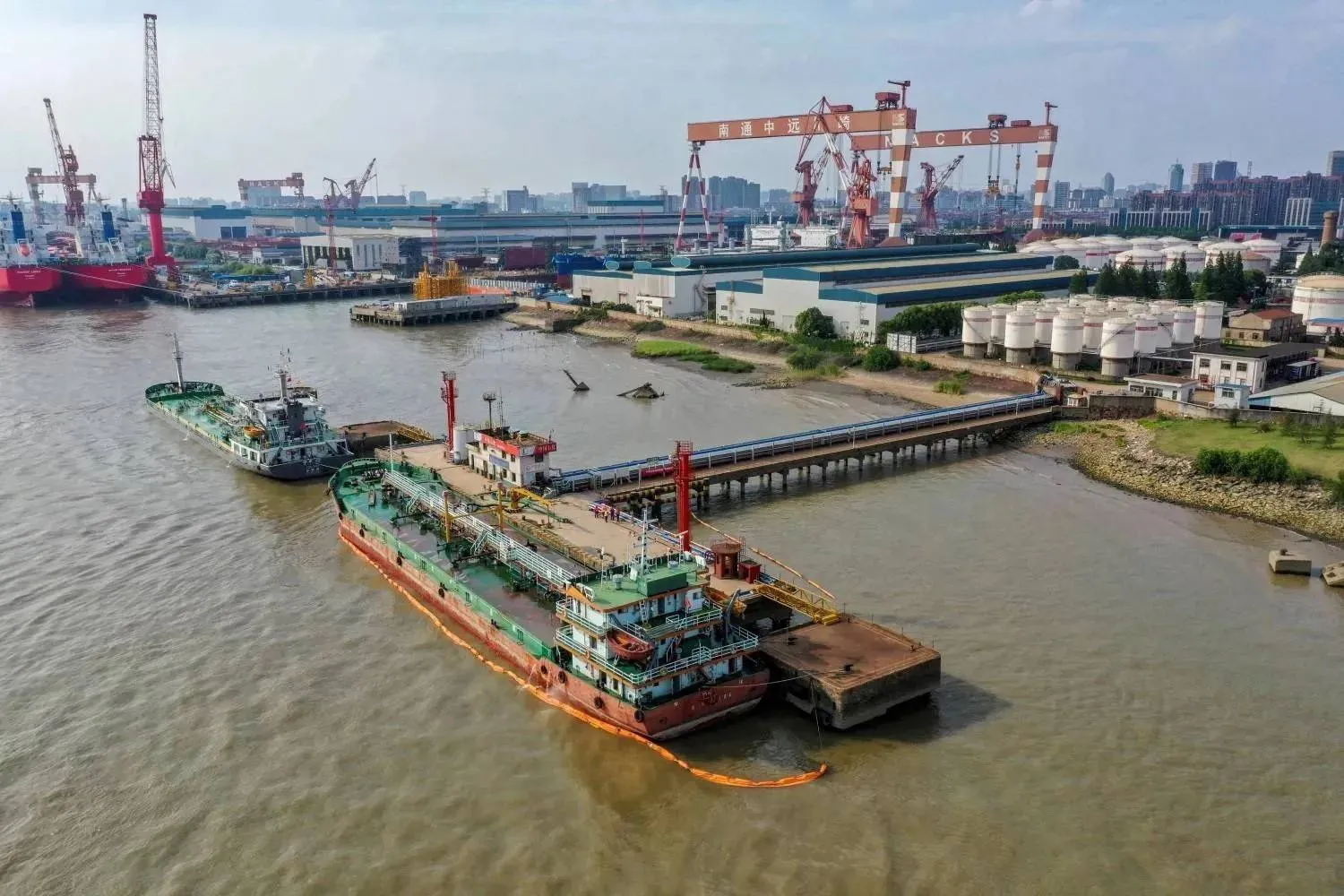
The Saudi Ports Authority (Mawani) signed a contract with Arabian Agricultural Services Company (ARASCO) to establish a logistics center for storage and distribution at King Abdulaziz Port in Dammam, reported the Saudi Press Agency on Monday.

Valued at SAR200 million, the center will span 40,000 square meters and aims to bolster food security in the Kingdom while increasing port capacity.

The move aligns with the objectives of the National Transport and Logistics Strategy to solidify the Kingdom's position as a global logistics hub.

The contract further strengthens Mawani’s ongoing efforts to boost the efficiency of national supply chains and optimize operations at King Abdulaziz Port.

The investment is designed to bolster King Abdulaziz Port's capabilities in grain unloading and storage by constructing warehouses capable of handling up to 100,000 metric tons.