


Saudi Arabia Draws Silicon Valley with $21 Bn Investment Deals

Buildings are seen in Riyadh, Saudi Arabia, December 18, 2017. REUTERS/Faisal Al Nasser/ File Photo
TT

Saudi Arabia Draws Silicon Valley with $21 Bn Investment Deals

Buildings are seen in Riyadh, Saudi Arabia, December 18, 2017. REUTERS/Faisal Al Nasser/ File Photo

Tech and investment heavyweights from Silicon Valley descended on the Saudi capital this week on a historic visit alongside US President Donald Trump, marking a dramatic revival of strategic partnerships that had stalled under previous restrictive US policies.

The visit, seen as a pivot away from Washington’s earlier constraints on exporting artificial intelligence technology, featured some of the most influential figures in the global tech industry.

Among those attending Tuesday’s high-level gathering were Tesla CEO Elon Musk, NVIDIA founder Jensen Huang, OpenAI CEO Sam Altman, Amazon chief Andy Jassy, BlackRock Chairman Larry Fink, and Palantir CEO Alex Karp.

The visit was hailed by officials as ushering in a “new golden era” of US-Saudi relations. It came just one day after Crown Prince Mohammed bin Salman announced the launch of HUMAIN, a Saudi AI innovation venture aimed at reshaping the Kingdom’s future through advanced technology.

In just 48 hours, US investment pledges in Saudi Arabia’s AI sector surged from $3 billion to over $21 billion, according to forum organizers.

Also announced was an expanded strategic partnership between Saudi Arabia’s Public Investment Fund and Google Cloud, projected to contribute approximately $70.6 billion to the Kingdom’s GDP in the coming years.

The series of announcements reflect Riyadh’s growing ambition to become a global hub for artificial intelligence, backed by top-tier US tech leadership and capital.

NVIDIA has delivered 18,000 next-generation AI chips to HUMAIN, in a move that could open the floodgates for artificial intelligence semiconductors across the Middle East.

The landmark delivery coincides with a sharp shift in US export policy, as the Trump administration begins dismantling restrictions on semiconductor exports imposed under President Joe Biden.

On Tuesday, the US Commerce Department announced it would scrap Biden’s “AI deployment rule,” which had created three broad tiers of access for countries seeking to acquire AI chips. The rule was due to take effect on Thursday.

The reversal signals a significant policy pivot, potentially expanding access to powerful AI technology for key allies in the region, including Saudi Arabia, which has been aggressively positioning itself as a future hub for artificial intelligence and advanced computing.

Industry analysts say the delivery of NVIDIA’s high-performance chips marks a major step toward establishing a regional AI infrastructure capable of supporting large-scale machine learning, cloud computing, and autonomous systems.

Saudi Foreign Minister Prince Faisal bin Farhan affirmed that the Kingdom’s strategic partnership with the US in artificial intelligence and hyperscale data centers is expected to generate more than 22,000 high-quality jobs.

Speaking at a press conference, Prince Faisal emphasized that deepening cooperation in advanced technologies will play a key role in shaping Saudi Arabia’s economic future and workforce development.
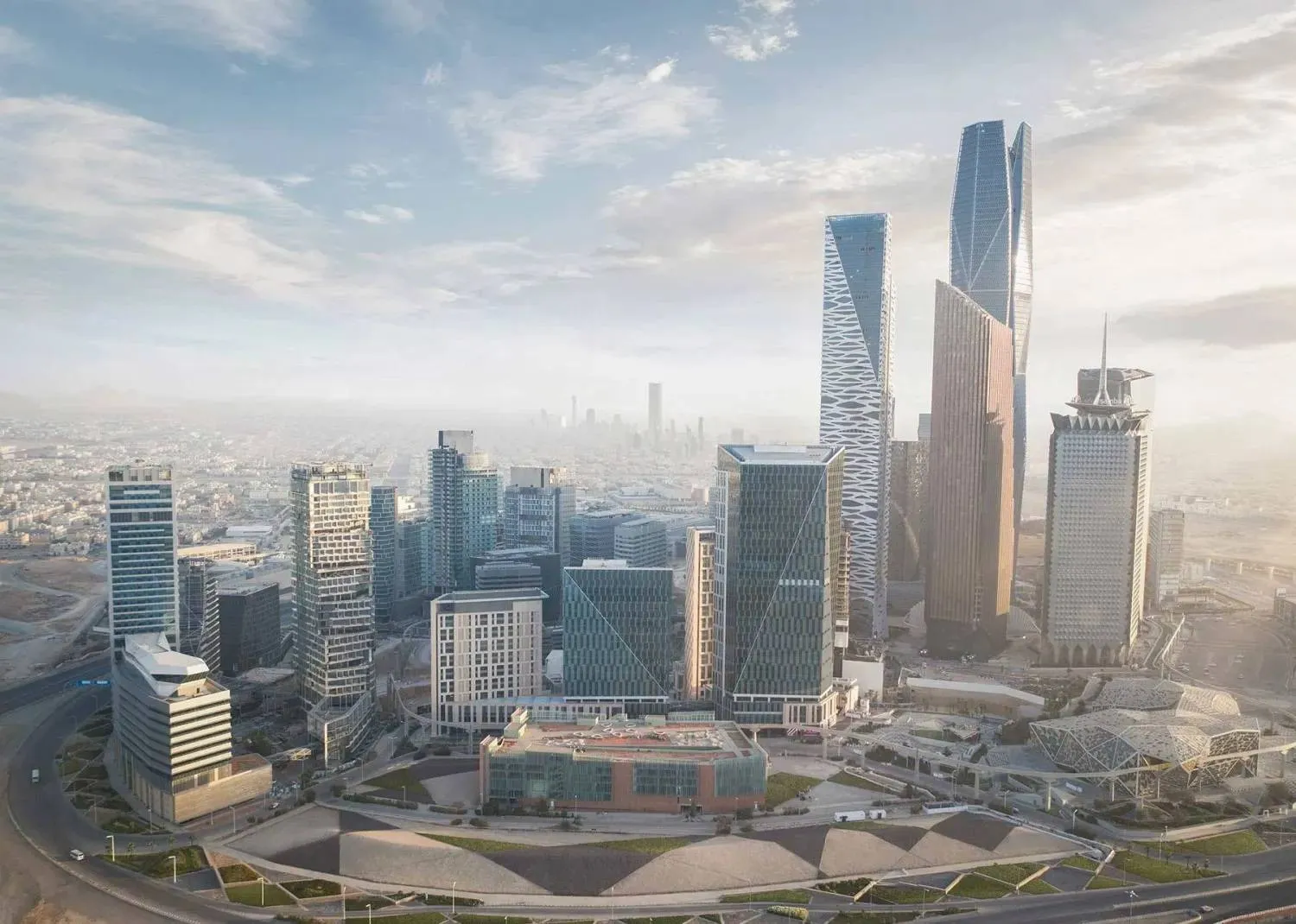



Saudi Arabia Allows Contracting Exceptions for Firms without Regional HQ

The King Abdullah Financial District in Riyadh (Asharq Al-Awsat)
TT

Saudi Arabia Allows Contracting Exceptions for Firms without Regional HQ

The King Abdullah Financial District in Riyadh (Asharq Al-Awsat)

Saudi Arabia has introduced greater flexibility into its investment environment, allowing government entities, under strict controls to safeguard spending efficiency and ensure the delivery of critical projects, to seek exceptions to contract with international companies that do not have regional headquarters in the kingdom.

The Local Content and Government Procurement Authority notified all government bodies of the mechanism to apply for exemptions through the Etimad digital platform.

The step is designed to balance enforcement of the “regional headquarters relocation” decision, in force since early 2024, with the needs of technically specialized projects or those driven by intense price competition.

Under a government decision that took effect at the start of 2024, state entities, including authorities, institutions and government-affiliated funds, are barred from contracting with any foreign commercial company whose regional headquarters in the region is located outside Saudi Arabia.

According to the information, the Local Content and Government Procurement Authority informed all entities of the rules governing contracts with companies that lack a regional headquarters in the kingdom and related parties.

Government entities may request an exemption from the committee for specific projects, multiple projects or a defined time period, provided the application is submitted before launching a tender or initiating direct contracting procedures.

Submission mechanism

In two circulars, the authority detailed how to submit exemption requests and clarified the cases in which contracting is permitted under the controls. It said the exemption service was launched on the Etimad platform in November 2025.

The service is available to entities that float tenders through Etimad. Requests for tenders launched before the service went live, as well as those issued outside the platform, will continue to follow the previously adopted process.

Etimad is the kingdom’s official financial services portal run by the Ministry of Finance, aimed at driving digital transformation of government procedures and boosting transparency and efficiency in managing budgets, contracts, payments, tenders and procurement. The platform streamlines transactions between state entities and the private sector.

Technical criteria

When issuing the contracting controls, the government made clear that companies without a regional headquarters in Saudi Arabia, or related parties, are not barred from bidding for public tenders.

However, their offers can only be accepted in two cases: if there is no more than one technically compliant bid, or if the offer ranks among the best technically and is at least 25% lower in price than the second-best bid after overall evaluation.

Contracts with an estimated value of no more than 1 million riyals ($266,000) are also exempt. The minister may, in the public interest, amend the threshold, cancel the exemption or suspend it temporarily.

More than 700 headquarters

More than 700 multinational companies had relocated their regional headquarters to Riyadh by early 2026, exceeding the initial target of attracting 500 companies by 2030. The program seeks to cement the kingdom’s position as a regional business hub and to localize global expertise.

When announcing the contracting ban, Saudi Arabia said the move was intended to incentivize foreign firms dealing with the government and its affiliated entities to adjust their operations.

It aims to create jobs, curb economic leakage, raise spending efficiency and ensure that key goods and services procured by government entities are delivered inside the kingdom with appropriate local content.

The government said the policy aligns with the objectives of the Riyadh 2030 strategy unveiled during the recent Future Investment Initiative forum, where 24 multinational companies announced plans to move their regional headquarters to the Saudi capital.

It stressed that the decision does not affect any investor’s ability to enter the Saudi economy or continue working with the private sector.


IMF Board to Review Staff-level $8.1 Bln Agreement for Ukraine

The city's downtown on a frosty winter day, amid Russia's attack on Ukraine, in Kyiv, Ukraine February 19, 2026. REUTERS/Alina Smutko
TT

IMF Board to Review Staff-level $8.1 Bln Agreement for Ukraine

The city's downtown on a frosty winter day, amid Russia's attack on Ukraine, in Kyiv, Ukraine February 19, 2026. REUTERS/Alina Smutko

The International Monetary Fund on Thursday said its board ​would review a staff-level agreement for a new $8.1 billion lending program for Ukraine in coming days.

IMF spokeswoman Jule Kozack told reporters that Ukrainian authorities had completed the prior actions needed to move forward with the request ⁠of a new ⁠IMF program, including submission of a draft law on the labor code and adoption of a budget.

She said Ukraine's economic growth in 2025 ⁠was likely under 2%. After four years of war, the country's economy had settled into a slower growth path with larger fiscal and current account balances, she said, noting that the IMF continues to monitor the situation closely.

"Russia's invasion continues to take a ⁠heavy ⁠toll on Ukraine's people and its economy," Kozack said. Intensified aerial attacks by Russia had damaged critical energy and logistics infrastructure, causing disruptions to economic activity, Reuters quoted her as saying.

As of January, she said, 5 million Ukrainian refugees remained in Europe and 3.7 million Ukrainians were displaced inside the country.


US Stocks Fall as Iran Angst Lifts Oil Prices

A screen displays a stock chart at a work station on the floor of the New York Stock Exchange (NYSE) in New York City, US, April 6, 2022. REUTERS/Brendan McDermid
TT

US Stocks Fall as Iran Angst Lifts Oil Prices

A screen displays a stock chart at a work station on the floor of the New York Stock Exchange (NYSE) in New York City, US, April 6, 2022. REUTERS/Brendan McDermid

Wall Street stocks retreated early Thursday as worries over US-Iran tensions lifted oil prices while markets digested mixed results from Walmart.

US oil futures rose to a six-month high as Iran's atomic energy chief Mohammad Eslami said no country can deprive the Islamic republic of its right to nuclear enrichment, after US President Donald Trump again hinted at military action following talks in Geneva.

"We'd call this an undercurrent of concern that is bubbling up in oil prices," Briefing.com analyst Patrick O'Hare said of the "geopolitical angst."

About 10 minutes into trading, the Dow Jones Industrial Average was down 0.6 percent at 49,379.46, AFP reported.

The broad-based S&P 500 fell 0.5 percent to 6,849.35, while the tech-rich Nasdaq Composite Index declined 0.6 percent to 22,621.38.

Among individual companies, Walmart rose 1.7 percent after reporting solid results but offering forecasts that missed analyst expectations.

Shares of the retail giant initially fell, but pushed higher after Walmart executives talked up artificial intelligence investments on a conference call with analysts.

The US trade deficit in goods expanded to a new record in 2025, government data showed, despite sweeping tariffs that Trump imposed during his first year back in the White House.