

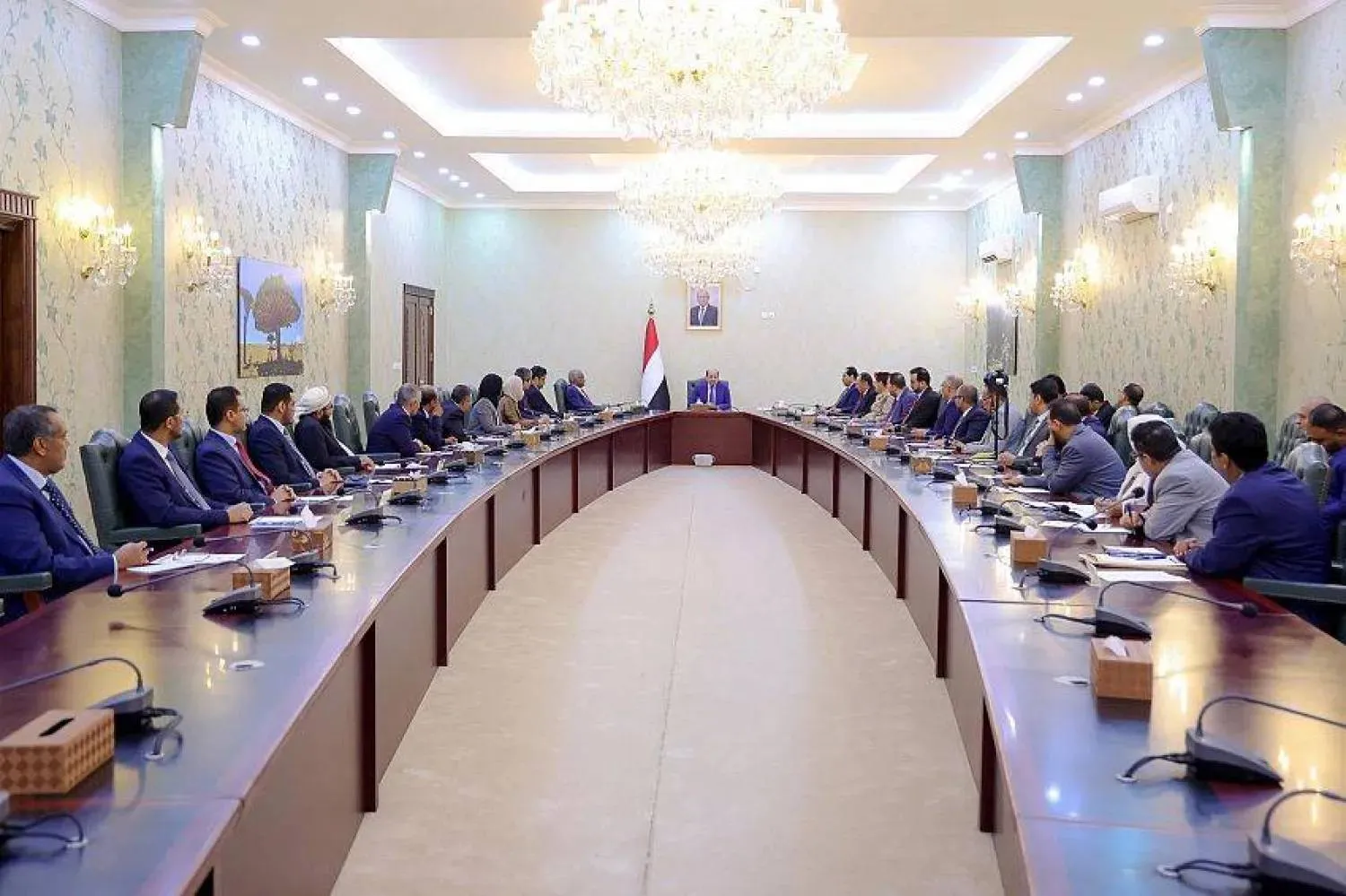

Yemen PM Announces Comprehensive Reform Plan with Saudi Support

Zindani government holds first meeting after ministers return to Aden (Saba News Agency)
TT

Yemen PM Announces Comprehensive Reform Plan with Saudi Support

Zindani government holds first meeting after ministers return to Aden (Saba News Agency)

Yemen’s new government convened its first cabinet meeting on Thursday in the temporary capital Aden, with Prime Minister Shayea al-Zindani presiding after ministers completed their return to the country to resume duties, in what officials cast as the start of a hands-on push to stabilize security, revive services and shore up a battered economy with broad Saudi backing.

The meeting coincided with remarks by Presidential Leadership Council member Abdulrahman al-Mahrami, who warned against unrest in Aden, in an apparent reference to attempts led by elements of the dissolved Southern Transitional Council. “We will not allow any attempts to destabilize public order or drag our city into chaos or futile conflicts,” he said.

At the cabinet’s first meeting following its return to Aden, Zindani stressed that “there is no room for any government member to remain outside the country,” affirming that the government would be present on the ground, living among the population and addressing their daily needs, in a move aimed at restoring public trust and strengthening direct government performance.

The Yemeni prime minister, who also retains the foreign affairs portfolio, said his government would enter a new phase of field-based work from Aden, emphasizing that the next stage would rely on direct engagement with citizens, enhancing the effectiveness of state institutions and achieving tangible improvements in services and economic and security stability.

He said improvements in some basic services in recent weeks were not temporary, but the result of disciplined measures and practical reforms, alongside significant Saudi support, which he said had once again proven to be a pillar of the Yemeni state and a key partner in achieving peace and ensuring stability. He added that Saudi moves in support of the Yemeni people were consistent with international law.

Zindani said the government was working to ensure the sustainability of service delivery so that citizens feel a real and lasting difference, not a fleeting improvement, noting that the coming phase would include serious steps to combat corruption, enhance transparency and enforce the law as key pillars for building effective state institutions.

Reforms on all fronts

On the economic front, Zindani announced that the government would present a realistic 2026 budget for the first time in years, giving top priority to the regular payment of public-sector salaries as a legal and moral obligation.

Measures would also be taken to curb inflation and contain the erosion of citizens’ purchasing power, thereby easing living burdens.

On the security and military fronts, he said the government was committed to removing all military camps from Aden and other cities and to unifying military and security decision-making under the state’s authority, to strengthen stability and prevent multiple centers of influence.

He stressed the importance of respecting rights and equality for all citizens, and of not allowing calls that promote chaos or threaten public order.

Regarding the southern issue, the prime minister expressed confidence that south-south dialogue would open a genuine window to address it, calling on southerners to abandon the rhetoric of treason and avoid fueling strife and grudges, and to entrench a culture of tolerance and move beyond past conflicts.

He said southerners are the ones concerned with determining their present and future through dialogue, away from the imposition of individual or factional will, stressing there was no room to politicize or diminish the southern issue, which he described as a national cause concerning all Yemenis.

On the peace track, Zindani said the state retained all options to restore its institutions if the Houthis remained intransigent, while affirming that the internationally recognized government continues to extend its hand for peace and to end the Houthi coup, alongside efforts to launch a broad process of reconstruction, development and modernization.

Gradual work

Upon his arrival at Aden International Airport, Zindani said the government’s return to the country represents a practical commitment to shoulder national responsibilities and directly address accumulated challenges facing citizens, particularly amid difficult economic conditions and the repercussions of the ongoing war.

In his first interview after being sworn in as prime minister, Zindani said his government would soon relocate to Aden, noting that being inside the country was not a symbolic step but a prerequisite for effective decision-making and restoring the regular functioning of state institutions.

Speaking to Asharq Al-Awsat, he said the current phase “does not tolerate broad rhetoric,” but requires gradual work to rebuild trust and restore institutional rhythm, stressing that improving living conditions, services, and economic recovery are urgent priorities.

He justified retaining the foreign affairs portfolio as necessary to complete organizational and diplomatic reforms he had previously begun.

Zindani said his cabinet was formed based on professional criteria, away from quota-based arrangements, with a focus on competence, specialization and national balance.

Economically, he adopted what he described as a realistic tone, avoiding quick promises, and said recovery requires restructuring financial administration, controlling resources, enhancing transparency and activating oversight.

He said unifying political and military decision-making would enable state institutions to enforce the law, make accountability possible and give the government a more cohesive negotiating position in any upcoming peace process with the Houthis.

No tolerance for unrest

In support of Zindani’s government, Presidential Leadership Council member Abdulrahman al-Mahrami said security and stability in Aden would remain a non-negotiable priority.

He stressed that no attempts would be allowed to undermine public order or drag Aden into chaos and futile conflicts.

In a statement on his official X account, he reaffirmed that Aden’s security and stability will remain a priority and the government will accept no compromise or negligence.

"We will not allow any attempts to destabilize public order or drag our city into chaos or futile conflicts, without detracting from the political path of the south and its cause," he said.

He added: “We look forward to a South-South dialogue sponsored by Riyadh. It is a historic opportunity that we value and hold on to, and we thank the Kingdom’s leadership for it. We also affirm our full support for the government headed by Dr. Shayea al-Zindani, urging all its members to provide services and improve living conditions in a way that citizens can feel.”

Al-Mahrami pledged to follow up on performance “with care, transparency and responsibility,” calling on “everyone to unite, reject rumors, strengthen the spirit of national responsibility and stand together to protect the capital and safeguard state institutions.”

He added: “We trust that all understand the importance of preserving security and stability as the foundation for government and institutional work and the provision of services, away from political direction or exploitation by any party to harm people’s lives and increase their suffering, without detracting from our just cause.”



Israel Military Issues Evacuation Warning for Area of South Lebanon

 Smoke rises following an explosion in southern Lebanon, near the Israel-Lebanon border, as seen from northern Israel, April 28, 2026. (Reuters)
Smoke rises following an explosion in southern Lebanon, near the Israel-Lebanon border, as seen from northern Israel, April 28, 2026. (Reuters)
TT

Israel Military Issues Evacuation Warning for Area of South Lebanon

 Smoke rises following an explosion in southern Lebanon, near the Israel-Lebanon border, as seen from northern Israel, April 28, 2026. (Reuters)
Smoke rises following an explosion in southern Lebanon, near the Israel-Lebanon border, as seen from northern Israel, April 28, 2026. (Reuters)

Israel's military on Tuesday warned residents of more than a dozen villages and towns in southern Lebanon to immediately evacuate and head northwards, saying it would respond to Hezbollah's "violation of the ceasefire" there.

The military "does not intend to harm you, and out of concern for your safety, you are required to evacuate your homes immediately and move away from the specified area towards the Sidon District", Arabic-language spokesman Avichay Adraee posted on X.

"Anyone present near Hezbollah elements, their facilities or their weapons is endangering their life," he added.

All the areas listed in the post appear to be outside or on the border of the so-called "Yellow Line" -- a strip of Lebanese territory around 10 kilometers (six miles) deep along the border within which Israeli troops are operating.

Israel and Iran-backed Hezbollah have traded blame over violations of the fragile ceasefire in Lebanon agreed earlier this month, and attacks by both sides have continued.

In two incidents on Tuesday morning, the Israeli military said an interceptor was launched "toward a suspicious aerial target that was identified in an area where Israeli forces are operating in southern Lebanon".

On both occasions, it said the target did not cross into Israeli territory.

The military also announced on Tuesday morning that one soldier had been severely injured and another lightly injured a day earlier "as a result of an explosive drone impact during operational activity in southern Lebanon".

"This incident constitutes a violation of the ceasefire understandings by the Hezbollah terrorist organization," it said.

Israeli Prime Minister Benjamin Netanyahu said Monday that Hezbollah's rockets and drones remained a key threat requiring action by the Israeli military, adding that Israel was continuing to carry out strikes.

Hezbollah drew Lebanon into the Middle East war on March 2 by firing rockets towards Israel to avenge the killing of Iranian supreme leader Ali Khamenei.


Dozens of Gaza Children Arrive in Jordan for Medical Care

A wounded Palestinian girl, evacuated from Gaza for medical treatment, arrives in an ambulance at the King Hussein Bridge in Jordan, April 27, 2026. (Reuters)
TT

Dozens of Gaza Children Arrive in Jordan for Medical Care

A wounded Palestinian girl, evacuated from Gaza for medical treatment, arrives in an ambulance at the King Hussein Bridge in Jordan, April 27, 2026. (Reuters)

A new group of wounded or ill Palestinian children from Gaza have arrived in Jordan to receive medical care, the kingdom's army said on Tuesday.

They are the 26th group of children transported to Jordan since the start of the war in Gaza in October 2023.

The 81 children, accompanied by 108 family members, arrived through the King Hussein, or Allenby, border crossing between the occupied West Bank and Jordan, the army said in a statement.

It is part of the "Jordanian medical corridor" initiative that King Abdullah II agreed to following a meeting with US President Donald Trump in February 2025.

Under the initiative, around 2,000 children will be transported to Jordan to receive medical care.

Since March last year, more than 716 children have been transferred in cooperation with the World Health Organization, the majority of them suffering from fractures, major wounds or cancer.

"The children will be treated in a number of Jordanian hospitals, as part of the kingdom's ongoing medical and humanitarian efforts to provide healthcare and medical support to our brothers and sisters in the Gaza Strip," the army said.

A ceasefire has largely held in Gaza since last October, but some violence has persisted.


Iraqi Leaders to Begin Thorny Talks on Forming Cabinet

 Iraqi Prime Minister Mohammed Shia al-Sudani meets with Ali al-Zaidi, the Coordination Framework’s nominee for prime minister, in Baghdad, Iraq, April 28, 2026. (Iraqi Prime Minister’s Media Office/Handout via Reuters)
Iraqi Prime Minister Mohammed Shia al-Sudani meets with Ali al-Zaidi, the Coordination Framework’s nominee for prime minister, in Baghdad, Iraq, April 28, 2026. (Iraqi Prime Minister’s Media Office/Handout via Reuters)
TT

Iraqi Leaders to Begin Thorny Talks on Forming Cabinet

 Iraqi Prime Minister Mohammed Shia al-Sudani meets with Ali al-Zaidi, the Coordination Framework’s nominee for prime minister, in Baghdad, Iraq, April 28, 2026. (Iraqi Prime Minister’s Media Office/Handout via Reuters)
Iraqi Prime Minister Mohammed Shia al-Sudani meets with Ali al-Zaidi, the Coordination Framework’s nominee for prime minister, in Baghdad, Iraq, April 28, 2026. (Iraqi Prime Minister’s Media Office/Handout via Reuters)

Iraqi leaders are expected to begin complex talks on Tuesday over forming a government and allocating cabinet portfolios under new prime minister-designate Ali al-Zaidi.

Five months on from elections, Iraq remains deadlocked in negotiations over a new administration, after US pressure scuppered the choice for prime minister of the majority bloc in parliament.

Two-time ex-premier Nouri al-Maliki, who has close ties to Iran, had been endorsed by the bloc but was forced to step back after an ultimatum from US President Donald Trump.

Since the 2003 invasion of Iraq led by the United States, the country has walked a tightrope between the competing influences of Washington and Tehran.

On Monday, Iraq's new President Nizar Amedi nominated businessman Zaidi as prime minister-designate, giving him the daunting task of putting a cabinet together in the next 30 days amid fierce political wrangling.

The Coordination Framework -- the majority bloc in parliament and an alliance of Shiite groups with varying ties to Iran, had backed Maliki but appears to have yielded to the US pressure.

The framework has now endorsed Zaidi and thanked Maliki, a key member of their alliance, for dropping out.

Iraq's state-run INA news agency quoted a framework official late Monday as saying the alliance would meet on Tuesday with Zaidi to discuss the cabinet.

Zaidi said he is determined to work "with all political forces", INA reported.

Seen as a compromise figure, Zaidi, 40, is little known in political circles, and has never held a government post.

A businessman and owner of a television channel, he once headed one of the many Iraqi banks that are banned from conducting dollar transactions under US anti-money laundering regulations.

If Zaidi succeeds in forming a government, he will replace Mohammed Shia al-Sudani, who until recently enjoyed smooth relations with the US.

Sudani's hopes for a second term as prime minister faded after he failed to stop Iran-backed groups from targeting US interests during the Middle East war.

A political source told AFP that the Coordination Framework endorsed Zaidi "after checking" with US representatives.

Victoria J. Taylor, director of the Iraq Initiative at the Atlantic Council think tank, said on X that "the framework would not have nominated him without some sense that the US would accept his nomination".

Trump's "public opposition to Maliki was deeply embarrassing and the framework doesn't want to go down that road again," added Taylor, who is a former US deputy assistant secretary for Iraq.

Zaidi's nomination also emerged 10 days after an Iranian commander visited Iraq and met with political leaders.