


What Happens to Trump’s Tariffs Now that a Court Has Knocked them Down?

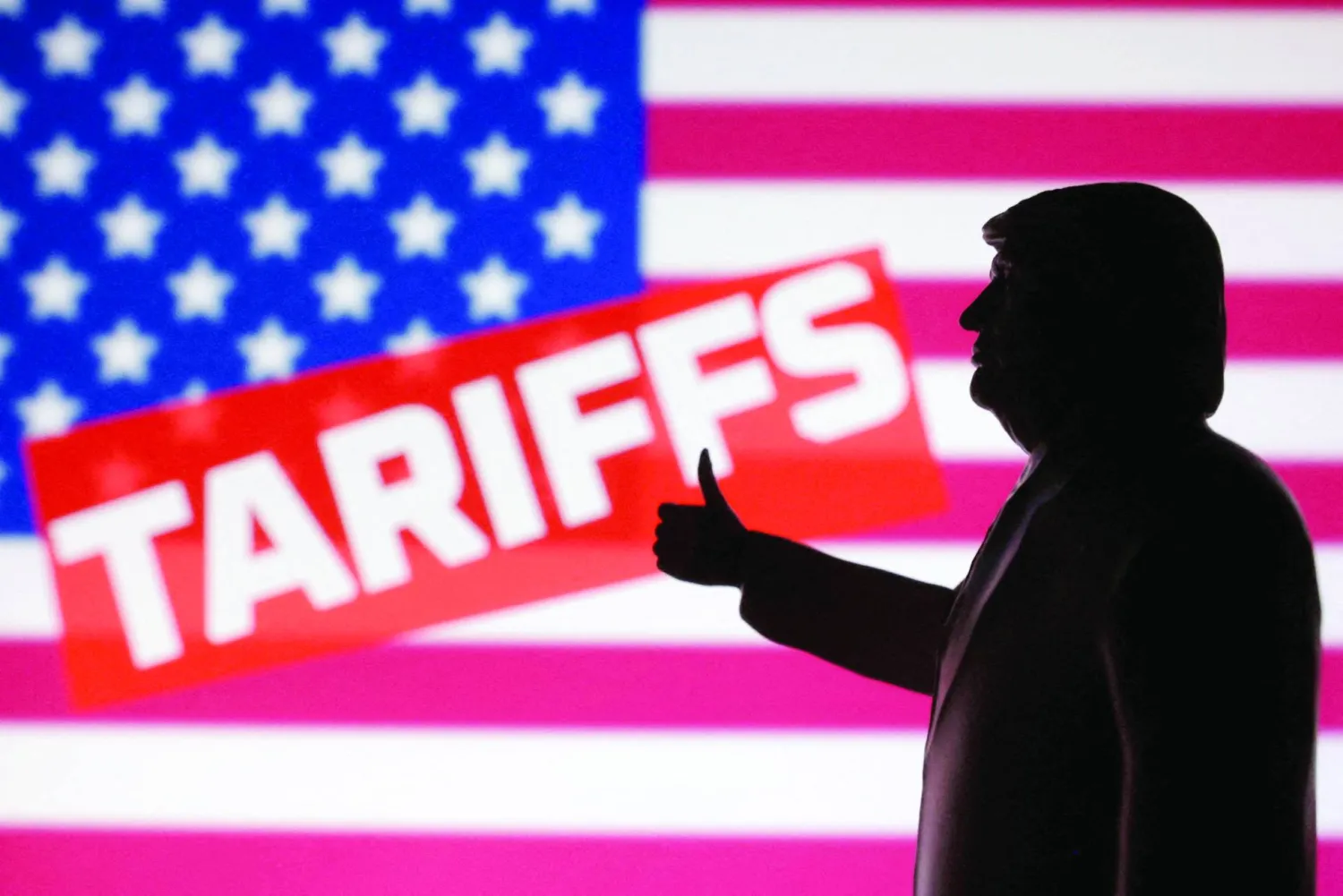
FILE PHOTO: A 3D-printed miniature model depicting US President Donald Trump, US flag and word "Tariffs" in this illustration taken,  April 17, 2025. REUTERS/Dado Ruvic/Illustration/File Photo/File Photo
FILE PHOTO: A 3D-printed miniature model depicting US President Donald Trump, US flag and word "Tariffs" in this illustration taken, April 17, 2025. REUTERS/Dado Ruvic/Illustration/File Photo/File Photo
TT

What Happens to Trump’s Tariffs Now that a Court Has Knocked them Down?

FILE PHOTO: A 3D-printed miniature model depicting US President Donald Trump, US flag and word "Tariffs" in this illustration taken,  April 17, 2025. REUTERS/Dado Ruvic/Illustration/File Photo/File Photo
FILE PHOTO: A 3D-printed miniature model depicting US President Donald Trump, US flag and word "Tariffs" in this illustration taken, April 17, 2025. REUTERS/Dado Ruvic/Illustration/File Photo/File Photo

A federal court in New York handed President Donald Trump a big setback Wednesday, blocking his audacious plan to impose massive taxes on imports from almost every country in the world.

A three-judge panel of the US Court of International Trade ruled that Trump overstepped his authority when he invoked the 1977 International Emergency Economic Powers Act to declare a national emergency and justify the sweeping tariffs.

The tariffs overturned decades of US trade policy, disrupted global commerce, rattled financial markets and raised the risk of higher prices and recession in the United States and around the world, The Associated Press said.

The US Court of International Trade has jurisdiction over civil cases involving trade. Its decisions can be appealed to the US Court of Appeals for the Federal Circuit in Washington and ultimately to the Supreme Court, where the legal challenges to Trump’s tariffs are widely expected to end up.

Which tariffs did the court block? The court’s decision blocks the tariffs Trump slapped last month on almost all US trading partners and levies he imposed before that on China, Mexico and Canada.

On April 2, Trump imposed so-called reciprocal tariffs of up to 50% on countries with which the United States runs a trade deficit and 10% baseline tariffs on almost everybody else. He later suspended the reciprocal tariffs for 90 days to give countries time to agree to reduce barriers to US exports. But he kept the baseline tariffs in place. Claiming extraordinary power to act without congressional approval, he justified the taxes under IEEPA by declaring the United States' longstanding trade deficits “a national emergency.”

In February, he'd invoked the law to impose tariffs on Canada, Mexico and China, saying that the illegal flow of immigrants and drugs across the US border amounted to a national emergency and that the three countries needed to do more to stop it.

The US Constitution gives Congress the power to set taxes, including tariffs. But lawmakers have gradually let presidents assume more power over tariffs — and Trump has made the most of it.

The tariffs are being challenged in at least seven lawsuits. In the ruling Wednesday, the trade court combined two of the cases — one brought by five small businesses and another by 12 US states.

The ruling does leave in place other Trump tariffs, including those on foreign steel, aluminum and autos. But those levies were invoked under a different law that required a Commerce Department investigation and could not be imposed at the president’s own discretion.

Why did the court rule against the president? The administration had argued that courts had approved then-President Richard Nixon’s emergency use of tariffs in a 1971 economic and financial crisis that arose when the United States suddenly devalued the dollar by ending a policy that linked the US currency to the price of gold. The Nixon administration successfully cited its authority under the 1917 Trading With Enemy Act, which preceded and supplied some of the legal language later used in IEPPA.

The court disagreed, deciding that Trump’s sweeping tariffs exceeded his authority to regulate imports under IEEPA. It also said the tariffs did nothing to deal with problems they were supposed to address. In their case, the states noted that America's trade deficits hardly amount of a sudden emergency. The United States has racked them up for 49 straight years in good times and bad.

So where does this leave Trump's trade agenda? Wendy Cutler, a former US trade official who is now vice president at the Asia Society Policy Institute, says the court's decision "throws the president’s trade policy into turmoil.”

“Partners negotiating hard during the 90-day tariff pause period may be tempted to hold off making further concessions to the US until there is more legal clarity," she said.

Likewise, companies will have to reassess the way they run their supply chains, perhaps speeding up shipments to the United States to offset the risk that the tariffs will be reinstated on appeal.

The trade court noted that Trump retains more limited power to impose tariffs to address trade deficits under another statute, the Trade Act of 1974. But that law restricts tariffs to 15% and only for 150 days with countries with which the United States runs big trade deficits.

For now, the trade court's ruling “destroys the Trump administration’s rationale for using federal emergency powers to impose tariffs, which oversteps congressional authority and contravenes any notion of due process,” said Eswar Prasad, professor of trade policy at Cornell University. "The ruling makes it clear that the broad tariffs imposed unilaterally by Trump represent an overreach of executive power.''




Menzies Chairman to Asharq Al-Awsat: Aviation Services Sector Highly Resilient Despite Regional Disruptions

Chairman of Menzies Aviation Hassan El-Houry. (Menzies Aviation)
TT

Menzies Chairman to Asharq Al-Awsat: Aviation Services Sector Highly Resilient Despite Regional Disruptions

Chairman of Menzies Aviation Hassan El-Houry. (Menzies Aviation)

The aviation services sector continues to demonstrate strong resilience amid geopolitical tensions disrupting air traffic across the Middle East, said Hassan El-Houry, chairman of Menzies Aviation.

While airspace closures, flight cancellations and reroutings have strained operations, El-Houry described the situation as a stress test for an industry that has historically rebounded from crises.

In an interview with Asharq Al-Awsat, he outlined a transformation phase for the company, which has surpassed $3 billion in annual revenue for the first time, while highlighting expansion plans and growing investment in artificial intelligence.

Recent tensions have affected Menzies’ operations in markets including Iraq, Pakistan and Jordan, with broader impacts on global cargo routes and international airports. Rising jet fuel costs have added further pressure.

However, El-Houry said the aviation sector has repeatedly proven its ability to absorb shocks, with demand for air travel typically rebounding after crises. He expects passenger confidence to recover gradually as regional stability improves.

Airlines, he added, are increasingly prioritizing efficiency, cost control and operational flexibility. This shift has accelerated demand for integrated service providers with global reach and the capability to maintain safe and reliable operations during periods of disruption.

The trend is particularly evident in Saudi Arabia, where low-cost carriers such as flynas and flyadeal are expanding rapidly, driving demand for cost-effective service partners.

Menzies reported a 16% rise in revenue in 2025, exceeding $3 billion. El-Houry attributed the growth to disciplined strategy execution, structured expansion and stronger multi-service partnerships with airlines and airports.

The company now operates at 347 airports in 65 countries, handling 5.3 million flights annually, with a customer retention rate of 90%.

Its acquisition of G2 Secure Staff has significantly expanded its footprint in the United States, reinforcing its position as a leading aviation services provider in the world’s largest market.

To address cost pressures, Menzies is investing in innovation, including AI-powered tools that use computer vision to measure cabin baggage and advanced baggage reconciliation systems to improve accuracy and reduce manual workloads.

A workforce planning optimization system is already deployed in more than 30 locations and is expected to cover over 22,000 employees by the end of 2026.

El-Houry said acquisitions remain central to long-term growth, with the company pursuing expansion in both established and high-potential markets. Saudi Arabia is a key focus, with the Kingdom aiming to reach 330 million passengers annually under Vision 2030.

On technology, Menzies is expanding its MACH cargo management system, now active at 46 sites and handling 55% of cargo volumes. The company is also developing AI-based risk detection systems to enhance safety oversight, while aiming for full AI integration in workforce planning by 2028.

Sustainability remains a priority, with more than $200 million invested to increase the share of electric ground support equipment to 25% globally, supporting a net-zero emissions target by 2045.

El-Houry also pointed to growth opportunities in emerging markets, particularly in the Middle East, Asia and Latin America. In India, Menzies has secured a ground handling license at Kempegowda International Airport in Bengaluru and launched a new site for Air Menzies International as part of its global expansion strategy.


S. Korea Secures 270 Mn Barrels of Oil from Suppliers Unaffected by Hormuz Blockade

A display shows oil prices as cars queue at a gas station in Seoul. (Reuters)
TT

S. Korea Secures 270 Mn Barrels of Oil from Suppliers Unaffected by Hormuz Blockade

A display shows oil prices as cars queue at a gas station in Seoul. (Reuters)

South Korea has secured supplies of more than 270 million barrels of crude oil via routes unaffected by the US blockade of the Strait of Hormuz, a senior official said on Wednesday.

"I hereby report to the nation that visits to four countries have secured the import of 273 million barrels of crude oil by the end of this year," Kang Hoon-sik, chief of staff to the president, said.

The amount is sufficient for more than three months of South Korea's oil needs, Kang said after he returned from a trip to Kazakhstan, Oman, Saudi Arabia and Qatar.

Like many Asian economies, South Korea has faced mounting risks to its energy supplies since US-Israeli attacks on Iran in late February prompted Tehran to effectively close the strait.

Kang said around 60 percent of South Korea's crude oil imports last year transited through the waterway, which the United States began blockading this week.

He said Seoul had also secured an additional 2.1 million tons of naphtha, an important oil-derived component used to make a range of plastic goods.

That figure "(amounts) to roughly one month's worth of imports based on last year's volume", Kang said.

The supplies of both materials "will therefore contribute directly and materially to stabilizing domestic supply and demand," he said.


Oil Prices Fall on Expectations US-Iran Peace Talks May Resume

A cild pushes a bicycle near Grand Winner 1, an oil and chemical tanker, moored at Kurnell in Sydney, Australia, April 15, 2026. (Reuters)
TT

Oil Prices Fall on Expectations US-Iran Peace Talks May Resume

A cild pushes a bicycle near Grand Winner 1, an oil and chemical tanker, moored at Kurnell in Sydney, Australia, April 15, 2026. (Reuters)

Oil prices fell for a second day on Wednesday on expectations peace talks between the US and Iran may resume and supply will eventually be released from the key Middle East producing region trapped by the closure of the Strait of Hormuz.

Brent crude futures were down16 cents, or 0.2%, to $94.63 a barrel at 0635 GMT, after falling 4.6% in the previous session. US West Texas Intermediate crude was down 70 cents, or 0.8%, to $90.58. The contract dropped 7.9% the session before.

The war has mostly shut the Strait of ‌Hormuz, a key ‌waterway for crude and refined product flows out of the Gulf ‌to ⁠global buyers, particularly in ⁠Asia and Europe.

US President Donald Trump said talks with Tehran on ending the war could resume this week after ending over the weekend without any agreement. But the US has also enacted a blockade of shipping leaving Iranian ports that its military said on Wednesday has completely halted trade going in and out of the country by sea.

Despite a two-week ceasefire, transit through the strait remains uncertain, with traffic at only a fraction of the 130 or so vessels that moved ⁠through the waterway before the war, sources said on Tuesday.

"The trajectory ‌of oil prices will likely hinge less on battlefield ‌developments and more on diplomatic momentum. Markets are increasingly reacting to headlines around negotiations rather than troop deployments," ‌said Priyanka Sachdeva, senior market analyst at Phillip Nova.

"Each signal of renewed dialogue has ‌been met with price declines, suggesting that traders are systematically unwinding the 'war premium' embedded into crude earlier this month."

Refiners are desperately seeking alternative crude supply, pushing the premiums they are willing to pay for oil from areas such as the US Gulf Coast and North Sea.

A cargo of WTI Midland for ‌delivery to Rotterdam traded at a record premium of $22.80 a barrel above benchmark European prices on Tuesday.

A US destroyer stopped two ⁠oil tankers from ⁠leaving Iran on Tuesday, a US official said.

"While diplomatic headlines suggest the possibility of renewed US-Iran talks and even a temporary easing of transit restrictions, the physical reality remains fragmented," the Schork Group said in a note.

The market stands to lose some access to further supply after two US administration officials told Reuters on Tuesday the US will not renew a 30-day waiver of sanctions on Iranian oil at sea that expires this week, and quietly let a similar waiver on sanctions on Russian oil expire over the weekend.

Later in the day, markets will be watching for official US inventory data from the Energy Information Administration due at 10:30 a.m. ET (1430 GMT).

US crude oil stockpiles were expected to have risen slightly last week, while distillate and gasoline inventories likely fell, a Reuters poll showed.

Market sources familiar with American Petroleum Institute figures said on Tuesday US crude oil inventories jumped for the third straight week.